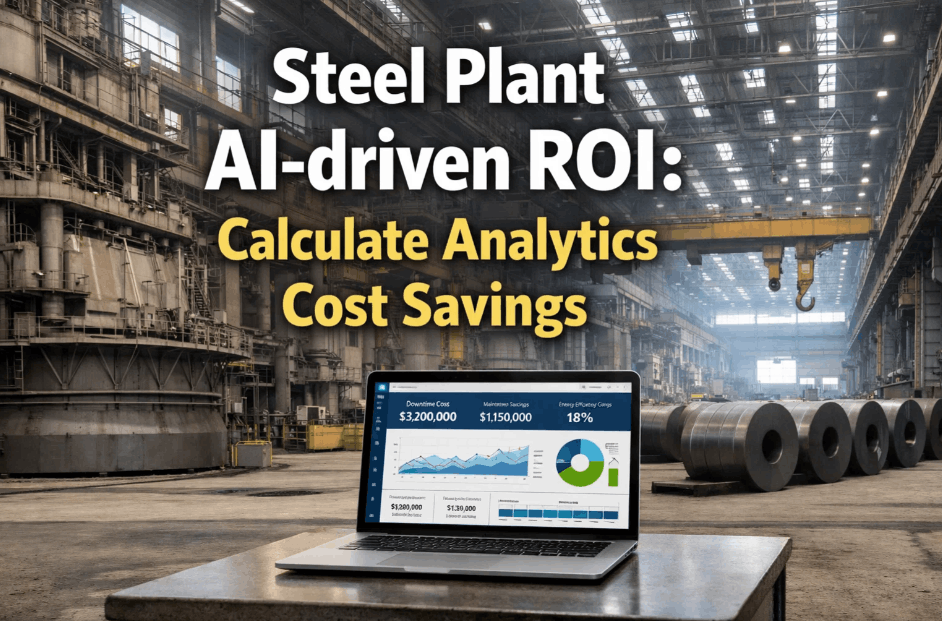
In the ultra-competitive landscape of modern metallurgy, justifying the capital expenditure for digital transformation requires undeniable financial proof. Fortunately, the math in heavy industry is brutally straightforward: when you operate equipment designed to run 24/7/365, unplanned downtime is the single most destructive force to your P&L. A single unpredicted blast furnace tap-hole delay or continuous caster breakout can obliterate $2 million to $5 million in raw material waste, secondary mechanical destruction, and lost shipping tonnage instantly. Calculating your steel plant AI-driven ROI involves mapping these catastrophic risks against the precision of modern predictive maintenance logic. By aggressively targeting downtime prevention, supply chain spare-parts optimization, and gross energy reclamation, an AI-driven business case for steel operations consistently proves a zero-cash-flow-negative payback horizon within six to nine months. Book a demo to run your plant's specific operational limits through our custom steel analytics investment calculator.
Calculate the Massive Return of AI-Driven Steel Logic
Unlock hidden millions trapped in your operating budget. Convert reactive mechanical failures into highly scheduled micro-interventions to eliminate catastrophic equipment cascades forever.
Why Reactive Maintenance Annihilates Steel Profit Margins
Accepting a 'run-to-failure' culture in heavy steel manufacturing creates a compounding negative financial cycle. When a $20,000 cooling pump fails without warning, it doesn't just cost $20,000 to replace. It starves the primary drive bearing of lubrication, warping a $400,000 gearbox, which then halts the hot strip mill for 36 hours. The $20,000 hardware failure just resulted in $1.8 million of delayed order shipments and secondary mechanical ruin. Eradicating this chain reaction is the core function of steel AI-driven payback. Schedule a scoping call to identify your most expensive recurring failure loops.
Five Distinct Pillars of Steel AI-Driven ROI Generation
True steel analytics ROI is not just a vague promise of "more uptime." It is derived mathematically across five distinct operational vectors that physically alter the cash outlays required to run the mill shift-to-shift.
Proving the Equation: ROI Realized on the Steel Floor
Evaluating the steel AI-driven business case requires looking at actual prevented crises. These real-world financial saves dictate why leading enterprise mills deploy AI.
Scenario 1: Predictive Strip Mill Drive Save
The AI detected phase-alignment drift within the FFT vibration signals on a cold reversing mill. A micro-intervention was scheduled during a 1-hour lulls, replacing a single $4,000 gearset instead of destroying a $350k primary gearbox and losing 12 hours of rolling.
Scenario 2: Preempting a Caster Breakout
Thermal and oscillator correlation models predicted a high probability of shell sticking in segment zero of the caster. Operators slowed casting speed dynamically based on the AI alert, preventing molten steel from bypassing the mold and freezing the entire machine.
Scenario 3: Overtime Labor Contraction
With AI autonomously assigning strict priority levels to alarms, maintenance supervisors stopped calling in entire 'A-Teams' on double-time Sunday rates to hunt down ambiguous PLC warning lights, executing repairs safely on standard Monday day shifts.
Scenario 4: The 18-Year Asset Lifespan
A multi-million dollar overhead scrap crane was slated for end-of-life replacement based purely on calendar age. The AI asset registry proved via strain-gauge tracking that structural fatigue was minimal, safely deferring the $12M capital burn for another 4 years.
Steel AI ROI Calculator Formula Matrix
To secure CFO approval, the deployment of steel mill analytics must survive rigorous financial mapping. Use this framework to build your own steel analytics cost savings case.
| Financial Variable | Baseline Legacy State | iFactory AI-Driven State |
|---|---|---|
| Unplanned Outage Cost | 14 hrs/mo @ $45,000/hr = -$7.5M/yr | Dropped to 5 hrs/mo (+ $4.8M gross margin recovered) |
| Spares Holding Cost | $45M Inventory @ 12% carrying cost | Reduced to $35M via predictive JIT parts (-$1.2M carrying fee) |
| Energy Waste (Friction) | 80MWh/year lost to degraded bearings | Optimized lube cycles recover 15% efficiency |
| Emergency Shipping | $600k/yr on overnight heavy cargo air | Defect detected 30 days early allows cheap sea freight |
| Capital Depreciation | Standard 15-year accounting depreciation | Intelligent nursing pushes useable life to 19 years |
How the AI Tracks Ledger Reality
Proving a return on investment means ensuring the operational data genuinely links back to the corporate ledger. Our intelligent architecture permanently binds the plant floor API hooks to your SAP financial matrices.
SCADA Passive Monitoring
Data streaming directly from the Level 1 historian networks establishes the baseline behavior of the mill. We map precisely how often the mill halts before AI is deployed, defining the $0 cost baseline.
SAP Parts Requisition Gateway
The AI connects to the SAP accounting backend. Every time a predictive alert generates a micro-intervention, the system logs the exact $ cost of the specific spare part consumed, eliminating hypothetical assumptions.
Labor Burden Integration
The platform tracks wrench-time on the digital tablets natively. If a mechanic finishes a bearing grease task in 14 minutes, that exact labor rate is multiplied and committed to the cost-analysis dashboard.
The Auto-ROI Dashboard Generation
The C-Suite logs into an executive view where the algorithm actively compares current reliability costs against the historical baseline, generating beautiful, undeniable financial graphs tracking millions reclaimed in real-time.
The Steel Plant Savings Pilot Roadmap
We do not demand massive upfront capital blindly. Validating steel AI-driven payback occurs through a meticulously structured 90-day financial staging process, guaranteeing zero risk exposure.
Criticality Mapping & Vulnerability Audit
Our financial engineering team reviews your SAP ledgers alongside your operations director to isolate the single most expensive recurring failure metric in your plant (e.g. descale pump blowouts).
Edge Ingestion on Targeted Sub-System
We install the cloud AI strictly over the selected bottleneck area. Data runs silently to establish algorithms, building an airtight correlation matrix that guarantees fault isolation.
Live Save Generation
The platform goes live for the pilot. Over 30 days, the AI predicts anomalies. You execute targeted maintenance based strictly on the alerts, logging the prevented failure value mathematically.
Financing the Cross-Plant Expansion
Having generated measurable CapEx saves (often $300k+ in the first quarter), the software effectively pays for its own plant-wide expansion license directly out of recovered margins.
Steel AI-Driven ROI: Frequently Asked Questions
Prove the Business Case for Steel Intelligence Today.
Stop guessing the cost of your mechanical blind spots. Deploy a precision AI tracking layer that locks into your financial backend to ensure every avoided breakdown adds raw bottom-line revenue to your next quarterly statement.