Cement plants lose ₹12-18 crore annually from unplanned equipment failures—kiln refractory collapse, mill bearing seizures, crusher breakdowns. Traditional time-based maintenance either over-maintains (wasting resources) or under-maintains (causing failures). Condition-based maintenance (CBM) monitors actual equipment health—predicting failures 2-6 weeks early, reducing unplanned downtime 40-60%, and cutting maintenance costs 25-35%. Leading plants like UltraTech and Ambuja have proven CBM delivers 300-450% ROI within 18 months. This guide shows how to transition from reactive/preventive to predictive maintenance. Get your CBM implementation roadmap to see ROI potential or continue reading.
Condition-Based Maintenance in Cement Plants
Predict Failures, Reduce Downtime & Optimize Maintenance Schedules
The Maintenance Challenge in Cement Plants
Why Traditional Maintenance Fails
Reactive Maintenance
Run-to-failure approach. Wait until equipment breaks, then scramble to repair. Result: Unplanned downtime 15-20%, catastrophic failures, production losses ₹8-12 lakh/hour. Still used by 40% of cement plants.
Time-Based Maintenance
Fixed calendar schedules. Service every X hours regardless of condition. Result: Over-maintain healthy equipment (waste resources), under-maintain stressed equipment (still get failures). Industry standard but inefficient.
The CBM Solution
Monitor actual equipment health. Vibration, temperature, oil condition tell you WHEN to intervene. Result: Maintain only when needed, predict failures weeks early, optimize resource deployment. See CBM benefits.
Single kiln refractory failure: 5-7 day shutdown worth ₹4-6 crore lost revenue. Mill gearbox failure: 3-4 day shutdown worth ₹2.5-3.5 crore. Crusher rotor failure: 2-3 days worth ₹1.5-2 crore. CBM detects these failures 2-6 weeks early—enabling planned repairs during scheduled shutdowns at 1/10th the cost.
Reactive vs Preventive vs Condition-Based
Three Maintenance Approaches Compared
Reactive
Run until failure
Downtime: 15-20% unplanned
Maintenance cost: High (emergency repairs)
Inventory: Large (emergency spares)
Still used by 40% of plants—catastrophic failures common.
Preventive (Time-Based)
Fixed schedules
Downtime: 8-12% unplanned
Maintenance cost: Medium (planned work)
Inventory: Medium (scheduled parts)
Industry standard—but over-maintains 30-40% of equipment.
Condition-Based
Monitor actual health
Downtime: 3-6% unplanned
Maintenance cost: Low (optimized interventions)
Inventory: Low (predictable failures)
World-class approach—maintain only when needed. Learn implementation.
Example: Mill Gearbox Maintenance
Calculate Your CBM ROI Potential
Custom assessment for your cement plant. See the cost of current failures vs CBM implementation investment.
Five Core CBM Technologies
Critical Equipment Monitoring Methods
Vibration Analysis
For: Motors, bearings, gearboxes, fans, mills
Detects: Bearing wear, misalignment, imbalance, looseness 2-6 weeks early
Cost: ₹2-5 lakh per machine (sensors + system)
Thermal Imaging
For: Kiln shell, electrical systems, motors, bearings
Detects: Refractory hotspots, electrical faults, bearing failures 1-4 weeks early
Cost: ₹3-8 lakh (camera) + training
Oil Analysis
For: Gearboxes, hydraulics, compressors
Detects: Wear metals, contamination, degradation 4-8 weeks early
Cost: ₹2,000-5,000 per sample, monthly testing
Ultrasonic Testing
For: Compressed air leaks, electrical arcing, bearing lubrication
Detects: Air leaks (save 20-30% energy), early bearing issues
Cost: ₹1.5-4 lakh (equipment)
Motor Current Analysis
For: Electric motors (mills, fans, crushers)
Detects: Rotor bars, stator faults, load issues 2-4 weeks early
Cost: ₹3-6 lakh per motor (permanent monitoring)
Not sure which CBM technologies to prioritize? Our maintenance specialists can guide you — We'll help identify high-impact monitoring points.
Critical Equipment to Monitor
Prioritize High-Impact Assets
Kiln System
Monitor: Kiln shell temperature (thermal imaging), kiln drive gearbox (vibration + oil), ID/FD fans (vibration), kiln alignment (laser)
Why: Single kiln failure = ₹4-6 crore loss. CBM prevents 60-80% of unplanned kiln stops.
Cement Mills
Monitor: Mill drive motors (current analysis), gearboxes (vibration + oil), bearings (vibration), classifier (vibration)
Why: Mill failure = ₹2.5-3.5 crore loss. Gearbox failures most common—CBM reduces 70-80%.
Crushers & Conveyors
Monitor: Crusher bearings (vibration), drive motors (current), conveyor drives (vibration + thermal)
Why: Crusher failure = ₹1.5-2 crore loss. Bearing failures account for 60% of crusher downtime. See monitoring plan.
Auxiliary Systems
Monitor: Compressors (vibration + oil), pumps (vibration), electrical systems (thermal)
Why: Smaller individual losses but high frequency. Compressed air leaks alone waste ₹30-50 lakh/year energy.
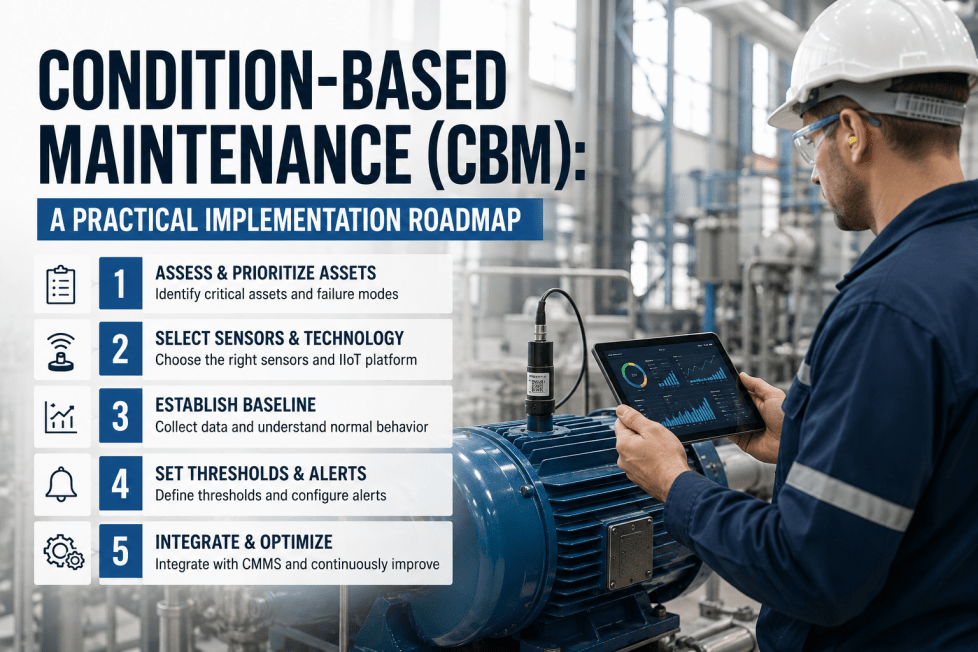
CBM Implementation Roadmap
✓ 6-Month Quick Start Program
Phase 1: Foundation (Month 1-2)
- ✓ Identify critical equipment (top 20 assets)
- ✓ Baseline assessment—current failure modes
- ✓ Select CBM technologies (vibration + thermal + oil)
- ✓ Procure equipment, train technicians
- ✓ Establish monitoring frequencies
Phase 2: Deployment (Month 3-4)
- ✓ Install vibration sensors on critical assets
- ✓ Begin thermal imaging routes (weekly/monthly)
- ✓ Start oil analysis program (monthly sampling)
- ✓ Establish baseline condition data
- ✓ Set alarm thresholds (ISO standards)
Phase 3: Optimization (Month 5-6)
Analyze trends, refine thresholds, integrate with CMMS for automated work orders. First failure predictions—validate by inspecting flagged equipment. Expand to secondary equipment based on ROI.
Business Case: Investment vs Returns
Typical 3,000 TPD Cement Plant CBM ROI
Year 1 Investment
₹60-85 LakhEquipment: Vibration sensors (₹25-35L), thermal camera (₹5-8L), oil analysis setup (₹3-5L)
Software: CBM platform + CMMS integration (₹15-20L)
Training: Technician certification (₹5-8L)
Implementation: Consulting support (₹7-12L)
Annual Value Gained
₹2.5-4.2 CrDowntime reduction: Prevent 2-3 major failures worth ₹1.5-2.5 Cr
Maintenance optimization: 25-35% cost reduction = ₹60-90 lakh savings
Energy savings: Leak detection, optimal operation = ₹30-50 lakh
Extended asset life: 15-20% longer equipment life = ₹30-50 lakh/year
5-Year Returns
300-450%Payback period: 3-5 months typical
Year 1 ROI: 320-420%
Year 2-5 ROI: Pure gain (minimal incremental cost)
Total 5-year value: ₹12-20 crore vs ₹60-85 lakh investment. Get custom ROI model.
Predictable maintenance: Plan shutdowns, optimize resource deployment. Safety improvement: Prevent catastrophic failures that risk personnel. Knowledge retention: Digital system captures tribal knowledge. Competitive advantage: Higher reliability enables aggressive production targets. CBM transitions maintenance from cost center to value creator.
Ready to Implement CBM at Your Plant?
Get a customized implementation roadmap with equipment selection, monitoring plan, and 5-year ROI projection. See exactly which failures you'll prevent and the payback timeline.
Real Plant Success Story
4,000 TPD Cement Plant (Gujarat) - 12 Month CBM Implementation
Before CBM (Baseline)
- Unplanned downtime: 12% (85 hours/month)
- Major failures: 4-5 per year (₹2-3 Cr each)
- Maintenance cost: ₹18 Cr annually
- Annual failure loss: ₹12-15 Cr
After CBM (Month 12)
- Unplanned downtime: 4.5% (32 hours/month)
- Major failures: 1 per year (₹2.5 Cr)
- Maintenance cost: ₹12.5 Cr annually
- Annual failure loss: ₹2.5 Cr
Key failures prevented through CBM:
- Cement mill gearbox bearing failure detected 5 weeks early via oil analysis—saved ₹3.2 Cr (emergency repair + downtime)
- Kiln ID fan rotor imbalance caught 3 weeks early via vibration—saved ₹1.8 Cr
- Raw mill drive motor rotor bar crack detected 4 weeks early via current analysis—saved ₹2.5 Cr
- 15+ minor failures prevented (bearings, alignment issues)—saved additional ₹4-5 Cr
Critical success factor: Maintenance manager championed program with weekly review meetings. Integrated CBM data into daily planning—treating alerts as seriously as production targets. Technical training for 12 maintenance technicians created in-house expertise.
Condition-Based Maintenance: Key Takeaways
- Current state: Cement plants lose ₹12-18 crore annually from unplanned equipment failures that CBM could prevent
- CBM advantage: Predicts failures 2-6 weeks early vs reactive (failure) or preventive (over-maintenance) approaches
- Five core technologies: Vibration analysis, thermal imaging, oil analysis, ultrasonic testing, motor current analysis
- Priority equipment: Kiln system (Priority 1), cement mills (Priority 2), crushers/conveyors (Priority 3)
- Quick start possible: 6-month implementation targeting top 20-30 critical assets delivers first results
- Proven ROI: ₹60-85 lakh investment returns ₹2.5-4.2 crore annually—300-450% ROI with 3-5 month payback
- Value beyond cost: Predictable maintenance, improved safety, knowledge retention, competitive advantage
Ready to implement CBM at your cement plant?
Start Your CBM Journey Today
Get customized condition-based maintenance roadmap for your cement plant.
See which equipment to monitor, technology recommendations, and projected ROI—no commitment required.