Predictive Maintenance in 2026: How AI Reduces Downtime in Factories
By Matthew Short on December 16, 2025
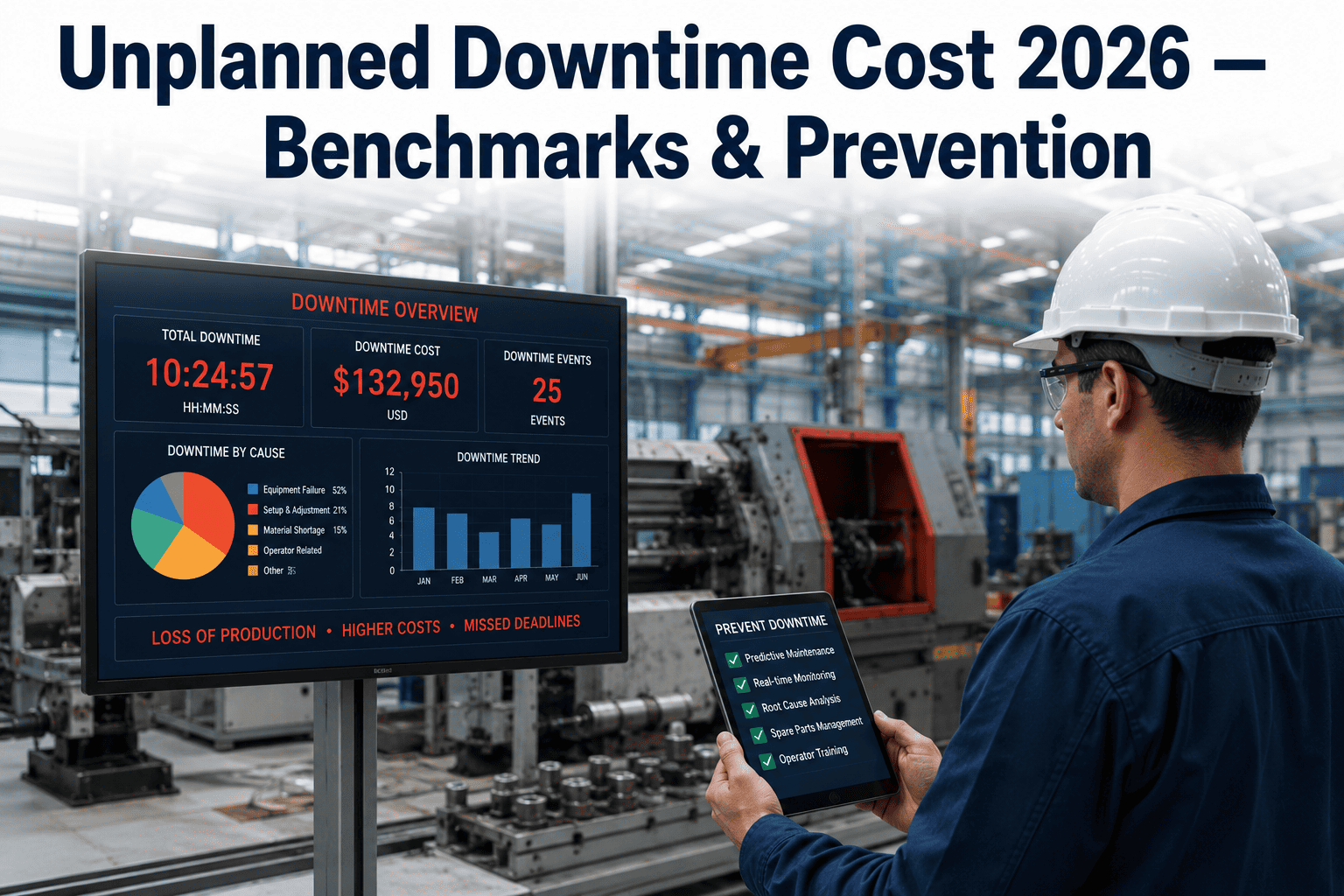
Unplanned downtime has become manufacturing's most expensive problem. According to Siemens' True Cost of Downtime 2024 report, the world's 500 largest companies lose approximately $1.4 trillion annually due to unplanned outages—equivalent to 11% of their total revenues. In the automotive sector alone, an idle production line costs up to $2.3 million per hour, or $600 per second. The average manufacturing facility now experiences 25 downtime incidents monthly, with each hour of unplanned downtime costing at least 50% more than it did in 2019.
But there's a solution transforming how factories approach equipment reliability. Predictive maintenance powered by AI, IoT sensors, and machine learning is enabling manufacturers to forecast failures weeks or even months in advance, scheduling repairs during planned downtime rather than reacting to catastrophic breakdowns. The predictive maintenance market reflects this transformation, projected to grow from $10.93 billion in 2024 to over $70 billion by 2032—a CAGR exceeding 26%. For manufacturing leaders heading into 2026, understanding and implementing AI-driven predictive maintenance isn't optional—it's a competitive imperative.
The $1.4 Trillion Problem
The True Cost of Unplanned Downtime
What equipment failures really cost global manufacturers
$1.4T
Annual losses from unplanned downtime across Fortune 500 companies
11% of total revenues
$2.3M
Per hour in automotive
$600 per second
$260K
Average per hour across manufacturing
Aberdeen Research
$59M
Annual per plant in heavy industry
4x increase since 2019
800
Hours of downtime annually
Average manufacturer
Each hour of unplanned downtime now costs 50% more than in 2019 due to inflation, supply chain complexity, and higher production demands
This comprehensive guide explores how AI-driven predictive maintenance is revolutionizing factory operations in 2026, the technologies enabling accurate failure prediction, proven ROI metrics, and practical implementation strategies. Ready to explore how predictive maintenance can transform your operations? Schedule a consultation with our team.
The Predictive Maintenance Market Explosion: 2025-2032
The predictive maintenance market is experiencing unprecedented growth as manufacturers recognize the strategic value of preventing failures before they occur. Multiple market research firms project the market to grow at compound annual growth rates exceeding 20%, with some segments approaching 35% CAGR. This growth is driven by declining sensor costs, advances in AI and machine learning algorithms, and the compelling ROI that early adopters are demonstrating.
Market Trajectory
Predictive Maintenance Market Growth
Explosive expansion driven by AI, IoT, and proven ROI
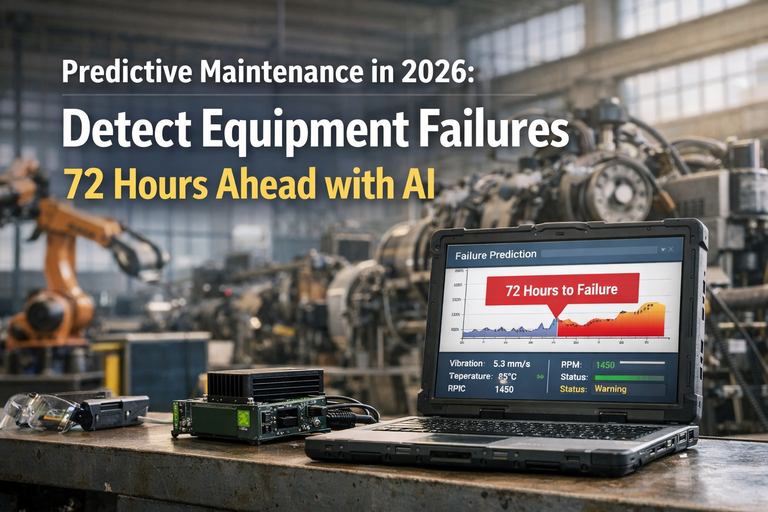
Predictive maintenance represents a fundamental shift from reactive and preventive approaches to a data-driven strategy that forecasts equipment failures before they occur. The technology stack combines IoT sensors for continuous data collection, edge and cloud computing for processing, machine learning algorithms for pattern recognition, and visualization dashboards for actionable insights. Modern AI systems can predict failures 30-90 days in advance, giving maintenance teams ample time to plan interventions during scheduled downtime.
The Evolution of Maintenance Strategies
From reactive repairs to AI-powered prediction
Reactive
Fix it when it breaks
Highest costUnplanned downtimeCollateral damage
Preventive
Schedule-based maintenance
Reduces failuresOver-maintenanceWasted resources
Condition-Based
Monitor and respond to changes
Better timingLess wasteStill reactive
Predictive (AI)
Forecast failures before they occur
30-90 day advance warning80-97% accuracyOptimized scheduling
The AI Predictive Maintenance Technology Stack
1
Data Collection Layer
Continuous monitoring of equipment health parameters
Alerts & notificationsWork order generationCMMS integrationParts procurement
The core technologies enabling predictive maintenance include vibration analysis (the most widely used technique, representing 39.7% of implementations), thermal imaging, oil analysis, acoustic monitoring, and motor current analysis. These sensor inputs feed machine learning models that compare real-time data against baseline performance patterns to identify anomalies indicating developing faults. Modern systems achieve 80-97% accuracy in predicting equipment failures, with leading implementations identifying issues 60-90 days before traditional monitoring would detect problems.
The financial case for predictive maintenance is overwhelming. Research consistently demonstrates that organizations implementing AI-driven predictive maintenance achieve 10:1 to 30:1 ROI ratios within 12-18 months. Studies show predictive maintenance reduces maintenance costs by 18-25% compared to preventive approaches, and up to 40% compared to reactive maintenance. Beyond direct cost savings, organizations experience 30-50% reductions in unplanned downtime, 20-40% extensions in equipment lifespan, and significant improvements in safety and product quality.
Proven Returns
The ROI of Predictive Maintenance
Research-backed metrics from real implementations
10:1 to 30:1
ROI within 12-18 months
McKinsey Research
18-25%
Maintenance cost reduction vs. preventive
40%
Cost savings vs. reactive maintenance
30-50%
Reduction in unplanned downtime
20-40%
Extension in equipment lifespan
9%
Improvement in asset availability
12%
Reduction in maintenance costs
14%
Reduction in safety/quality risks
Real-World Success Stories
Automotive Manufacturing
$500K
Prevented maintenance costs
Prevented 5 weeks of downtime on a stamping press, achieving ROI in less than 3 months
Fortune 200 Manufacturing
76%
Incident rate reduction
Using advanced predictive analytics in their safety management system
Power Generation
$7.5M
Annual savings
Strategic implementation enabling planned maintenance vs. emergency response
Global Automotive Plant
30%
Maintenance cost reduction
40% improvement in equipment uptime through digital twin integration
Fortune 500 companies stand to save an estimated 2.1 million hours of downtime and $233 billion in maintenance costs annually with full adoption of condition monitoring and predictive maintenance. For individual facilities, the math is compelling: a plant experiencing 400 annual hours of unplanned downtime at $6,730 per hour loses $2.69 million yearly. A 32% reduction through predictive maintenance saves $861,000 annually in prevented downtime alone—before counting maintenance cost savings and equipment lifespan extension.
Digital Twins: The Future of Predictive Maintenance
Digital twin technology represents the next evolution in predictive maintenance capability. A digital twin is a virtual replica of a physical asset that combines real-time sensor data with physics-based simulation models to create a continuously updated mirror of equipment behavior. Unlike traditional monitoring that tracks individual parameters, digital twins integrate multiple data streams to understand complex interactions between components, achieving 88-97% failure prediction accuracy for well-defined equipment types.
Next Generation
Digital Twin Technology for Predictive Maintenance
Virtual replicas enabling advanced simulation and prediction
Physical Asset
VibrationTemperaturePressureSpeed
Real-time sync
Digital Twin
SimulationPredictionWhat-if analysisOptimization
88-97%
Failure prediction accuracy
60-90
Days advance warning
50-70%
Unplanned downtime reduction
35-50%
Maintenance cost reduction
Organizations implementing comprehensive digital twin predictive maintenance programs report ROI within 18-36 months, with initial investments of $200,000-600,000 typically generating $1.2-3.5 million in annual savings. A chemical manufacturer achieved $2 million in annual savings through decreased equipment failures after implementing digital twin technology, while automotive plants have achieved 30% reductions in maintenance costs and 40% improvements in equipment uptime.
Implementation Roadmap for 2026
Successfully implementing predictive maintenance requires a phased approach that balances quick wins with long-term capability building. Organizations should start with pilot projects on critical equipment with the highest downtime costs or safety implications, then scale based on proven results. The key challenges organizations face include skills gaps (the top barrier cited in surveys), legacy system integration, data quality issues, and cultural resistance to new ways of working.
Predictive Maintenance Implementation Roadmap
A phased approach to successful deployment
1
Months 1-3
Assessment & Planning
Identify critical assets with highest downtime costs
Establish data collection and integration pipelines
Train initial ML models on historical data
Integrate with CMMS for automated work orders
3
Months 7-12
Validation & Optimization
Validate predictions against actual outcomes
Refine models based on performance feedback
Train maintenance staff on new workflows
Document ROI and build business case for expansion
4
Year 2+
Scale & Continuous Improvement
Expand to additional asset classes and facilities
Implement digital twin capabilities for complex assets
Integrate prescriptive recommendations
Drive continuous model improvement through feedback loops
Top Implementation Challenges
1
Skills Gap
Biggest barrier to AIoT success—shortage of AI, ML, and data science expertise
2
Legacy System Integration
PLCs and SCADA systems not designed for AI analytics
3
Data Quality Issues
Incomplete, inconsistent, or siloed equipment data
4
High Implementation Costs
Initial investment in sensors, infrastructure, and expertise
5
Cultural Resistance
Change management and employee adoption challenges
Ready to Reduce Downtime with AI-Powered Predictive Maintenance?
iFactory's integrated EAM, MOM, and MES platform provides the sensor integration, data infrastructure, and AI analytics capabilities you need to implement predictive maintenance and start reducing unplanned downtime immediately.
What is predictive maintenance and how does it work?
Predictive maintenance is a data-driven strategy that uses IoT sensors, AI, and machine learning to monitor equipment health and forecast when failures are likely to occur—allowing maintenance to be performed before breakdowns happen. The technology continuously collects data on parameters like vibration, temperature, pressure, and power consumption, then uses AI algorithms to identify patterns that indicate developing faults. Modern systems can predict failures 30-90 days in advance with 80-97% accuracy, enabling planned interventions during scheduled downtime.
What is the ROI of predictive maintenance?
Research consistently demonstrates that predictive maintenance delivers 10:1 to 30:1 ROI ratios within 12-18 months of implementation. Specific benefits include 18-25% reduction in maintenance costs compared to preventive approaches, up to 40% savings versus reactive maintenance, 30-50% reduction in unplanned downtime, and 20-40% extension in equipment lifespan. A typical facility with $2.69 million in annual downtime costs can save $861,000+ through a 32% downtime reduction—before counting other savings.
How much does unplanned downtime cost manufacturers?
Unplanned downtime costs vary significantly by industry and company size. According to Siemens' True Cost of Downtime 2024 report, Fortune 500 companies lose approximately $1.4 trillion annually (11% of revenues) due to unplanned outages. Automotive manufacturers face costs up to $2.3 million per hour, while the average manufacturing facility loses around $260,000 per hour. Each hour of downtime now costs 50% more than in 2019 due to inflation, supply chain complexity, and higher production demands.
What is the difference between predictive and preventive maintenance?
Preventive maintenance follows a fixed schedule (e.g., changing oil every 3 months) regardless of actual equipment condition, which can result in over-maintenance and wasted resources. Predictive maintenance uses real-time data and AI to determine optimal maintenance timing based on actual equipment health, intervening only when data indicates a developing problem. Studies show predictive maintenance saves 8-12% compared to preventive approaches, eliminates unnecessary maintenance activities, and provides much earlier warning of potential failures.
What is a digital twin in predictive maintenance?
A digital twin is a virtual replica of a physical asset that combines real-time sensor data with simulation models to mirror equipment behavior. Unlike traditional monitoring that tracks individual parameters, digital twins integrate multiple data streams to understand complex component interactions, achieving 88-97% failure prediction accuracy. They enable "what-if" scenario testing, identify performance degradation 60-90 days before traditional monitoring, and allow optimization without risking actual equipment. Organizations typically see ROI within 18-36 months.
How long does it take to implement predictive maintenance?
A typical predictive maintenance implementation takes 6-12 months for initial pilot deployment with 3-5 critical assets, followed by 12-24 months for full-scale rollout. The first phase (1-3 months) involves assessment and planning, the pilot phase (4-6 months) covers sensor deployment and initial model training, and the validation phase (7-12 months) focuses on refining predictions and training staff. Most organizations achieve 60-70% of projected savings within the first quarter post-implementation and full payback within 6-14 months.
The Future of Manufacturing Is Predictive
As we move into 2026, predictive maintenance is no longer an emerging technology—it's a proven strategy delivering measurable returns across every manufacturing sector. With downtime costs at historic highs and AI capabilities advancing rapidly, the gap between organizations that embrace predictive maintenance and those that don't will only widen.
The data is clear: companies implementing AI-driven predictive maintenance achieve dramatic reductions in unplanned downtime, significant extensions in equipment life, and ROI that justifies investment within the first year. Those that continue relying on reactive or purely preventive approaches will find themselves at an increasing competitive disadvantage.
The question isn't whether to implement predictive maintenance—it's how quickly you can begin capturing its benefits.