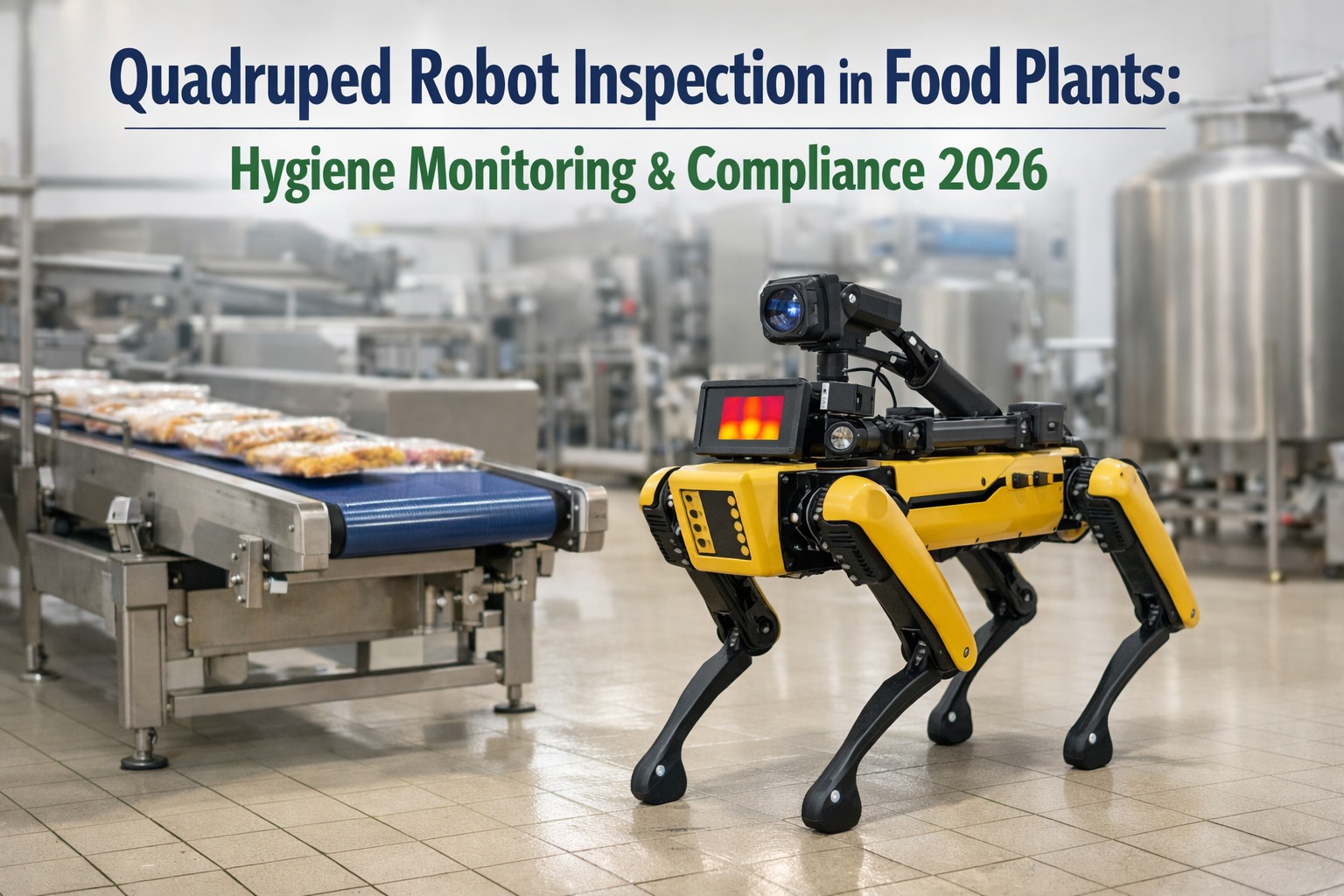
A cheese manufacturer in Wisconsin deployed a quadruped robot for overnight hygiene patrols — and within three months, the robot identified 23 equipment issues that human walkthroughs had missed, including a refrigeration compressor showing early thermal anomalies and multiple drain covers with biofilm buildup invisible to the naked eye. Meanwhile, 48 million Americans still get sick from foodborne illness every year, FDA FSMA enforcement is accelerating, and the average food recall costs manufacturers millions in destroyed product, litigation, and lost retail contracts. Quadruped robot dogs equipped with thermal cameras, AI vision, and environmental sensors are transforming how food plants approach inspection — and iFactory is the CMMS platform that turns every robotic finding into an automated, audit-ready maintenance action.
Human Inspectors Miss Things. Robot Dogs Don't.
Traditional food plant inspections rely on human walkthroughs — limited by shift schedules, fatigue, sensory capabilities, and the simple fact that a person can only inspect what they can see. Quadruped robots equipped with thermal imaging, AI-powered cameras, and environmental sensors patrol your facility 24/7, detecting hygiene violations, equipment anomalies, and contamination risks that are literally invisible to human inspectors. They climb stairs, traverse wet floors, navigate cold storage, and access areas too difficult for wheeled robots — capturing data at every checkpoint and feeding it directly into iFactory's CMMS for immediate action.
Cargill's Amsterdam Multiseed facility already uses Boston Dynamics' Spot for machine inspections and safety checks as part of its "Plant of the Future" program. The inspection robot market is growing at nearly 20% annually. The question for food manufacturers isn't whether robotic inspection is coming — it's whether you'll adopt it before your next FDA audit or contamination event forces you to.
See How iFactory Turns Robot Inspections Into Automated Compliance
In 30 minutes, we'll show you how iFactory integrates with quadruped robot platforms — turning every thermal scan, hygiene finding, and equipment anomaly into an audit-ready work order without manual data entry.
What Quadruped Robots Actually Detect in Food Plants
Robot dogs aren't novelties — they're sensor platforms on legs. Here are the six critical inspection capabilities that iFactory integrates into automated compliance workflows:
Thermal Anomaly Detection
Infrared cameras identify refrigeration failures, motor overheating, electrical hot spots, and cold chain breaches invisible to the human eye — before product loss or equipment failure occurs.
AI Hygiene Violation Detection
Computer vision trained on food safety standards identifies biofilm accumulation, standing water, damaged seals, open drains, and sanitation gaps — flagging issues that human inspectors routinely miss.
Environmental Monitoring
Onboard sensors measure air temperature, humidity, particulates, and gas levels throughout the facility during every patrol — not just at fixed sensor locations. Mobile monitoring fills coverage gaps.
Equipment Health Checks
Acoustic imaging and vibration sensors detect abnormal motor sounds, air leaks, and bearing wear on conveyor systems, mixers, and packaging equipment — catching mechanical issues during off-hours patrols.
Safety & Security Patrols
Overnight and weekend autonomous patrols verify equipment status, detect intrusions, confirm lockout/tagout compliance, and identify spills or structural hazards — all before the morning shift arrives.
Visual Documentation
High-resolution photos and 3D scans at every checkpoint create a timestamped, geotagged visual record — automatically stored in iFactory for FDA audit readiness, HACCP documentation, and trend analysis.
Every one of these findings flows directly into iFactory. Book a free demo to see how robotic inspection data becomes automated work orders in your CMMS.
How iFactory Turns Robot Data Into Compliance Actions
A robot that finds problems is useful. A robot whose findings automatically generate prioritized work orders, trigger corrective actions, and build audit-ready documentation is transformational. Here's the iFactory integration workflow:
Robot Executes Scheduled Inspection Route
The quadruped follows a pre-programmed route through your facility, stopping at each checkpoint to capture thermal images, visual scans, environmental readings, and acoustic data. Routes cover production floors, cold storage, washdown areas, loading docks, and utility corridors — including areas inaccessible to wheeled robots.
Onboard AI Identifies and Prioritizes Issues
The robot's AI engine compares each capture against trained baselines — classifying issues by type (hygiene, thermal, mechanical, environmental) and severity (critical, high, routine). Critical findings trigger immediate alerts. Routine findings queue for scheduled review.
Findings Become Maintenance Actions — No Manual Entry
Classified findings upload to iFactory with photos, location data, severity levels, and recommended actions — all attached automatically. Critical issues generate immediate work orders assigned to the right technician. Routine findings queue for scheduled maintenance review.
iFactory Builds Your Audit-Ready Record Automatically
Every patrol, every finding, every corrective action is documented in iFactory — creating a continuous, timestamped compliance record for HACCP, SQF, FSMA, and FDA audits. Trend analysis reveals recurring issues, improving zones, and emerging risks over time.
The iFactory Advantage: Other CMMS platforms require someone to manually enter inspection findings. iFactory receives robotic inspection data automatically — photos, severity, location, recommended action — and generates work orders without a single keystroke. Your team fixes problems. iFactory handles the paperwork. See this workflow live in a demo →
Why Food Plants Need Robotic Inspection Now
Three converging forces are making autonomous inspection mandatory — not optional — for food manufacturers who want to stay compliant, competitive, and contamination-free:
FDA FSMA Enforcement Is Accelerating
The FDA's Food Traceability Rule requires records retrievable within 24 hours. High-risk facilities face inspections every 3 years, with reinspection fees of $340/hour for non-compliance. Paper checklists and manual walkthrough logs won't survive an aggressive FDA audit. iFactory's robot-integrated inspection records are always current, always complete, and always retrievable in minutes.
Recalls Are Getting More Expensive
A single contamination event can destroy entire production batches, trigger multi-million-dollar recalls, and permanently damage retail relationships. Quadruped robots running nightly hygiene patrols catch biofilm, standing water, and temperature breaches before they reach your product. Prevention costs a fraction of a recall — and iFactory ensures every finding gets fixed, not just logged.
The Labor Shortage Hits Inspection Hardest
Qualified food safety inspectors are scarce and expensive. Manual walkthrough rounds are time-consuming, fatiguing, and inconsistent. Quadruped robots don't call in sick, skip checkpoints, or miss the overnight shift. They supplement your existing team — handling repetitive patrol work so your trained inspectors focus on critical judgment calls and corrective actions.
What iFactory Delivers for Food Plant Inspection
Robot Data Integration
Thermal images, visual findings, environmental readings, and acoustic data flow from quadruped robots directly into iFactory — no manual data entry, no re-keying, no delay between detection and action.
Automated Work Orders
Every classified finding generates a prioritized work order with photos, location data, severity level, and recommended corrective action — assigned to the right technician automatically.
Audit-Ready Documentation
HACCP logs, SQF records, FSMA inspection histories, and corrective action verification — all auto-generated from normal operations. Your compliance record is always current, never backfilled.
Trend Analysis & Risk Mapping
iFactory tracks inspection findings over time — showing recurring hygiene zones, deteriorating equipment, and seasonal risk patterns. Turn data into prevention strategy, not just reaction.
Turn Your Next FDA Audit Into a Competitive Advantage
30 minutes. Zero obligation. We'll show you how iFactory integrates robotic inspection data, automates compliance documentation, and gives your team audit-ready records that FDA inspectors actually respect.
Which Food Plants Benefit Most?
Biofilm accumulation in wet environments is the leading contamination risk. Robot dogs with AI vision detect biofilm on drains, equipment surfaces, and conveyor joints that human inspectors routinely miss — especially during overnight non-production hours when biofilm growth accelerates.
Cold chain integrity is non-negotiable. Thermal patrols catch refrigeration failures, door seal breaches, and temperature excursions hours before they compromise product safety — automatically generating work orders through iFactory before a single pound of product is at risk.
Allergen cross-contact, pest entry points, and equipment wear on high-speed packaging lines are persistent risks. Quadruped robots inspect areas between production runs — catching residue, seal failures, and structural gaps that trigger costly line shutdowns during human audits.
CIP system verification, filler head hygiene, and cold storage monitoring require round-the-clock vigilance. Robot patrols supplement CIP validation with visual confirmation — and iFactory documents every cycle for SQF and HACCP audit readiness.
The Future of Food Safety Is Already Here
Cargill is running robot patrols in its Amsterdam facility. Boston Dynamics' Spot is performing thousands of inspections weekly across food, chemical, and manufacturing plants worldwide. The inspection robot market is growing at nearly 20% annually. FSMA enforcement is tightening. Recalls are getting more expensive. And human inspector shortages aren't getting better. The food plants that adopt quadruped robotic inspection now — integrated with an AI CMMS like iFactory — will have years of compliance data, proven reliability records, and contamination prevention track records that their competitors simply cannot replicate.
Your Competitors Are Already Deploying Robot Inspections
30 minutes. Zero obligation. We'll show you how iFactory turns quadruped robot inspection data into automated work orders, audit-ready compliance documentation, and measurable food safety improvements — all from a single platform.