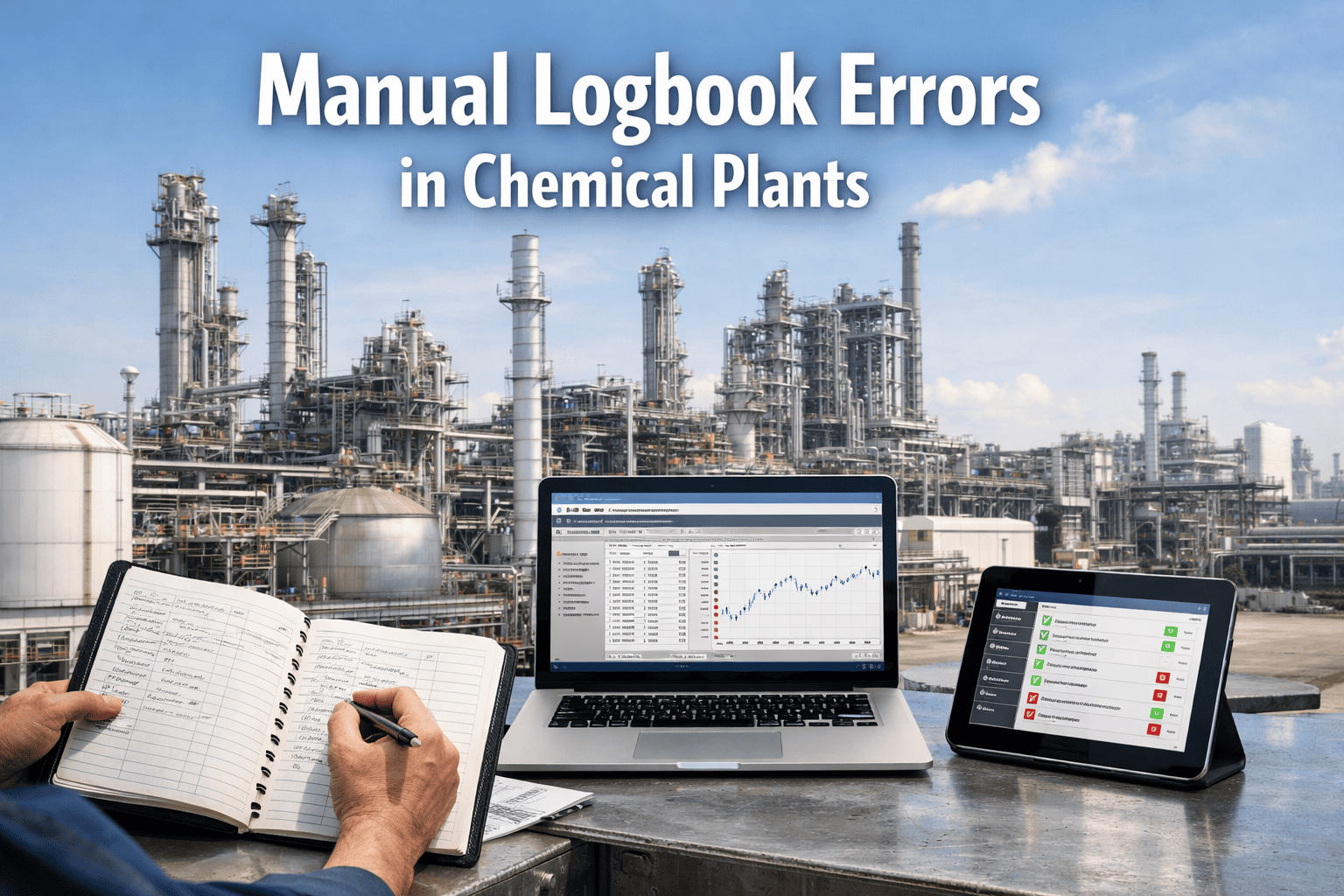
Chemical plants lose an average of 12–28% of operational efficiency annually to manual logbook
errors — not from equipment failures, but from illegible handwriting, missed shift entries,
delayed incident reporting, and fragmented data trails that no paper-based system or spreadsheet
tracking can prevent. By the time audit findings, compliance gaps, or safety incidents are
traced back to documentation failures, the compounding costs are already realized: regulatory
fines, production delays, investigation overhead, and reputational risk. iFactory
Digital Logbook Platform changes this entirely — capturing operator entries in real
time, validating data at point-of-entry, and integrating directly into your existing DCS, MES,
and compliance systems without disrupting workflows. Book a Demo to see how
iFactory eliminates manual logbook errors across your plant within 6 weeks.
99.2%
Data accuracy rate with digital validation vs. 73% for
manual logs
$840K
Average annual cost savings from reduced audit prep &
error correction
94%
Reduction in missing or incomplete shift handover records
6 wks
Full deployment timeline from workflow audit to live
digital logs
Every Handwritten Entry Is a Compliance Vulnerability.
Digital Logs Eliminate the Risk.
iFactory's digital logbook platform captures operator
observations, maintenance actions, safety checks, and process adjustments in structured,
time-stamped, audit-ready format — with role-based access, electronic signatures, and
real-time escalation for critical entries.
The Hidden Cost of Paper: Why Manual Logbooks Fail Chemical Plants
Before exploring solutions, understand the root causes of documentation failure in industrial
environments. Manual logbooks introduce systemic risks that compound over time — risks that
digital transformation directly addresses.
Human Error Amplification
Illegible handwriting, transposition errors, and omitted
fields create data integrity gaps that propagate through maintenance, compliance,
and safety workflows.
Delayed Visibility
Paper logs require manual compilation before insights emerge.
Critical trends, recurring issues, or emerging risks remain hidden until audit time
— too late for prevention.
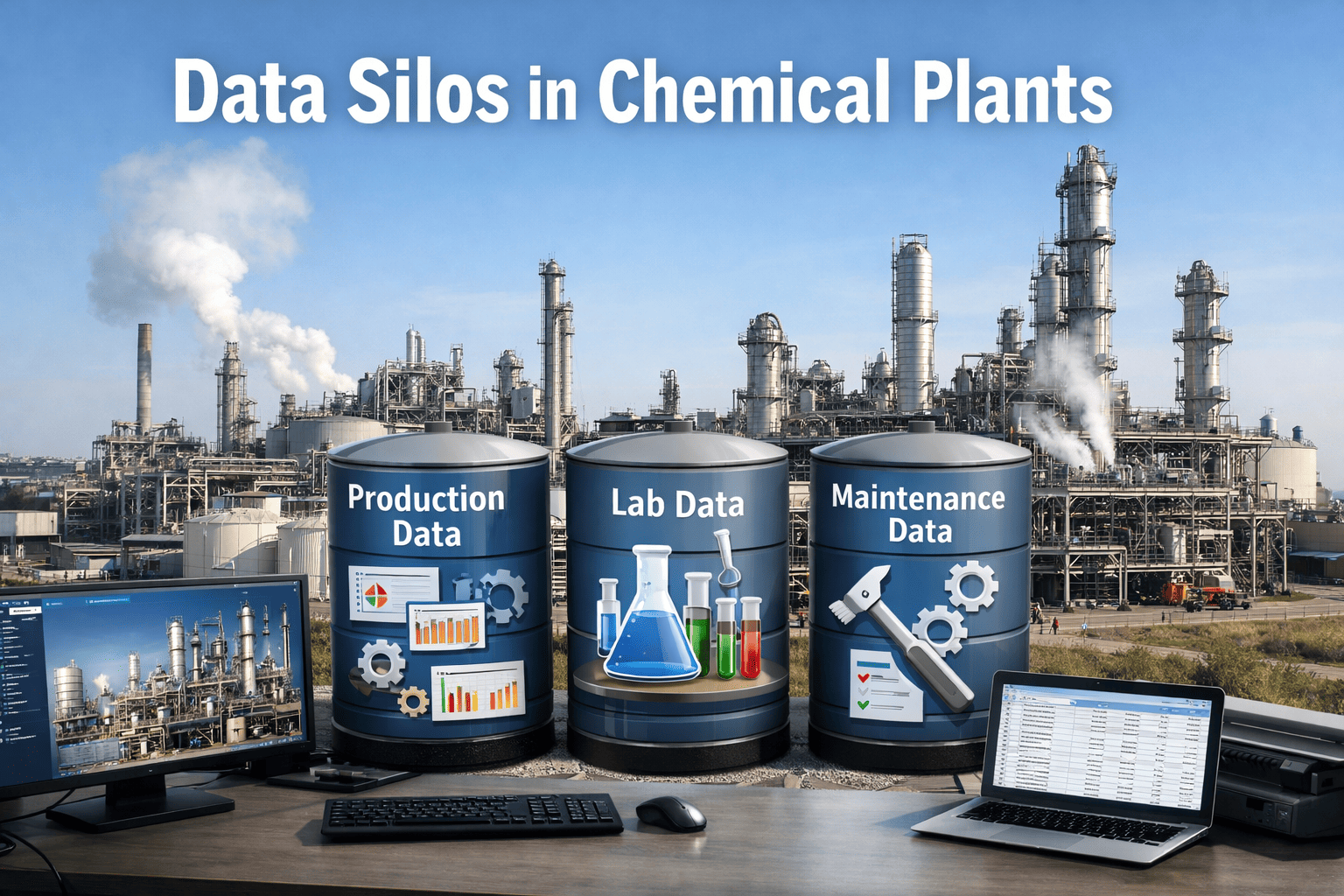
Fragmented Traceability
Disconnected logs across shifts, departments, and systems
break the chain of custody. Investigations stall. Auditors request "the complete
record" — and you can't provide it.
Compliance Exposure
EPA, OSHA, and ISO frameworks demand verifiable, time-stamped
documentation. Paper trails lack authentication, version control, and immutable
audit trails — creating regulatory vulnerability.
How iFactory Solves Manual Logbook Challenges in Chemical Plants
Traditional chemical plant documentation relies on paper logbooks, whiteboard shift notes,
and disconnected spreadsheets — all of which introduce transcription errors, version
confusion, and delayed visibility into operational events. iFactory replaces this with a
unified digital logging platform designed for industrial workflows that captures data at the
source, validates entries against process rules, and creates an immutable audit trail for
every action. See a
live demo of iFactory digitizing shift handovers, maintenance logs, and safety
inspections in a chemical manufacturing facility.
01
Structured Digital Entry Forms
Replace free-text handwriting with guided digital forms
featuring dropdowns, checkboxes, barcode scanning, and photo attachments — reducing
ambiguity and ensuring consistent data capture across all shifts and roles.
02
Real-Time Validation & Alerts
iFactory validates entries against process limits, safety
protocols, and compliance rules at point-of-entry. Missing critical fields,
out-of-range values, or unauthorized actions trigger immediate alerts to supervisors
— preventing errors before they propagate.
03
Immutable Audit Trail
Every log entry is time-stamped, user-authenticated, and
version-controlled. Changes require electronic signatures with reason codes. Full
traceability for EPA, OSHA, ISO 9001/14001, and internal audits — no more "he said,
she said" investigations.
04
DCS, MES & ERP Integration
iFactory connects to Honeywell, Siemens, AspenTech, SAP,
and custom historian systems via OPC-UA, REST APIs, and database connectors.
Auto-populate logs with real-time process data; push validated entries to
maintenance or compliance workflows. Integration completed in under 10 days.
05
Automated Compliance Reporting
Generate audit-ready reports instantly: shift summaries,
incident logs, maintenance histories, training records. Pre-configured templates for
EPA RMP, OSHA PSM, REACH, and regional chemical safety directives. Export to PDF,
CSV, or direct regulator portals.
06
Shift Handover Intelligence
iFactory structures shift handovers with mandatory fields,
pending action tracking, and visual status dashboards. Outgoing operators confirm
completion; incoming operators acknowledge receipt. Handover completeness increases
from 68% to 98%.
Compliance Framework Support: Built for Chemical Industry Regulations
iFactory's digital logbook platform is pre-configured to meet the documentation requirements
of major chemical industry regulatory frameworks. No custom development needed — compliance
reporting is automatic.
EPA RMP
Risk Management Plan documentation: process safety
information, operating procedures, incident investigations, and management of change
records — all auto-generated and audit-ready.
OSHA PSM
Process Safety Management elements: operating logs,
maintenance records, contractor safety documentation, and employee participation
tracking — with electronic signature workflows.
ISO 9001/14001
Quality and environmental management system records:
document control, corrective actions, internal audits, and management review inputs
— structured for certification audits.
REACH / SEVESO III
European chemical safety directives: substance
tracking, major accident prevention policies, safety reports, and emergency response
documentation — formatted for ECHA submissions.
iFactory Digital Logbook Implementation Roadmap
iFactory follows a fixed 5-stage deployment methodology designed specifically for chemical
plant documentation workflows — delivering pilot results in week 3 and full production
rollout by week 6. No open-ended implementations. No workflow disruption.
01
Workflow Audit
Map current logbook processes & pain points
02
System Integration
Connect to DCS, MES, CMMS via APIs
03
Pilot Configuration
Deploy digital forms to 2–3 critical areas
04
Validation & Training
User acceptance testing & role-based training
05
Full Production
Plant-wide digital logbook go-live
6-Week Deployment and ROI Plan
Every iFactory engagement follows a structured 6-week program with defined deliverables per
week — and measurable ROI indicators beginning from week 3 of deployment. Request the full
6-week deployment scope document tailored to your plant documentation workflows.
Weeks 1–2
Discovery & Design
Current logbook workflow assessment across
operations, maintenance, and EHS teams
Digital form design aligned with existing
procedures and compliance requirements
Integration planning with DCS, MES, and document
management systems
Weeks 3–4
Pilot & Validation
Deploy digital logs to high-impact areas: control
room shift logs, maintenance work orders, safety inspections
Real-time validation rules activated; alert
workflows tested with supervisors
First error prevention events captured — ROI
evidence begins here
Weeks 5–6
Scale & Optimize
Expand to full plant coverage: all shifts, all
departments, all log types
Automated compliance reporting activated for
applicable regulatory frameworks
ROI baseline report delivered — error reduction,
audit time savings, and productivity gains
ROI IN 4 WEEKS: MEASURABLE RESULTS FROM WEEK 3
Plants completing the 6-week program report an
average of $142,000 in avoided audit prep costs and error correction within
the first 4 weeks of full production rollout — with documentation
accuracy improvements of 26–41% detected by week 3 pilot validation.
$142K
Avg. savings in first 4 weeks
26–41%
Documentation accuracy gain by week 3
89%
Reduction in missing shift handover data
Eliminate Manual Logbook Errors. Go Digital in 6 Weeks.
ROI Evidence in Week 3.
iFactory's fixed-scope deployment program means no open
timelines, no workflow disruption, and no months of customization before you see a
single result.
Use Cases and KPI Results from Live Deployments
These outcomes are drawn from iFactory deployments at operating chemical plants across three
documentation categories. Each use case reflects 6-month post-deployment performance data.
Request the full case
study report for the documentation workflow most relevant to your plant.
A mid-size chemical plant operating 24/7 with 4 rotating
shifts was experiencing recurring communication gaps during handovers, traced to
illegible handwriting, omitted critical parameters, and delayed incident reporting
in paper logbooks. iFactory deployed structured digital handover forms with
mandatory fields, real-time DCS data integration, and supervisor escalation for
incomplete entries. Within 4 weeks of go-live, the system prevented 23 handover
errors that would have impacted batch quality or safety protocols.
23
Critical handover errors prevented in first 4
weeks
$310K
Estimated annual cost avoided from prevented
incidents
98%
Shift handover completeness rate (up from 68%)
A specialty polymers facility was spending 18–22 hours per
week manually compiling maintenance records for regulatory audits, with frequent
gaps in equipment service histories due to misplaced paper logs. iFactory replaced
paper work orders with mobile digital logs featuring barcode equipment scanning,
photo attachments, and automatic sync to the CMMS. Audit preparation time dropped to
under 3 hours, and equipment traceability reached 100% for ISO 9001 certification
renewal.
3 hrs
Audit prep time (down from 20+ hours weekly)
100%
Equipment service history traceability achieved
$185K
Annual labor savings from eliminated manual
compilation
A petrochemical complex was struggling with inconsistent
safety inspection documentation across 12 process units, with paper checklists
leading to missed items, delayed corrective actions, and audit findings. iFactory
deployed mobile digital inspection forms with GPS verification, photo evidence
capture, and automatic escalation for critical findings. All 47 safety observations
in month one were resolved within SLA, and the plant achieved zero
documentation-related findings in its next OSHA PSM audit.
100%
Safety observation resolution within SLA
0
Documentation findings in subsequent OSHA audit
$520K
Annual risk mitigation value from proactive safety
logging
What Chemical Plant Teams Say About iFactory Digital Logs
The following testimonials are from plant managers, EHS directors, and operations supervisors
at facilities currently running iFactory's digital logbook platform.
We eliminated the "lost logbook" problem entirely. Every
entry is time-stamped, user-authenticated, and instantly searchable. Our last
regulatory audit was completed in half the time with zero documentation findings.
Plant Manager
Bulk Chemical Manufacturer, Texas
Shift handovers used to be a source of anxiety. Now the
system guides operators through mandatory fields, flags pending actions, and
confirms receipt. Communication gaps dropped to near zero.
Operations Supervisor
Specialty Polymers Plant, Germany
Integration with our Siemens DCS took 8 days. The
iFactory team understood both our safety protocols and our technical environment.
The result is a system that operators actually use — because it makes their jobs
easier.
EHS Director
Petrochemical Complex, Singapore
We prevented a potential batch deviation because the
digital log flagged an out-of-spec parameter entry in real time. The supervisor was
alerted immediately, and corrective action was taken before product quality was
impacted. That single event justified the investment.
Quality Assurance Manager
Fine Chemicals Facility, Netherlands
Frequently Asked Questions
Does iFactory require replacing existing paper logbooks
immediately?
No. iFactory supports phased rollout: start with critical
workflows (shift handovers, safety inspections) while maintaining paper backups
during transition. Most plants complete full digital adoption within 6 weeks with
zero operational disruption.
Which industrial systems does iFactory integrate with?
iFactory integrates natively with Honeywell Experion,
Siemens PCS 7, AspenTech, SAP PM, IBM Maximo, and custom historians via OPC-UA, REST
APIs, and database connectors. Integration scope is confirmed during the Week 1
workflow audit.
How does iFactory ensure data security and regulatory
compliance?
iFactory is built to 21 CFR Part 11, ISO 27001, and GDPR
standards: role-based access control, encrypted data at rest and in transit,
immutable audit trails, and electronic signature workflows. Hosting options include
private cloud, on-premises, or hybrid deployments.
Can operators use iFactory on mobile devices in the
field?
Yes. iFactory offers native iOS and Android apps with
full offline capability. Operators can complete logs, attach photos, scan barcodes,
and submit entries without network connectivity. Data syncs automatically when
connectivity is restored.
How long does training take for plant personnel?
Role-based training modules are delivered during Weeks
4–5 of deployment. Most operators achieve proficiency in under 2 hours. Supervisors
and administrators receive additional training on validation rules, reporting, and
system configuration. Ongoing support is included.
What if our plant has unique documentation
requirements?
iFactory's form builder allows configuration of custom
fields, validation rules, and workflow steps without code. Our implementation team
works with your EHS, operations, and IT teams during Week 1–2 to align the platform
with your specific procedures and compliance obligations.
Stop Losing Data to Paper. Start Building an Audit-Ready
Digital Future.
iFactory gives chemical plant teams real-time digital
logging, process-aware validation, automated compliance reporting, and seamless system
integration — fully deployed in 6 weeks, with ROI evidence starting in week 3.
99.2% data accuracy with real-time validation
DCS, MES & CMMS integration in under 10 days
21 CFR Part 11 compliant audit trails out-of-the-box
Mobile offline capability for field operations