Your factory generates terabytes of sensor data every week. Your MES logs every cycle. Your SCADA tracks every alarm. But if that data lives in silos — disconnected from a live simulation of your actual operations — you are running a digital factory on analog decisions. NVIDIA's GPU-accelerated server infrastructure now makes it possible to build real-time digital twins that do not just visualize your plant — they predict failures, optimize throughput, and autonomously trigger maintenance actions before downtime occurs. The digital twin manufacturing market hit $4.6 billion in 2025 and is growing at 28% CAGR. The factories deploying this technology today are pulling ahead. The ones waiting are falling behind. This guide breaks down how NVIDIA server integration powers smart factory intelligence — from edge to cloud — and how a CMMS closes the loop between simulation and execution. If your maintenance team still reacts to failures instead of preventing them, it is time to connect your digital twin to your maintenance workflows. iFactory bridges simulation intelligence and maintenance execution — book a 30-minute assessment to see how.
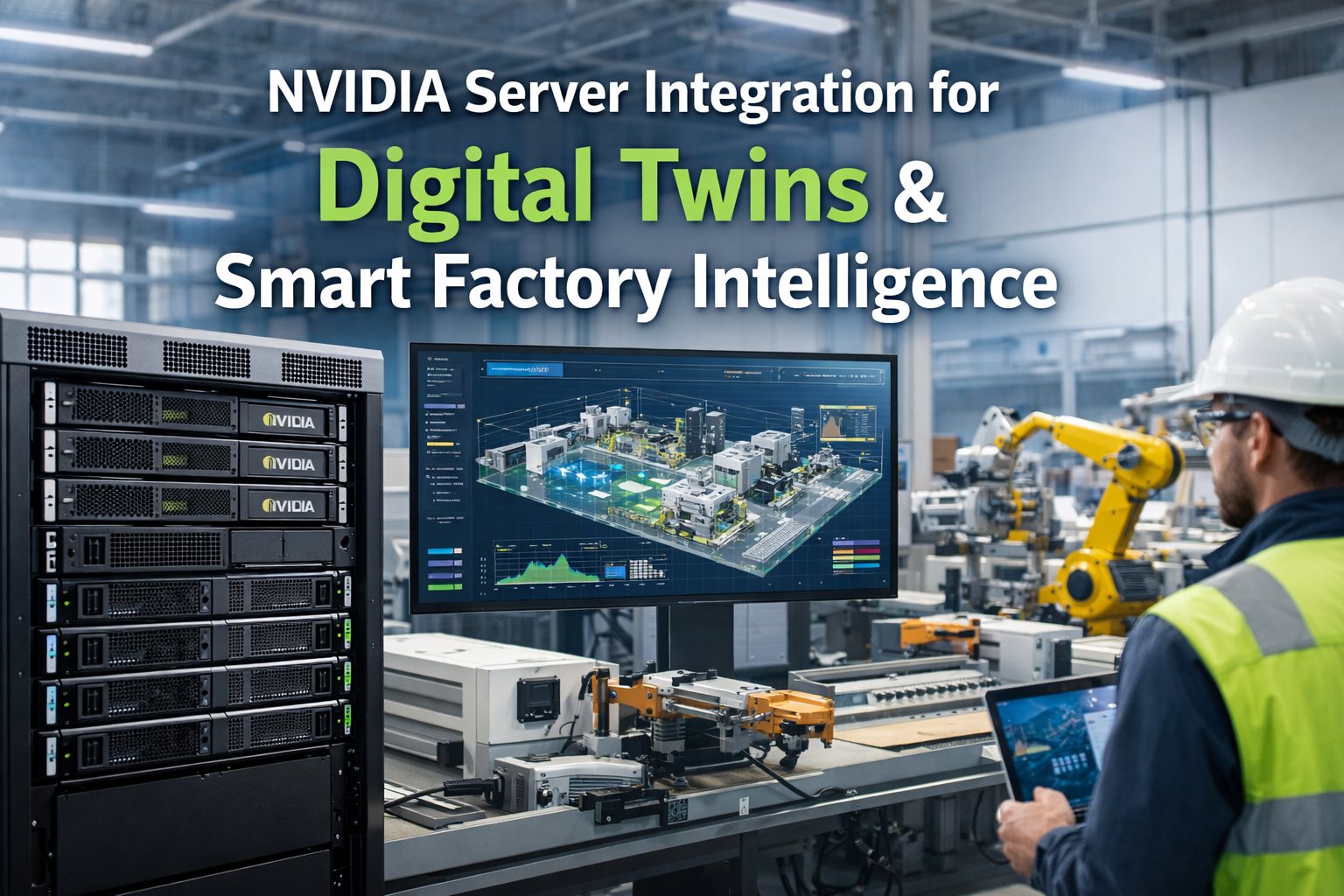
NVIDIA Server Integration for Digital Twins & Smart Factory Intelligence
GPU-Accelerated Simulation, AI-Driven Analytics, and Predictive Maintenance for Industry 4.0 Operations
$34B
Global Digital Twin Market Size (2026)
35%
Reduction in Unplanned Downtime with AI Digital Twins
92%
Of Companies Report 10%+ ROI from Digital Twin Investments
Why Smart Factories Need GPU-Accelerated Infrastructure
A digital twin is not a 3D model sitting on a server. It is a live, physics-accurate simulation fed by real-time sensor data — and it demands computational power that traditional IT infrastructure cannot deliver. NVIDIA's GPU platform provides the foundation that makes real-time factory simulation actually possible.
What Factories Generate
✗ Thousands of IoT sensors producing continuous data streams
✗ Vision systems generating gigabytes of inspection imagery per shift
✗ SCADA and PLC systems logging millions of events daily
✗ Vibration, thermal, and acoustic sensors running 24/7
Why Traditional IT Fails
✗ CPU-based systems cannot run physics simulation in real time
✗ Batch processing creates hours-long delays in insight delivery
✗ Siloed analytics tools miss cross-system failure patterns
✗ No unified environment for simulation, AI, and operations
What NVIDIA Enables
✓ Real-time physics simulation of entire production lines
✓ AI inference at the edge — defect detection in milliseconds
✓ Parallel processing of thousands of sensor feeds simultaneously
✓ Unified simulation, analytics, and AI on one platform
The NVIDIA Smart Factory Stack: What Each Layer Does
NVIDIA's industrial AI platform is not a single product — it is a layered stack from edge hardware to cloud simulation. Understanding each layer helps you deploy the right components for your operation.
Edge Layer
NVIDIA Jetson & IGX — On-Machine Intelligence
Compact GPU modules embedded directly on machines and production lines. Runs AI inference locally — defect detection, anomaly classification, and sensor fusion — without cloud latency. Processes vision and vibration data in real time at the point of generation.
Latency: Sub-10ms
Server Layer
NVIDIA GPU Servers — Plant-Level AI and Simulation
On-premise GPU servers running factory-wide AI models, digital twin simulations, and aggregated analytics. Handles predictive maintenance models, production optimization, and physics-based simulation of equipment behavior. Keeps sensitive operational data on-site for security and compliance.
On-Premise Control
AI Layer
NVIDIA NIM & Isaac — AI Microservices and Robotics
Pre-trained AI microservices for manufacturing use cases — quality inspection, predictive maintenance, robot path planning, and natural-language querying of operational data. Deploy ready-made AI capabilities without building models from scratch.
Pre-Built AI Models
In 2025, $1.2 trillion in investments toward building out U.S. production capacity was announced. The nation's leading manufacturers — BMW, Caterpillar, Foxconn, Toyota, TSMC, Lucid Motors — are using NVIDIA Omniverse to build factory digital twins that simulate, optimize, and operate production before physical deployment. This is not a research project. It is production infrastructure.
What a Real-Time Digital Twin Actually Does for Your Factory
A digital twin connected to live production data transforms every operational decision — from maintenance scheduling to layout optimization. Here is what it delivers in practice.
Predictive Maintenance
Calendar-based PM schedules
AI models predict failure windows
35% less unplanned downtime
Layout & Line Planning
Physical trial and error
Simulate changes before deploying
Weeks to hours for reconfiguration
Quality Inspection
Manual sampling, delayed feedback
Vision AI inspects 100% of output
50% fewer defect escapes
Energy Optimization
Static consumption baselines
Real-time energy modeling per asset
Up to 30% energy savings
Robot Deployment
Months of programming and testing
Train in simulation, deploy to floor
70% faster robot programming
Cross-Team Collaboration
Siloed tools, version conflicts
Shared live model for all teams
Single source of truth
Bridge the Gap Between Simulation and Maintenance
Digital twins predict failures. iFactory executes the response. When your simulation flags a degrading bearing or an overheating motor, iFactory auto-generates the work order, assigns the technician, and tracks completion — closing the loop between intelligence and action.
The Edge-to-Cloud Architecture: How Data Flows in a Smart Factory
The real value of NVIDIA server integration is not in any single component — it is in the connected data architecture from machine edge to cloud analytics to maintenance execution.
Shop Floor Sensors
IoT sensors, PLCs, SCADA, vision systems, vibration monitors — raw operational data from every machine and process.
Edge AI (NVIDIA Jetson/IGX)
Real-time inference at the machine level. Anomaly detection, defect classification, and sensor fusion happen in milliseconds — no cloud round-trip.
On-Premise GPU Server
Plant-wide AI models aggregate edge data. Predictive maintenance algorithms, digital twin simulation, and production optimization run locally.
Omniverse Digital Twin
Physics-accurate, real-time 3D simulation of the entire factory. Engineers, operators, and maintenance teams collaborate on one shared model.
CMMS / iFactory
Predicted failures become work orders. Maintenance schedules auto-adjust. Asset health scores update continuously. Every insight triggers an action.
Operational Outcomes
Higher uptime, lower maintenance costs, faster changeovers, better quality, and data-driven capital planning — measurable within months.
Who Is Already Building NVIDIA-Powered Smart Factories?
This is not theoretical. The world's largest manufacturers are deploying NVIDIA digital twins into production environments right now.
B
BMW — 30+ Factories on Omniverse
BMW built real-time digital twins of their global production network using Omniverse. Engineers across 30+ sites collaborate on unified factory models — simulating robot coordination, material flow, and worker ergonomics before physical deployment.
Scale
30+ Plants
S
Siemens + NVIDIA — First AI-Driven Factory (2026)
Siemens and NVIDIA are building the world's first fully AI-driven adaptive manufacturing site in Erlangen, Germany. An "AI Brain" powered by Omniverse continuously analyzes the digital twin, tests improvements virtually, and pushes validated changes to the shop floor.
Launch
2026
C
Caterpillar — Predictive Maintenance and Dynamic Scheduling
Caterpillar uses Omniverse digital twins alongside NVIDIA NIM microservices to predict and optimize factory maintenance. NVIDIA cuOpt software optimizes their supply chain performance in parallel with production simulation.
Focus
Predictive
F
Foxconn — 242,000 sq ft AI-Optimized Facility
Foxconn used Omniverse to design, simulate, and optimize a new Houston facility for manufacturing NVIDIA AI infrastructure. Robotic cells, assembly lines, and material flow were tested virtually before construction began.
Site
Houston, TX
T
Toyota — Warehouse Automation via Digital Twin
Toyota uses Omniverse-integrated simulation at its Georgetown, Kentucky facility to test complex automation scenarios with autonomous mobile robots — validating logistics flows digitally before deploying to the production floor.
Location
Kentucky
The Digital Twin Market: Growth Trajectory
The investment numbers tell the story. Digital twin technology in manufacturing is scaling from early adoption to enterprise standard — fast.
Global Digital Twin Market
$24–36B
$34–49B
$228–385B
Manufacturing Segment
$4.6B
$5.9B
$42.6B (28% CAGR)
Manufacturing Share of Market
35.1%
—
Largest Segment
Enterprise Adoption Rate
75%+ using at some level
—
40%+ in pilot-to-enterprise rollout
ROI Timeline
3–6 months for initial results; 12–36 months for full ROI (92% report 10%+ returns)
How CMMS Completes the Digital Twin Loop
A digital twin without maintenance integration is a dashboard that no one acts on. The factories getting real ROI connect their simulation intelligence directly to work order execution.
What You Get
✓ Beautiful 3D visualization of your plant
✓ Real-time sensor data displayed on screen
✓ Predictive alerts when anomalies are detected
What Is Missing
✗ No automatic work order generation
✗ No spare parts linkage or technician assignment
✗ No maintenance history loop back into the twin
✗ Alerts require manual follow-up to become action
What You Get
✓ Predictive alert auto-generates a prioritized work order
✓ Technician assigned based on skill, shift, and proximity
✓ Spare parts reserved from inventory automatically
✓ Completion data feeds back into the twin model
✓ Asset health scores update with every repair
✓ Full audit trail for compliance and lifecycle costing
Result
Every prediction becomes a measured, tracked, completed action — not a notification someone ignores
Frequently Asked Questions
What does NVIDIA server integration mean for a manufacturing facility?
It means deploying GPU-accelerated computing at the edge (on machines), on-premise (plant servers), and in the cloud (simulation platforms) to run AI inference, digital twin simulations, and predictive analytics in real time. NVIDIA provides the hardware (Jetson, IGX, GPU servers) and software (Omniverse, NIM, Isaac) that together power AI-driven factory operations — from defect detection on the line to full-plant simulation for layout planning.
How much does a digital twin implementation cost?
Costs vary widely depending on scope. A single-line digital twin pilot can start in the tens of thousands, while full-factory implementations with NVIDIA Omniverse run into six or seven figures. The ROI data is strong: 92% of companies report returns above 10%, with many seeing 20%+ returns. Manufacturing implementations often show initial results within 3–6 months through maintenance cost reductions of 25–55% and efficiency improvements of 15–42%.
Do I need NVIDIA hardware to build a digital twin?
Not necessarily for basic digital twins. But for real-time, physics-accurate simulation with AI-driven analytics — the kind that actually predicts failures and optimizes production — GPU acceleration is essential. NVIDIA's platform is the industry standard used by BMW, Siemens, Caterpillar, Toyota, and others precisely because CPU-based alternatives cannot handle the computational load of real-time factory simulation at scale.
How does a CMMS connect to a digital twin?
Through API integration. The digital twin platform (like Omniverse) identifies anomalies, predicts failures, and flags assets needing attention. The CMMS (like iFactory) receives those signals and automatically creates work orders, assigns technicians, reserves parts, and tracks completion. The repair data then feeds back into the digital twin, improving its predictive accuracy over time. This closed-loop architecture is what separates operational digital twins from visualization-only models.
Your Digital Twin Predicts. iFactory Executes.
Connect your factory simulation to real maintenance workflows. iFactory turns every AI-generated prediction into a tracked work order — auto-assigned, parts-linked, and completion-verified. Stop watching dashboards. Start preventing failures.