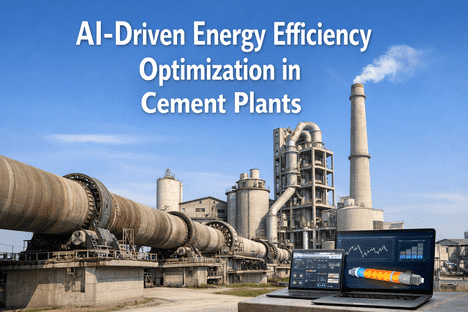
A Madhya Pradesh cement plant committed to 25% TSR (Thermal Substitution Rate) using agricultural biomass—rice husk and mustard stalk. Their kiln operators struggled to maintain clinker quality. Too much biomass? Free lime spiked to 2.8% (target: <1.2%). Too little? Coal costs remained high. The fuel mix changed hourly as biomass moisture varied from 12% to 28%. Manual adjustments couldn't keep pace. Result: TSR stuck at 11-13% despite having enough biomass supply. The plant abandoned their 25% target, citing "quality concerns." They had the fuel—they lacked the intelligence to use it.
Indian cement plants average 3-5% TSR—far below the 15-20% global benchmarks and 30-40% achieved in Europe. The challenge isn't fuel availability—India generates 62 million tonnes of agricultural waste annually. The challenge is optimization: AFR combustion characteristics vary dramatically (calorific value, moisture, ash content), requiring real-time fuel mix adjustments that humans can't execute fast enough. AI-powered optimization now enables 20-25% TSR while maintaining quality, reducing coal dependency by ₹4-6 crores annually per plant. Here's how.
Alternative Fuel Optimization in Cement Plants: How AI Enables AFR Usage in India
Achieve 20-25% TSR | Reduce Coal Costs ₹4-6Cr Annually | Meet 2030 Decarbonization Targets
Alternative Fuel Types & TSR Potential
Six Major AFR Categories for Indian Cement
Agricultural Biomass
8-12% TSRRice husk, wheat straw, mustard stalk, sugarcane bagasse. Calorific: 3000-3800 kcal/kg
RDF (Refused Derived Fuel)
10-15% TSRMunicipal solid waste, plastic waste, paper. Calorific: 3500-4500 kcal/kg
Industrial Waste
5-10% TSRSpent solvents, paint sludge, rubber waste. Calorific: 4000-6000 kcal/kg
Petcoke
15-25% TSRPetroleum refinery byproduct. Calorific: 7000-8000 kcal/kg. Low cost but high sulfur.
Wood Waste & Sawdust
6-10% TSRFurniture industry waste, sawmills. Calorific: 3200-4000 kcal/kg
Tire-Derived Fuel
3-5% TSRShredded scrap tires. Calorific: 7000-8500 kcal/kg. High energy but limited supply.
Percentage of total thermal energy from alternative fuels vs coal. 20% TSR = 20% of kiln energy from AFR, 80% from coal. India average: 3-5% TSR. Global leaders (Europe): 30-40% TSR. AI enables 20-25% TSR in Indian conditions.
Get Free AFR Feasibility Study for YOUR Plant
We'll analyze your fuel sources, kiln specifications, and local AFR availability to calculate achievable TSR and cost savings. See exactly which alternative fuels work for your plant.
- Local AFR source mapping
- Achievable TSR calculation
- Fuel mix optimization strategy
- Quality impact assessment
- Cost savings projection (₹)
- Implementation roadmap
Questions about AFR types or feasibility? Chat with AFR specialists — We'll help identify best fuels for your region.
How AI Optimizes AFR Usage: Four Core Capabilities
Real-Time Fuel Mix Optimization
1. Dynamic Fuel Mix Calculation
AI adjusts coal-AFR ratio every 5-10 minutes based on current conditions
- Monitors AFR calorific value in real-time (varies 15-30%)
- Accounts for moisture content (8-28% in biomass)
- Compensates for ash content differences
- Maintains target kiln temperature (±5°C)
- Predicts combustion behavior 10-15 minutes ahead
2. Quality Maintenance
Ensures clinker quality despite variable AFR composition
- Maintains free lime <1.2% with 20%+ AFR
- Controls LSF, SM, AM ratios precisely
- Prevents reducing atmosphere from biomass
- Manages sulfur input from petcoke
- Optimizes clinker formation temperature
3. Equipment Protection
Prevents damage from aggressive AFR combustion
- Monitors refractory wear from alkali/sulfur
- Controls coating buildup in preheater
- Prevents burner pipe damage from hotspots
- Manages dust circulation load
- Optimizes flame shape and length
4. Cost Optimization
Maximizes AFR usage while minimizing total fuel cost
- Calculates real-time fuel cost per tonne clinker
- Optimizes for lowest cost mix meeting quality
- Accounts for handling costs (biomass bulkier)
- Considers seasonal AFR availability
- Balances immediate vs long-term savings
Case Study: Maharashtra Cement Plant AFR Success
AI-Powered AFR Optimization - 18-Month Deployment
3800 TPD Plant | Biomass + RDF + Petcoke Mix
Baseline: 4% TSR (rice husk only) | ₹32 Cr annual fuel cost | 780 kcal/kg total fuel consumption
- Month 1-3: Installed AFR handling system (rice husk + RDF), baseline 4% TSR
- Month 4-6: AI trained on fuel characteristics, TSR increased to 12%
- Month 7-12: Added petcoke blend, TSR reached 18%
- Month 13-18: Optimization refined, stable 23% TSR with zero quality issues
- Fuel mix breakdown: Coal 77% | Rice husk 8% | RDF 7% | Petcoke 8%
Four Critical Challenges & AI Solutions
Why Manual AFR Management Fails
Challenge 1: Variable Fuel Properties
AFR calorific value varies 20-30% batch-to-batch. Biomass moisture fluctuates 12-28% seasonally. Operators can't adjust fast enough—result is quality swings or burning excess coal.
Real-time calorific value estimation from combustion data. Adjusts coal-AFR ratio every 5 minutes to maintain constant thermal input despite AFR variability.
Challenge 2: Quality Risk Perception
Plant managers fear AFR will compromise clinker quality. Conservative approach: limit TSR to "safe" 5-8%, leaving cost savings unrealized. Fear prevents optimization.
Predictive quality modeling proves AFR impact. System demonstrates 20%+ TSR maintains quality, building confidence through data. Gradual TSR increase with continuous validation.
Challenge 3: Equipment Wear Concerns
Aggressive AFR (high sulfur, alkali, chlorine) accelerates refractory wear, coating buildup. Plants limit TSR to protect equipment, even when fuel is available.
Monitors refractory temperature, coating thickness, alkali circulation. Optimizes AFR mix to maximize TSR while keeping equipment wear within acceptable limits. Predicts maintenance needs 2-3 weeks early.
Challenge 4: Complex Multi-Fuel Optimization
With 3-4 fuel types (coal + biomass + RDF + petcoke), optimal mix has 10,000+ combinations. Humans can't calculate fastest solution—stick with simple recipes that underutilize AFR.
Multi-objective optimization: minimize cost, maintain quality, protect equipment, maximize AFR—simultaneously. Solves 10,000+ combinations in 30 seconds, implements optimal mix automatically.
See Live AFR Optimization Demo
Watch AI adjust fuel mix in real-time as AFR properties change. See how system maintains quality while maximizing TSR—something impossible manually.
Implementation: 90-Day Ramp to 20% TSR
Phased AFR Deployment Strategy
Month 1: AFR Baseline & Source Assessment
Current TSR measurement, fuel cost analysis. Survey local AFR sources (biomass, RDF, industrial waste). Assess handling infrastructure needs. Establish quality baseline for comparison.
Month 2: AI Model Training
Train models on current fuel mix. Test AFR combustion characteristics (calorific value, ash, moisture). Develop quality prediction models. Simulate 10-15% TSR scenarios virtually before implementation.
Month 3: Gradual TSR Increase
Start 8-10% TSR with single AFR type (safest). AI monitors quality impact continuously. Increase 2-3% every 2 weeks if quality maintained. Reach 15% TSR by end of month 3.
Month 4+: Multi-Fuel Optimization
Introduce second/third AFR types. AI optimizes complex fuel blends. Target 20-25% TSR achieved by month 6. Continuous improvement: system learns seasonal patterns, refines over 12 months.
Triple Benefits: Cost, Carbon, Compliance
Why AFR Optimization Delivers 3x Value
Fuel Cost Reduction
₹4-6CrAnnual savings for 4000 TPD plant at 20% TSR. AFR typically 30-50% cheaper than coal per unit energy.
Carbon Footprint
-30%CO₂ reduction vs 100% coal. Biomass CO₂-neutral, RDF diverts landfill emissions. Critical for 2030 net-zero targets.
Circular Economy
100%Waste valorization—agricultural waste, MSW, industrial byproducts become valuable fuel. Environmental + social benefits.
Regulatory Compliance
ReadyMeet MoEFCC co-processing targets. Qualify for green cement certifications. Prepare for future carbon pricing.
Fuel Security
HedgedReduced coal dependency = less exposure to coal price volatility. Diversified fuel sources = supply chain resilience.
Brand Value
PremiumGreen cement positioning. ESG compliance attracts investors. Sustainability certifications enable premium pricing.
Want detailed ROI for your plant size? Get custom calculation — We'll show exact savings based on your fuel costs and achievable TSR.
AFR Optimization Takeaways
- 20-25% TSR achievable with AI optimization—5-8x higher than India's 3-5% average
- ₹4-6 Cr annual fuel savings typical for 4000 TPD plant with 20% TSR
- 30% CO₂ reduction from replacing coal with biomass and RDF—critical for 2030 targets
- Quality maintained—AI keeps free lime <1.2% despite 20%+ AFR usage
- 90-day ramp from baseline to 20% TSR with gradual, validated increases
- Triple value—cost savings + carbon reduction + regulatory compliance simultaneously
Achieve 20-25% TSR with AI-Powered AFR Optimization
Free AFR feasibility study: We'll map your local fuel sources and calculate achievable TSR and savings.
See exactly how much coal cost you can eliminate with alternative fuels.