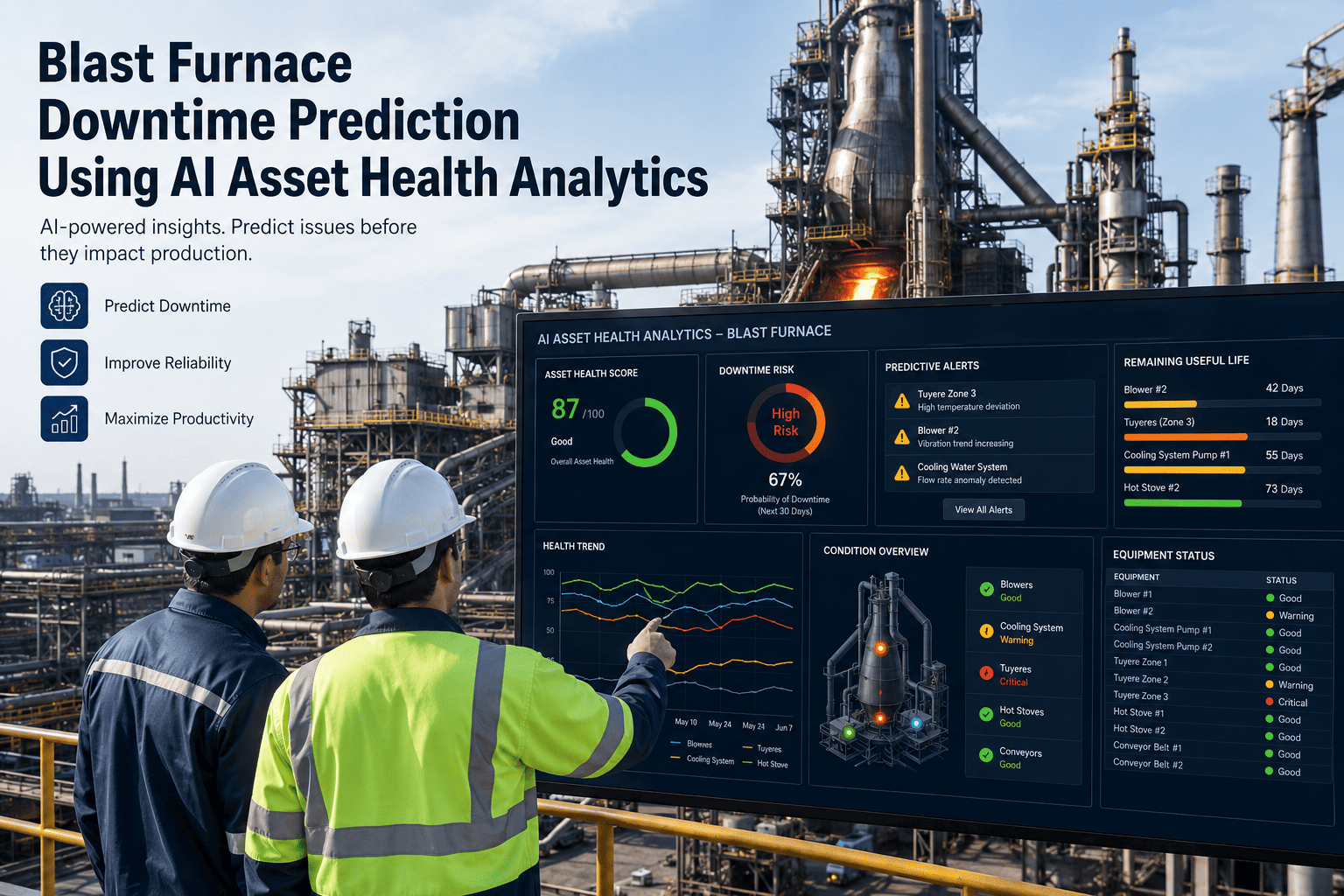
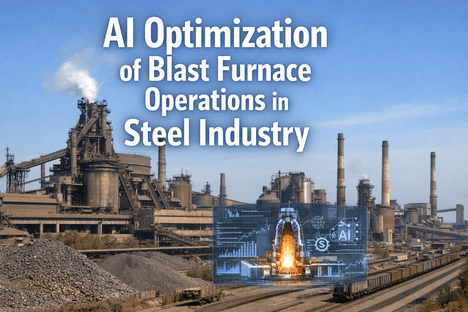
Blast furnaces are India's most complex metallurgical reactors—2,000+ tons of iron ore, coke, and limestone reacting at 1,500°C to produce 10,000 tons/day hot metal. Yet operators control them with 2-hour delayed measurements and experience-based decisions. AI real-time optimization delivers 7% productivity gains, 5% coke savings, and stable silicon control by predicting furnace behavior 60-120 minutes ahead. Leading Indian steel plants have reduced quality deviations 68% after AI deployment. Schedule a furnace optimization assessment, or continue reading.
Blast Furnace AI Optimization: Real-Time Control for Indian Steel Mills
7% Productivity | 5% Coke Savings | 90-Min Predictive Control
The Control Challenge: Why Manual Operations Fail
Four Critical Control Variables
Hot Metal Temperature
Target: 1,480-1,520°C. ±20°C acceptable. Manual control: ±50°C swings common. AI: ±15°C stability, 92% prediction accuracy 2 hours ahead.
Silicon Content
Target: 0.5-0.6%. Critical for BOF operations. Manual: 30-40% off-spec. AI reduces to <10%. Predicts silicon 90 min early for burden adjustment.
Coke Rate
Typical: 480-520 kg/ton HM. Every 10 kg reduction = ₹45 Cr annual (10,000 TPD). AI optimization achieves 5% reduction through thermal efficiency.
Productivity
Target: 2.2-2.5 t/m³/day. Manual operation: frequent slowdowns from instability. AI maintains steady state, 7% throughput gain. Questions on BF control?
Measurement delay: Silicon analysis takes 2 hours (sample → lab → result). By then, furnace conditions changed. Thermal inertia: Burden changes take 6-8 hours to affect output—operators adjust blindly. Multi-variable complexity: 50+ parameters interact—temperature affects silicon, coke affects both, blast rate affects all. Human limitations: Operators work 8-hour shifts, AI monitors 24/7 with consistent logic.
Get Free Blast Furnace Performance Analysis
We'll analyze your historical data (temperature, silicon, coke rate, productivity) and identify AI optimization opportunities. See potential savings from stable control and predictive adjustments.
Experiencing silicon or temperature instability? Get immediate metallurgist consultation — We'll review your operation and suggest corrective actions.
AI Solutions: Four Real-Time Control Systems
Predictive Models for Furnace Optimization
Silicon Forecasting
90-120 minPrediction lead time for burden adjustments
- ML model trained on 18+ months historical data (silicon, temperature, burden, blast)
- Inputs: burden basicity, thermal load, hearth temperature, top gas composition
- Predicts silicon trend 90-120 min ahead with 88% accuracy (±0.08%)
- Recommends precise ore/limestone ratio changes to maintain 0.5-0.6% target
Thermal Model
±15°CHot metal temperature control stability
- Physics-based heat balance model + ML calibration to actual furnace
- Tracks heat input (coke, oxygen enrichment, blast temp) vs output (HM, slag, gas)
- Predicts HM temp 2 hours ahead, recommends coke or blast adjustments
- Maintains 1,480-1,520°C target with ±15°C vs ±50°C manual control
Burden Optimization
5%Coke rate reduction through optimal charging
- AI calculates optimal ore/coke layers for current furnace state and raw material quality
- Accounts for ore variability (Fe content, basicity, slag volume requirements)
- Maximizes thermal efficiency—reduces coke 5% (480 → 456 kg/ton typical)
- Dynamic adjustment every 30 min based on top gas CO/CO₂ ratio feedback. Want to see burden optimization in action? Schedule a live demo with real furnace data.
Anomaly Detection
15-30 minEarly warning of instability or equipment issues
- Monitors 50+ parameters for abnormal patterns (pressure drop, burden descent, wall temp)
- Detects channeling, hanging, scaffolding 15-30 min before operators notice
- Predicts refractory hotspots indicating lining wear requiring investigation
- Catches tuyere blockage early through blast distribution analysis
Case Study: 18-Month Results (Indian Integrated Steel Plant)
BF#7 AI Deployment (3,200 m³ Furnace)
Commissioned 1998 (26 years old) | 10,200 TPD Hot Metal
Baseline (Pre-AI): 492 kg/ton coke rate, 2.18 t/m³/day productivity, 1,505°C ±48°C temperature swings, 38% silicon off-spec rate
- Productivity: 2.18 → 2.34 t/m³/day. AI-maintained steady state eliminated 22 slowdowns (18 months), each costing 800 tons production.
- Coke rate: 492 → 468 kg/ton. 24 kg reduction × 10,200 TPD × ₹35,000/ton coke = ₹86 Cr/year fuel savings.
- Silicon control: 38% → 12% off-spec (0.5-0.6% target). Reduced BOF rejects, improved downstream quality, ₹35 Cr/year value.
- Temperature stability: ±48°C → ±16°C. Stable thermal regime extended refractory life 18%, deferred ₹45 Cr reline by 8 months.
- Implementation insight: First 6 months in advisory mode (AI recommends, operators decide). Trust built through 85%+ accuracy. Month 7+: closed-loop control for burden, blast—operators monitor, AI executes. Get implementation roadmap for your furnace.
Implementation: 12-Month Deployment
Four-Phase Rollout
Data Integration (Month 1-3)
Connect to BF Level-2 system, install additional sensors (wall temp, burden probes), establish data historian. Collect 3 months baseline data for model training. Cost: ₹2-3 Cr for instrumentation + IT infrastructure.
Model Development (Month 4-6)
Train AI models on historical data + physics constraints. Validate 85%+ accuracy. Deploy in shadow mode (AI predicts silently, operators don't see yet). Refine models based on actual vs predicted. Need ML expertise? Our metallurgists can help.
Advisory Mode (Month 7-9)
AI displays recommendations to operators (burden changes, blast adjustments). Operators decide whether to follow. Track acceptance rate and accuracy. Build trust. Typical: 40% acceptance Month 7 → 85% Month 9.
Closed-Loop Control (Month 10-12)
AI executes burden and blast adjustments automatically (operators can override). Real-time optimization active 24/7. Continuous learning from new data. Full benefits realized: 7% productivity, 5% coke savings, stable silicon.
ROI & Benefits: Quantified Value
Three Value Streams
Fuel Savings
₹80-100CrPer 10,000 TPD furnace annually. 5% coke reduction (480 → 456 kg/ton) = 24 kg/ton × 10,000 TPD × 365 days × ₹35,000/ton coke = ₹86 Cr/year. Largest single benefit.
Productivity Gain
₹40-60CrPer furnace annually. 7% throughput increase (10,000 → 10,700 TPD) = 255,500 tons/year additional HM × ₹20,000/ton margin = ₹51 Cr. No CAPEX required—extract from existing asset.
Quality Improvement
₹30-40CrPer furnace annually. Silicon control reduces BOF rejects, improves steel quality consistency, enables premium product mix. Stable operations extend refractory life 15-20%, defer ₹45 Cr reline.
Your specific ROI depends on furnace size, current coke rate, and raw material costs. Get customized financial analysis for your blast furnace operation.
Need help building business case for management? We can create board presentation with furnace-specific ROI, payback timeline, and implementation plan.
Blast Furnace AI Optimization Takeaways
- 7% productivity + 5% coke savings proven in Indian steel operations—₹150-200 Cr annual value per 10,000 TPD furnace
- 90-120 min silicon prediction enables proactive burden adjustments vs 2-hour delayed lab results
- ±15°C temperature stability (vs ±50°C manual) extends refractory life 15-20%, defers ₹45 Cr reline
- 88% prediction accuracy achieved through ML + physics-based thermal models trained on 18+ months data
- 12-month implementation: Data (0-3mo) → Models (4-6mo) → Advisory (7-9mo) → Closed-loop (10-12mo)
- 2-3 month payback typical with ₹8-12 Cr investment, 1,400-1,800% Year 1 ROI for 10,000 TPD furnace
Ready to optimize your blast furnace with AI?
Deploy AI Optimization for Your Blast Furnace
Get free performance analysis of your furnace operation based on proven deployment methodology.
See potential savings from stable control, reduced coke rate, and increased productivity.