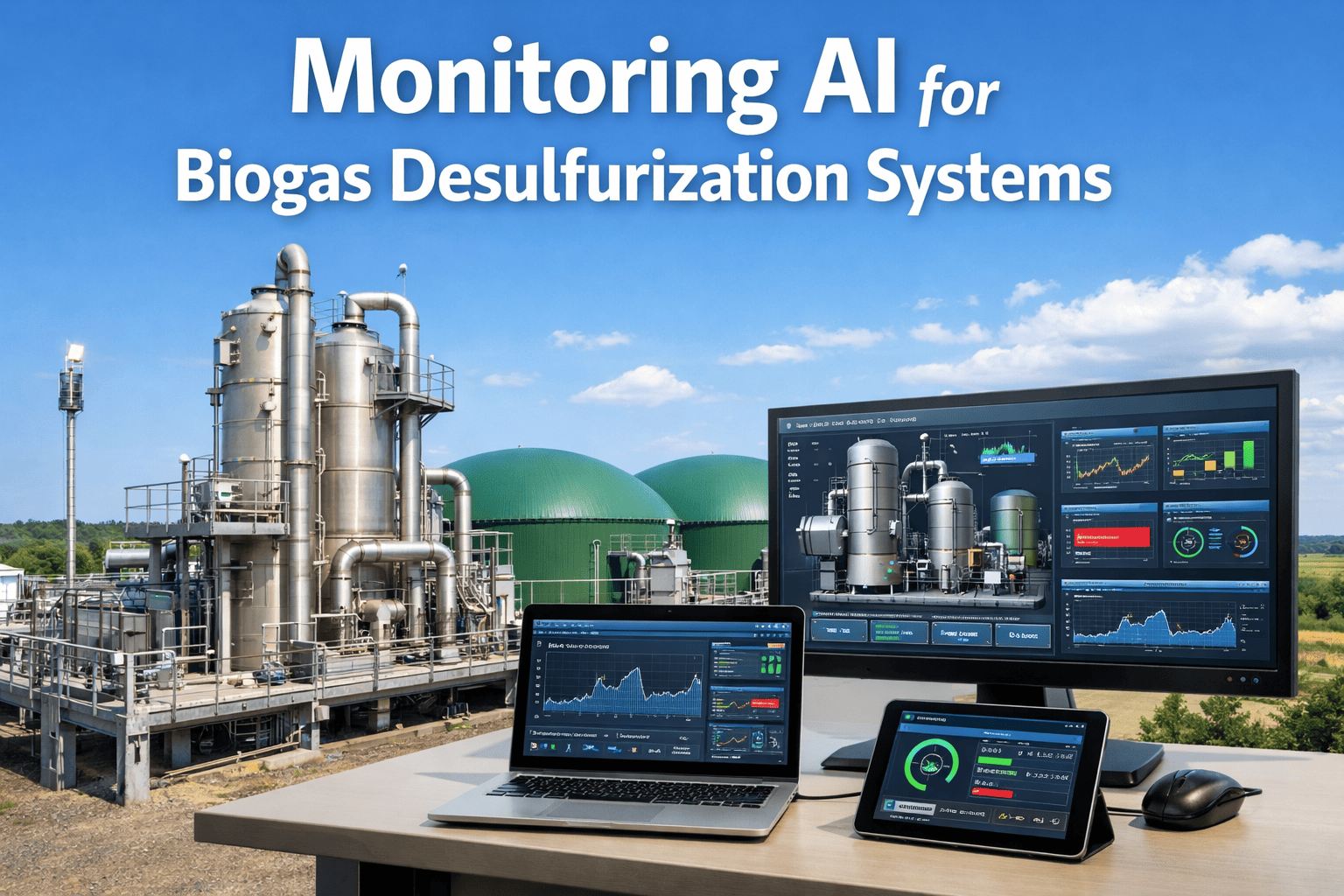
Biogas plant operators know the pain—a CHP engine throws a bearing at 2 AM, a digester mixer seizes mid-fermentation, or a slurry pump cavitates into failure during peak production. Each unplanned shutdown bleeds $15,000-50,000 in emergency repairs, kills RNG credit generation, and can destabilize the entire anaerobic digestion process for weeks. In 2026, AI-powered predictive maintenance is giving biogas facilities a way out of this cycle: IoT sensors and machine learning models now detect the vibration signatures, temperature anomalies, and pressure shifts that precede equipment failure—weeks before anything breaks. The result is 95%+ uptime, 60% lower emergency repair costs, and maintenance teams that fix problems on their schedule instead of reacting to crises. Schedule a free 30-minute uptime assessment and our engineers will identify which equipment failures are draining your biogas plant's profitability.
The Hidden Cost of Running Biogas Plants on Fixed Maintenance Schedules
Most biogas facilities still maintain equipment on fixed calendar intervals—oil changes every 400 hours, pump inspections every quarter, heat exchanger cleaning every six months. This approach was designed for stable industrial environments, not for the corrosive, biologically volatile conditions inside a biogas plant. Hydrogen sulfide in raw biogas eats through engine components at unpredictable rates. Feedstock variability shifts mechanical loads on mixers and pumps from week to week. Struvite scaling fouls heat exchangers at rates that have nothing to do with calendar time.
The result is a maintenance strategy that is simultaneously too early and too late. Perfectly functional oil gets drained at scheduled intervals while a bearing defect developing between service windows goes undetected until it destroys a gearbox. Industry data confirms that biogas plant maintenance consumes roughly one-third of total annual operating costs—and a significant portion of that spend is either wasted on unnecessary scheduled service or multiplied 4-5x by emergency repairs after preventable failures. contact to support for iFactory and start replacing calendar-based guesswork with real-time condition monitoring that services equipment only when it actually needs attention.
$53.5B
Global biogas market value in 2025, growing to $87.8B by 2034
1/3
Share of annual biogas operating costs consumed by maintenance alone
95%+
Target uptime for mature biogas plants—most run 85-90% without AI systems
5 Equipment Breakdowns That Shut Down Biogas Plants Without Warning
Not every piece of biogas equipment justifies AI-level monitoring. But the five failure categories below account for the vast majority of forced outages and emergency spending across the industry. These are the assets where predictive sensors pay for themselves fastest—often within the first prevented failure.
01
CHP Engine and Generator Seizures
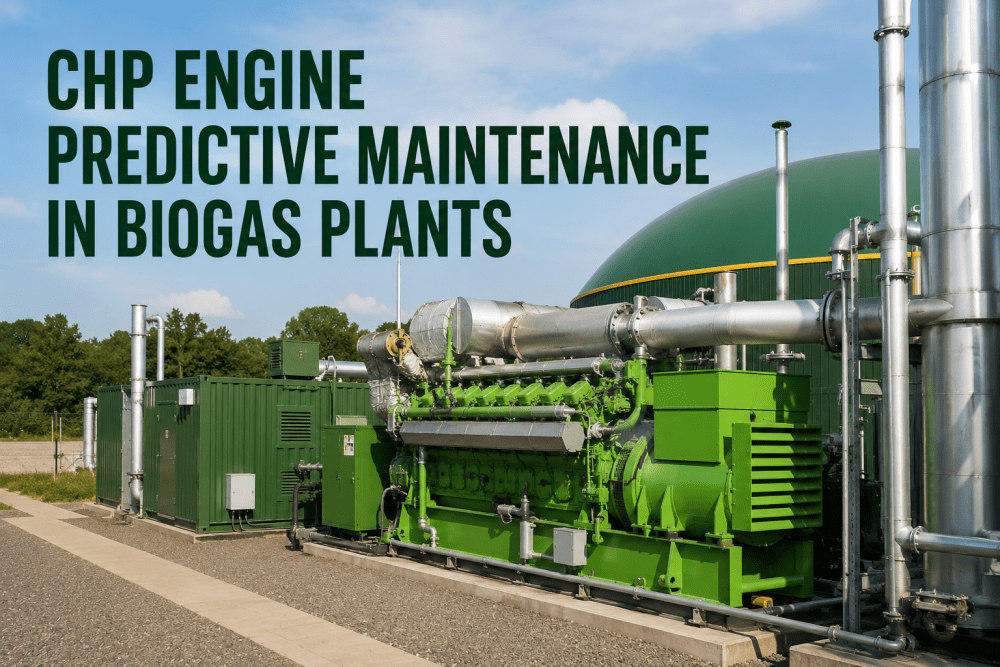
Corrosive H2S and siloxanes in raw biogas accelerate bearing wear, turbocharger degradation, and cylinder liner scoring at rates that defy manufacturer service intervals. A single forced CHP outage can cost $15,000-50,000 in emergency repairs plus days of lost energy revenue. AI vibration and exhaust gas analysis catches these failure patterns 4-12 weeks before catastrophic damage.
02
Digester Mixer and Agitator Failures
Submersible mixer shaft seals fail, impellers go out of balance, and gearboxes degrade under heavy slurry loads that vary with every feedstock batch. When mixers go down, stratification and dead zones crash biological performance—sometimes taking weeks to recover lost methane yield. Torque and vibration sensors catch bearing degradation 2-4 weeks before total seizure.
03
Slurry Pump Cavitation and Impeller Erosion
Abrasive feedstock grinds through pump impellers, seals, and casings at rates that depend on solids content—not service schedules. Cavitation pitting reduces flow capacity progressively until the pump fails completely, starving the digester of substrate. Motor current deviation and flow-rate tracking detect degradation 1-3 weeks before critical failure.
04
Gas Upgrading Membrane and Compressor Wear
Membrane perforation and compressor valve degradation push methane purity below pipeline specifications—forcing operators to flare gas instead of injecting revenue-generating RNG. These failures develop gradually but cross the quality threshold suddenly. Pressure differential and gas composition monitoring identifies issues 3-6 weeks before methane slip becomes critical.
05
Heat Exchanger Fouling from Struvite and Biofilm
Struvite crystallization, calcium carbonate scaling, and biofilm buildup choke thermal transfer—starving digesters of heat and crashing mesophilic or thermophilic process stability. One facility reported cleaning every 1-2 days before switching to AI-predicted cleaning cycles based on actual fouling rates, reducing cleaning downtime from 2 hours per day to 2 hours per month.
Find out which 3-5 equipment failures are draining your maintenance budget the most. Book a free demo and our engineers will map your highest-risk assets, recommend optimal sensor placement, and show you projected downtime savings within 30 minutes.
Book a Demo
Why Corrosive Biogas Environments Destroy Calendar-Based Maintenance Plans
The fundamental problem with time-based maintenance in biogas is that equipment degradation rates are driven by biological and chemical conditions—not calendar time. A CHP engine burning clean natural gas might reliably need service every 800 hours. The same engine running on raw biogas with variable H2S concentrations might need attention at 300 hours one month and 900 hours the next. Fixed schedules cannot adapt to this reality.
Calendar Maintenance vs. AI Condition Monitoring in Biogas
A German biogas farm running two CHP engines on fixed 400-hour service intervals switched to real-time AI oil condition monitoring. The system extended average service intervals to 800 hours by measuring actual lubricant degradation instead of guessing—cutting maintenance costs and oil consumption by 50% while eliminating unexpected breakdowns entirely.
— Condition-based monitoring deployment data, European biogas operations
From Vibration Data to Failure Alerts: Inside the AI Prediction Engine
AI predictive maintenance for biogas plants is built on four technology layers that work together to convert raw sensor signals into plain-language maintenance alerts. Each layer adds intelligence—from capturing physical measurements to generating automated work orders with specific failure modes, spare part requirements, and optimal repair scheduling windows.
Layer 1
Industrial Sensor Network
Accelerometers on CHP bearings, thermocouple arrays on digester walls, pressure transducers on gas lines, ultrasonic flow meters on slurry systems, and motor current sensors on pumps. Industrial-grade hardware withstands the corrosive, high-moisture biogas environment while capturing equipment health data at sub-second intervals. Wireless mesh networks eliminate expensive cabling across sprawling plant layouts.
Layer 2
Edge Computing and Local Anomaly Detection
Ruggedized edge computers aggregate hundreds of sensor streams and run initial anomaly filtering locally. This guarantees critical failure signatures are captured even during internet outages—the edge buffers all data and syncs when connectivity returns. Local processing also reduces cloud bandwidth by transmitting only meaningful deviation events rather than raw data floods.
Layer 3
Machine Learning Pattern Recognition
Neural networks trained on biogas-specific failure datasets analyze equipment behavior against dynamic baselines that automatically adjust for feedstock changes, seasonal temperature variation, and production schedule shifts. The AI detects subtle degradation patterns—bearing inner race defects, early-stage cavitation, membrane thinning—that are invisible to human inspection or simple threshold alarms. Remaining Useful Life calculations tell teams exactly how many operating hours remain.
Layer 4
Automated Work Order Generation
When AI confirms an impending failure, it generates a prioritized work order in your CMMS with the specific failure mode, recommended corrective action, required spare parts, and optimal scheduling window that avoids peak production periods. No manual intervention needed between detection and action.
contact to support for iFactory today and get AI-generated predictive work orders flowing directly into your existing maintenance system.
Stop Paying Emergency Prices for Preventable Biogas Equipment Failures
iFactory connects sensor data, AI failure prediction, and automated work orders into a single platform—replacing calendar-based maintenance schedules with real-time equipment intelligence that adapts to your plant's unique biological and chemical conditions.
Measured Results After Deploying AI Monitoring at Biogas Facilities
The financial case for predictive maintenance compounds across four dimensions simultaneously. Fewer unplanned outages mean lower repair costs, which means longer equipment life, which means more consistent RNG production and credit revenue. These gains accelerate over time as AI models accumulate your plant's specific failure data and sharpen prediction accuracy.
Fewer Forced Shutdowns
Plants using AI monitoring report 45% reduction in unplanned outage events. Degradation that previously caused surprise failures is now flagged and resolved during planned maintenance windows—protecting both production and biological process stability.
Smaller Repair Bills
Emergency repairs cost 4-5x planned maintenance. Converting crisis spending into scheduled service cuts total repair expenditure by up to 60%. One prevented CHP engine failure alone can save $15,000-50,000 in emergency contractor premiums and expedited parts shipping.
Longer Asset Life
Catching degradation early prevents cascading secondary damage that shortens asset life. CHP engines, slurry pumps, and heat exchangers under AI monitoring report 20-30% longer service life before major overhaul—pushing more value from every capital dollar invested.
Faster Audit Preparation
AI platforms automatically log equipment health data, maintenance actions, and gas quality readings required for environmental compliance. Automated audit-ready reporting cuts regulatory preparation time by over half—eliminating the manual spreadsheet scramble before inspections.
See exactly how much your biogas plant could save with predictive maintenance. Get Support for a free iFactory account and our team will model your specific ROI based on your equipment profile, maintenance history, and current downtime patterns.
Get Support
Works With Your Existing SCADA, CMMS, and ERP Infrastructure
AI predictive maintenance does not replace your existing plant systems—it plugs into them. Predictive insights flow directly into the SCADA screens, CMMS platforms, and financial tools your teams already use every day, so adoption requires no workflow changes or retraining.
Integration Architecture for Biogas Operations
8-Week Path from First Sensor to Live Failure Predictions
Deploying AI predictive maintenance across a biogas facility does not require a multi-year IT project. Most plants move from initial asset audit to live predictive alerts in 8-10 weeks using a phased approach that delivers measurable wins on high-impact equipment before expanding plant-wide.
Week 1-2
Asset Criticality Ranking and Failure Archaeology
Engineers audit every major asset, dig through historical maintenance logs, and rank equipment by failure frequency, repair cost, and production impact. The goal is a prioritized sensor deployment map that targets the 20% of assets responsible for 80% of your downtime and emergency spending. Existing SCADA and PLC data sources are cataloged for integration.
Week 3-5
Sensor Installation and Network Commissioning
Non-invasive IoT sensors go onto priority assets—vibration accelerometers on CHP engine bearings and mixer shafts, pressure and temperature probes on digesters and heat exchangers, flow and current sensors on slurry pumps. Edge computing hardware connects to your existing plant network. CMMS integration is configured so predictive work orders route automatically to the right maintenance teams.
Week 6-8
AI Baseline Learning and Threshold Tuning
Machine learning models ingest both historical and live sensor data to build equipment-specific health baselines. Anomaly thresholds are tuned to your plant's unique operating profile—factoring in feedstock variability, seasonal temperature shifts, and production schedules. False alarm rates are driven down through iterative calibration so maintenance teams trust every alert they receive.
Week 9 Onward
Live Alerts, Continuous Learning, and Expansion
Real-time predictive alerts go live. Your team receives prioritized warnings with failure mode identification, remaining useful life estimates, and recommended repair actions. As the AI accumulates plant-specific data, predictions get sharper every week. Sensor coverage expands to additional equipment based on proven ROI from early deployments.
Book a free demo and our team will build a customized 8-week deployment plan with sensor recommendations and projected uptime gains for your specific facility.
Turn Biogas Plant Maintenance Into an Uptime Engine
Your fixed service schedule cannot detect a digester mixer bearing developing a defect or a CHP engine losing combustion efficiency between inspections. iFactory deploys AI that monitors every critical biogas asset continuously, predicts failures weeks before they happen, and routes automated work orders to your team—so your plant produces RNG revenue instead of emergency repair invoices.
Frequently Asked Questions
How quickly does AI predictive maintenance pay for itself in a biogas plant?
Most facilities detect actionable equipment issues within the first 30-60 days of sensor deployment. Quick wins from catching early-stage pump cavitation, bearing degradation, or heat exchanger fouling typically pay for the entire monitoring infrastructure within 6-9 months. Returns accelerate as AI models learn your specific equipment failure signatures over the first year.
Book a free demo and get a custom ROI projection showing exactly how much your biogas plant can save with predictive maintenance.
Our equipment is 10+ years old and has no built-in sensors—can AI monitoring still work?
Absolutely. Modern retrofit sensor kits are designed specifically for legacy biogas equipment. Non-invasive vibration accelerometers bolt onto housings, clamp-on ultrasonic flow meters wrap around pipes, wireless temperature probes attach to surfaces, and current sensors clip onto motor cables—all without modifying existing equipment or interrupting production. Most sensors are battery-powered or energy-harvesting, so no new wiring runs are needed even to remote plant locations.
Biogas digestion is inherently variable—how does AI avoid constant false alarms?
AI models are trained specifically on biogas operational data including the inherent variability of anaerobic digestion. Multi-variate algorithms correlate mechanical sensor readings with biological process parameters like pH, temperature, feedstock composition, and gas production rates simultaneously. The system learns that a vibration change following a feedstock switch is expected, while the identical vibration pattern during stable conditions signals genuine mechanical degradation. This contextual intelligence keeps false alarm rates below 5% within the first calibration cycle.
Get Support and explore the iFactory dashboard to see how AI separates real mechanical threats from normal process variation in live biogas data.
What if our plant loses internet connectivity—do we lose failure detection?
No. Edge computing devices at the plant run anomaly detection algorithms locally and buffer all sensor data during connectivity outages. Critical failure alerts are delivered through multiple channels including local alarm systems, SMS, and satellite links where needed. When connectivity returns, buffered data syncs automatically to the cloud AI engine for deep pattern analysis. Your plant never goes unmonitored.
Can AI monitoring help meet environmental and RNG compliance requirements?
Yes—this is one of the highest-value secondary benefits. The platform automatically logs all equipment health data, maintenance actions, gas quality readings, and operational parameters needed for regulatory compliance. Automated reporting generates audit-ready documentation for emissions monitoring, safety system verification, and RIN/LCFS credit tracking. Operators report cutting audit preparation time by over 55% while eliminating manual data entry errors.
Schedule a free demo to see automated compliance reporting in action and learn how biogas operators are cutting audit preparation time by over half.