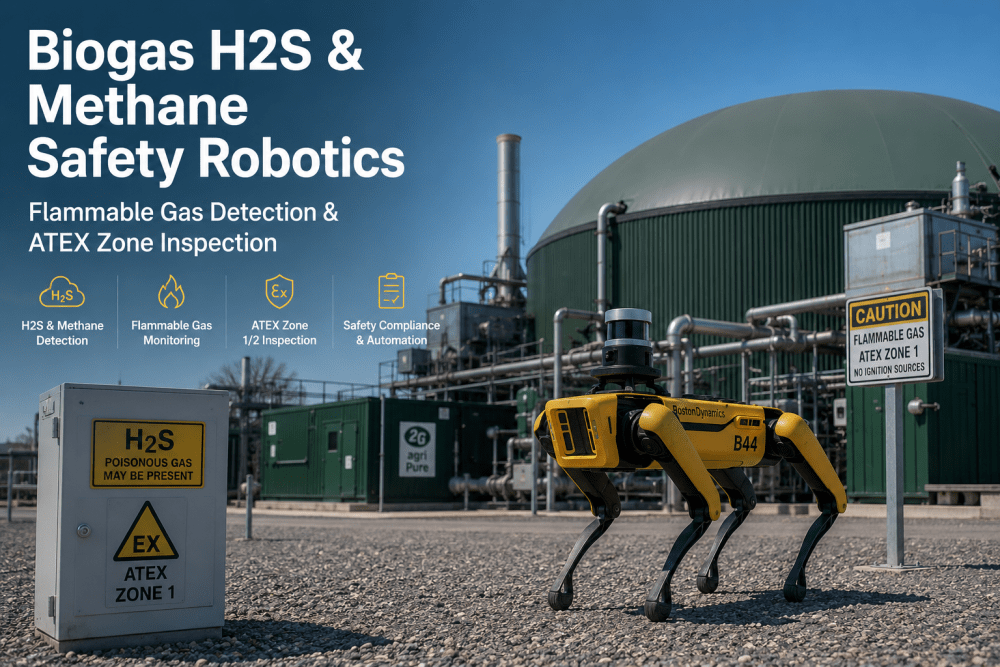
Biogas H2S & Methane Safety Robotics: Flammable Gas Detection & ATEX Zone Inspection
By Dahlia Anderson on May 28, 2026
Underground gas storage facilities are among the most operationally complex assets in the midstream sector — simultaneously managing reservoir pressure dynamics, injection and withdrawal scheduling, seasonal demand swings, aging compressor infrastructure, and real-time regulatory compliance. For decades, operators have relied on manual monitoring, static seasonal schedules, and reactive maintenance cycles that leave significant efficiency and safety value on the table. Artificial intelligence is changing that calculus. AI gas storage optimization in underground facilities gives operators the predictive intelligence, real-time reservoir control, and automated traceability that turn passive storage infrastructure into actively managedprofit-generating assets. This article explains exactly how AI is being deployed across underground gas storage today — and how iFactory's platform delivers that intelligence to your operations. For a facility-specific assessment, Book a Demo.
OPENING HERO CTA
AI · Underground Storage · Midstream Operations · Predictive Maintenance
How AI Improves Gas Storage Optimization in Underground Facilities
From real-time reservoir modeling and AI injection scheduling to predictive maintenance and automated FERC compliance — iFactory delivers the operational intelligence that turns your underground storage asset into a precision-managed, measurably profitable facility.
Annual losses from suboptimal underground storage cycling globally
30%
Compression energy savings achievable via AI injection scheduling
40%
Reduction in unplanned shutdowns with AI predictive maintenance
95%
Demand forecast accuracy with AI vs. 72% with manual scheduling
SECTION 1: THE OPERATIONAL CHALLENGE
Why Traditional Underground Gas Storage Management Falls Short
Conventional underground storage operations depend on fixed seasonal schedules, monthly manual SCADA reviews, and inspection cycles that leave critical performance and safety gaps between review windows. Three structural problems drive measurable operational and financial loss every production cycle — and none of them can be solved without continuous, AI-driven intelligence.
±15%
Pressure Deviation in Manual Cycles
Manually scheduled injection and withdrawal cycles routinely operate outside optimal pressure bands — accelerating reservoir degradation, increasing compressor wear, and reducing effective working gas capacity season over season without any alert being triggered.
72%
Manual Demand Forecast Accuracy
Seasonal demand planning without AI integration averages only 72% accuracy — resulting in costly over-injection during low-demand periods and dangerous inventory shortfalls during peak withdrawal windows that force emergency spot market purchases at premium prices.
48hr
Average Leak Detection Lag
Manual inspection cycles and fixed-threshold SCADA alerts leave underground methane migration and wellhead seal degradation undetected for up to 48 hours — driving EPA Subpart W exposure and environmental liability that no operator can afford in today's regulatory climate.
SECTION 2: AI APPLICATIONS
6 AI Capabilities Transforming Underground Gas Storage Operations
AI optimization in underground storage is not a single capability — it is a layered intelligence stack applied across reservoir management, scheduling, safety, maintenance, and regulatory compliance simultaneously. Each layer delivers independent value; together they transform the facility's operating economics.
Reservoir Intelligence
Dynamic Pressure & Reservoir Modeling
AI reservoir models ingest real-time pressure, temperature, and flow sensor data to continuously update underground formation maps — enabling operators to maintain optimal pressure bands, maximize working gas capacity, and prevent subsurface integrity events that require costly remediation or regulatory reporting.
↑ 18% working gas capacity recovery
Scheduling
AI Injection & Withdrawal Scheduling
Machine learning models optimize injection and withdrawal timing against real-time spot prices, pipeline nominations, compression energy costs, and weather-driven demand signals — replacing static seasonal schedules with dynamic operating plans that maximize arbitrage value and minimize energy-per-MCF stored.
↓ 30% compression energy cost
Forecasting
Demand Forecasting & Inventory Positioning
AI demand forecasting integrates weather API data, grid load signals, industrial customer nomination patterns, and historical withdrawal curves to generate 7-to-90 day forward inventory positions — enabling procurement, hedging, and operations teams to align on working gas targets before supply gaps emerge.
↑ 95% forecast accuracy
Safety
Continuous Leak & Emissions Detection
AI-powered sensor fusion combines wellhead pressure telemetry, surface methane sensor arrays, and acoustic emission data to flag subsurface migration and seal degradation within minutes. Automated alerts feed directly into incident reporting workflows, satisfying EPA Subpart W and state-level LDAR obligations in real time.
↓ 85% leak detection lag
Maintenance
Predictive Equipment Maintenance
Compressor stations, injection valves, wellhead assemblies, and dehydration units generate continuous vibration, temperature, and pressure-differential signals. AI models identify degradation patterns 24–72 hours before failure — reducing unplanned shutdowns by 40% and eliminating the material waste and safety risk of emergency repair mobilizations.
↓ 40% unplanned shutdowns
Compliance
Automated Regulatory & ESG Reporting
AI traceability platforms log injection volumes, withdrawal rates, pressure exceedances, emissions events, and maintenance actions in real time — generating FERC storage capacity filings, EPA methane compliance packages, and ESG disclosures in under one hour versus days of manual data assembly.
↓ 60% reporting labor cost
SECTION 3: HOW IT WORKS - WORKFLOW
The AI Optimization Loop: From Sensor Data to Operational Decision
AI underground storage optimization is not a single-step calculation — it is a continuous closed loop where sensor data, reservoir models, external market signals, and compliance logging all reinforce each other in real time. Understanding the loop is what separates facilities that deploy AI as a reporting tool from facilities that use it as an operational control system.
01
Sensor & SCADA Data Ingestion
Wellhead pressure, injection flow rates, compressor telemetry, surface emissions sensors, and pipeline interconnect data stream continuously into the AI platform — creating a real-time digital representation of the underground facility's operating state across every active well and surface component.
02
Reservoir State Estimation
AI reservoir models fuse sensor streams with geological formation data to maintain a continuously updated subsurface pressure map — identifying zones approaching capacity limits, cushion gas boundaries, and pressure differential risks before they become operational or integrity events requiring emergency response.
03
Demand Signal Integration
External demand signals — weather forecasts, grid load data, customer pipeline nominations, and spot market prices — are integrated with reservoir state and pipeline capacity data to generate optimal injection and withdrawal schedules for the next 1, 7, and 30-day operating horizons simultaneously.
04
Automated Control Recommendations
AI generates compressor setpoint adjustments, valve sequencing recommendations, and injection rate changes — delivered to operators as actionable alerts, or executed directly through SCADA interfaces within defined safety envelopes in automated configurations, with full decision audit trail maintained.
05
Compliance & Audit Documentation
Every operating decision, sensor event, and system response is logged automatically — generating the FERC, EPA Subpart W, and ESG audit trail as a byproduct of daily operations, eliminating manual report compilation and reducing regulatory exposure during inspection and enforcement cycles.
SECTION 4: COMPARISON TABLE
Conventional Operations vs. AI-Optimized Underground Storage: A Direct Comparison
Operating Parameter
Conventional Operations
AI-Optimized with iFactory
Injection Scheduling
Seasonal fixed schedule, manually adjusted monthly at best
Dynamic daily optimization against real-time price and demand signals
Pressure Management
Manual SCADA setpoints, ±15% pressure band deviation routine
AI reservoir model maintains optimal band, ±3% deviation
Demand Forecasting
Historical averages, 72% 30-day accuracy on a good month
Multi-signal AI model, 95% 30-day forecast accuracy
Leak Detection
Manual inspection + threshold alerts, 48hr average detection lag
Continuous AI sensor fusion, under 4hr average detection time
iFactory Brings AI Storage Optimization Intelligence to Your Underground Facility
From real-time pressure modeling and AI injection scheduling to predictive maintenance alerts and automated EPA and FERC compliance documentation — iFactory captures the operational intelligence that turns your storage asset into a precision-managed, measurably profitable facility.
Expert Perspective: What Midstream Storage Operators Experience After AI Deployment
The single largest untapped margin in underground gas storage is the gap between static operating schedules and what the reservoir can actually deliver in real time. Operators who close that gap with AI consistently recover 15–20% more working gas volume from the same infrastructure, without capital investment. The reservoir was always capable of delivering more — the intelligence layer was missing.
Senior Reservoir Engineer
Underground Storage Operations, U.S. Midstream Operator
AI pressure management consistently outperforms manual operations across all reservoir formation types — including depleted fields, aquifer formations, and salt cavern facilities at any operating scale
Facilities integrating AI demand forecasting with injection scheduling report measurably higher peak-day deliverability performance during extreme weather events compared to facilities on static schedules
The regulatory compliance dividend of AI traceability is consistently underestimated — automated documentation reduces FERC reporting burden by 60% while improving audit defensibility for EPA Subpart W filings
A single prevented compressor failure typically pays for a full year of AI platform costs at most mid-size underground storage facilities — making predictive maintenance the fastest-return AI deployment in the midstream sector
SECTION 6: CONCLUSION
Conclusion: AI Gas Storage Optimization Is Not a Future Investment — It Is a Current Competitive Requirement
Underground gas storage operators competing in today's market face a convergence of pressures that manual operations cannot absorb: tighter regulatory oversight, increasing demand forecast volatility driven by renewable grid penetration, aging compressor and wellhead infrastructure, and equity investors demanding quantified ESG performance documentation at the facility level.
The operators achieving measurably better results — higher working gas capacity utilization, lower compression costs, fewer unplanned shutdowns, faster regulatory response — are not operating fundamentally different physical infrastructure. They are extracting more intelligence from the operational data their facilities already generate every day. AI platforms like iFactory make that intelligence operational without requiring capital equipment replacement, SCADA system overhauls, or dedicated data science teams.
The reservoir has always been capable of delivering more. The AI optimization layer is what closes the gap between physical capability and commercial outcome. Book a Demo to see iFactory running in a live underground storage environment, or contact our support team for a facility-specific assessment.
Most underground storage operators complete initial AI platform deployment within 14–21 days. The deployment timeline covers sensor integration with existing SCADA and field instrumentation, reservoir model initialization using existing production history and formation data, and operator interface configuration. Facilities with modern SCADA systems and accessible historian data typically achieve the faster end of this range. The iFactory platform operates as a data and intelligence layer above existing control infrastructure — no compressor replacements, wellhead modifications, or SCADA overhauls are required. Early performance results are typically visible within the first 30 days of live operation. Book a Demo to discuss your specific facility configuration.
Effective AI underground storage optimization draws on four primary data categories. First, real-time operational telemetry: wellhead pressure, injection and withdrawal flow rates, compressor vibration and temperature, valve positions, and surface methane sensor readings from existing SCADA and field instrumentation. Second, historical operating records: past injection and withdrawal cycles, pressure decline curves, equipment maintenance logs, and prior emissions events — which AI models use for reservoir calibration and equipment health baseline establishment. Third, external market and weather signals: natural gas spot prices, pipeline nominations, power grid load data, and weather forecast feeds for demand modeling. Fourth, geological and formation data: static reservoir characterization data used to initialize the subsurface pressure model. iFactory's integration team manages the data pipeline setup; operators do not require in-house data engineering capability to deploy.
AI storage platforms satisfy regulatory documentation requirements by generating an automated, timestamped audit trail of all operational events as a continuous byproduct of daily platform operation. For FERC storage capacity and deliverability reporting, this includes injection volumes, withdrawal rates, working gas inventory levels, and capacity test results — all logged at the sensor level with chain-of-custody integrity. For EPA Subpart W methane emissions reporting, the platform logs all sensor-detected emissions events, response times, corrective actions, and atmospheric dispersion estimates from continuous surface monitoring. For PHMSA integrity management obligations, the platform logs all pressure anomaly detections, risk assessments, and maintenance responses. What previously required 3–5 days of manual data aggregation can be produced from the iFactory dashboard in under one hour.
Yes — this is one of the highest-value use cases for AI in underground storage. Peak-day deliverability depends on reservoir pressure state at the start of the withdrawal event, compressor availability, and pipeline interconnect conditions — all of which AI models monitor and optimize continuously. Conventional operations frequently enter peak withdrawal periods with suboptimal reservoir pressure states because injection scheduling did not account for the probability and magnitude of upcoming demand events. AI demand forecasting models that integrate weather forecasting with grid load projections generate pre-positioning recommendations days in advance — ensuring reservoir pressure, working gas inventory levels, and compressor readiness are aligned for peak deliverability before the demand event arrives. Operators using AI-optimized storage consistently report higher peak-day deliverability performance against rated capacity than facilities operating on static seasonal schedules. Book a Demo to see the peak-day planning model in action.
Smaller and mid-size underground storage operators frequently achieve faster relative ROI than large integrated midstream companies — for three reasons. First, smaller facilities typically have proportionally higher manual operating costs that AI automation directly reduces. Second, a single prevented compressor failure or avoided regulatory enforcement action represents a larger percentage of total facility revenue at smaller operations. Third, iFactory's cloud-based, mobile-first platform architecture was specifically designed to eliminate the IT infrastructure and dedicated data science staffing requirements that previously made AI adoption economically inaccessible for operators outside the top-tier midstream tier. Facilities operating as few as 2–5 storage wells and a single compressor station qualify for iFactory deployment. The 14-day go-live timeline and subscription-based commercial model allow smaller operators to access AI optimization without a capital commitment cycle.
FINAL CTA
Your Underground Storage Facility Is Already Generating the Data to Operate Smarter. AI Makes It Actionable.
Operators who move from static seasonal schedules to AI-driven dynamic optimization consistently recover more working gas capacity, reduce compression costs, prevent equipment failures, and satisfy regulatory obligations faster — from the same physical infrastructure, without capital expenditure. iFactory deploys in 14 days and delivers measurable operational impact before the first quarterly reporting cycle.