.png)
In anaerobic digestion, the difference between a stable digester producing at design capacity and crashed digester requiring weeks of recovery is rarely a single catastrophic event — it is a sequence of measurable chemical signals that go undetected until they have already compounded beyond easy correction. pH, volatile fatty acids (VFA), and alkalinity (expressed as the FOS/TAC ratio) are the three earliest and most reliable indicators of digester stability. When these parameters drift outside their optimal operating windows — even by small margins — methane yield begins declining within 24 to 48 hours. When operators catch that drift in real time using Statistical Process Control, they intervene before the yield loss is permanent. When they don't, a digester crash that takes seven days to develop takes thirty days to reverse. This article explains how SPC on pH, VFA, and alkalinity transforms biogas plant process stability from a reactive management problem into a genuinely anticipatory one.
Is Your Biogas Digester Running on Real-Time SPC for pH, VFA & Alkalinity?
iFactory AI delivers continuous Statistical Process Control monitoring for digester stability parameters — giving biogas operations teams actionable alerts before pH crash, VFA accumulation, or alkalinity imbalance destroy methane output.
pH, VFA, and Alkalinity: The Three Early Warning Systems of Digester Health
Anaerobic digestion is a four-stage biological process — hydrolysis, acidogenesis, acetogenesis, and methanogenesis — and the methanogenic archaea responsible for methane production in the final stage are extraordinarily sensitive to chemical imbalance. They operate optimally within a pH window of 6.8 to 7.5 and are inhibited below 6.5. The problem is that pH alone is a lagging indicator — by the time pH drops measurably, VFA accumulation has already been underway for 24 to 72 hours and significant methane yield loss has occurred. This is why monitoring all three parameters — and applying SPC to each — is the standard for process stability management at high-performing biogas facilities.
The most commonly monitored but least sensitive early indicator. pH depression below 7.0 signals active VFA accumulation already in progress. SPC control charts on pH detect systematic drift before operators see alarm-level deviation.
The primary early warning signal of digester instability. VFA accumulates when acetoclastic methanogenesis is inhibited — by overloading, temperature shock, toxic inputs, or inhibitory compounds. Elevated VFA precedes pH depression by 24–72 hours at mesophilic conditions.
The FOS/TAC ratio (volatile organic acids to total inorganic carbonate) is the most informative single stability metric in anaerobic digestion. It integrates VFA load against buffering capacity, providing a dimensionless stability index. FOS/TAC above 0.4 indicates buffer depletion risk; above 0.5 signals imminent instability.
Applying Statistical Process Control to Digester Chemistry: What the Charts Actually Tell You
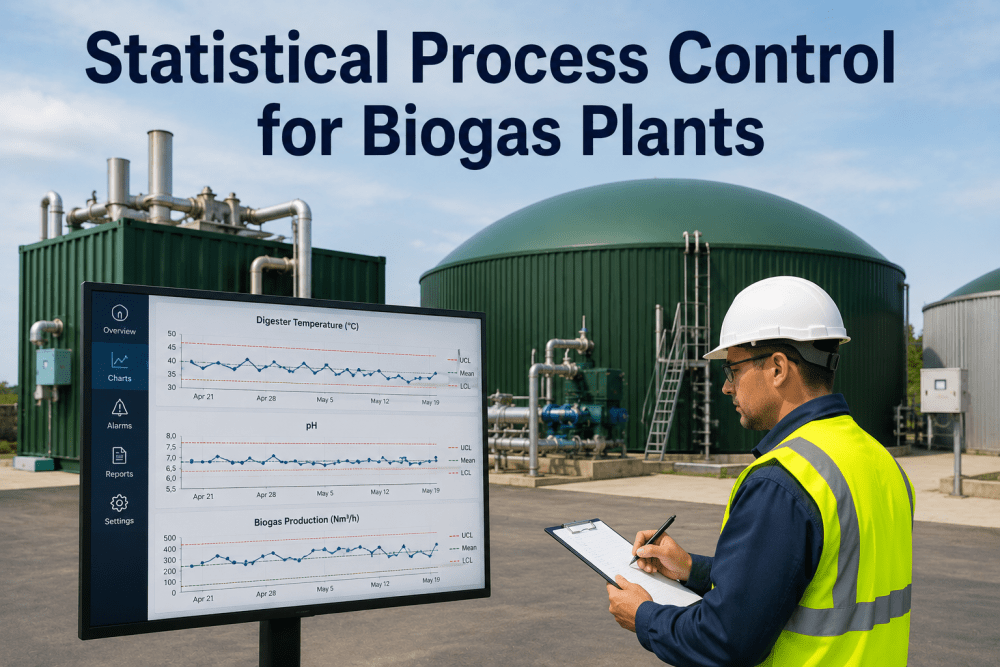
Statistical Process Control uses control charts — X-bar, Individuals (I-MR), and CUSUM — to distinguish between common-cause variation (natural biological fluctuation inherent to the process) and special-cause variation (systematic shifts that indicate a real change in process condition). In digester chemistry, this distinction is operationally critical: not every VFA measurement above 400 mg/L requires intervention, but a sustained upward trend across six consecutive readings — even if each individual value stays within historical range — is a CUSUM signal that something systematic has changed in the biological environment.
| SPC Chart Type | Best Applied To | Signal Detected | Typical Alert Lead Time | Operator Action Triggered |
|---|---|---|---|---|
| Individuals (I-MR) Chart | Daily pH readings, batch VFA measurements | Single point outside 3-sigma control limits | Same measurement cycle | Immediate investigation of feed composition or OLR |
| CUSUM Chart | VFA trend monitoring, FOS/TAC drift | Sustained directional shift before limit breach | 24–72 hours before alarm threshold | Organic loading rate reduction, supplemental alkalinity |
| EWMA Chart | pH trending, alkalinity ratio | Small persistent mean shift (0.1–0.2 pH units) | 12–48 hours before visible operator concern | Feed rate adjustment, bicarbonate supplementation review |
| X-bar / R Chart | Multiple daily VFA samples, lab replicates | Process mean shift and variability increase | Within current shift | Feed substrate quality investigation |
| Multivariate SPC (T² Chart) | Combined pH + VFA + FOS/TAC simultaneously | Correlated multi-parameter deviation pattern | Earliest possible — 48–96 hours | Full process audit, loading suspension if T² exceeds UCL |
iFactory AI's Statistical Quality Control platform implements all five chart types simultaneously on incoming biogas process data — with control limits calculated from each facility's own operating history, not generic industry defaults. Book a Demo to see how iFactory maps SPC chart types to your specific digester parameters and sampling schedule.
The Four Digester Instability Scenarios SPC Catches Before They Become Crashes
Digester instability does not occur randomly. The same four process scenarios generate the majority of pH depression, VFA accumulation, and alkalinity imbalance events at operating biogas facilities. SPC control charts detect the chemical fingerprint of each scenario in its early stage — before biological function is irreversibly disrupted — because each has a characteristic progression pattern that manifests in the parameter data before it manifests as a plant problem.
Organic Overloading
Feeding rate exceeds methanogenic capacity. Hydrolysis and acidogenesis outpace acetoclastic methanogens, causing VFA accumulation faster than conversion to methane.
Temperature Shock
Digester temperature drops below mesophilic optimum (35°C ±2°C) or thermophilic range (55°C ±2°C) due to heating system failure or cold feedstock introduction.
Inhibitory Compound Ingestion
Ammonia (from protein-rich feedstocks), sulfide, long-chain fatty acids, or trace metal toxicity selectively inhibit methanogens while acidogens continue operating normally.
Alkalinity Depletion
Bicarbonate buffer capacity consumed faster than it is replenished — often from low-alkalinity feedstocks, inadequate lime or bicarbonate dosing, or extended high-OLR operation.
Reactive Chemistry Monitoring vs. SPC-Driven Process Control — The Stability Gap
Most operating biogas plants today use alarm-threshold monitoring — a single setpoint per parameter that fires when a value crosses a fixed limit. This approach is structurally reactive: it detects problems only after they have already developed to a measurable level of severity. SPC replaces fixed-threshold alerting with pattern-based detection that responds to trends, shifts, and correlations across parameters simultaneously — catching process change in its developmental stage rather than its symptomatic stage.
- pH alarm fires at 6.8 — VFA has been accumulating for 48+ hours before this point
- VFA checked once daily from lab sample — intraday accumulation events invisible
- FOS/TAC ratio calculated manually from separate measurements, updated weekly at best
- Operator response triggered by alarm state — corrective action always after yield loss has begun
- No detection of gradual trend development — only sudden threshold crossings generate alerts
- Inhibitory compound events misread as stable because pH remains elevated while VFA climbs
- Digester crashes documented after the fact — root cause analysis driven by memory
- Recovery from crash takes 3–6 weeks and consumes significant supplemental inoculum cost
- CUSUM on VFA fires 36–72 hours before pH alarm threshold — operators act before yield loss
- Continuous or high-frequency inline VFA monitoring with SPC chart updated in real time
- FOS/TAC ratio calculated automatically from sensor data and trended on EWMA control chart
- SPC signal triggers corrective action recommendation — OLR reduction, alkalinity dosing, feed adjustment
- Trend detection catches 6-point consecutive drift long before any individual value exceeds control limit
- Multivariate T² chart correlates pH + VFA + FOS/TAC — inhibition scenarios detected even when pH is stable
- Every instability event is documented with parameter data for root cause analysis and prevention
- Crash prevention eliminates recovery costs — digester maintains continuous high-yield operation
Stop Reacting to Digester Crashes. Start Preventing Them With SPC.
iFactory AI's Statistical Quality Control platform gives biogas operations teams real-time SPC charts on pH, VFA, and FOS/TAC — with automated corrective action recommendations that protect 7-day methane output before biological function is disrupted.
A Structured Path to SPC-Driven Digester Stability at Your Biogas Facility
Deploying SPC on biogas digester chemistry does not require replacing existing instrumentation or interrupting digester operations. iFactory AI connects to existing SCADA systems, online analyzers, and laboratory information management systems (LIMS) through standard data interfaces — and SPC control limits are calculated from each facility's own operating history, not industry generic values. The four-phase deployment below reflects the approach validated at operating biogas plants with continuous AD operations and feed variability management requirements.
Phase 1 — Data Integration & Baseline Characterization (Weeks 1–6)
iFactory AI connects to existing process data sources — online pH probes, VFA analyzers (titrimetric or inline NIR), LIMS lab results, and SCADA historians — through read-only API interfaces. No modification to existing control systems is required. Historical process data (minimum 90 days, ideally 6–12 months) is used to calculate facility-specific control limits for each digester and each parameter independently. This baseline phase characterizes the natural biological variation of your specific feedstock mix and operating regime — so SPC charts distinguish real process change from normal seasonal and compositional variation. Book a Demo to review your plant's specific data architecture with iFactory's biogas process team.
Phase 2 — SPC Chart Activation & Alert Validation (Weeks 7–14)
SPC control charts go live for pH, VFA, and FOS/TAC across all monitored digesters. All SPC alerts are reviewed by process engineers during the validation period before any automatic corrective action recommendations are generated. This phase serves two purposes: it calibrates chart sensitivity to operational realities — including planned feed composition changes, seasonal temperature transitions, and maintenance-related process interruptions — and it builds operator familiarity with the difference between SPC trend signals and actual out-of-control conditions requiring intervention.
Phase 3 — Corrective Action Integration & Multivariate Monitoring (Weeks 15–24)
Automated corrective action recommendations go live — linking SPC alert type and severity to specific operational responses (OLR reduction percentage, bicarbonate dosing quantity, feed blend adjustment). Multivariate T² control charts are activated to monitor combined pH + VFA + FOS/TAC correlation patterns, enabling detection of inhibition scenarios that univariate charts miss. Integration with the plant's corrective action program generates condition report drafts with SPC chart data, parameter history, and recommended corrective action pre-populated for engineer review.
Phase 4 — Process Optimization & Yield Benchmarking (Week 24 Onward)
With 6+ months of SPC-monitored operations accumulated, iFactory AI's process intelligence identifies the specific process conditions — feedstock compositions, OLR levels, temperature profiles, seasonal patterns — most strongly correlated with optimal FOS/TAC ratios and maximum methane yield. Monthly performance reports compare SPC-monitored outcomes against pre-deployment baselines, quantifying yield improvement, crash event reduction, and specific gas production gains attributable to improved process stability management.
Expert Perspective: What Changes When SPC Is Running Continuously on Digester Chemistry
The most significant operational shift that SPC brings to biogas process management is not the detection of individual out-of-control events — it is the change in how process engineers relate to chemistry data between those events. In alarm-based monitoring, digester chemistry is essentially unknown between measurement points. In SPC-monitored operations, process state is continuously characterized against its own established baseline, and the early signal patterns of every major instability scenario are detectable before they develop clinical significance.
What SPC changed most fundamentally at our facility was the relationship between VFA data and operator action. Before we deployed control charts, our process engineers looked at VFA once a day from the morning lab run and made a judgment call based on whether it was above or below our historical comfort level. That judgment was good — they were experienced people — but it was entirely threshold-based and entirely backward-looking. What CUSUM charts gave us was a forward-looking signal. When VFA is at 380 mg/L but has been climbing steadily for five consecutive measurements, CUSUM fires. The absolute value is still within our historical range. But the trend is out of control. That distinction — between value-based and trend-based detection — is where all the early warning value lives in digester management.
The FOS/TAC monitoring was the second revelation. We had been measuring FOS and TAC separately and calculating the ratio manually during weekly process reviews. By the time an adverse ratio appeared in a weekly report, we were already three or four days into the instability event. Continuous FOS/TAC trending with EWMA charts gave us a real-time stability index rather than a weekly postmortem. In our first six months of SPC operation, we had three CUSUM alert events on VFA. In all three cases, the alerts fired between 40 and 65 hours before pH would have dropped to our old alarm level.
The Case for SPC on pH, VFA, and Alkalinity Is Biological, Operational, and Commercial
The biological case for SPC on digester chemistry parameters is unambiguous: VFA accumulation precedes pH depression by 24 to 72 hours, and FOS/TAC ratio shifts precede pH crash by 48 to 96 hours under alkalinity depletion scenarios. These are lead times that alarm-threshold monitoring structurally cannot access. SPC control charts — particularly CUSUM for VFA trend detection and EWMA for FOS/TAC ratio monitoring — convert those lead times into actionable alerts that give operators 40 to 65 hours of corrective window before methane yield is threatened. The operational case follows directly: at a biogas facility generating 5–15 MMSCFD, a single avoided crash event — representing 14 to 30 days of partial or full yield loss — generates $200,000 to $1.5 million in recovered revenue against a fraction of that in platform investment. The commercial case closes the argument: biogas purchasers, offtake agreement counterparties, and renewable energy certificate programs increasingly reward demonstrated process stability — and an SPC-monitored facility has the documented process performance record to support those commercial relationships.
iFactory AI's Statistical Quality Control platform deploys SPC on pH, VFA, and FOS/TAC without modifying existing SCADA or control infrastructure, using each facility's own operating history to establish biologically meaningful control limits. The path from data integration to live SPC charts is 6–8 weeks. The path to full multivariate monitoring and corrective action integration is 5–6 months. The documented return from a single avoided digester instability event exceeds total platform investment. Book a Demo with iFactory's biogas process team to build a facility-specific SPC deployment plan and begin the path to continuous high-yield digester operations at your plant.
Deploy Real-Time SPC Across Your Biogas Digesters — Protect 7-Day Methane Output
iFactory AI delivers continuous Statistical Process Control on pH, VFA, and FOS/TAC — with CUSUM and EWMA charts, multivariate T² monitoring, and automated corrective action recommendations built for anaerobic digestion process stability.
SPC for Biogas pH, VFA & Alkalinity — Frequently Asked Questions
Why is VFA monitoring more valuable than pH alone for detecting digester instability?
pH is a lagging indicator of instability — by the time pH drops measurably below 7.0, VFA accumulation has typically been underway for 24 to 72 hours and the bicarbonate buffer has already been partially depleted. VFA monitoring provides 24 to 72 hours of advance warning before pH depression becomes visible at mesophilic conditions. Under high-alkalinity operating conditions — common in facilities processing protein-rich feedstocks — pH may remain stable above 7.2 even while VFA climbs toward inhibitory levels, making VFA monitoring the only reliable early warning signal available. SPC applied to VFA converts this lead time advantage into actionable corrective action windows that pH alarm monitoring structurally cannot provide.
What is the FOS/TAC ratio and why is it a better stability indicator than pH or VFA individually?
FOS (Flüchtige Organische Säuren, volatile organic acids) divided by TAC (Totaler Anorganischer Kohlenstoff, total inorganic carbonate) is a dimensionless ratio that expresses acid loading relative to buffering capacity simultaneously. A facility with high VFA but also high alkalinity may be genuinely stable; a facility with moderate VFA but rapidly declining alkalinity is approaching instability. FOS/TAC integrates both dimensions into a single index. The target operating range of 0.3 to 0.4 applies across mesophilic and thermophilic temperature regimes and most common feedstock types. FOS/TAC above 0.5 is a pre-crash warning that requires immediate OLR reduction regardless of pH status. EWMA SPC charts on FOS/TAC detect the sustained upward trend toward this threshold 48 to 96 hours before the ratio reaches alarm level.
How does iFactory AI's SPC platform calculate control limits for biogas digester parameters?
The baseline calculation uses a minimum of 90 days (and ideally 6 to 12 months) of process data from stable, high-yield operating periods to establish the natural variation envelope specific to each digester's feedstock mix, temperature regime, and organic loading rate. Control limits calculated this way reflect real biological variability rather than textbook ideals, which means SPC charts generate fewer false-positive alerts on normal operating variation while remaining sensitive to genuine process change. Book a Demo to review your facility's historical data quality and baseline calculation requirements with iFactory's biogas engineering team.
What instrumentation is required to implement continuous SPC on VFA and FOS/TAC at an existing biogas plant?
The minimum instrumentation requirement depends on the sampling frequency needed for effective SPC chart performance. For I-MR and X-bar charts, daily laboratory measurements (titrimetric VFA by FOS/TAC titration) integrated through a LIMS interface are sufficient for CUSUM and EWMA chart operation. For real-time SPC with sub-hourly chart updates, inline or at-line analyzers — near-infrared (NIR) probes for VFA estimation, or automated titrimetric analyzers for FOS/TAC — provide continuous data streams.
How does SPC monitoring interact with existing biogas plant SCADA and control systems?
iFactory AI connects to existing SCADA historians, online analyzer data streams, and LIMS exports through read-only API interfaces — there is no write access to existing control systems and no modification to pH probe, VFA analyzer, or digester control infrastructure at any stage of deployment. SPC charts and corrective action recommendations are generated and displayed on iFactory's engineering dashboard and mobile interface as advisory outputs for operator and process engineer review. Automated corrective action execution (OLR adjustment, dosing pump actuation) is only enabled in later deployment phases and only if the plant's control architecture supports it and the operations team elects to activate it after the alert validation period. Book a Demo to walk through your plant's specific SCADA integration architecture with iFactory AI's biogas integration team.