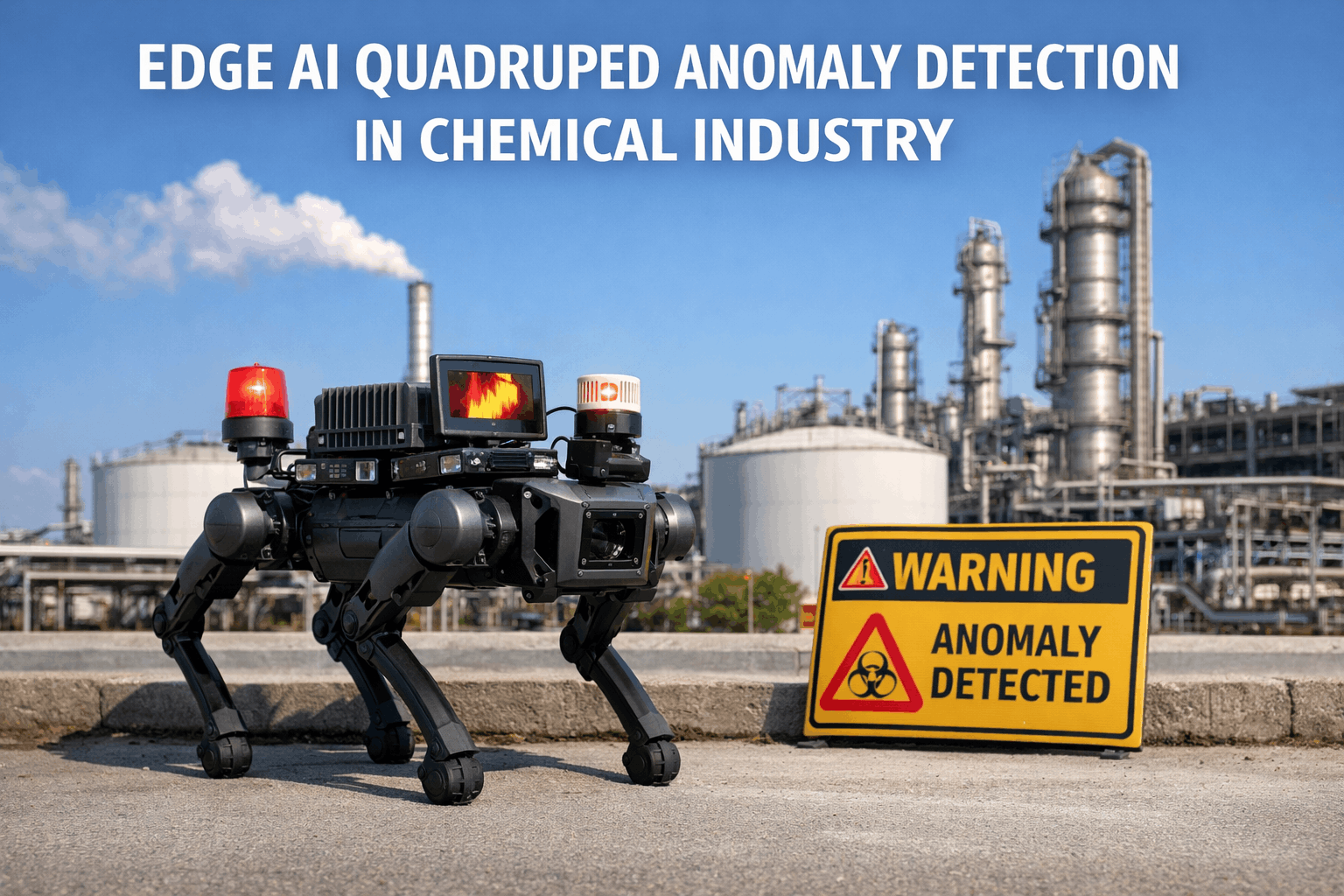
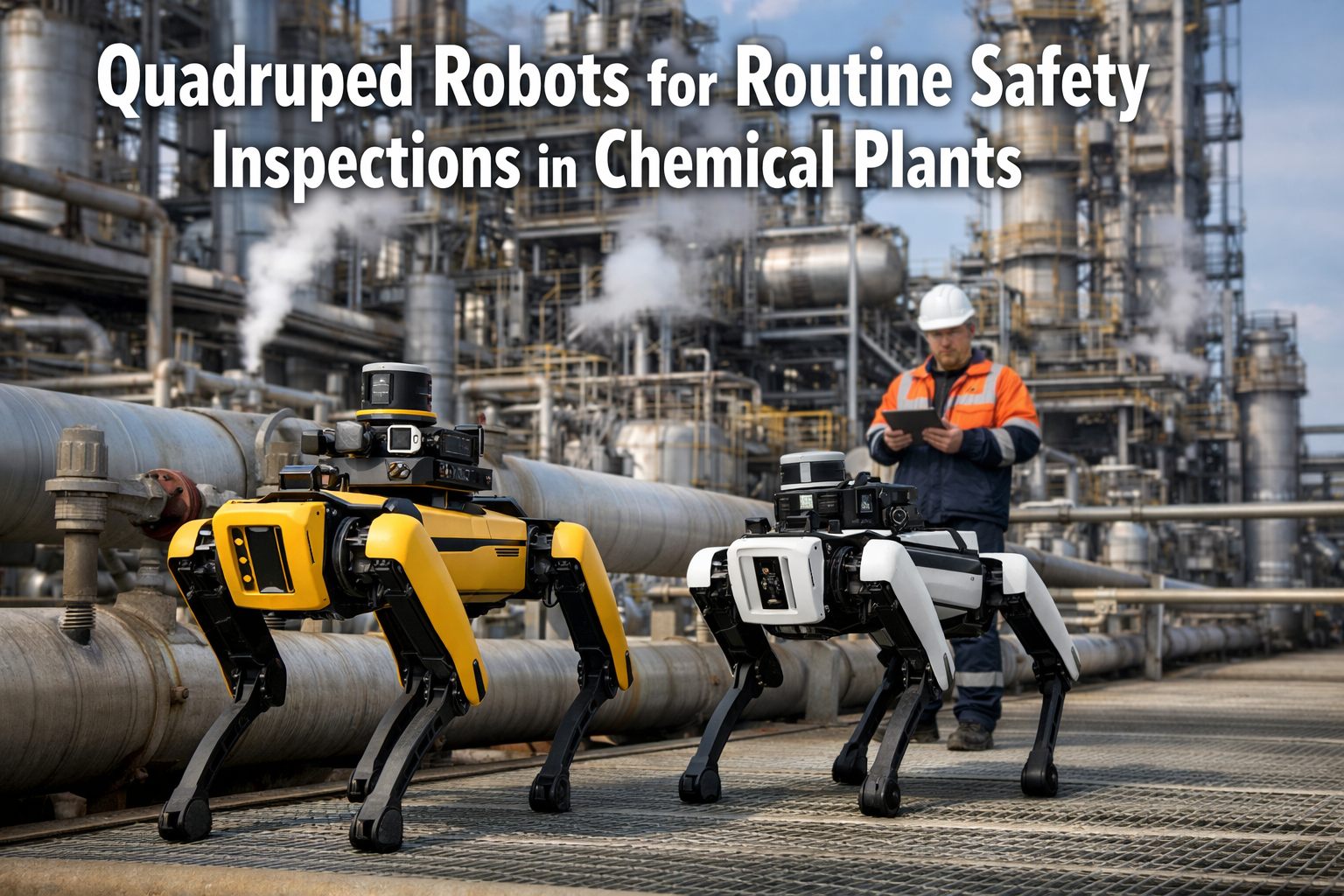
A quadruped detecting an H₂S spike cannot wait 400–800 ms for a cloud round-trip — in process safety environments, that latency gap separates a contained incident from an evacuation. Edge AI solves this: inference runs onboard, generating anomaly alerts in under 50 ms with zero connectivity dependency. iFactory's Onboard Model Management, Edge Telemetry, and Model Update Alerts make edge inference deployable and continuously improving across a quadruped fleet in classified process areas. Book a demo to see the modules live.
Edge AI vs Cloud Inference: The Detection Latency Gap
Cloud Inference (Traditional)
400–800 ms round-trip latency
Dependency: Requires live Wi-Fi / 5G connectivity in classified zones
Risk: Connectivity drop = blind robot = no anomaly detection
Edge + Cloud Hybrid
Pre-filtering onboard, final classification in cloud
Risk: Critical alerts still dependent on connectivity
Full Edge AI (iFactory Onboard)
Full inference onboard — gas, thermal, acoustic, visual in one pass
Zero connectivity dependency for safety-critical detection
The Four-Stage Edge AI Pipeline on a Chemical Plant Quadruped
Edge AI anomaly detection is a four-stage pipeline running entirely on the robot's onboard hardware. iFactory's Onboard Model Management ensures every robot runs validated, current model versions.
Stage 1
Multi-Modal Sensor Fusion
Electrochemical/PID gas detectors, LWIR thermal camera, acoustic microphones, and RGB camera stream at 10–100 Hz — time-synchronized and fed into the inference pipeline in one cycle.
iFactory Edge Telemetry buffers streams, confidence scores, and detection timestamps onboard — syncing a complete mission record to the dashboard when connectivity is available.
Stage 2
Onboard Inference Engine
Quantized models run inference per stream, then fuse cross-modal signals. A thermal hotspot alone is low-confidence; combined with an elevated VOC at the same GPS coordinate, the fused score crosses threshold — dramatically cutting false positives and missed detections.
iFactory tracks version, validation accuracy, and deployment timestamp per robot. An outdated or drifted model triggers a Model Update Alert — no robot operates on unvalidated logic without supervisory awareness.
Stage 3
Alert Generation & Local Action
When the fused score crosses threshold, the robot halts, re-scans, and assembles a timestamped evidence package — sensor readings, image, GPS, confidence score, asset ID — in under 50 ms. The alert transmits via Edge Telemetry on next connectivity.
Edge Telemetry prioritizes by severity — gas above 20% LEL, thermal exceedance, and bearing faults transmit first, triggering push notifications to designated personnel.
Stage 4
Continuous Model Improvement
Every confirmed anomaly becomes a training example; false positives and missed detections feed the retraining pipeline. When performance drifts, iFactory generates a Model Update Alert identifying affected robots, underperforming categories, and recommended model version.
Model Update Alerts fire on retraining completion, performance drift, or new equipment added to the route — deployed OTA during charging cycles, no mission interruption.
Teams building edge AI inspection programs should book a demo to see iFactory's edge modules configured for each use case.
The Four Edge AI Hardware and Software Components
Reliable edge inference requires four validated components — each with distinct IT/OT requirements before deployment.
Typical hardware: NVIDIA Jetson Orin NX (16–64 TOPS), Intel Movidius, or Qualcomm QCS8550
Inference throughput: 4–8 sensor streams simultaneously at 30–100 Hz
Power draw: 10–30W — critical for battery-operated quadrupeds
iFactory management:
iFactory tracks compute utilization per robot — a model update pushing latency beyond 50 ms fires an alert before deployment, and sustained high-temperature operation triggers a maintenance flag.
Gas detection: PID (10 ppb sensitivity), electrochemical (H₂S/CO/O₂), NDIR (hydrocarbon), optional TDLAS for specific target compounds
Thermal: LWIR/MWIR uncooled microbolometer, 320×240 to 640×480, ±2°C accuracy
Acoustic: Contact and airborne sensors, 20 Hz – 80 kHz, FFT-based spectral analysis onboard
iFactory management:
Calibration expiry and drift history are tracked in iFactory Edge Telemetry; a sensor nearing expiry or drifting triggers a Model Update Alert — systematic miscalibration errors are harder to catch than outright failure.
Onboard buffer: 4–24 hours of full mission telemetry stored locally (NVMe SSD)
Transmission: Wi-Fi 6 / private 5G when available; store-and-forward when in RF dead zones
Prioritization: Critical alerts → normal alerts → sensor summaries → full telemetry
iFactory management:
iFactory monitors transmission lag per robot; data falling behind threshold fires an alert — a robot that detected anomalies but cannot transmit them is an invisible blind spot.
Model registry: Central repository of validated models with version, training data, and validation metrics per detection category
Deployment: OTA push to robots during charging — zero inspection mission interruption
Rollback: One-click revert to any previous validated version per robot or fleet-wide
iFactory management:
iFactory maintains the full audit trail — model version, validation accuracy, and active alerts per robot per mission — so any missed detection can be immediately traced to whether the model was within validated parameters at the time.
One Platform. Every Robot. Every Model. Every Alert.
iFactory's Onboard Model Management, Edge Telemetry, and Model Update Alerts give chemical plant inspection teams complete visibility into what every quadruped is detecting, which model version it's running, and when its inference needs updating — from a single dashboard, without touching a robot.
Edge AI Performance: What Good Looks Like
The performance gap between average and world-class edge AI translates directly into missed anomalies and false alarm fatigue — both erode the value of a robotic inspection program.
Detection latency
80–200 ms
<50 ms
Model optimization pre-deployment; compute utilization monitoring
False positive rate
15–25% of alerts
<5% of alerts
Cross-modal fusion; confirmed-detection training feedback loop
Missed detections (recall)
10–18% miss rate
<3% miss rate
Model Update Alerts on recall drift; sensor calibration tracking
Model currency
Ad hoc updates, unknown drift
Continuous performance monitoring, alert-driven updates
Onboard Model Management version tracking and drift alerting
Fleet-wide consistency
Variable — robots run different model versions
100% validated version — uniform detection across fleet
Centralized OTA deployment; per-robot audit trail
False positive rate determines whether plant personnel trust the inspection program. A robot generating 20+ false alarms per week trains operators to dismiss alerts — eroding the value of real detections. iFactory's cross-modal fusion and confirmed-detection feedback loop targets false positives below 5%.
Five Use Cases Delivering Measurable Improvements
Edge AI quadrupeds with iFactory are delivering measurable improvements across five chemical plant scenarios. Book a demo to see how iFactory configures each.
LDAR in ATEX Zones
PID/TDLAS onboard inference, <500 ppm
2–4× per shift — no human Zone 1 entry
Edge Telemetry + GPS log
Thermal anomaly detection
LWIR model on equipment-specific baselines
Hot spots detected before process deviation
Onboard Model Management
Bearing fault detection
Acoustic emission FFT — 5–80 kHz
Transmits fault type only — no raw stream
Edge Telemetry
Visual structural anomaly
Multi-frame temporal CV model
Flags changes between cycles, not just thresholds
Model Update Alerts
Compound anomaly (fused)
Gas + thermal + acoustic in one inference pass
72+ hour lead time on seal/valve failures
All three modules
Building a Production-Grade Edge AI Inspection Program
Effective deployment spans four disciplines — robotics, AI/ML, process safety, and OT network architecture. Teams that treat it as purely IT or purely robotics consistently underperform.
Generic models generate excessive false positives on your specific equipment. Allow 4–8 weeks of baseline collection — the robot accumulates normal signatures for every asset before alerting goes live. iFactory versions these baselines; Model Update Alerts fire when drift requires retraining.
See the baseline workflow in a demo.
Chemical plants have RF dead zones exactly where detection matters most. Design assuming 20–40% of each mission operates without connectivity: inference continues onboard, alerts queue in the Edge Telemetry buffer, and the full mission record uploads on reconnection. iFactory alerts the control room if a robot goes dark beyond threshold.
Models that don't improve degrade. Build the feedback workflow from week one: every confirmed or dismissed alert routes to iFactory's model registry as a labeled training example. If inspectors dismiss without recording outcomes, a Model Update Alert flags the gap before performance drifts.
A gas detection model update is functionally equivalent to recalibrating a fixed detector — it requires documentation, validation, and authorization. iFactory enforces a mandatory approval gate before OTA deployment. The full audit trail is exportable for OSHA PSM and ATEX Zone change management documentation.
Expert Perspective: Why Onboard Inference Is a Safety Architecture Decision
Edge inference is an architectural decision, not just a performance upgrade. A cloud-dependent safety system fails at the network — and chemical plants have worst connectivity exactly where detection matters most. The plants building effective programs treat model lifecycle like any safety instrumented system: version control, validation testing, change management. When a Model Update Alert fires because H₂S recall has drifted, that alert is as important as a PLC fault alarm.
Treat Model Drift as a Maintenance Event
A recall drop from 97% to 89% means missing 1 in 11 detections. Set model performance thresholds in iFactory the same way you set process alarm setpoints: deliberate, documented, and enforced automatically — not discovered during incident review.
Budget 6 Months for Model Maturation
Programs reach detection targets 4–6 months after deployment — after the feedback loop has accumulated enough confirmed detections to retrain on your equipment signatures. Use iFactory's Edge Telemetry dashboard to track maturation explicitly, not subjective inspector feedback.
One Model Registry for the Whole Fleet
Fleets where robots run different model versions create investigation nightmares — if one robot missed what another would have caught, the investigation has no clean answer. iFactory's centralized registry ensures fleet-wide version consistency and makes any deviation visible before it becomes an incident finding.
Edge AI That Runs When Connectivity Doesn't. Models That Improve Without Manual Intervention.
iFactory's Onboard Model Management, Edge Telemetry, and Model Update Alerts deliver the complete edge AI infrastructure for chemical plant quadruped fleets — from first deployment through continuous model improvement, with the audit trail and safety-change management discipline that OSHA PSM and ATEX compliance requires.
Frequently Asked Questions
What is edge AI inference on a quadruped robot?
Edge AI means the anomaly detection model runs on the robot's onboard hardware — no cloud, no connectivity required. Sensor data is classified locally in under 50 ms. iFactory's Onboard Model Management deploys, versions, and monitors models across the full fleet from a central dashboard.
Can edge AI quadrupeds operate in ATEX Zone 1 classified areas?
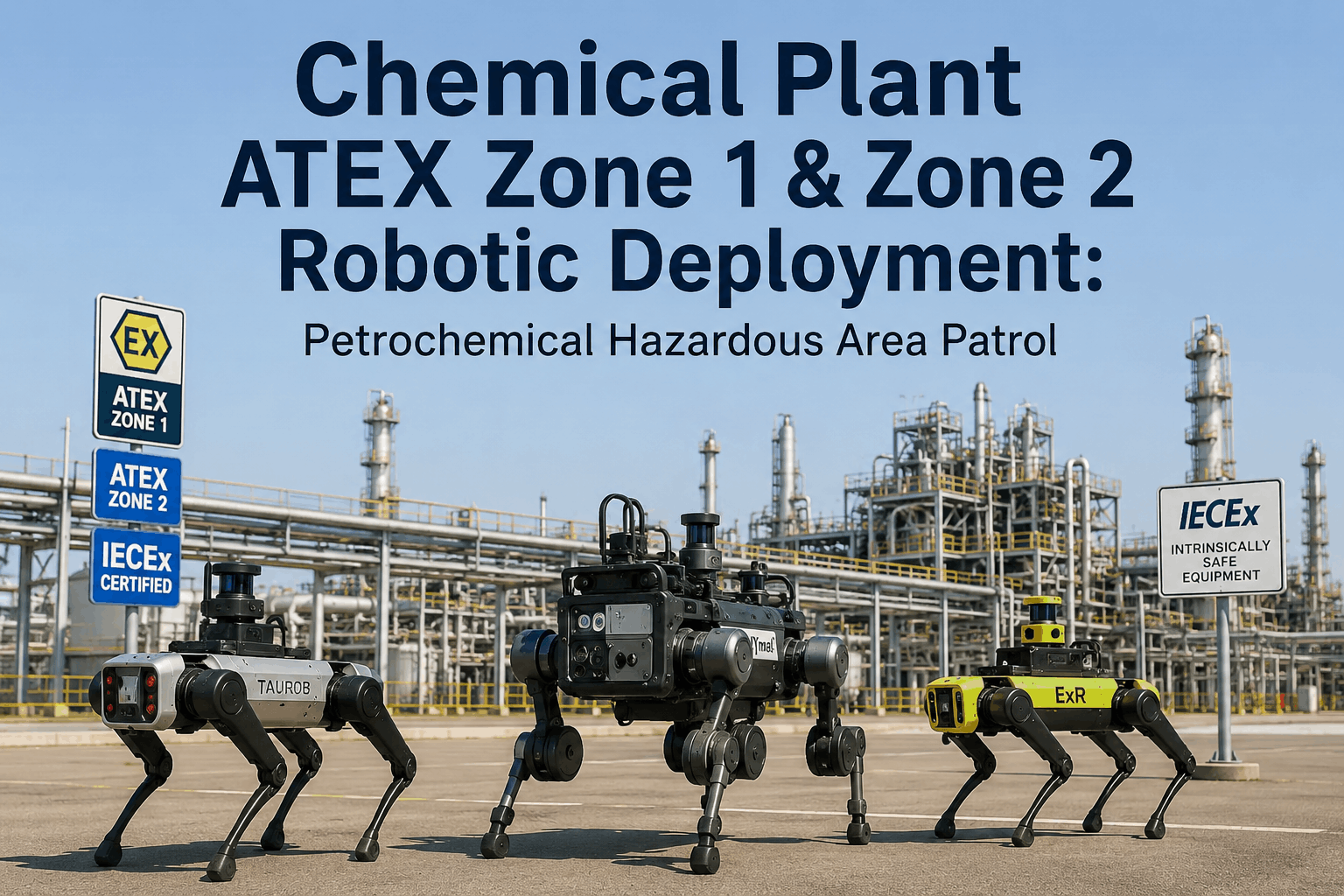
Yes. Compute and sensors must be in ATEX/IECEx Zone 1 certified enclosures for the relevant gas group and temperature class. Inference models have no zone requirement — only the hardware does. iFactory Edge Telemetry operates over intrinsically safe Wi-Fi with store-and-forward buffering for RF-restricted zones.
How long does it take to train plant-specific anomaly detection models?
Baseline collection: 4–8 weeks. Production-grade performance — false positives below 5%, recall above 95% — takes 3–6 months with active feedback on confirmed and dismissed detections. iFactory's Edge Telemetry dashboard tracks maturation explicitly.