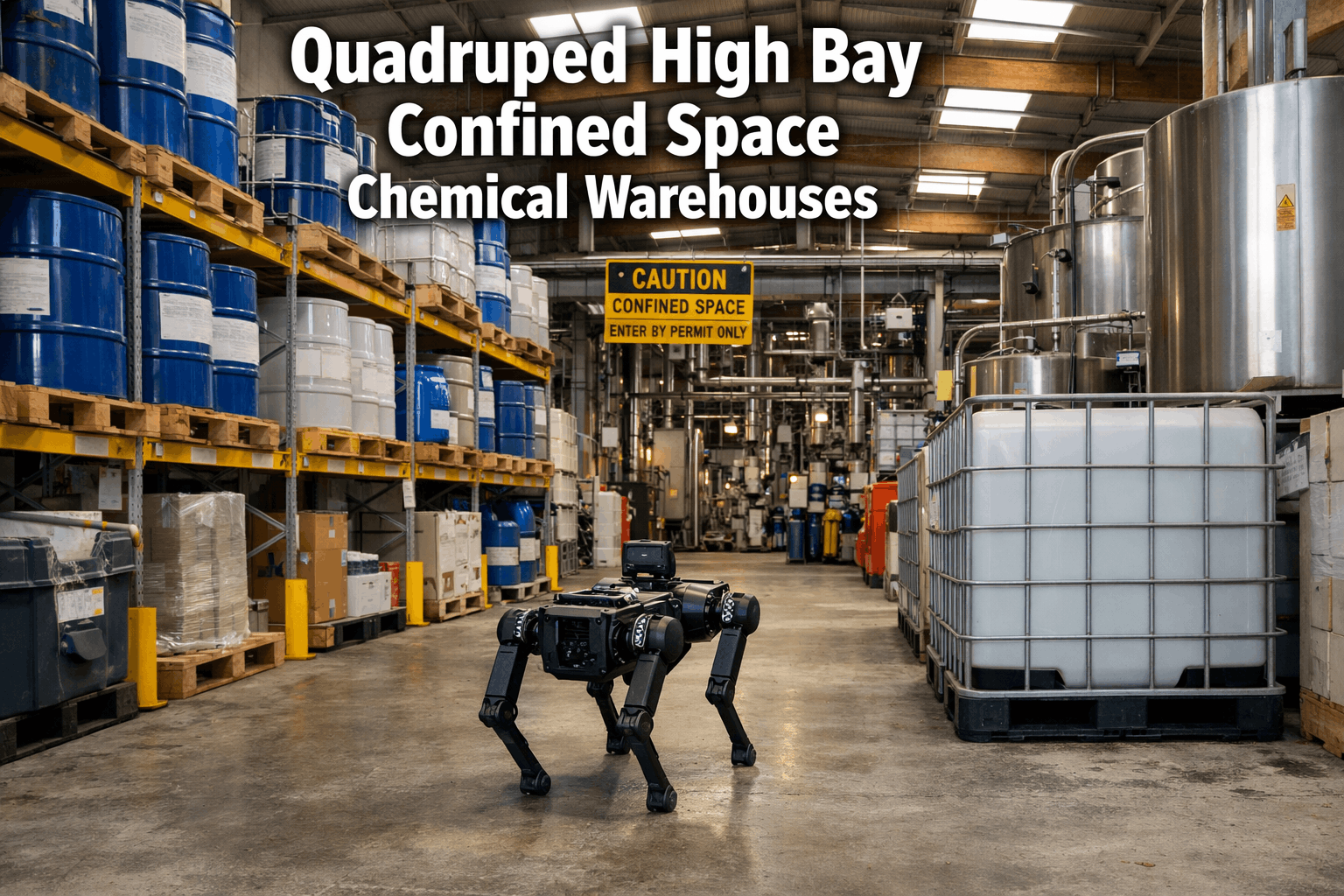
Chemical warehouses spend more time protecting workers from inspections than running them. One confined space entry burns 2–4 hours of permit setup for 20 minutes of work. Full-facility rack inspections take 8–11 days and 6 personnel. Quadruped robots change the equation: the robot enters first, iFactory logs everything, the human arrives only when conditions are confirmed safe. Book a demo to see iFactory's confined space and navigation modules live.
163
Confined space fatalities per year in the US — most caused by atmospheric hazards a robotic pre-entry survey would detect first (OSHA / BLS 2023)
11× faster
High-bay inspection speed: 340,000 sq ft in 8 hours vs. 11 days — with GPS-verified Path Replay at every rack position
$47K
Average cost of a confined space incident in a chemical facility — vs. zero with robotic pre-entry atmospheric survey
Five Bottlenecks That Break Manual Inspection Programs
✕
Sightline gaps at top-level racking
Levels above 20 ft are invisible from the floor. Elevated platform setup: 45–90 min per aisle, two-person crew, aisle lockout — in a live chemical warehouse.
iFactory solution: Quadruped with elevated sensor mast scans every rack level from ground — no elevated access, no aisle lockout. Path Replay records every scan point with timestamp. See how Path Replay documents every rack level — book a demo.
✕
Confined space permit prep consumes 85% of total job time
OSHA 1910.146 requires written permit, atmospheric test, standby attendant, and rescue plan before any human enters — four hours of setup for 20 minutes of inspection.
iFactory solution: Robot performs pre-entry atmospheric survey (O₂, LEL, H₂S, CO). Confined Space Entry Log auto-generated with gas readings and timestamp. Human entry only if conditions confirm safe.
✕
Paper logs show presence, not location-specific coverage
An inspector's initials prove they were in the building — not that Level 7, Row 34 was physically examined. OSHA audits require location-specific evidence.
iFactory solution: Path Replay records GPS-confirmed route with timestamps at every scan point, overlaid on the warehouse floor plan. Exact coverage, every mission, exportable on demand.
✕
Blocked aisles create undocumented coverage gaps
Manual inspectors skip blocked sections without noting it — or navigate unsafely. The compliance record shows full coverage when it did not happen.
iFactory solution: Obstruction Alerts fire the moment the robot's LIDAR detects a blocked route — logging location, camera image, and the affected coverage area so every gap is documented in real time.
✕
No cross-mission trend visibility
Paper forms go in binders. Nobody connects three consecutive H₂S readings in the same sump vault. Chronic hazards stay invisible.
iFactory solution: Every mission feeds a searchable cross-mission database. Recurring atmospheric anomalies and chronic obstruction zones surface automatically — triggering escalated monitoring and corrective work orders.
From 11 Days and 6 Workers to 8 Hours and Zero Elevated Access.
iFactory's Confined Space Entry Logs, Path Replay, and Obstruction Alerts turn every quadruped navigation mission into a GPS-verified, sensor-confirmed compliance record — no paper, no gaps, no reconstruction from memory.
Three iFactory Modules That Do the Work
What Each Module Captures on Every Mission
01
Confined Space Entry Logs
O₂ · LEL · H₂S · CO · Target compound readings
Auto-generated for every space the robot surveys. Records the space ID, pre-entry atmospheric readings at 10 Hz, survey duration, and mission ID as the authorizing record. Human entry flag only clears when all readings confirm safe.
02
Path Replay
GPS-confirmed · 1-second intervals · Floor plan overlay · Rack-level resolution
Records the robot's exact route with position and sensor state logged every second. Exportable as a visual coverage map showing which rack rows, aisle segments, and confined spaces were surveyed — and when. The location-specific record paper programs cannot produce.
03
Obstruction Alerts
LIDAR detection · Camera image · Coverage gap map · Supervisor push notification
Fires the moment the robot detects a blocked route. Supervisor receives location, image, and affected coverage area with three response options: clear and continue, accept gap with documented justification, or reschedule. Every decision logged in the mission record.
Manual vs. Robotic + iFactory
Space Type
Manual Program
Robotic + iFactory
Reduction
High-bay rack inspection (full facility)
8–11 days, 4–6 personnel, elevated access required
6–10 hours autonomous, 1 supervisor remote
90%+
Confined space pre-entry survey
2–4 hours per entry (permit, standby, monitoring setup)
8–15 min per space, no permit trigger, auto-logged
85–95%
Inventory reconciliation scan
3–5 days, handheld scanners on elevated platforms
4–8 hours autonomous, path replay verified
80–90%
Hazmat storage area inspection
1–2 hours, PPE, buddy system, atmospheric checks
20–40 min, gas + thermal + visual, zero human exposure
60–75%
Off-hours perimeter patrol
Not feasible — no staffed overnight program
Fully autonomous, scheduled, obstruction alerts on-call
100% new coverage
Want to see these numbers applied to your facility? Book a 30-minute demo and we'll map the time savings to your current inspection schedule.
Financial Impact
Savings Category
How It Saves
Annual Value
Confined space incident prevention
Robotic pre-entry eliminates atmospheric exposure. Each prevented incident avoids $47K–$340K in combined costs.
$94K–$680K
Inspection labor recovery
11-day cycles become 8-hour missions. Confined space prep reduced 85–95% per entry.
$180K–$420K
OSHA citation avoidance
Path Replay and Entry Logs close documentation gaps. Serious citation: $15,625. Willful: $156,259.
$50K–$300K
Early racking defect detection
Monthly LIDAR geometry scan catches progressive deflection before failure. Racking collapse: $280K–$1.4M.
$140K–$700K
Total annual value
Incident prevention + labor + citations + defect detection + insurance
$464K–$2.1M
Book a demo to get a savings estimate built around your warehouse size and inspection cycle.
30-Day Deployment Roadmap
W1
Facility Mapping and Hazard Zone Classification
Import floor plan, define hazard tiers per aisle and confined space, GPS-tag all permit-required entry points, and create mission templates for each inspection type.
W2
Sensor Calibration and Entry Log Configuration
Calibrate gas sensors to your compound set, configure Entry Log templates, set Obstruction Alert routing, and validate Path Replay fidelity against a manual aisle walk.
W3
Parallel Mission Validation
Run robot alongside existing manual inspection for three missions. Compare coverage, validate atmospheric readings, tune obstruction sensitivity.
W4
Full Autonomous Operation and Compliance Review
First fully autonomous mission across all tier zones. Export inspection report, verify it satisfies OSHA rack and confined space documentation obligations. Program is live. Book a demo to see the W1 setup process for your facility.
The Robot Goes First. The Record Is Automatic. The Compliance Is Defensible.
Replace paper-based inspection programs with GPS-verified, sensor-confirmed, timestamped records that survive OSHA review and support insurance claims — without a single handwritten note. 30 days to full deployment.
Frequently Asked Questions
Does robotic pre-entry satisfy OSHA 1910.146 permit requirements?
Not automatically — only eliminating the recognized hazard reclassifies a permit-required space. However, robotic surveys fulfill the atmospheric testing requirement of 1910.146(d)(5) before authorized entry, and iFactory's Confined Space Entry Log format supports reclassification petitions for spaces that consistently return safe readings.
What happens when the robot can't navigate around an obstruction?
iFactory fires an Obstruction Alert with the blockage location, a camera image, and the affected coverage area. The supervisor chooses: clear and continue, accept the gap with a documented justification, or reschedule the segment. Every decision is logged so compliance documentation reflects actual coverage. Contact support to configure obstruction protocols.
Can the robot scan chemical inventory labels at height?
Yes. Quadrupeds with a 4–6 m elevated mast and zoom camera read GHS labels, barcodes, QR codes, and RFID tags at rack levels up to 40 ft from aisle level. Every scan maps to its GPS-confirmed rack position in the Path Replay record.
How does Path Replay support post-incident investigation?
Path Replay provides a second-by-second sensor record across all historical missions. If a spill or atmospheric event is discovered, the previous mission shows whether readings at that location were already elevated — root cause analysis without memory reconstruction.
What is the ROI timeline?
15–18 recovered person-days per semi-annual cycle = $60K–$120K directly. One prevented incident recovers platform costs entirely. Total annual value $464K–$2.1M vs. platform costs $35K–$80K = 6:1 to 27:1 return in year one.
.png)