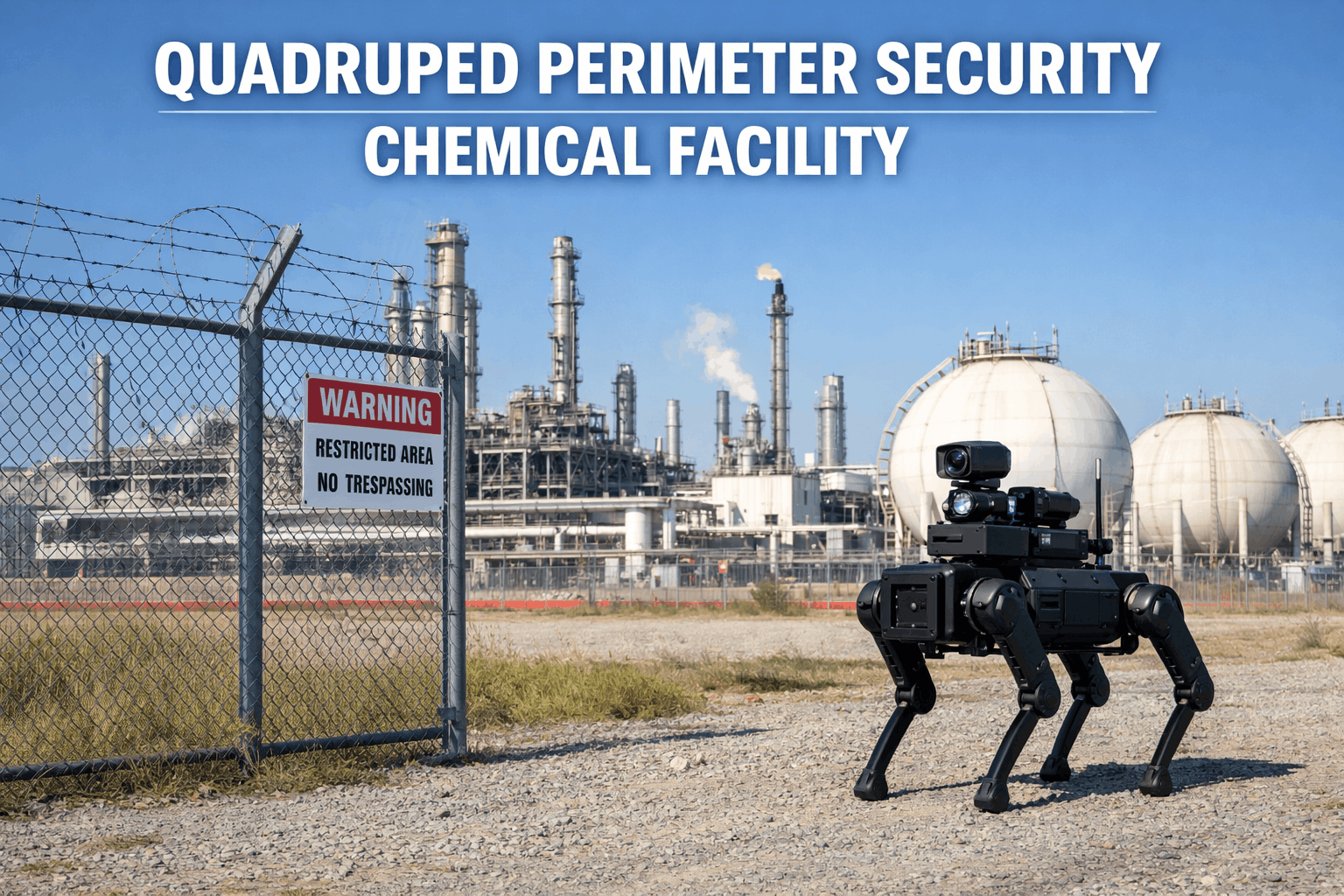
Chemical facilities present one of the most challenging perimeter security environments in any industry — miles of fencing surrounding hazardous process areas, tank farms, loading racks, and utility corridors that must be monitored 24 hours a day across terrain that ranges from paved roads to unpaved berms, drainage channels, and remote fence lines that fixed cameras cannot cover without blind spots. Traditional security programs rely on guard patrols driving or walking predetermined routes at predictable intervals — intervals that anyone observing the facility for a few days can time. Fixed CCTV systems cover high-priority zones but leave secondary perimeter sections monitored only by fence-mounted intrusion detection sensors that generate false alarms from wildlife, weather, and vegetation at rates that erode operator confidence and response urgency. Autonomous quadruped robots change the security equation by executing unpredictable patrol patterns across terrain that vehicles cannot traverse, streaming live camera feeds with onboard analytics that distinguish humans from animals and vehicles from environmental motion, and correlating every detection event with the facility's access control and alarm systems in real time. Book a free demo to see how iFactory's perimeter alarm integration, patrol logging, and access event correlation transform chemical facility security from scheduled guard rounds into continuous, AI-enhanced perimeter surveillance.
The Difference Between Scheduled Guard Rounds and Continuous Autonomous Patrol
A guard patrol is a predictable event — it follows the same route, at approximately the same time, covering the same ground in the same sequence. Anyone observing the facility for 48 hours can map the patrol pattern, identify the coverage gaps between rounds, and know exactly how long each perimeter section is unobserved. Fixed cameras compensate for some gaps but create their own vulnerabilities: limited fields of view, degraded performance in fog, rain, and low light, and a reliance on control room operators to monitor dozens of feeds simultaneously — a task where human attention drops measurably after 20 minutes of screen watching. Autonomous quadruped patrols eliminate both problems — randomized routes that never repeat the same pattern, onboard AI analytics that classify threats without relying on a human operator watching a screen, and terrain capability that reaches fence lines and perimeter zones inaccessible to patrol vehicles. Book a demo to see iFactory's randomized patrol scheduling and alarm correlation dashboard.
Six Autonomous Patrol Capabilities That Transform Chemical Facility Perimeter Security
Each capability below covers the technology, what it detects, how it integrates with iFactory's security event management platform, and when it activates during patrol operations. These capabilities operate simultaneously on a single quadruped platform — the robot does not switch between modes but runs all sensors continuously throughout every patrol cycle.
Predictability is the single greatest vulnerability in any physical security patrol program. iFactory's patrol route generator divides the facility perimeter into configurable patrol zones, assigns priority weights based on risk assessment (higher-value zones get more frequent visits), and generates a unique route for every patrol cycle that satisfies two constraints: every zone is visited within its maximum allowed interval, and no route sequence repeats within a rolling 30-day window. The robot executes variable-speed transits between zones with randomized dwell times at each checkpoint — making it impossible for an external observer to predict when the robot will be at any specific location.
The quadruped's onboard analytics engine fuses data from three sensor streams simultaneously — RGB cameras for daylight identification, thermal cameras for low-light and obscured-visibility detection, and LiDAR for range measurement and object geometry classification. The edge-computing AI model classifies detected objects into four categories in real time: human, vehicle, animal, or environmental (vegetation movement, debris, precipitation). Only human and vehicle detections in exclusion zones generate security alerts — reducing the false alarm rate by 75% compared to fence-mounted motion sensors that cannot distinguish a person from a coyote or a windblown tarp. Every detection event is logged in iFactory with the classification, confidence score, GPS coordinates, timestamp, and a video clip of the detection context.
When a perimeter fence sensor triggers an alarm, iFactory receives the alarm signal and immediately calculates the nearest patrol robot's position relative to the alarm zone. If a robot is within redirect range, it autonomously diverts from its current patrol route and navigates to the alarm location — arriving with ground-level camera views that fixed elevated CCTV cannot provide. The robot's visual analytics confirm or clear the alarm within minutes, and iFactory logs the correlation: fence alarm triggered at a specific time, robot arrived at a specific time, visual classification determined the cause. This correlation record transforms raw alarm data into actionable intelligence — revealing which fence zones generate chronic false alarms, which alarm types have the highest true-positive rates, and where sensor maintenance or recalibration is needed. Book a demo to see alarm-to-robot correlation in iFactory's security dashboard.
Access event correlation is the capability that connects physical security observation to digital access control records in real time. When the quadruped's analytics engine detects a human presence in a perimeter zone, iFactory cross-references that detection against the facility's access control system — checking whether any badge-in event, gate log entry, or visitor registration corresponds to a person authorized to be in that zone at that time. If no matching access event exists, iFactory escalates the detection from a routine patrol observation to an unauthorized presence alert — dispatching a security response with the robot's live video feed, GPS coordinates, and the access correlation analysis already attached. This eliminates the traditional process where a guard discovers a person, radios the control room, the control room checks badge records manually, and minutes pass before anyone determines whether the person belongs there. Contact support for access control integration configuration.
Every autonomous patrol generates a complete, objective patrol log in iFactory — the exact GPS path the robot traveled, the timestamp at each zone entry and exit, the dwell time at every checkpoint, every detection event with classification and confidence score, every alarm correlation, and the complete video record of the entire patrol. This log is generated automatically as a byproduct of normal patrol operation — no guard filling out a paper log, no supervisor verifying that checkpoints were actually visited, no question about whether the patrol route was completed as assigned. For chemical facilities subject to CFATS (Chemical Facility Anti-Terrorism Standards), MTSA, or PSM security requirements, the patrol log serves as auditable evidence that perimeter security patrols were conducted at the documented frequency, covering the documented zones, with the documented detection capabilities operational throughout.
The most critical perimeter security hours — nighttime, fog, heavy rain, extreme cold — are exactly when human guard patrol effectiveness drops the most and when intruders are most likely to attempt access. Quadruped robots maintain full patrol capability in complete darkness using thermal imaging and near-infrared illumination that is invisible to the human eye. The thermal camera detects human body heat signatures regardless of ambient lighting conditions, while LiDAR provides range and object geometry data unaffected by fog, rain, or smoke. The robot's IP67-rated chassis operates continuously through rain, dust storms, snow, and coastal salt spray environments common at Gulf Coast, Northeast, and industrial corridor chemical facilities. iFactory logs environmental conditions during each patrol — temperature, precipitation, visibility — enabling security managers to verify that patrol coverage did not degrade during the exact conditions when coverage matters most. Book a demo to see night and adverse weather patrol capabilities.
iFactory integrates autonomous quadruped patrol telemetry with perimeter alarm systems, access control records, and AI visual analytics — giving security teams continuous, auditable perimeter coverage without false alarm fatigue. Contact support to discuss your facility's security integration requirements.
How to Configure Quadruped Patrol Coverage — Based on Your Facility Layout
Not every chemical facility has the same perimeter security profile. Use this matrix to identify the primary patrol configuration, robot count, and integration priorities for your facility type — then configure iFactory's patrol scheduler and alarm correlation engine to match.
Our perimeter fence alarm system was generating 180 to 220 alarms per month. Our security team was dispatching guards to every single one because we had no way to verify remotely from ground level — our nearest PTZ camera was 400 meters from the south fence line. After deploying two quadruped patrol robots with iFactory's alarm correlation, the robots verified 85% of those alarms within 3 minutes of the trigger. Of the 200-odd monthly alarms, exactly 11 were confirmed human detections over a six-month period — the rest were deer, feral hogs, windblown debris, and one recurring section of loose fence fabric that we finally repaired after the robot's patrol log showed it triggering the same sensor zone 30 times in one month. Our guard force went from chasing alarms to managing genuine security events. The CFATS auditor told us our patrol documentation was the most complete they had seen at any Tier 2 facility.
Quadruped Perimeter Security — FAQs
How many quadruped robots are needed to cover a typical chemical facility perimeter?
Can the quadruped robots operate in classified hazardous areas within the facility perimeter?
How does iFactory's alarm correlation reduce false alarm response dispatches?
Does autonomous patrol logging satisfy CFATS and MTSA security documentation requirements?
Stop Chasing False Alarms. Start Running Autonomous Patrols That See, Classify, and Document Everything.
iFactory integrates autonomous quadruped patrol scheduling, onboard AI visual analytics, perimeter alarm correlation, and access event cross-referencing into a single security management platform — with 100% objective patrol logging that satisfies CFATS, MTSA, and PSM audit requirements out of the box.