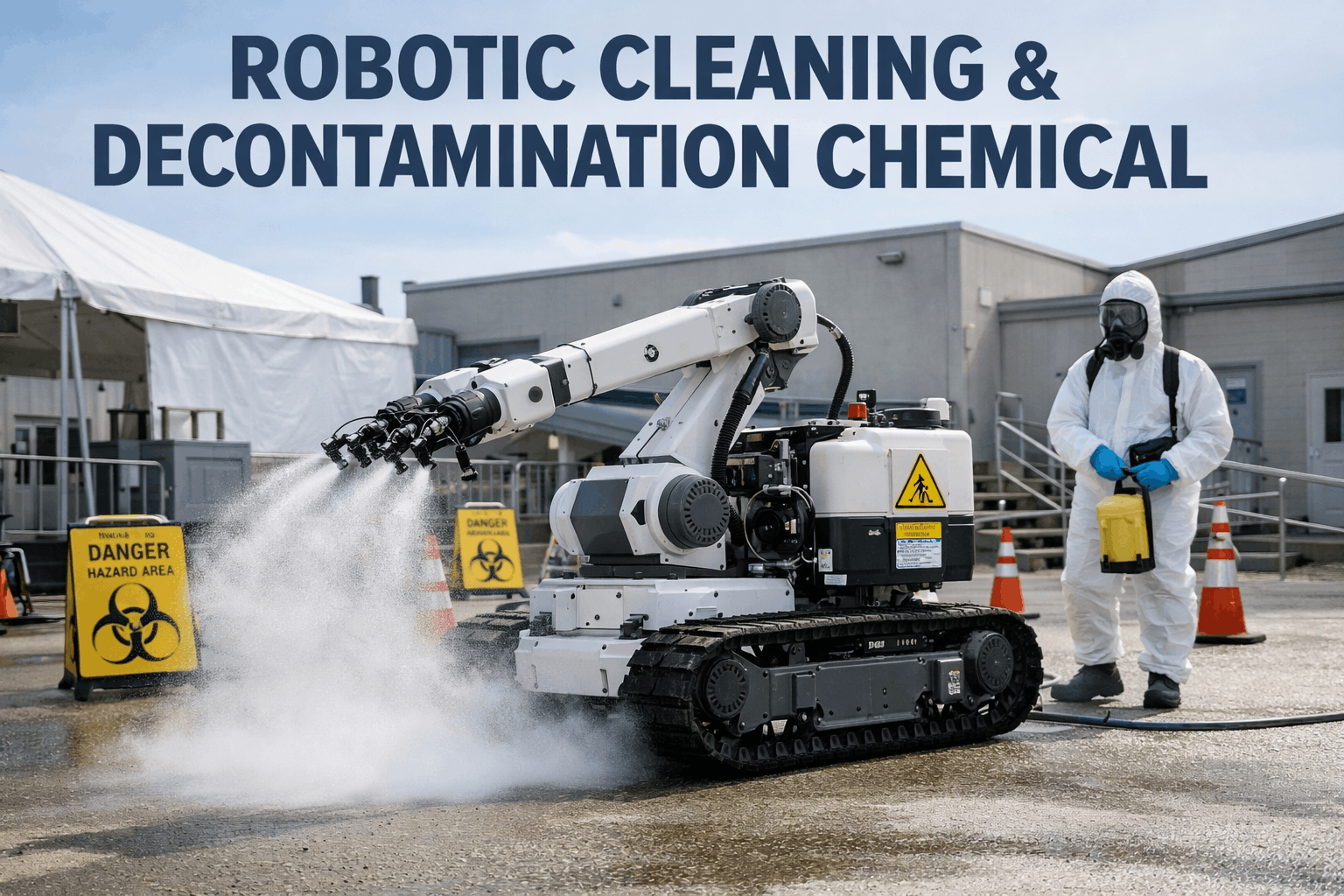
Robotic Cleaning & Decontamination for Chemical Processing Areas
By Jennie on March 7, 2026
Residue left in a reactor after a campaign change is not an aesthetic problem — it is a regulatory event. Manual cleaning programs expose workers to the hazardous substances your process is engineered to contain, and produce paper validation records that break under OSHA PSM, EPA PFAS, and FDA 21 CFR Part 11 scrutiny. Robotic decontamination changes the equation: the robot enters the contaminated zone, executes the validated clean cycle, and generates a digital record — before a human approaches the surface. iFactory connects those records to Chemical Usage Logs, Clean Cycle Scheduling, and Validation Records modules. Book a demo to see iFactory's decontamination compliance modules live.
Robotic Decontamination in Chemical Processing: 2026 Compliance Snapshot
Manual Cleaning Programs
82%
of Plants — Reactive Culture
Paper validation, chemical exposure, audit gaps
VS
Robotic Cleaning + iFactory
40%
Downtime Reduction
100% validated cycles, zero unlogged chemical usage
— Chemical Processing Industry Report 2024; iFactory Platform Outcomes; OSHA PSM Enforcement Data 2025; ACC Chemical Safety Report
Two Robotic Decontamination Architectures for Chemical Processing
Chemical facilities deploy two robotic cleaning configurations. Both eliminate direct human chemical exposure — they differ in surface reach, infrastructure interaction, and the iFactory validation data each generates.
Fixed
Automated CIP / Spray-Ball Systems
1
iFactory Clean Cycle Scheduling triggers CIP sequence based on batch completion or elapsed time
2
Pre-rinse, caustic wash, acid rinse, and final rinse phases execute per validated SOP parameters
3
Chemical volume, concentration, temperature, flow rate, and contact time logged in real time by iFactory
4
Validation Record auto-generated — pass/fail determination against acceptance criteria, stored against equipment asset
Best For:Reactors, vessels, heat exchangers, closed piping systems
Zone Support:ATEX Zone 1 & 2 rated components, intrinsically safe instrumentation
iFactory Link:Clean Cycle Scheduling + Chemical Usage Logs + Validation Records
Mobile
Quadruped Robotic Decontamination Units
1
iFactory work order dispatches quadruped to the decontamination zone — no human pre-entry required
2
Onboard chemical applicator delivers decontaminant to surfaces — internal equipment, spill zones, or structural surfaces
3
Onboard sensors confirm surface coverage, residue detection, and chemical concentration in real time
4
GPS-confirmed coverage map, chemical usage totals, and validation outcome logged to iFactory before zone clearance
Best For:Spill decontamination, open process areas, confined space pre-entry decon
Zone Support:ATEX/IECEx Zone 1 certified configurations available
iFactory Link:Chemical Usage Logs + Validation Records + Corrective Work Orders
The Validation Gap: Why Manual Cleaning Records Fail Regulatory Scrutiny
Under OSHA PSM, EPA PFAS, and FDA standards, a cleaning event not documented to specification legally did not happen. Paper logs, post-hoc volume estimates, and after-the-fact sign-offs satisfy none of these requirements.
Cleaning Validation Documentation Quality — Manual vs. Robotic + iFactory
Robotic Cleaning — iFactory Validation Record Score
100% Validated — Real-Time, Traceable
Hybrid (Automated CIP + Manual Log Entry)
~55% Defensible
Traditional Manual Cleaning Program
~18% Auditable
$20BAnnual US chemical industry downtime — cleaning failures among leading triggers of unplanned shutdowns
May 2026GHS Rev. 7 deadline — updated SDS reclassifies cleaning chemical hazard categories and PPE obligations
82%of plants operate reactively — cleaning validation gaps expose them to OSHA PSM citation and EPA enforcement
How iFactory Turns Every Clean Cycle into Compliance Infrastructure
Raw clean cycle data is only valuable if it's captured, linked, and preserved. iFactory's modules convert each cleaning event into structured, audit-ready compliance records.
Chemical Usage Logs
Every cleaning agent dispensed is logged in real time: CAS number, GHS SDS reference, volume, concentration, application method, asset ID, and timestamp. Usage totals accumulate automatically against inventory — providing the substance-level trail EPA PFAS Section 8(a)(7) requires.
100% chemical traceability — every decontaminant dispensed logged against asset, batch, and regulatory reference
Clean Cycle Scheduling
Manages campaign-end cycles, time-triggered cleans, pre-maintenance decontamination workflows, and regulatory-mandated frequencies. Missed cycles trigger automatic escalation alerts. Adherence rates are tracked and reportable for PSM PHA documentation and GMP batch records.
Zero missed mandatory cleaning cycles — automated escalation closes every scheduling gap before the next campaign starts
Validation Records
Captures all measured parameters against acceptance criteria — temperature, contact time, flow rate, concentration, residue readings — and produces a timestamped pass/fail determination stored immutably against the equipment asset. Exports in 21 CFR Part 11 and EU GMP Annex 11 compliant formats.
Audit-ready validation documentation generated automatically — no manual sign-off delays, no reconstructed records
AI Predictive Cleaning Alerts
Analyzes fouling indicators, differential pressure trends, and heat transfer efficiency drift to predict cleaning need before scheduled intervals. 30-day early warning with 95% accuracy — preventing cleaning-driven failures and eliminating emergency decontamination events.
95% predictive accuracy — cleaning triggered by fouling data, not fixed calendars, reducing both over-cleaning and emergency shutdowns
Connect Your Robotic Cleaning Systems to Chemical Usage Logs, Scheduling & Validation in One Platform
iFactory integrates CIP systems and mobile robotic decontamination units with Chemical Usage Logs, Clean Cycle Scheduling, Validation Records, and AI predictive alerts — delivering end-to-end cleaning compliance documentation for chemical processors across the US and Canada.
The Cleaning Program Intelligence Gap: Manual vs. Robotic + iFactory
The gap is not cleaning effectiveness — most manual programs clean adequately. The gap is evidence. Without a digital record of what was cleaned, with what chemical, and to what standard, the event cannot be defended in a regulatory review.
Scroll to compare
Capability
Manual Cleaning Program
Robotic + iFactory Integration
Worker Chemical Exposure
Direct contact with decontaminants and residual process chemicals — every cleaning event
Robot enters first — zero human exposure to reactive or hazardous cleaning environments
Chemical Usage Documentation
Volume estimated post-event, transcribed to paper — unverifiable under EPA review
Real-time dispensing log per CAS number — automatic inventory reconciliation
Cycle Parameter Capture
Temperature, contact time, concentration noted manually — often after the fact
Continuous sensor capture against validated acceptance criteria — contemporaneous record
Validation Outcome
Supervisor sign-off — no independent verification of cycle completion
Automated pass/fail determination — immutable digital Validation Record stored against asset
Schedule Compliance
Missed cycles undocumented — no automated escalation
Automated escalation on missed or failed cycles — zero gaps in the cleaning record
Audit Readiness
~18% auditable — days to reconstruct, frequently incomplete
100% traceable — on-demand export for OSHA, EPA, and GMP review
"A manual cleaning log signed by a supervisor who was not present is not validation documentation — it is an attestation that cleaning occurred, which is a fundamentally weaker standard. Enforcement actions against facilities with contamination incidents consistently cite documentation failures as an aggravating factor independent of the cleaning outcome itself. iFactory's Chemical Usage Logs give facilities the substance-level traceability that EPA PFAS enforcement is already demanding."
— Process Safety Management Specialist, Chemical Industry Advisory Council; OSHA PSM Enforcement Trends Analysis 2025; EPA PFAS Enforcement Action Review
The ROI of Robotic Decontamination Integration
100%
Validation Record Completeness
Every clean cycle produces a timestamped, parameter-verified Validation Record stored against the equipment asset — no manual sign-offs, no reconstruction from memory
40%
Downtime Reduction
AI-predicted fouling alerts trigger cleaning before process degradation — preventing the unplanned shutdowns that cost the industry $20B annually
95%
Predictive Alert Accuracy
30-day early warning identifies fouling progression — converting reactive emergency decontamination events into planned, validated clean cycles
Zero
Unlogged Chemical Events
Every decontaminant dispensed tracked in real time against CAS number, SDS version, volume, and asset — full EPA and OSHA traceability from first dispense to waste disposal
2026 Is the Year Cleaning Records Become a Competitive Advantage
Chemical manufacturers with robotic decontamination programs and digital Validation Records will move through OSHA, EPA, and GHS Rev. 7 audits in hours. Those still on paper logs will spend weeks reconstructing records. iFactory makes the transition defensible from day one.
What constitutes a validated cleaning cycle under OSHA PSM and FDA standards?
OSHA PSM 1910.119 requires documentation that the procedure was executed correctly — not just that cleaning occurred. FDA 21 CFR Part 211.67 and ICH Q7 require documented evidence that residues are consistently reduced to acceptance limits. iFactory's Validation Records module captures all parameters — concentration, contact time, temperature, rinse volumes, residue results — against validated acceptance criteria, producing a contemporaneous electronic record that satisfies both standards. Book a demo to see how Validation Records are structured for your regulatory context.
How does the May 2026 GHS Revision 7 update affect cleaning chemical SDS and PPE requirements?
GHS Rev. 7 revises thresholds for skin corrosion, eye damage, and respiratory sensitization — categories common in industrial cleaning. Cleaning agents may be reclassified to higher hazard categories, triggering updated SDS by the May 19, 2026 OSHA deadline and potentially new PPE specifications. iFactory's Chemical Usage Logs store SDS version references against each usage event, letting facilities identify which cleaning events used pre-revision SDS and flag documentation updates needed before the deadline.
Can robotic decontamination systems operate safely in ATEX Zone 1 classified areas?
Yes, with certified equipment. Both fixed CIP and mobile quadruped units are available in ATEX/IECEx Zone 1 configurations. If the cleaning chemical is flammable, the dispensing system must be rated for the substance's gas group and temperature class. iFactory's Chemical Usage Logs capture chemical identity, concentration, and application zone for every event — documenting that each chemical was applied within the equipment's zone certification boundaries.
How does iFactory's Clean Cycle Scheduling integrate with existing CMMS and ERP systems?
iFactory connects to SAP PM, IBM Maximo, Infor EAM, and others via REST API and OPC-UA. Cleaning work orders flow to the CMMS; completion data and Validation Records flow back to iFactory. ERP integration feeds chemical usage data directly into inventory and procurement — eliminating manual reconciliation after each campaign. Typical setup from API configuration to live scheduling: 2–3 weeks.
What is the ROI timeline for a robotic decontamination program with iFactory integration?
Labor recovery from eliminating manual cleaning in hazardous zones is measurable from cycle one: $80K–$200K annually for facilities running 3–5 campaigns per week. One prevented contamination-driven shutdown recovers $500K–$2M. OSHA citation avoidance (serious: $15,625; willful: $156,259) adds further return. Total program ROI: 5:1 to 18:1 in year one, improving as AI alerts reduce emergency decontamination frequency.
Residue left in a reactor after a campaign change is not an aesthetic problem — it is a regulatory event. Manual cleaning programs expose workers to the hazardous substances your process is engineered to contain, and produce paper validation records that break under OSHA PSM, EPA PFAS, and FDA 21 CFR Part 11 scrutiny. Robotic decontamination changes the equation: the robot enters the contaminated zone, executes the validated clean cycle, and generates a digital record — before a human approaches the surface. iFactory connects those records to Chemical Usage Logs, Clean Cycle Scheduling, and Validation Records modules. Book a demo to see iFactory's decontamination compliance modules live.
Robotic Decontamination in Chemical Processing: 2026 Compliance Snapshot
Manual Cleaning Programs
82%
of Plants — Reactive Culture
Paper validation, chemical exposure, audit gaps
VS
Robotic Cleaning + iFactory
40%
Downtime Reduction
100% validated cycles, zero unlogged chemical usage
— Chemical Processing Industry Report 2024; iFactory Platform Outcomes; OSHA PSM Enforcement Data 2025; ACC Chemical Safety Report
Two Robotic Decontamination Architectures for Chemical Processing
Chemical facilities deploy two robotic cleaning configurations. Both eliminate direct human chemical exposure — they differ in surface reach, infrastructure interaction, and the iFactory validation data each generates.
Fixed
Automated CIP / Spray-Ball Systems
1
iFactory Clean Cycle Scheduling triggers CIP sequence based on batch completion or elapsed time
2
Pre-rinse, caustic wash, acid rinse, and final rinse phases execute per validated SOP parameters
3
Chemical volume, concentration, temperature, flow rate, and contact time logged in real time by iFactory
4
Validation Record auto-generated — pass/fail determination against acceptance criteria, stored against equipment asset
Best For:Reactors, vessels, heat exchangers, closed piping systems
Zone Support:ATEX Zone 1 & 2 rated components, intrinsically safe instrumentation
iFactory Link:Clean Cycle Scheduling + Chemical Usage Logs + Validation Records
Mobile
Quadruped Robotic Decontamination Units
1
iFactory work order dispatches quadruped to the decontamination zone — no human pre-entry required
2
Onboard chemical applicator delivers decontaminant to surfaces — internal equipment, spill zones, or structural surfaces
3
Onboard sensors confirm surface coverage, residue detection, and chemical concentration in real time
4
GPS-confirmed coverage map, chemical usage totals, and validation outcome logged to iFactory before zone clearance
Best For:Spill decontamination, open process areas, confined space pre-entry decon
Zone Support:ATEX/IECEx Zone 1 certified configurations available
iFactory Link:Chemical Usage Logs + Validation Records + Corrective Work Orders
The Validation Gap: Why Manual Cleaning Records Fail Regulatory Scrutiny
Under OSHA PSM, EPA PFAS, and FDA standards, a cleaning event not documented to specification legally did not happen. Paper logs, post-hoc volume estimates, and after-the-fact sign-offs satisfy none of these requirements.
Cleaning Validation Documentation Quality — Manual vs. Robotic + iFactory
Robotic Cleaning — iFactory Validation Record Score
100% Validated — Real-Time, Traceable
Hybrid (Automated CIP + Manual Log Entry)
~55% Defensible
Traditional Manual Cleaning Program
~18% Auditable
$20BAnnual US chemical industry downtime — cleaning failures among leading triggers of unplanned shutdowns
May 2026GHS Rev. 7 deadline — updated SDS reclassifies cleaning chemical hazard categories and PPE obligations
82%of plants operate reactively — cleaning validation gaps expose them to OSHA PSM citation and EPA enforcement
How iFactory Turns Every Clean Cycle into Compliance Infrastructure
Raw clean cycle data is only valuable if it's captured, linked, and preserved. iFactory's modules convert each cleaning event into structured, audit-ready compliance records.
Chemical Usage Logs
Every cleaning agent dispensed is logged in real time: CAS number, GHS SDS reference, volume, concentration, application method, asset ID, and timestamp. Usage totals accumulate automatically against inventory — providing the substance-level trail EPA PFAS Section 8(a)(7) requires.
100% chemical traceability — every decontaminant dispensed logged against asset, batch, and regulatory reference
Clean Cycle Scheduling
Manages campaign-end cycles, time-triggered cleans, pre-maintenance decontamination workflows, and regulatory-mandated frequencies. Missed cycles trigger automatic escalation alerts. Adherence rates are tracked and reportable for PSM PHA documentation and GMP batch records.
Zero missed mandatory cleaning cycles — automated escalation closes every scheduling gap before the next campaign starts
Validation Records
Captures all measured parameters against acceptance criteria — temperature, contact time, flow rate, concentration, residue readings — and produces a timestamped pass/fail determination stored immutably against the equipment asset. Exports in 21 CFR Part 11 and EU GMP Annex 11 compliant formats.
Audit-ready validation documentation generated automatically — no manual sign-off delays, no reconstructed records
AI Predictive Cleaning Alerts
Analyzes fouling indicators, differential pressure trends, and heat transfer efficiency drift to predict cleaning need before scheduled intervals. 30-day early warning with 95% accuracy — preventing cleaning-driven failures and eliminating emergency decontamination events.
95% predictive accuracy — cleaning triggered by fouling data, not fixed calendars, reducing both over-cleaning and emergency shutdowns
Connect Your Robotic Cleaning Systems to Chemical Usage Logs, Scheduling & Validation in One Platform
iFactory integrates CIP systems and mobile robotic decontamination units with Chemical Usage Logs, Clean Cycle Scheduling, Validation Records, and AI predictive alerts — delivering end-to-end cleaning compliance documentation for chemical processors across the US and Canada.
The Cleaning Program Intelligence Gap: Manual vs. Robotic + iFactory
The gap is not cleaning effectiveness — most manual programs clean adequately. The gap is evidence. Without a digital record of what was cleaned, with what chemical, and to what standard, the event cannot be defended in a regulatory review.
Scroll to compare
Capability
Manual Cleaning Program
Robotic + iFactory Integration
Worker Chemical Exposure
Direct contact with decontaminants and residual process chemicals — every cleaning event
Robot enters first — zero human exposure to reactive or hazardous cleaning environments
Chemical Usage Documentation
Volume estimated post-event, transcribed to paper — unverifiable under EPA review
Real-time dispensing log per CAS number — automatic inventory reconciliation
Cycle Parameter Capture
Temperature, contact time, concentration noted manually — often after the fact
Continuous sensor capture against validated acceptance criteria — contemporaneous record
Validation Outcome
Supervisor sign-off — no independent verification of cycle completion
Automated pass/fail determination — immutable digital Validation Record stored against asset
Schedule Compliance
Missed cycles undocumented — no automated escalation
Automated escalation on missed or failed cycles — zero gaps in the cleaning record
Audit Readiness
~18% auditable — days to reconstruct, frequently incomplete
100% traceable — on-demand export for OSHA, EPA, and GMP review
"A manual cleaning log signed by a supervisor who was not present is not validation documentation — it is an attestation that cleaning occurred, which is a fundamentally weaker standard. Enforcement actions against facilities with contamination incidents consistently cite documentation failures as an aggravating factor independent of the cleaning outcome itself. iFactory's Chemical Usage Logs give facilities the substance-level traceability that EPA PFAS enforcement is already demanding."
— Process Safety Management Specialist, Chemical Industry Advisory Council; OSHA PSM Enforcement Trends Analysis 2025; EPA PFAS Enforcement Action Review
The ROI of Robotic Decontamination Integration
100%
Validation Record Completeness
Every clean cycle produces a timestamped, parameter-verified Validation Record stored against the equipment asset — no manual sign-offs, no reconstruction from memory
40%
Downtime Reduction
AI-predicted fouling alerts trigger cleaning before process degradation — preventing the unplanned shutdowns that cost the industry $20B annually
95%
Predictive Alert Accuracy
30-day early warning identifies fouling progression — converting reactive emergency decontamination events into planned, validated clean cycles
Zero
Unlogged Chemical Events
Every decontaminant dispensed tracked in real time against CAS number, SDS version, volume, and asset — full EPA and OSHA traceability from first dispense to waste disposal
2026 Is the Year Cleaning Records Become a Competitive Advantage
Chemical manufacturers with robotic decontamination programs and digital Validation Records will move through OSHA, EPA, and GHS Rev. 7 audits in hours. Those still on paper logs will spend weeks reconstructing records. iFactory makes the transition defensible from day one.
What constitutes a validated cleaning cycle under OSHA PSM and FDA standards?
OSHA PSM 1910.119 requires documentation that the procedure was executed correctly — not just that cleaning occurred. FDA 21 CFR Part 211.67 and ICH Q7 require documented evidence that residues are consistently reduced to acceptance limits. iFactory's Validation Records module captures all parameters — concentration, contact time, temperature, rinse volumes, residue results — against validated acceptance criteria, producing a contemporaneous electronic record that satisfies both standards. Book a demo to see how Validation Records are structured for your regulatory context.
How does the May 2026 GHS Revision 7 update affect cleaning chemical SDS and PPE requirements?
GHS Rev. 7 revises thresholds for skin corrosion, eye damage, and respiratory sensitization — categories common in industrial cleaning. Cleaning agents may be reclassified to higher hazard categories, triggering updated SDS by the May 19, 2026 OSHA deadline and potentially new PPE specifications. iFactory's Chemical Usage Logs store SDS version references against each usage event, letting facilities identify which cleaning events used pre-revision SDS and flag documentation updates needed before the deadline.
Can robotic decontamination systems operate safely in ATEX Zone 1 classified areas?
Yes, with certified equipment. Both fixed CIP and mobile quadruped units are available in ATEX/IECEx Zone 1 configurations. If the cleaning chemical is flammable, the dispensing system must be rated for the substance's gas group and temperature class. iFactory's Chemical Usage Logs capture chemical identity, concentration, and application zone for every event — documenting that each chemical was applied within the equipment's zone certification boundaries.
How does iFactory's Clean Cycle Scheduling integrate with existing CMMS and ERP systems?
iFactory connects to SAP PM, IBM Maximo, Infor EAM, and others via REST API and OPC-UA. Cleaning work orders flow to the CMMS; completion data and Validation Records flow back to iFactory. ERP integration feeds chemical usage data directly into inventory and procurement — eliminating manual reconciliation after each campaign. Typical setup from API configuration to live scheduling: 2–3 weeks.
What is the ROI timeline for a robotic decontamination program with iFactory integration?
Labor recovery from eliminating manual cleaning in hazardous zones is measurable from cycle one: $80K–$200K annually for facilities running 3–5 campaigns per week. One prevented contamination-driven shutdown recovers $500K–$2M. OSHA citation avoidance (serious: $15,625; willful: $156,259) adds further return. Total program ROI: 5:1 to 18:1 in year one, improving as AI alerts reduce emergency decontamination frequency.