A commercial building's HVAC infrastructure typically consumes up to 50% of the facility's total energy, with the Air Handling Unit (AHU) serving as the absolute heart of the system. Air handling units directly impact indoor air quality and energy consumption. A single compromised AHU doesn't just waste power; it circulates poor air, strains downstream variable air volume (VAV) boxes, and creates uncomfortable environments that lead to tenant complaints and productivity losses. Comprehensive AHU maintenance management covers filters, coils, dampers, fans, and VFDs for optimal building performance. Yet, many facilities still rely on reactive, calendar-based maintenance that fails to account for actual equipment condition. Filters are changed too late, causing static pressure drops; coils foul silently, destroying heat transfer efficiency; and failing fan bearings are ignored until they seize.
In 2026, modern commercial AHU maintenance requires a predictive, data-driven approach. By integrating IoT sensors, differential pressure monitors, and an intelligent AHU CMMS, facility managers can shift from reactive repairs to continuous AHU performance optimization. iFactory's AI-powered platform orchestrates a complete air handler maintenance program—analyzing real-time data to dictate the perfect AHU inspection schedule, trigger timely AHU coil cleaning, and ensure flawless AHU fan maintenance. Book a free AHU performance assessment to quantify your energy savings and indoor air quality improvements.
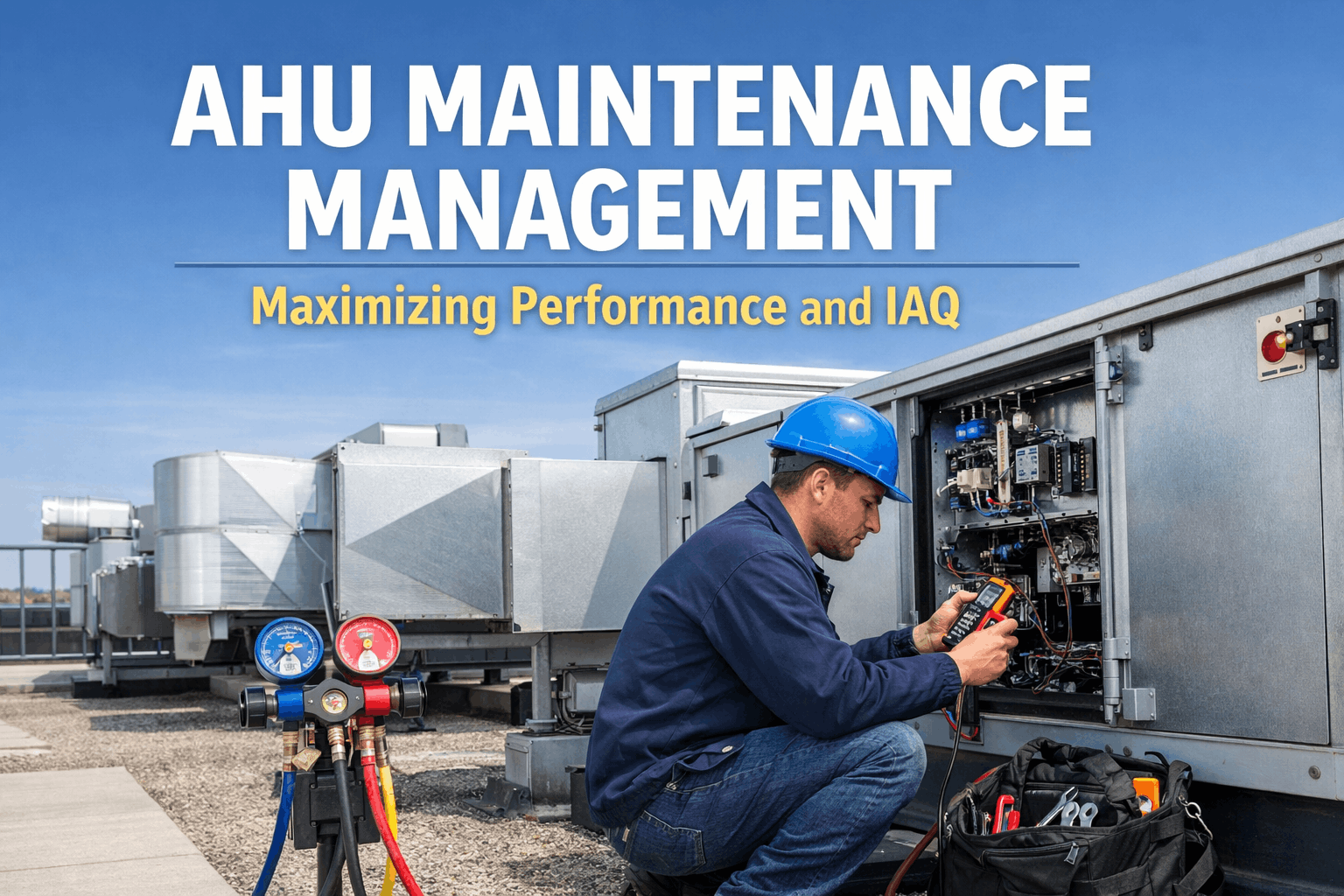
AHU (Air Handling Unit) Maintenance Management
Maximizing Performance and IAQ with AI-Optimized Filters, Coils, Dampers, Fans, and VFDs
15–30%
Energy Wasted by Poor AHU Preventive Maintenance
40%
Reduction in Unplanned Downtime via AHU CMMS
99.9%
IAQ Compliance & Superior Tenant Comfort Ratings
The Problem: Why Reactive Air Handling Unit Maintenance Fails
Air handling units face a compounding set of mechanical, thermal, and airflow challenges that calendar-based maintenance cannot adequately solve. Each component failure creates a cascading effect on the entire HVAC network—and together they explain why passive, reactive air handling unit maintenance is no longer an acceptable strategy for modern commercial real estate and industrial facilities.
Traditional Run-to-Failure AHU Architecture
Filter Neglect
Filters load beyond capacity, causing severe pressure drops and bypassing dirt.
Coil Fouling
Bypassed particulates coat cooling coils, destroying heat transfer efficiency.
Fan & Motor Strain
Fans overwork to overcome resistance, leading to premature bearing/belt failure.
Poor IAQ & High Cost
Skyrocketing energy consumption, poor ventilation, and sick building syndrome.
1
AHU Filter Management Failures
Waiting for a scheduled calendar date to change filters ignores actual particulate loading. Clogged filters dramatically increase static pressure, forcing supply fans to consume exponentially more power to push air. Conversely, collapsed filters allow debris to bypass, causing catastrophic downstream equipment fouling.
Impact
Pressure Drop
2
Delayed AHU Coil Cleaning
Just a fraction of a millimeter of biological growth or dust on an evaporator coil can reduce heat transfer efficiency by 20%. Without regular AHU coil cleaning driven by differential temperature analytics, chiller plants overwork, compressors fail prematurely, and dehumidification targets are routinely missed.
Efficiency Loss
20–30%
3
Inadequate AHU Fan Maintenance
Supply and return fans are the lungs of the building. Neglected AHU fan maintenance leads to unaligned belts, unlubricated bearings, and extreme vibration. A seized fan motor instantly shuts down conditioned air to thousands of square feet, triggering emergency repair premiums and immediate tenant evacuations.
Risk
Downtime
4
AHU Damper & VFD Maintenance Neglect
Stuck outside air dampers compromise indoor air quality or freeze coils in winter. Ignored AHU VFD maintenance means drives run at 100% speed continuously, entirely defeating the purpose of variable volume systems and squandering thousands of dollars in potential energy savings.
Waste
Energy Loss
The Four Pillars of an Air Handler Maintenance Program
A comprehensive air handler maintenance program integrates four distinct mechanical and electrical categories managed by an AI-powered CMMS. Each pillar serves a crucial function—and optimal building performance is achieved when all four are orchestrated simultaneously based on real-time sensor data, weather forecasts, and occupancy metrics.
AI-Orchestrated AHU Preventive Maintenance
Sensor Telemetry
Vibration, pressure, and thermal sensors capture real-time component health.
AHU CMMS Engine
iFactory analyzes data against digital twins to predict imminent failures.
Precision Maintenance
Auto-generates work orders for exactly what needs fixing, right on time.
AHU Performance Optimization
Sustained IAQ, maximized energy savings, and extended equipment lifespan.
Pillar 1: Airflow & Heat Transfer
✓ Dynamic AHU filter management based on differential pressure.
✓ Scheduled AHU coil cleaning utilizing thermal degradation analytics.
✓ Condensate pan treatments to prevent microbial growth and overflows.
✓ iFactory tracks exact static pressure drops across all filter banks.
Pillar 2: Mechanical Drive
✓ Advanced AHU fan maintenance including laser alignment and tensioning.
✓ Bearing lubrication schedules mapped to actual operating hours.
✓ Continuous vibration analysis to detect rotor imbalance early.
✓ Motor insulation and megger testing to prevent electrical shorts.
Pillar 3: Control & Efficiency
✓ Routine AHU damper maintenance to ensure free actuator movement.
✓ AHU VFD maintenance: cleaning heat sinks and checking connections.
✓ Calibration of outside air sensors to optimize economizer cooling.
✓ Drive parameter audits to ensure variable speed algorithms are active.
"Commercial AHU maintenance is no longer about just changing belts and filters twice a year. An air handling unit is a complex thermodynamic system. If the VFD isn't modulating correctly because of a bad static pressure sensor, or if the chilled water valve is hunting due to a fouled coil, the building bleeds money. A dynamic AHU inspection schedule driven by real-time CMMS analytics transforms maintenance from a sunk cost into a primary driver of building net operating income (NOI)."
How iFactory Manages Complete AHU Performance Optimization
iFactory's AI platform doesn't just digitize your AHU inspection schedule—it revolutionizes it. By tracking AHU preventive maintenance tasks dynamically, it ensures every maintenance hour is spent exactly where it delivers the highest return on IAQ and energy efficiency.
Automated Work Order Generation
✓ Triggers AHU filter management tasks only when pressure sensors dictate.
✓ Schedules AHU coil cleaning dynamically before energy penalties accumulate.
✓ Auto-assigns AHU damper maintenance prior to seasonal weather shifts.
✓ Maintains digital logs for every asset to ensure warranty compliance.
Eliminate Unplanned Downtime
✓ Analyzes fan motor vibration signatures to predict bearing failures 30 days out.
✓ Monitors AHU VFD maintenance parameters (temps, faults) to prevent drive blowouts.
✓ Detects sensor drift in discharge air temperature controls automatically.
✓ Recommends capital replacement vs. repair based on historical asset data.
Maximizing Energy Efficiency
✓ Tracks supply fan kW per CFM to ensure peak aerodynamic efficiency.
✓ Validates economizer operation during free-cooling weather windows.
✓ Identifies simultaneous heating and cooling caused by leaking valves.
✓ Optimizes static pressure setpoints dynamically based on actual zone demand.
Automated Health Intelligence
✓ Verifies required outside air ventilation rates for ASHRAE compliance.
✓ Documents AHU preventive maintenance for tenant lease requirements.
✓ Generates automated PM completion logs for local health department audits.
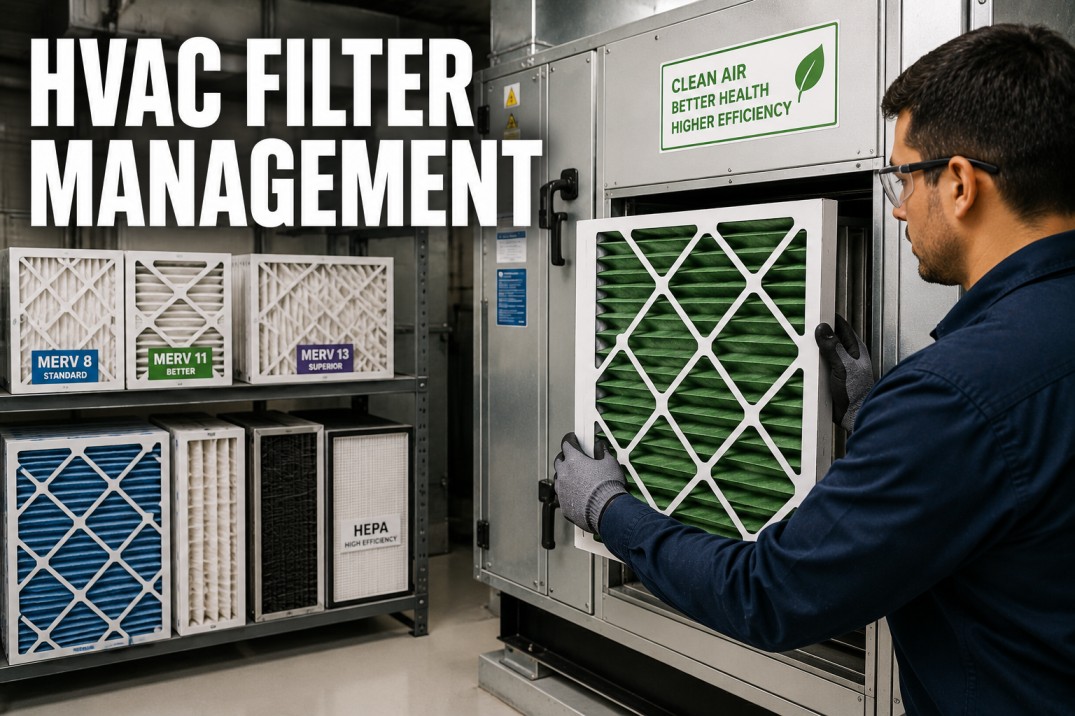
✓ Tracks specific filter MERV ratings and change-out histories natively.
Before vs. After: What AI-Managed AHU Maintenance Delivers
The operational gap between facilities running reactive air handler schedules and those utilizing an intelligent AHU CMMS shows up in every reliability, cost, and IAQ metric.
Filter Replacements
Strict 3-month cycle — often wasting clean filters or starving fans.
Condition-based via differential pressure sensors.
Optimized fan energy & filter costs.
Coil Heat Transfer
Cleaned only when visually filthy — losing up to 25% efficiency.
Cleaned based on thermal approach temperature analytics.
Restored cooling capacity instantly.
Fan Motor Uptime
Run-to-failure bearings causing sudden, catastrophic shutdowns.
Vibration analysis predicts failures weeks in advance.
Zero unplanned air handler outages.
VFD Optimization
Drives overridden to 100% manually and forgotten.
CMMS alerts when drives run continuously at full speed.
Restored variable volume savings.
IAQ Compliance
Stuck dampers ignored, choking off fresh outside air.
Automated damper stroke tests ensure proper ventilation.
Guaranteed ASHRAE 62.1 compliance.
Maximize HVAC Efficiency and Protect Indoor Air Quality
iFactory's AI platform orchestrates every aspect of commercial AHU maintenance—from filter management and coil cleaning to complex VFD parameter tracking. See the complete AHU CMMS platform in a live 30-minute demo.
Industry Drivers Accelerating Smart Air Handler Maintenance Programs
ASHRAE IAQ Standards
Stringent ventilation standards require verifiable AHU damper maintenance and filter tracking. iFactory auto-generates the compliance logs proving that fresh air intake and particulate filtration meet or exceed commercial health standards.
Energy Efficiency Mandates
With local Law 97 and similar carbon penalties taking effect, AHU performance optimization is critical. Ensuring AHU coil cleaning and AHU VFD maintenance are executed perfectly reduces HVAC energy consumption by 15-30%, directly avoiding regulatory fines.
Tenant Health & Safety
Post-pandemic leasing heavily favors "healthy buildings." Proper AHU preventive maintenance prevents mold growth in condensate pans and ensures high-MERV filters are never bypassed, protecting occupants and securing premium lease rates.
Equipment Capital Preservation
Replacing a commercial AHU can cost hundreds of thousands of dollars and disrupt operations for weeks. Consistent AHU fan maintenance and structural inspections extend the asset's useful life by 25-40%, deferring massive capital expenditures.
Expert Perspective
"AHU preventive maintenance is the highest-ROI activity a facilities team can perform. When you neglect an air handler, you don't just break a machine; you poison the indoor environment and drastically inflate your utility bills. A digital AHU inspection schedule driven by an intelligent CMMS ensures that AHU coil cleaning happens before the chiller is strained, and AHU fan maintenance occurs before the bearing shatters. It shifts the maintenance department from a reactive cost center into a proactive guardian of building value and occupant health."
Frequently Asked Questions
How does an AHU CMMS improve air handling unit maintenance?
An AHU CMMS digitizes and automates the entire air handler maintenance program. Instead of relying on memory or paper binders, the software generates automated work orders for AHU preventive maintenance based on runtime hours, calendar dates, or condition-based sensor data. It tracks the history of every filter change, motor lubrication, and belt replacement, ensuring nothing falls through the cracks.
Book a demo to see how an AHU CMMS streamlines facility operations.
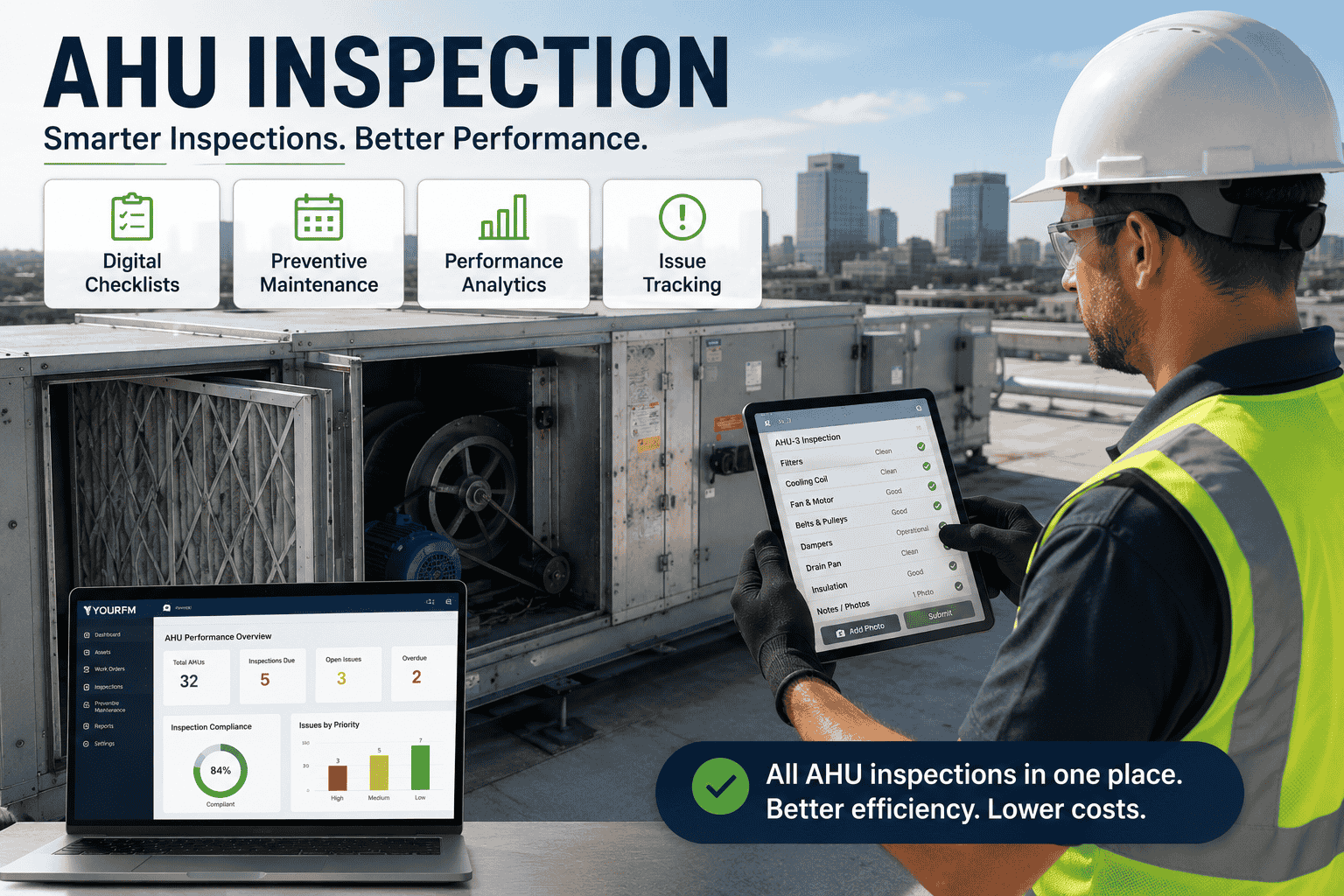
What should be included in a comprehensive AHU inspection schedule?
A thorough AHU inspection schedule must cover all functional zones: AHU filter management (checking differential pressure and tracking MERV replacements), AHU coil cleaning (inspecting for fouling, combing bent fins, and clearing condensate drain pans), AHU fan maintenance (checking belt tension, laser-aligning pulleys, and lubricating bearings), and electrical checks (verifying motor amp draws, tightening contactors, and performing AHU VFD maintenance). The schedule should mandate monthly visual checks and deep quarterly/annual PMs.
How does AHU coil cleaning affect energy consumption?
AHU coil cleaning is incredibly critical for AHU performance optimization. Cooling and heating coils rely on rapid heat transfer between the air and the water/refrigerant inside the tubes. Even a microscopic layer of dust or biofilm acts as an insulator, destroying that heat transfer. When this happens, the chilled water system has to work harder, and the supply fan has to push harder to overcome the restricted airflow. Regular commercial AHU maintenance that includes chemical coil cleaning can reduce HVAC energy consumption by 15% to 25%.
Why is AHU VFD maintenance critical for performance optimization?
Variable Frequency Drives (VFDs) modulate the speed of the AHU fan motors to match the exact airflow demand of the building, saving massive amounts of energy compared to running fans at 100% continuously. AHU VFD maintenance involves cleaning drive heat sinks, verifying cooling fan operation, checking terminal torques, and auditing drive parameters. If a VFD overheats and fails—or is manually overridden in "bypass" mode and forgotten—the building loses all variable-volume energy savings instantly. Visit our
iFactoryApp Support | Get Help & Technical Assistance page for VFD maintenance guides.
How does AHU damper maintenance impact indoor air quality?
AHU damper maintenance ensures that the outdoor air, return air, and exhaust air dampers actuate smoothly based on control signals. If an outdoor air damper is stuck closed due to failed linkages or a burnt actuator, the building receives zero fresh ventilation, leading directly to high CO2 levels, drowsiness, and poor IAQ. If it's stuck open during extreme heat or cold, the coils cannot condition the air fast enough, ruining tenant comfort and wasting energy. Regular stroke-testing of dampers is a non-negotiable part of AHU maintenance management.
Optimize IAQ. Cut Energy Costs. Prevent AHU Failures.
iFactory orchestrates comprehensive AHU maintenance management—from automated filter schedules and predictive coil cleaning to vibration analysis and VFD tracking—delivering uninterrupted comfort and massive efficiency gains from one connected AI platform.