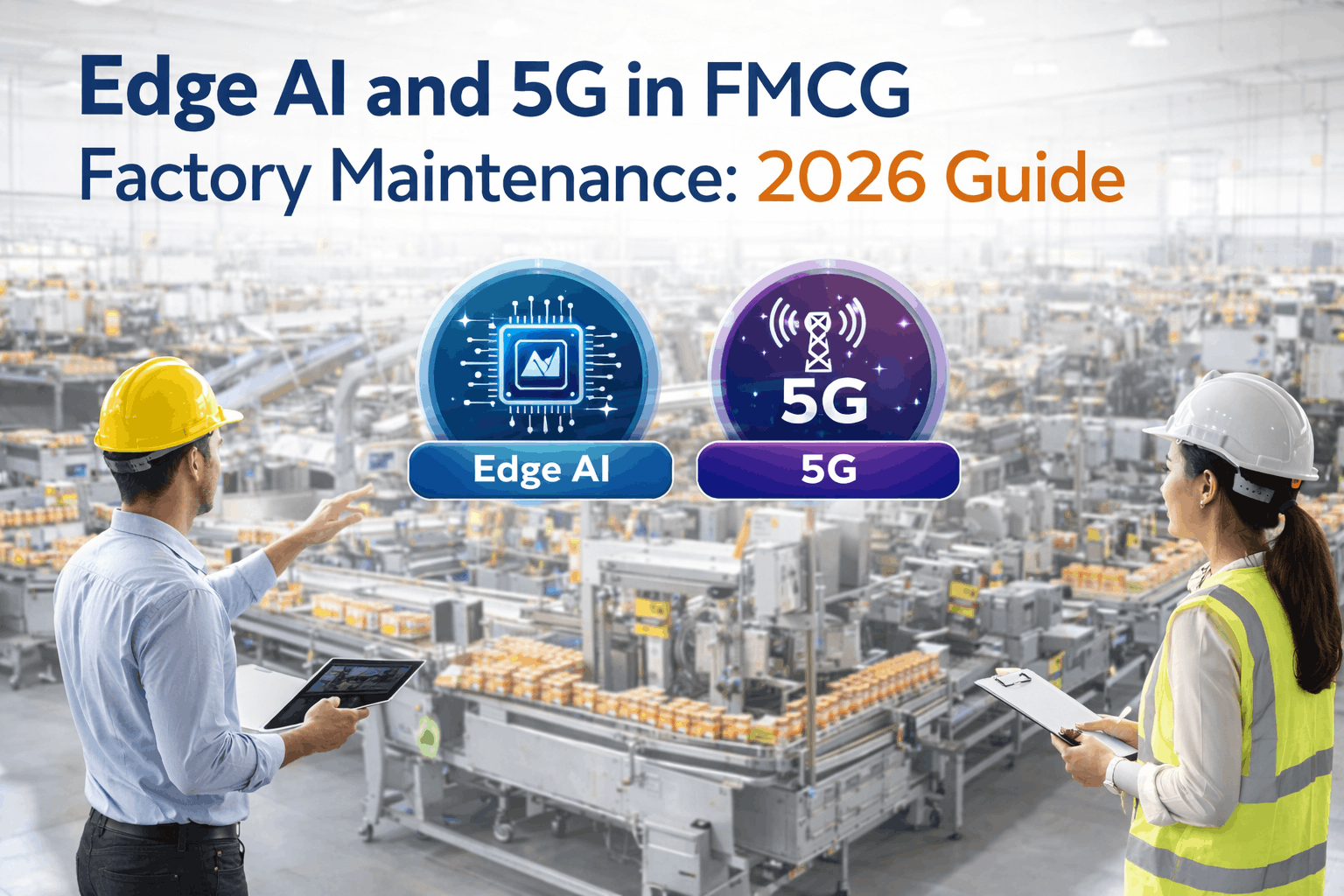
FMCG factories run on milliseconds. A conveyor that stalls for 20 minutes, a filling machine that drifts out of calibration, a cooling unit that underperforms during peak production — these aren't minor hiccups. They are margin killers. The technology that's finally closing the gap between a failure happening and a team responding is the union of Edge AI and 5G connectivity, and in 2026, that combination is reshaping how FMCG plants think about maintenance entirely.
Edge AI & 5G in FMCG Factory Maintenance
How real-time intelligence at the machine level is eliminating unplanned downtime and transforming maintenance from reactive to predictive.
Why the Old Model Breaks Down in FMCG
Traditional CMMS approaches rely on scheduled maintenance or manual observation. In FMCG environments — where machines operate 18 to 24 hours a day and product changeovers happen multiple times per shift — that model creates two chronic problems: over-maintenance that inflates costs and under-maintenance that causes failures.
Cloud-first IoT systems improved visibility, but they introduced a new bottleneck: latency. When sensor data has to travel to a cloud server and back before triggering an alert, you lose precious seconds. In a high-speed packaging line running 800 units per minute, a few seconds of undetected anomaly can mean thousands of wasted units.
Edge AI solves the latency problem by processing data directly at the machine. 5G solves the bandwidth and reliability problem by ensuring continuous, high-speed wireless connectivity across the entire factory floor. Together, they create a maintenance infrastructure that thinks and acts at machine speed. Ready to see this in your plant? Sign up for iFactory and explore edge-ready maintenance today.
The Architecture: How Edge AI and 5G Work Together
Understanding how these two technologies interlock is critical before deploying them in a live FMCG environment.
Smart Sensors at the Source
Vibration sensors, thermal cameras, acoustic emission detectors, and pressure transducers are embedded directly on or near equipment. These sensors capture real-time physical signatures that indicate machine health — bearing temperature, motor vibration frequency, belt tension, and more.
Edge Computing Nodes
Instead of sending raw data to a central cloud, edge nodes — ruggedized computing units installed on the factory floor — receive sensor streams and run trained AI models locally. These models detect deviations, predict failure trajectories, and issue real-time alerts without cloud dependency.
5G Private Networks
5G connectivity eliminates the wiring constraints that previously limited sensor density. Private 5G networks (deployed within the factory perimeter) deliver sub-millisecond latency, support thousands of simultaneous device connections, and maintain reliability even in electrically noisy manufacturing environments.
Centralized Intelligence Layer
Edge nodes synchronize with a central platform (like iFactory) to aggregate maintenance logs, update AI models, schedule work orders, and provide plant managers with a single dashboard view across all assets — combining the speed of edge with the visibility of the cloud.
Put Edge Intelligence to Work in Your FMCG Plant
iFactory integrates with edge AI systems and 5G-connected sensors to give your maintenance team real-time, actionable intelligence — before failures happen.
FMCG-Specific Applications That Are Already Delivering Results
Edge AI and 5G aren't theoretical for FMCG. Here's how leading manufacturers are applying them across the plant floor right now.
Filling and Sealing Lines
Filling machines are among the most maintenance-intensive assets in any FMCG plant. Edge AI models trained on vibration and acoustic data can detect early signs of pump cavitation, seal wear, and nozzle misalignment — often 48 to 72 hours before a visible failure occurs. With 5G connectivity, sensors on rotating components transmit data continuously without cable interference. Maintenance teams receive targeted alerts on mobile devices the moment a degradation threshold is crossed. Want to see this live? Book a demo with iFactory and watch real-time edge analytics in action.
Conveyor and Sortation Systems
In large FMCG facilities, conveyor networks can span hundreds of meters with dozens of drive motors and belt segments. Edge nodes positioned at critical junctions analyze motor load signatures and belt tension readings in real time. 5G-connected cameras perform AI-based visual inspection to detect belt fraying, misalignment, and debris accumulation. Work orders are auto-generated in iFactory the moment an anomaly is confirmed, ensuring maintenance is dispatched before a belt failure halts an entire production zone.
Refrigeration and Cold Chain Assets
Cold chain integrity is non-negotiable in food and beverage FMCG. Edge AI models monitor compressor performance, refrigerant pressure, condenser fan efficiency, and ambient temperature simultaneously. When multiple parameters drift in a correlated pattern — a classic early indicator of compressor failure — the edge node identifies the compound signal and escalates it instantly. Without edge processing, that same pattern might take minutes to surface through a cloud pipeline — by which time temperatures may already be outside compliance range.
Packaging and Labeling Equipment
Packaging machines involve a dense assembly of motors, actuators, sensors, and mechanical cams — all operating under tight tolerance conditions. Edge AI continuously compares current mechanical behavior against baseline models established during peak-performance operation. Drift in any parameter triggers a predictive alert. Sign up for iFactory to connect your packaging line sensors directly to an intelligent maintenance platform.
The Business Case: What FMCG Plants Are Measuring in 2026
Implementation Roadmap: From Pilot to Plant-Wide Deployment
Deploying edge AI and 5G maintenance capabilities doesn't require a complete infrastructure overhaul. The most successful FMCG implementations follow a phased approach that delivers value early and scales progressively.
Asset Criticality Mapping
Before placing a single sensor, map your assets by criticality — failure impact, maintenance cost, and replacement lead time. This determines where edge AI delivers the highest immediate ROI. Typically, filling lines, primary packaging machines, and refrigeration units top the list in FMCG environments.
Sensor Deployment and Baseline Capture
Install smart sensors on priority assets and allow the edge AI models to capture baseline operational signatures over 4 to 8 weeks. During this period, no alerts are issued — the system is learning what "normal" looks like for each specific machine in your specific operating context.
Alert Validation and Model Tuning
Once the model is active, maintenance technicians validate early alerts against physical inspection findings. This feedback loop rapidly improves model accuracy. Platforms like iFactory automate this feedback capture and apply it to model updates across the edge node network. Book a demo to see how iFactory manages this model feedback loop in FMCG environments.
5G Network Integration and Scale
With a validated edge AI program running on priority assets, deploy private 5G infrastructure to extend coverage across the full plant. This enables high-density sensor deployment on previously inaccessible rotating and mobile equipment — expanding your predictive maintenance program to the entire asset registry.
Common Challenges and How Leading FMCG Plants Overcome Them
Data Overload from High-Density Sensors
High-frequency sensor streams can generate millions of data points per hour. Edge AI solves this by filtering and processing data locally — only meaningful events and alerts are forwarded to the central platform, dramatically reducing data pipeline costs and complexity.
RF Interference in Metal-Heavy Environments
FMCG factories are full of metallic structures that historically disrupted wireless signals. Private 5G networks use licensed spectrum and advanced beamforming to maintain reliable connectivity even in highly shielded, electromagnetically complex environments.
Technician Adoption and Workflow Integration
Edge AI alerts are only valuable when maintenance teams act on them. Integrating alerts directly into a CMMS like iFactory — auto-generating work orders, assigning technicians, and tracking resolution — ensures edge intelligence translates into action rather than being ignored in a separate system.
Cybersecurity on the Factory Floor
Expanding connectivity creates new attack surfaces. Private 5G networks with network slicing and end-to-end encryption address this by isolating operational technology traffic from enterprise IT networks. Edge nodes with secure boot and encrypted firmware updates add an additional layer of protection. Sign up for iFactory to explore built-in security controls for your connected maintenance environment.
Transform Your FMCG Maintenance Strategy in 2026
iFactory connects your edge AI sensors, 5G infrastructure, and maintenance teams on a single intelligent platform — so every alert becomes a resolved work order, not a missed opportunity.
Frequently Asked Questions
What is edge AI in the context of factory maintenance
Edge AI refers to artificial intelligence models that run locally on computing hardware installed at or near the equipment being monitored — rather than sending data to a remote cloud server for analysis. In factory maintenance, this means sensors attached to machines transmit data to an edge node on the factory floor, which runs predictive models in real time and issues alerts without any cloud round-trip delay.
Why is 5G better than Wi-Fi for FMCG factory sensor networks
Private 5G networks offer several advantages over Wi-Fi in industrial environments: deterministic latency (consistent sub-millisecond response times), higher device density (thousands of simultaneous connections), greater resilience to RF interference from motors and metal structures, and network slicing capabilities that isolate operational technology traffic for security. Wi-Fi is susceptible to interference and congestion in sensor-dense factory environments.
How long does it take to train an edge AI model for a specific machine
Most edge AI platforms require a 4 to 8 week baseline capture period to learn the normal operational signatures of a specific machine in its specific environment. Modern transfer learning approaches can significantly accelerate this by applying pre-trained models for equipment categories and fine-tuning them on local data, sometimes reducing the baseline period to 2 to 3 weeks for common FMCG equipment types.
Can edge AI work with our existing legacy equipment
Yes. Edge AI does not require machines to have built-in digital connectivity. External sensors — vibration sensors, thermal sensors, acoustic emission detectors — can be retrofitted to legacy equipment and connected to edge nodes via wired or wireless protocols. The AI model observes external physical signals rather than internal machine data, making it compatible with virtually any electromechanical equipment.
What is the typical ROI timeline for an edge AI and 5G maintenance deployment in FMCG
Most FMCG manufacturers report positive ROI within 12 to 18 months of deploying edge AI and 5G-connected maintenance programs on critical assets. The primary value drivers are reduced unplanned downtime (often the single largest contributor), lower emergency repair costs, and extended asset lifespan through condition-based maintenance. Facilities with high-value equipment or high production volumes typically see faster payback periods.
How does iFactory integrate with edge AI and 5G sensor systems
iFactory connects to edge AI platforms and smart sensor networks through standard industrial IoT protocols (MQTT, OPC-UA, REST APIs). Alerts generated by edge nodes are automatically ingested by iFactory, which triggers configurable workflows — creating work orders, assigning technicians, escalating critical alerts, and capturing resolution data to feed back into AI model improvement cycles. The platform provides a unified view of all asset health data, maintenance activities, and predictive alerts across the entire FMCG facility.