Compressor failure is the single most expensive maintenance event in any HVAC system. A commercial rooftop compressor replacement runs $4,000–$12,000. A chiller compressor failure tops $30,000–$150,000. And in most facilities today, these failures arrive without warning — discovered only when cooling stops, temperatures spike, and the damage is already done. The technology to prevent this exists. AI-powered compressor health monitoring systems analyze vibration signatures, electrical patterns, refrigerant behavior, and thermal profiles in real time, building a continuous health score for every compressor in your building portfolio. Anomalies that precede failure — bearing wear, winding insulation breakdown, refrigerant migration, valve leakage — are detected 3–10 weeks before breakdown occurs, converting catastrophic failures into planned maintenance events. iFactory's AI platform delivers this capability across your entire HVAC compressor fleet. Book a free consultation to see live compressor health scores for equipment like yours.
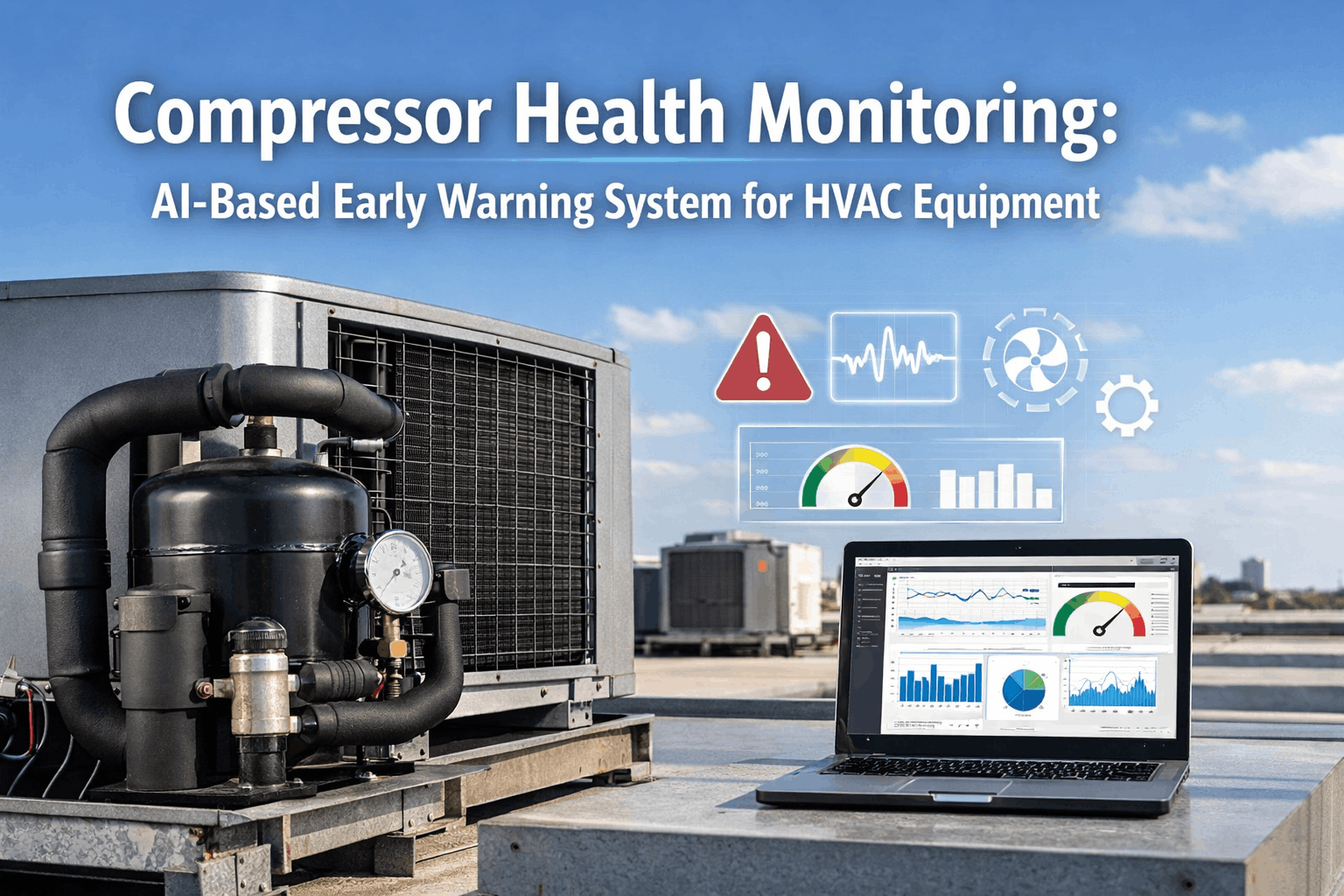
Compressor Health Monitoring
AI-Based Early Warning System for HVAC Equipment
Know your compressor's health score before it fails. AI models analyzing 40+ real-time parameters deliver 3–10 weeks of advance warning across every compressor type — rooftop units, chillers, VRF systems, and refrigeration equipment — eliminating the emergency repairs that destroy maintenance budgets.
The 5 Stages of Compressor Failure — and When AI Intervenes
Traditional monitoring detects failure at Stage 4 or 5 — when damage is already severe. AI health monitoring identifies the progression at Stage 1–2, when repair is simple, inexpensive, and planned.
Micro-Anomalies
Sub-threshold deviations in motor current draw and bearing temperature gradients. Invisible to human operators and standard BMS thresholds. AI detects statistical drift from baseline.
Pattern Emergence
Multiple parameters begin correlated decline. Vibration spectrum shows early frequency shifts. Oil temperature delta widens slightly. Composite fault signature becomes statistically significant.
Measurable Degradation
Performance efficiency drops 5–12%. Vibration amplitude increases measurably. Trained technician on-site might notice unusual sounds. Work order should be generated and parts ordered.
Rapid Deterioration
BMS thresholds begin triggering. Efficiency loss exceeds 20%. Vibration and noise clearly abnormal. Most reactive maintenance programs catch faults here — too late for cost-effective repair.
Catastrophic Failure
Compressor seizure, winding burnout, or bearing collapse. Cooling loss triggers occupant complaints, process disruption, or clinical risk. Emergency repair costs 5–10x planned intervention cost.
40+ Parameters Analyzed Per Compressor
No single measurement predicts compressor failure reliably. AI health scoring integrates four parameter domains simultaneously — the multi-signal correlation is what separates genuine fault detection from false alarms.
Mechanical Parameters
- Vibration amplitude (X/Y/Z axes)
- Vibration frequency spectrum (FFT)
- Bearing temperature differential
- Shaft speed and RPM variance
- Oil pressure and viscosity index
- Crankcase pressure trend
- Startup torque profile
Electrical Parameters
- Motor current draw (3-phase)
- Current imbalance between phases
- Power factor trending
- Winding resistance estimation
- Inrush current profile analysis
- Harmonic distortion levels
- Run capacitor health (single-phase)
Refrigeration Parameters
- Suction pressure and temperature
- Discharge pressure and temperature
- Compression ratio deviation
- Superheat and subcooling values
- Isentropic efficiency index
- Refrigerant charge trend analysis
- EXV valve position vs response
Thermal Parameters
- Motor winding temperature
- Shell temperature distribution
- Discharge gas temperature trend
- Ambient vs load-normalized delta
- Thermal cycling stress index
- Heat rejection efficiency ratio
- Cold start thermal shock scoring
From Sensor Data to Maintenance Action
A four-layer intelligence stack that turns raw compressor data into health scores, fault predictions, and automated maintenance directives — integrated with your existing workflows.
Sensor Fusion and Data Normalization
IoT sensors — vibration accelerometers, current transformers, pressure transducers, and temperature probes — feed data at 1–30 second intervals. The platform normalizes readings against load state, ambient conditions, and operating mode (startup, steady-state, shutdown, standby) to eliminate false positives caused by normal operational variation.
Dynamic Baseline Modeling
Each compressor unit gets its own AI-built performance baseline — calibrated to its specific model, age, load profile, refrigerant type, and installation conditions. Unlike generic fault thresholds, this personalized baseline detects anomalies unique to your equipment rather than comparing against industry averages that may not apply.
Multi-Domain Fault Pattern Matching
AI simultaneously analyzes all four parameter domains — mechanical, electrical, refrigeration, and thermal — matching composite signatures against a library of failure patterns built from thousands of documented compressor fault histories. Each fault type has a distinct multi-parameter signature that the model recognizes at sub-threshold levels weeks before individual parameters breach alarm limits.
Health Score, RUL Estimation, and Work Order Automation
Each compressor receives a 0–100 health score updated continuously, with color-coded severity levels (Healthy / Watch / Caution / Act Now / Critical). Declining scores trigger Remaining Useful Life projections with confidence intervals. At configurable thresholds, the system automatically generates CMMS work orders with fault description, urgency, parts list, and estimated labor — so maintenance teams act without manual analysis.
Performance Outcomes from AI Compressor Monitoring
Facilities deploying AI compressor monitoring across their HVAC fleet report 78% fewer emergency breakdown events in the first 18 months — converting reactive crisis response into scheduled planned maintenance.
Platform cost recovered 6.2x over through prevented repairs, energy savings, and extended equipment life across a typical 10–20 unit commercial HVAC portfolio.
Degraded compressors running with worn bearings, low charge, or fouled heat exchangers consume up to 22% excess energy. AI-guided timely intervention recovers this efficiency continuously.
The difference between a planned bearing replacement ($800–$1,200) and an unplanned compressor seizure ($8,000–$15,000) — captured every time AI delivers advance warning.
Compressors monitored and maintained based on AI health scoring run 7 additional service years on average versus units maintained on time-based schedules.
After a 90-day calibration period on your specific equipment, AI achieves 91% fault detection accuracy with false-positive rates below 4% — dramatically lower nuisance alarm rates than threshold-based BMS monitoring.
Compressor Types Supported by AI Health Monitoring
AI health models are pre-trained on failure patterns from all major commercial and industrial compressor types — no custom development required for standard equipment.
Centrifugal
Chiller compressors — magnetic bearing and conventional. Impeller wear, surge detection, thrust bearing monitoring.
Scroll
Rooftop units, split systems, VRF. Tip seal wear, scroll flank erosion, liquid slugging detection.
Screw
Industrial chillers and process cooling. Male/female rotor wear, slide valve health, bearing journal monitoring.
Reciprocating
Legacy commercial and refrigeration. Valve wear, piston ring degradation, connecting rod bearing analysis.
VRF / Mini-Split
Variable refrigerant flow systems. Inverter drive health, multi-circuit charge balance, coil efficiency tracking.
Process / Industrial
Pharmaceutical, food processing, and manufacturing process cooling compressors with critical uptime requirements.
Maintenance Strategy Scorecard
How AI health monitoring compares across the dimensions that determine real-world maintenance cost and reliability outcomes.
| Capability | Reactive | Scheduled PM | AI Health Monitoring |
|---|---|---|---|
| Fault Detection Lead Time | At failure | Nearest PM visit | 3–10 weeks ahead |
| Detection Method | Cooling loss / alarm | Manual inspection | 40+ parameter AI analysis |
| False Positive Rate | None (no alarms) | Moderate | Below 4% |
| Energy Waste Detection | Not detected | Not detected | Continuous efficiency tracking |
| Average Repair Cost | $8,000–$75,000 | $1,500–$8,000 | $600–$2,500 (planned) |
| Equipment Life Impact | Shortens by 3–7 years | Neutral to slight gain | Extends by 5–10 years |
| CMMS Integration | Manual entry | Scheduled work orders | Automated fault-triggered WOs |
| Multi-Site Scalability | Limited | Resource-intensive | Unlimited portfolio coverage |
Compressor Health Monitoring — Frequently Asked Questions
What hardware is required to get started?
Modern equipment (post-2012) typically has sufficient onboard sensors accessible via BACnet, Modbus, or manufacturer gateways. For older units or enhanced monitoring, a supplemental sensor kit — vibration accelerometer, 3-phase current transformers, and a wireless IoT gateway — costs $600–$1,800 per compressor and installs in 2–4 hours without system shutdown. Full hardware requirements are assessed at no cost during the initial consultation. Schedule hardware assessment.
How long before the AI starts detecting faults accurately?
Basic anomaly detection begins immediately using pre-trained compressor fault models. Equipment-specific calibration — where AI learns your unit's unique operational signature — takes 60–90 days. After calibration, fault detection accuracy reaches 88–94% with false positive rates below 4%. Energy efficiency benchmarking and recommendations are active from week one, delivering ROI before full predictive capability is achieved.
Can it monitor compressors across multiple buildings or sites?
Yes. The platform is designed for multi-site portfolio management. All compressors across your building portfolio are monitored from a single dashboard, with portfolio-level health scoring, site comparison analytics, and centralized work order management. Enterprise users manage 50–500+ compressor units from one interface. Each site's equipment maintains independent baseline calibration while rolling up to fleet-level reporting.
Does it integrate with our existing BMS and CMMS?
Yes. The platform connects to all major BMS platforms via BACnet/IP and REST APIs. CMMS integration covers OxMaint, IBM Maximo, SAP Plant Maintenance, ServiceNow, UpKeep, and Fiix — with bidirectional data flow so fault predictions automatically generate work orders and completed work orders feed back to update equipment health records. No replacement of existing systems is required. See integration demo.
What fault types can the AI detect?
The system is trained to detect bearing wear and fatigue, electrical winding insulation degradation, refrigerant charge loss and migration, valve wear and leakage (reciprocating and screw), impeller and scroll element erosion, lubrication system degradation, non-condensable gas contamination, capacity control mechanism wear, and thermal protection system degradation. Each fault type has a configurable alert threshold and escalation path.
What is the typical payback period?
For a commercial facility with 8–15 rooftop and chiller compressors, the platform typically achieves full payback in 4–7 months through a combination of prevented emergency repairs, energy efficiency recovery, and reduced overtime labor. Facilities with a history of frequent compressor failures often achieve payback in the first prevented failure event alone. A custom ROI projection using your actual fleet and repair history is provided as part of the free consultation. Get your ROI estimate.
See a Live Health Score for Your Compressors
Stop waiting for failures to tell you something is wrong. In a free 30-minute demo, our engineers will show you AI health monitoring configured for your specific compressor types, building profile, and maintenance workflows — with live data from equipment comparable to yours.
30 minutes. No sales pressure. See AI compressor health monitoring configured for your facility.
Schedule Free Demo ↗