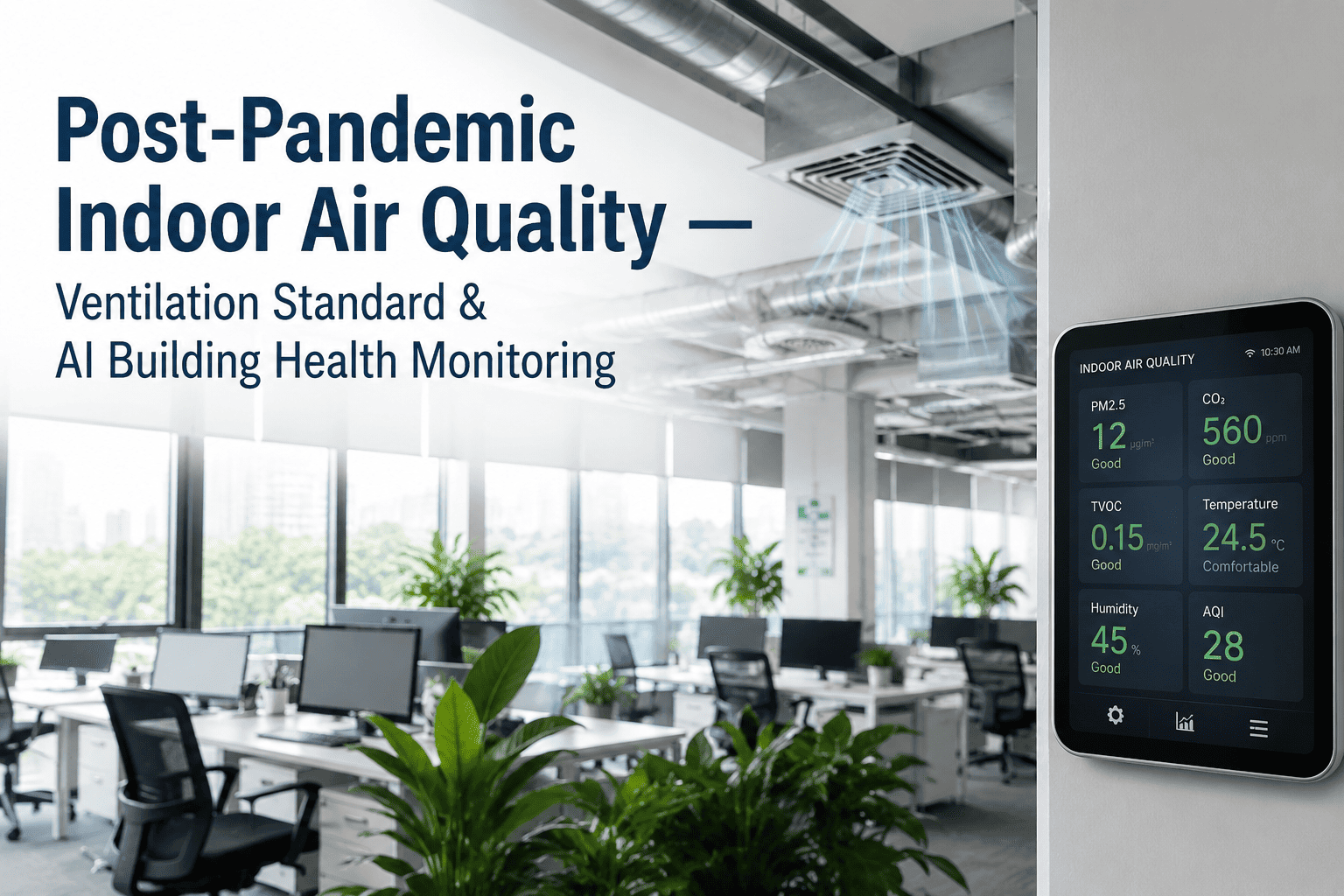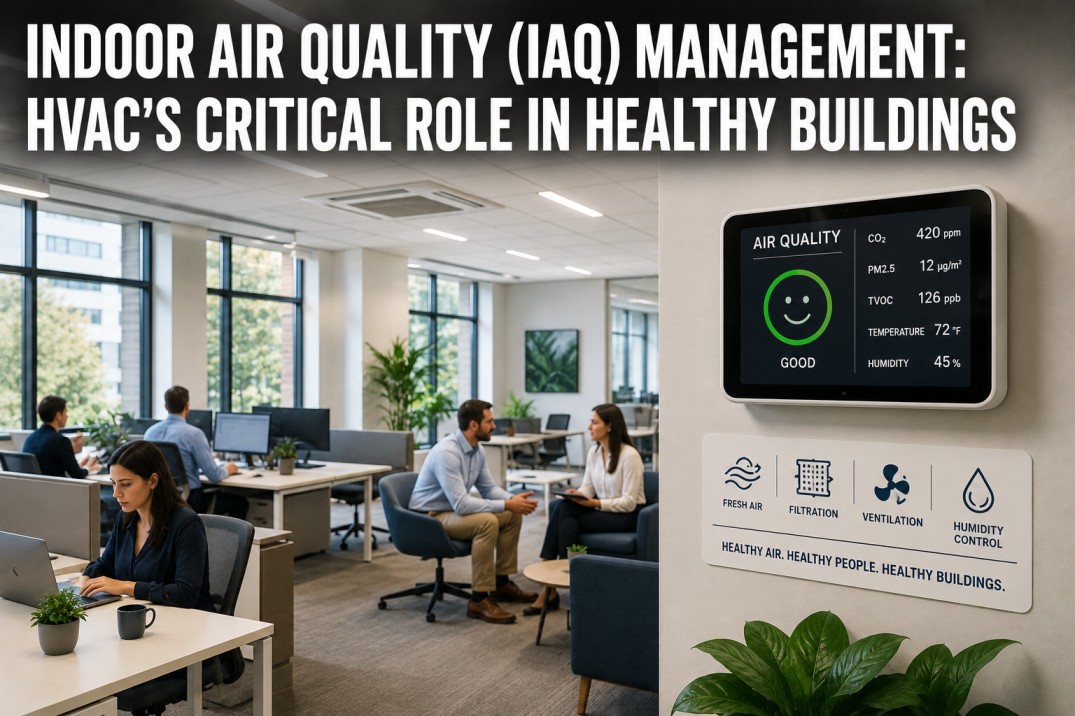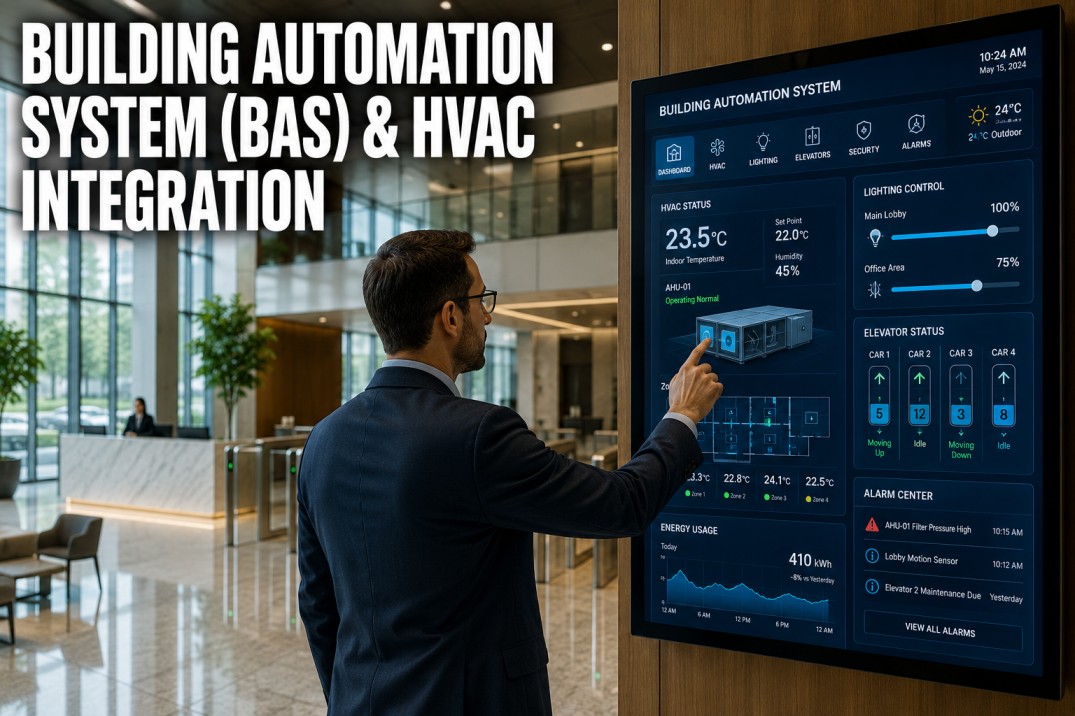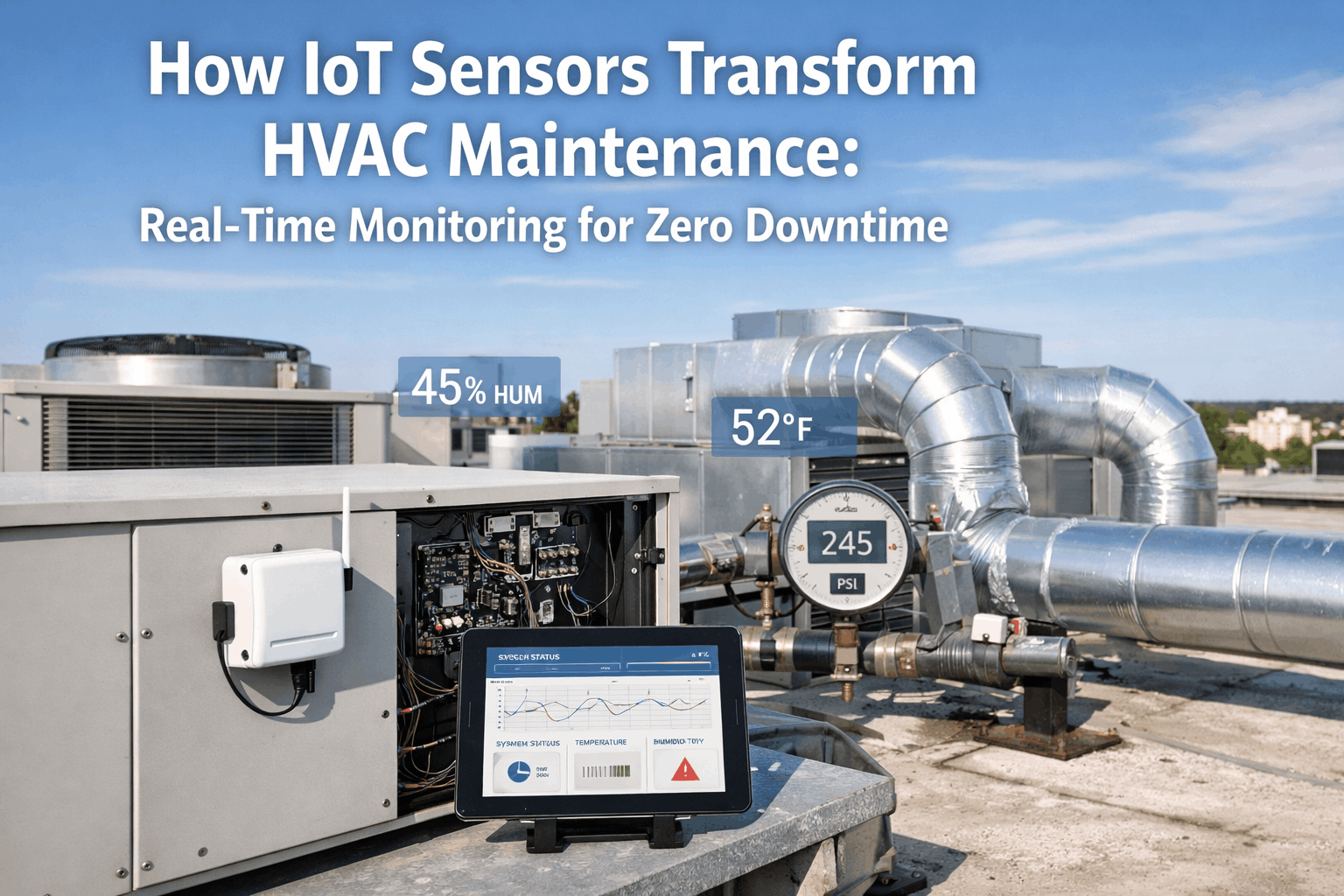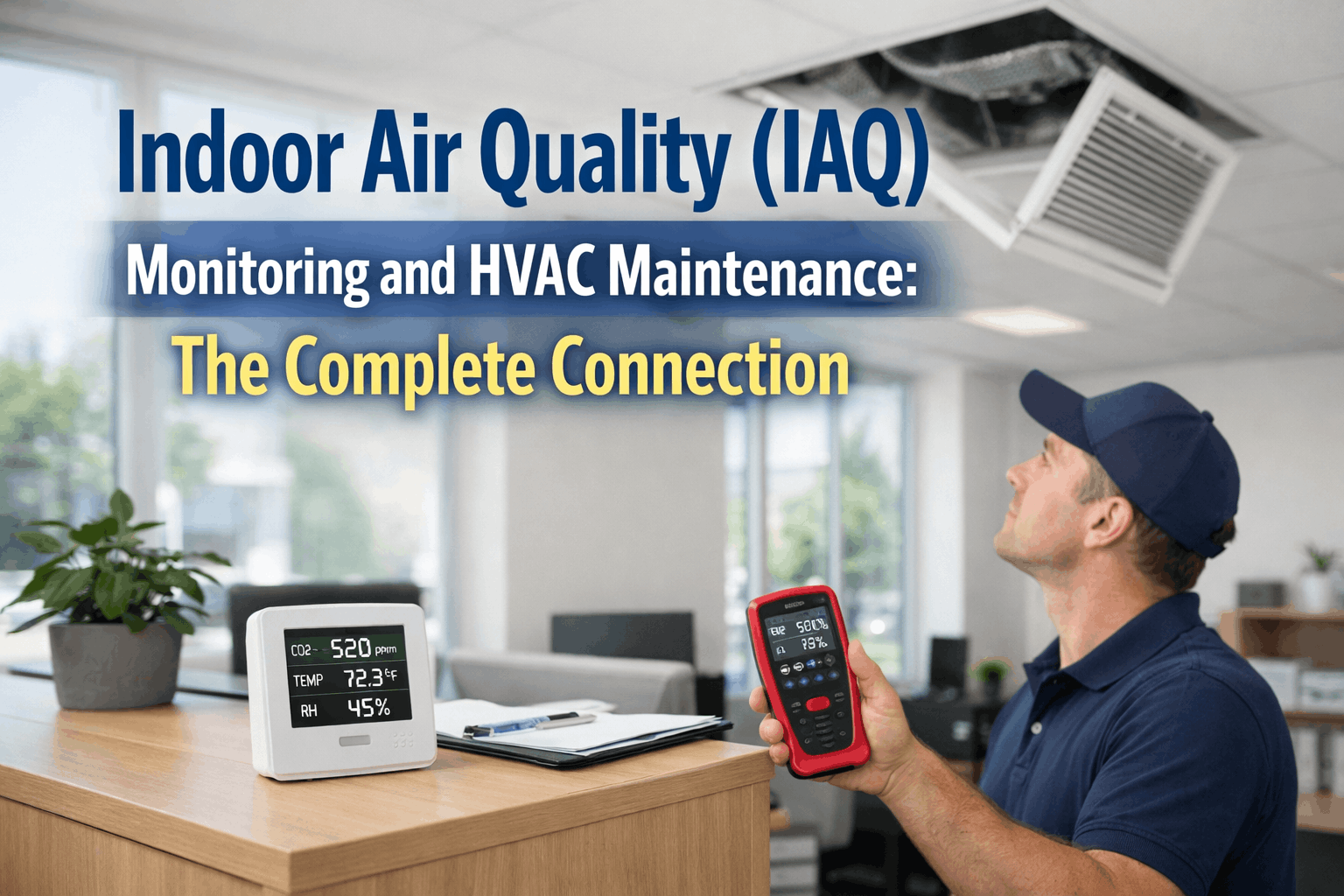
Indoor air quality is not separate from HVAC maintenance — it is the direct, measurable outcome of it. Every maintenance task your technicians perform, from changing filters and cleaning coils to calibrating dampers and verifying ventilation rates, directly determines whether building occupants breathe healthy air or harmful pollutants. The HVAC air quality monitoring market reached $46.3 billion in 2025 and is projected to reach $75.4 billion by 2035, driven by post-pandemic health awareness, regulatory mandates, and the integration of AI-driven predictive analytics into building systems. Research from Lawrence Berkeley National Lab found that increasing ventilation rates across US buildings could save $12–38 billion annually in reduced absenteeism, improved cognitive performance, and fewer sick building syndrome symptoms. MERV 13–14 filters reduce indoor PM2.5 by approximately 31%, and MERV 15+ filters by 39%, compared to lower-rated alternatives. EU building directives now mandate air quality sensor integration in new construction and major renovations. Yet in most buildings, HVAC maintenance still operates disconnected from IAQ data — technicians change filters on schedules, not based on actual air quality readings. iFactory's CMMS platform bridges this gap, connecting real-time IAQ sensor data with maintenance workflows to create a closed-loop system where air quality drives maintenance decisions and maintenance actions are verified by air quality outcomes. Book a free demo and connect your IAQ monitoring to your HVAC maintenance operations.
HEROIndoor Air Quality Monitoring and HVAC Maintenance
The Complete Connection
Every HVAC maintenance task you perform — or fail to perform — shows up in your IAQ data. This guide maps the complete connection between HVAC system health and indoor air quality: which maintenance failures cause which pollutant spikes, how IAQ sensors create maintenance triggers, and how to build a closed-loop system where air quality data drives your maintenance program.
Five Pollutants Your HVAC System Controls — And How to Monitor Them
Each indoor air pollutant has a direct relationship to specific HVAC maintenance tasks. Understanding these connections transforms reactive IAQ complaints into proactive maintenance triggers.
CO₂ — Carbon Dioxide
PM2.5 — Fine Particulate Matter
VOCs — Volatile Organic Compounds
Humidity — Relative Humidity (%RH)
CO — Carbon Monoxide
Which Maintenance Failures Cause Which Air Quality Problems
Every IAQ complaint traces back to a specific HVAC maintenance gap. This connection map lets facility teams and HVAC technicians diagnose air quality issues through the maintenance lens.
Low-MERV or clogged filters allow fine particulates and VOC-carrying particles to pass through. MERV 7–12 lets significantly more PM2.5 through than MERV 13+.
Insufficient fresh air intake concentrates occupant-generated CO₂ and indoor VOCs. Damper actuators fail, linkages break, and economizers malfunction — all reducing outdoor air below ASHRAE 62.1 requirements.
Fouled coils reduce dehumidification capacity. Indoor humidity rises above 60%, creating conditions for mold growth, dust mite proliferation, and bacterial contamination — all major IAQ and health hazards. See coil condition monitoring
Standing water in drain pans breeds bacteria, algae, and mold that are then distributed throughout the building via supply air. One of the most common sources of musty odors and biological contamination.
Leaking supply ducts lose conditioned, filtered air. Leaking return ducts pull unconditioned, unfiltered air from wall cavities, attics, and crawl spaces — introducing dust, insulation particles, and outdoor pollutants directly into the air stream.
Cracked heat exchangers allow combustion gases (CO, NOx) to enter supply airstream. Combined with negative building pressure from exhaust fans, this creates a life-safety hazard. CO monitoring is essential in any building with gas-fired HVAC equipment. See safety alert automation
IAQ-Driven Maintenance — How Sensor Data Creates Work Orders
The future of HVAC maintenance is a closed loop: IAQ sensors detect degradation, CMMS generates targeted work orders, technicians resolve root causes, and sensors verify the fix.
Detect
IoT IAQ sensors continuously monitor CO₂, PM2.5, VOCs, humidity, CO, and temperature across all zones. AI analytics establish baselines and identify anomalies — rising CO₂ in conference rooms, PM2.5 spikes after outdoor events, humidity creep from degrading coils.
Diagnose
AI correlates IAQ patterns with HVAC system data to identify probable root causes. CO₂ spike + normal occupancy = damper/economizer issue. PM2.5 rise + outdoor event = filter bypass or duct leak. Humidity climb + cooling running = coil fouling or drain blockage.
Dispatch
CMMS automatically generates a prioritized work order with specific diagnostic context, affected zones, probable root cause, and recommended procedures. Work order routes to the qualified technician nearest the affected area. See auto-dispatch in action
Resolve & Verify
Technician completes maintenance using digital checklists. Post-service, IAQ sensors verify the fix — CO₂ returns to baseline, PM2.5 drops, humidity normalizes. If IAQ doesn't improve within expected timeframe, a follow-up work order generates automatically.
Maintenance Protocols That Directly Improve Indoor Air Quality
Filtration Excellence
Upgrade to MERV 13 minimum for occupied spaces (ASHRAE's post-pandemic recommendation). Track filter differential pressure — change based on pressure drop, not calendar. Verify filter fit and sealing — gaps around filter frames allow unfiltered air bypass that negates filter effectiveness. In buildings with IAQ sensors, correlate filter changes with PM2.5 data to validate improvement and optimize change intervals.
Ventilation Verification
Use CO₂ as a real-time proxy for ventilation adequacy. ASHRAE Standard 62.1 specifies minimum rates — but compliance requires verification, not assumption. Test outdoor air damper position and actuator operation quarterly. Calibrate CO₂ sensors annually (sensor drift is the #1 cause of false DCV readings). Commission economizers before each cooling season. Measure actual airflow at outdoor air intakes, not just damper position. See ventilation monitoring
Humidity & Microbial Control
Clean evaporator coils bi-annually to maintain dehumidification capacity. Inspect and treat condensate drain pans and lines quarterly — use biocide tablets and verify positive drainage. Maintain indoor humidity between 40–60% RH. In heating season, verify humidifier operation and cleaning schedule. Inspect ductwork for moisture, insulation damage, or condensation — any standing moisture creates microbial amplification sites.
Combustion Safety
For buildings with gas-fired HVAC: perform annual combustion analysis, inspect heat exchangers for cracks, verify flue integrity and draft. Test building pressure with exhaust fans running — negative pressure can backdraft combustion gases. Integrate CO sensors with CMMS alerts for immediate response to any detection above background levels. CO monitoring is a life-safety requirement, not optional.
Duct Integrity
Perform duct leakage testing — target less than 5% leakage for IAQ-critical buildings. Seal all duct connections and penetrations. Inspect return air pathways for sources of unfiltered air — ceiling plenums, wall cavities, and mechanical room air bypassing filtration. Clean ductwork based on inspection, not arbitrary schedules. Verify building pressurization — positive pressure prevents infiltration of outdoor pollutants and soil gases. See duct assessment tools
How iFactory Connects IAQ Data to Maintenance Operations
Real-Time IAQ Dashboards in CMMS
View live IAQ readings across all zones — overlaid with HVAC system status, filter age, and last service dates. Spot the connection between maintenance state and air quality at a glance. Trend analysis reveals how each maintenance action affects IAQ metrics, building evidence for maintenance investment decisions. Facility managers, HVAC technicians, and building owners share one source of truth.
Automated IAQ-Triggered Work Orders
When any IAQ parameter exceeds thresholds or trends toward degradation, CMMS generates targeted work orders with sensor data, zone identification, probable cause analysis, and recommended procedures. No manual interpretation required.
Post-Service Verification
After maintenance completion, the system monitors IAQ data to verify improvement. If metrics don't return to baseline within the expected timeframe, a follow-up work order generates automatically — closing the loop between service and outcome. See closed-loop verification
Regulatory Compliance Reporting
Generate ASHRAE 62.1 ventilation compliance reports, WELL Building Standard documentation, LEED IEQ credit evidence, and EU EPBD air quality sensor mandates — all from integrated IAQ + maintenance data.
Filter Lifecycle Optimization
Track filter differential pressure + IAQ impact data to optimize change intervals. Replace filters based on actual performance degradation rather than calendar schedules — reducing waste while maintaining air quality standards.
Complete IAQ-HVAC Maintenance Coverage
Frequently Asked Questions — IAQ Monitoring & HVAC Maintenance
What IAQ metrics should we monitor and what do they tell us about HVAC health?
The five essential IAQ metrics are CO₂ (ventilation adequacy — above 1,000 ppm indicates insufficient outdoor air), PM2.5 (filtration effectiveness — spikes indicate filter failure or bypass), VOCs (ventilation and source control — elevated levels indicate inadequate dilution), humidity (coil and dehumidification performance — outside 40–60% indicates HVAC issues), and CO (combustion safety — any detection above background indicates a potential safety hazard from gas-fired equipment). Each metric maps directly to specific HVAC maintenance tasks, creating a diagnostic framework that transforms air quality data into actionable maintenance work orders. See IAQ diagnostic framework
How much does improving filtration actually help indoor air quality?
Research from Harvard's Healthy Buildings program found that upgrading from MERV 7–12 to MERV 13–14 filters reduces indoor PM2.5 by approximately 31%, and MERV 15+ filters by approximately 39%. These reductions occur specifically during occupied hours when mechanical ventilation is operating. The key factors are not just filter rating but also filter fit (no bypass gaps), change frequency (based on differential pressure, not calendar), and ductwork integrity (leaks pull unfiltered air past the filter). IAQ sensors provide the verification that filtration upgrades are actually delivering the expected improvement in your specific building.
What's the ROI of connecting IAQ monitoring to HVAC maintenance?
Lawrence Berkeley National Lab research found that optimizing ventilation across US buildings could save $12–38 billion annually in reduced absenteeism, improved cognitive performance, and fewer sick building symptoms. A study of 40 buildings found that increasing ventilation to 50 CFM/person reduced short-term absenteeism by 35%. The cost of providing better ventilation was found to be an order of magnitude smaller than the savings from improved occupant health and productivity. At the building level, IAQ-driven maintenance reduces reactive service calls, extends equipment life through optimized operation, and provides documentation for green building certifications that increase property value. Calculate your building ROI
How do we implement IAQ monitoring in existing buildings without major renovation?
Modern IAQ sensor technology makes retrofit straightforward. Low-cost wireless sensor nodes (typically $200–500 per monitoring point) measure CO₂, PM2.5, VOCs, temperature, and humidity with no wiring required. Sensors communicate via WiFi or cellular to cloud platforms that integrate with CMMS systems. Start with high-occupancy spaces (conference rooms, open offices), complaint-prone zones, and areas near known sources (kitchens, loading docks, parking garages). A typical commercial floor can be meaningfully monitored with 4–8 sensor nodes. The investment pays back through reduced complaints, optimized maintenance scheduling, and compliance documentation.
What building standards require IAQ monitoring and how does CMMS help comply?
ASHRAE 62.1 specifies minimum ventilation rates. LEED v4 offers IEQ credits for enhanced IAQ monitoring and management. WELL Building Standard requires continuous air quality monitoring with specific thresholds. The EU's updated Energy Performance of Buildings Directive (EPBD) now mandates air quality sensor integration in new construction and major renovations. RESET Air establishes performance-based IAQ targets. CMMS with integrated IAQ data generates compliance reports automatically — documenting ventilation rates, air quality readings, maintenance history, and corrective actions in the format each standard requires. See compliance reporting
Can IAQ data actually replace scheduled HVAC maintenance?
IAQ data supplements rather than replaces scheduled maintenance — but it dramatically optimizes it. Some tasks (filter changes, coil cleaning) can shift from calendar-based to condition-based scheduling using IAQ data as the trigger. Other tasks (combustion analysis, refrigerant checks, belt inspection) still require physical service visits. The optimal approach is hybrid: minimum scheduled maintenance intervals as a floor, with IAQ-triggered service when sensors detect degradation between scheduled visits. This catches developing issues that scheduled visits would miss while eliminating unnecessary service on systems that are performing well.
Your IAQ Data Already Knows What Maintenance You Need
Stop treating air quality and HVAC maintenance as separate disciplines. Connect your IAQ sensors to your CMMS and let air quality data drive your maintenance program — verifying every service action with real, measurable air quality outcomes.