Every manufacturing machine generates invisible warning signs before it fails — a bearing vibrating 0.2mm more than yesterday, a motor drawing 3% extra current, hydraulic fluid degrading particle by particle. Predictive maintenance captures these micro-signals through IoT sensors and AI analytics, transforming them into precise failure forecasts that tell your team exactly which component will fail, when it will happen, and what to do about it. With the global predictive maintenance market valued at over $14 billion in 2025 and growing at nearly 28% annually, manufacturers worldwide are abandoning reactive repair strategies in favor of data-driven precision that cuts unplanned downtime by up to 50% and slashes maintenance costs by 25-40%. Book a free predictive maintenance assessment to identify which equipment failures at your plant are preventable today.
How Predictive Maintenance Prevents Equipment Failure Before It Happens
Predictive maintenance fundamentally changes the relationship between your maintenance team and your equipment. Instead of waiting for a machine to break or servicing it on a fixed calendar regardless of condition, predictive systems continuously listen to each asset's health signals and alert you only when real degradation is detected — giving your team days or weeks of lead time to plan repairs around production schedules.
01
Continuous Condition Monitoring
Wireless IoT sensors mounted on critical equipment measure vibration, temperature, acoustic emissions, electrical current, and lubricant quality every fraction of a second. This creates a continuous digital pulse for each asset — a real-time portrait of machine health that no periodic manual inspection could ever match.
02
AI Pattern Recognition
Machine learning algorithms trained on millions of failure signatures analyze incoming sensor streams against each asset's unique behavioral baseline. The AI detects subtle multi-variable anomalies — like a simultaneous shift in vibration frequency and motor temperature that precedes bearing seizure by weeks — that no threshold-based rule or human observer would catch.
03
Remaining Life Calculation
Prognostic algorithms estimate the remaining useful life (RUL) of degrading components with confidence intervals. Your team does not just receive a vague warning — they see that a specific gearbox bearing has approximately 22 days of operational life remaining at current load conditions, enabling precision-timed intervention.
04
Automated Maintenance Action
When a prediction crosses the action threshold, the system automatically generates a prioritized work order in your CMMS — complete with failure diagnosis, recommended repair procedure, required parts, and estimated labor hours. Spare parts can be pre-ordered and repair windows coordinated with production scheduling without any manual handoff delays.
See how AI reads your equipment's health signals in real time. Book a demo where we will run predictive analytics on actual sensor data from manufacturing equipment similar to yours — and show you exactly what early failure detection looks like.
Book a Demo
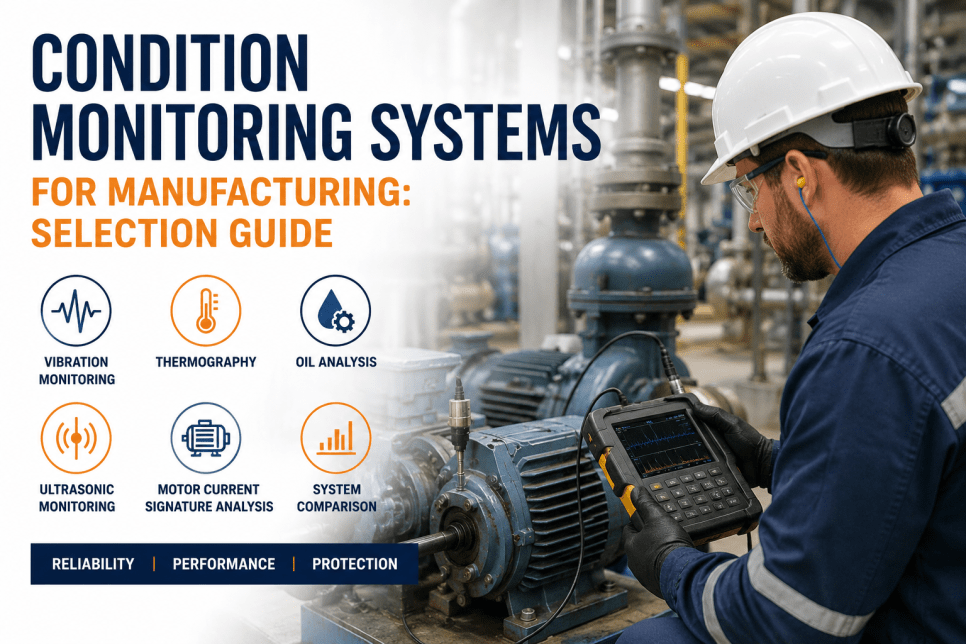
Vibration Analysis, Thermal Imaging, and Oil Testing: Choosing the Right Monitoring Method
Effective predictive maintenance matches specific monitoring techniques to the failure modes most likely to occur in each type of equipment. No single sensor type catches every problem — the most reliable programs combine multiple techniques to create overlapping detection coverage across all critical assets.
Vibration Analysis
Motors, pumps, compressors, gearboxes, fans, spindles
Identifies imbalance, misalignment, bearing defects, gear tooth wear, and structural looseness. Frequency spectrum analysis pinpoints the exact degrading component and estimates severity — detecting problems 3 to 6 months before functional failure in most rotating equipment.
Infrared Thermography
Electrical panels, bearings, steam traps, refractory, switchgear
Thermal cameras detect hotspots from loose connections, overloaded circuits, insulation breakdown, and excessive friction. Non-contact scanning covers large equipment areas at full production speed without shutdowns or physical access requirements.
Oil and Lubricant Analysis
Hydraulic systems, gearboxes, compressors, turbines, engines
Laboratory and inline analysis reveals metal particle contamination, viscosity breakdown, water ingress, and additive depletion. Ferrographic testing identifies exactly which internal component is generating wear particles — gears, bearings, or seals.
Ultrasonic Detection
Compressed air systems, steam traps, valves, early-stage bearings
High-frequency acoustic emission monitoring finds air and gas leaks, failing steam traps, and valve seat erosion. Particularly valuable for compressed air systems where leaks typically waste 20-30% of compressor energy output in manufacturing plants.
Motor Current Signature Analysis
Electric motors, VFDs, motor-driven pumps and conveyors
Current waveform analysis detects rotor bar cracks, stator winding degradation, eccentricity, and mechanical load anomalies — all without installing any additional sensors on the motor. Leverages existing electrical connections for non-invasive monitoring.
Real-World Cost Savings: What Manufacturers Gain from Predictive Maintenance
The financial case for predictive maintenance strengthens with every industry study published. Cost reductions come from multiple simultaneous value streams — fewer breakdowns, lower repair bills, extended component life, reduced spare parts inventory, and less overtime labor — creating compound returns that accelerate over time as AI models learn your equipment's unique behavior.
50%
Reduction in unplanned downtime through early failure detection and proactive repair scheduling before production impact
25-40%
Decrease in total maintenance costs by replacing unnecessary calendar-based service with condition-driven intervention
20-40%
Extension of equipment lifespan through optimized operating conditions and precisely timed component replacement
$233B
Estimated annual savings for Fortune 500 companies globally with full adoption of condition monitoring and predictive maintenance
Calculate your plant's specific savings potential. Get Support for iFactory and our team will map your highest-cost failure modes to predictive monitoring techniques that deliver the fastest payback at your facility.
Get Support
Which Machines Should You Monitor First? A Criticality-Based Equipment Guide
You do not need to instrument every asset on day one. The highest ROI comes from targeting equipment where failure consequences are severe, repair costs are high, and degradation patterns are detectable through condition monitoring. This criticality-based approach delivers fast wins that fund expansion to additional assets.
Equipment Prioritization for Predictive Monitoring
Your Equipment Is Talking. Start Listening.
iFactory connects your manufacturing equipment to AI-powered predictive analytics that detect bearing wear, motor degradation, hydraulic leaks, and thermal anomalies weeks before they stop production. Move from reactive repair bills to precision-timed maintenance that maximizes uptime and extends every asset's working life.
AI vs. Traditional Condition Monitoring: Why Machine Learning Changes Everything
Traditional condition monitoring relies on static alarm thresholds — vibration above X triggers an alert, temperature past Y sends a warning. AI-powered predictive maintenance replaces these rigid rules with adaptive intelligence that understands each asset's individual behavior and environmental context, dramatically reducing false alarms while catching failures that fixed thresholds miss entirely.
Fixed-Threshold Alerts
- Same alarm limits for identical machines regardless of age or load
- High false alarm rates create alert fatigue — teams start ignoring warnings
- Cannot correlate data across multiple sensor types simultaneously
- Binary pass/fail output with no remaining life estimation
- Requires manual threshold tuning as equipment ages
60%+
of condition alerts are false positives with static rules
AI Predictive Models
- Adaptive baselines learn each specific asset's normal behavior over time
- Context-aware alerts factor in load, speed, ambient conditions, and shift patterns
- Multi-variable pattern detection finds complex failure signatures across sensor feeds
- Remaining useful life estimation with confidence intervals for precise scheduling
- Models improve continuously as new operational and failure data is collected
90%+
prediction accuracy with trained ML models on production data
Step-by-Step: Launching Predictive Maintenance on Your Production Floor
A successful predictive maintenance program does not require instrumenting every machine simultaneously. The most effective rollouts start focused, prove value fast, and expand systematically based on demonstrated results — typically achieving measurable ROI within 6 to 12 months of the first sensor installation.
1
Criticality Audit
Rank equipment by downtime cost, failure frequency, and safety impact
Select top 10-15 assets for initial monitoring
Map each asset's failure modes to sensor types
Week 1-2
2
Sensor Installation
Mount wireless vibration, thermal, and condition sensors
Configure edge gateways for data aggregation
Validate sensor readings against known baselines
Week 3-5
3
AI Training Period
Collect 4-8 weeks of baseline operating data per asset
Train machine learning models on normal behavior patterns
Calibrate anomaly sensitivity and alert thresholds
Week 6-10
4
Scale Plant-Wide
Expand to additional equipment based on criticality rankings
Integrate alerts with CMMS for automated work orders
Refine AI models as confirmed failure data enriches predictions
Week 11+
Need help deciding which equipment to monitor first? Book a demo where our engineers will review your asset list, rank equipment by predictive maintenance ROI potential, and design the optimal sensor layout for your plant.
Book a Demo
Every Breakdown Was Predictable. You Just Were Not Listening.
Your manufacturing equipment generates thousands of data points every second that reveal when bearings will fail, motors will degrade, and hydraulic systems will leak. iFactory transforms that data into precise, actionable predictions — so your maintenance team replaces components days before failure, not hours after production stops.
Frequently Asked Questions
What is the difference between predictive and preventive maintenance?
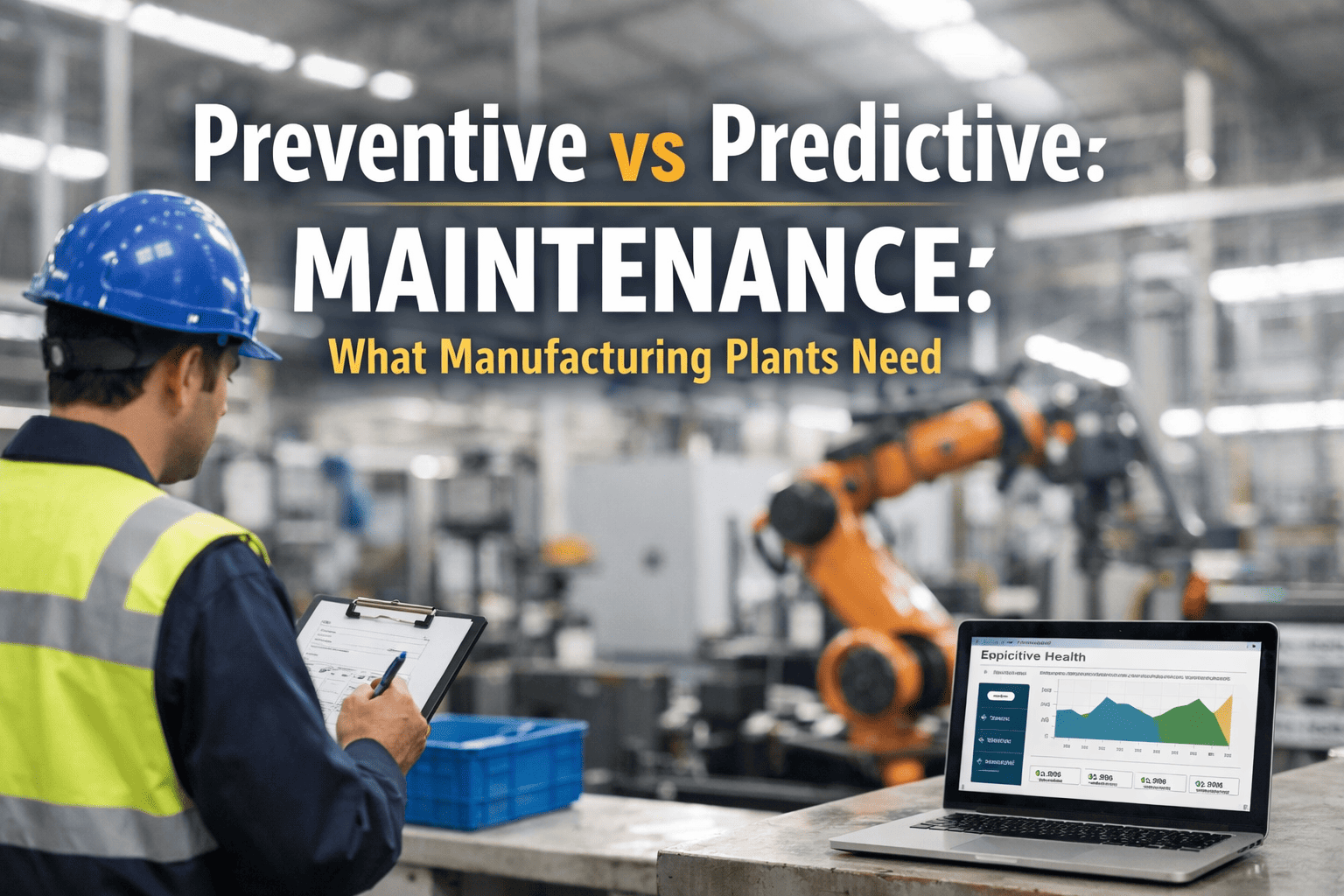
Preventive maintenance follows fixed schedules — replace a bearing every 6 months regardless of condition. Predictive maintenance monitors actual equipment condition in real time and triggers maintenance only when data indicates a developing problem. This means you repair exactly when needed: not too early (wasting parts and labor) and not too late (after the breakdown). Plants using predictive maintenance typically reduce maintenance costs by 25-40% compared to time-based preventive programs alone.
How much does it cost to implement predictive maintenance on manufacturing equipment?
Costs vary based on the number of assets monitored, sensor types required, and integration complexity. Wireless vibration and temperature sensors have dropped significantly in price, making it feasible to start monitoring critical equipment for a fraction of the cost of a single unplanned breakdown. Most plants begin with 10-15 highest-impact assets and expand based on proven ROI.
Book a demo to get a custom cost estimate and ROI projection based on your specific equipment and downtime history.
How long before AI models start accurately predicting equipment failures?
AI models typically need 4 to 8 weeks of baseline data collection to learn an asset's normal operating signature. After this training period, the models begin detecting anomalies and generating early warnings. Prediction accuracy improves continuously as more operational data — especially confirmed failure events — enriches the model. Most deployments achieve actionable prediction accuracy within 2 to 3 months of sensor installation.
Can predictive maintenance work on older manufacturing equipment?
Yes. Modern wireless sensors can be retrofitted to virtually any rotating, reciprocating, or electrical equipment regardless of age or manufacturer. Older equipment often benefits the most from predictive monitoring because aging assets have higher failure rates and are more likely to exhibit detectable degradation patterns.
Create your free iFactory account to explore retrofit sensor options compatible with your existing equipment fleet.
What manufacturing industries benefit most from predictive maintenance?
Any manufacturing environment with critical rotating equipment, high downtime costs, or expensive replacement parts benefits significantly. Automotive, aerospace, food and beverage, pharmaceutical, metals, plastics, and electronics manufacturing all show strong ROI. The manufacturing sector holds the largest market share for predictive maintenance adoption precisely because the cost of unplanned production stops is so severe in these environments.