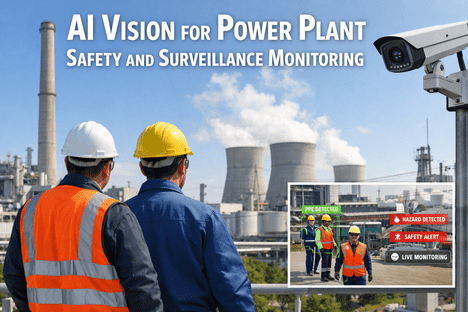
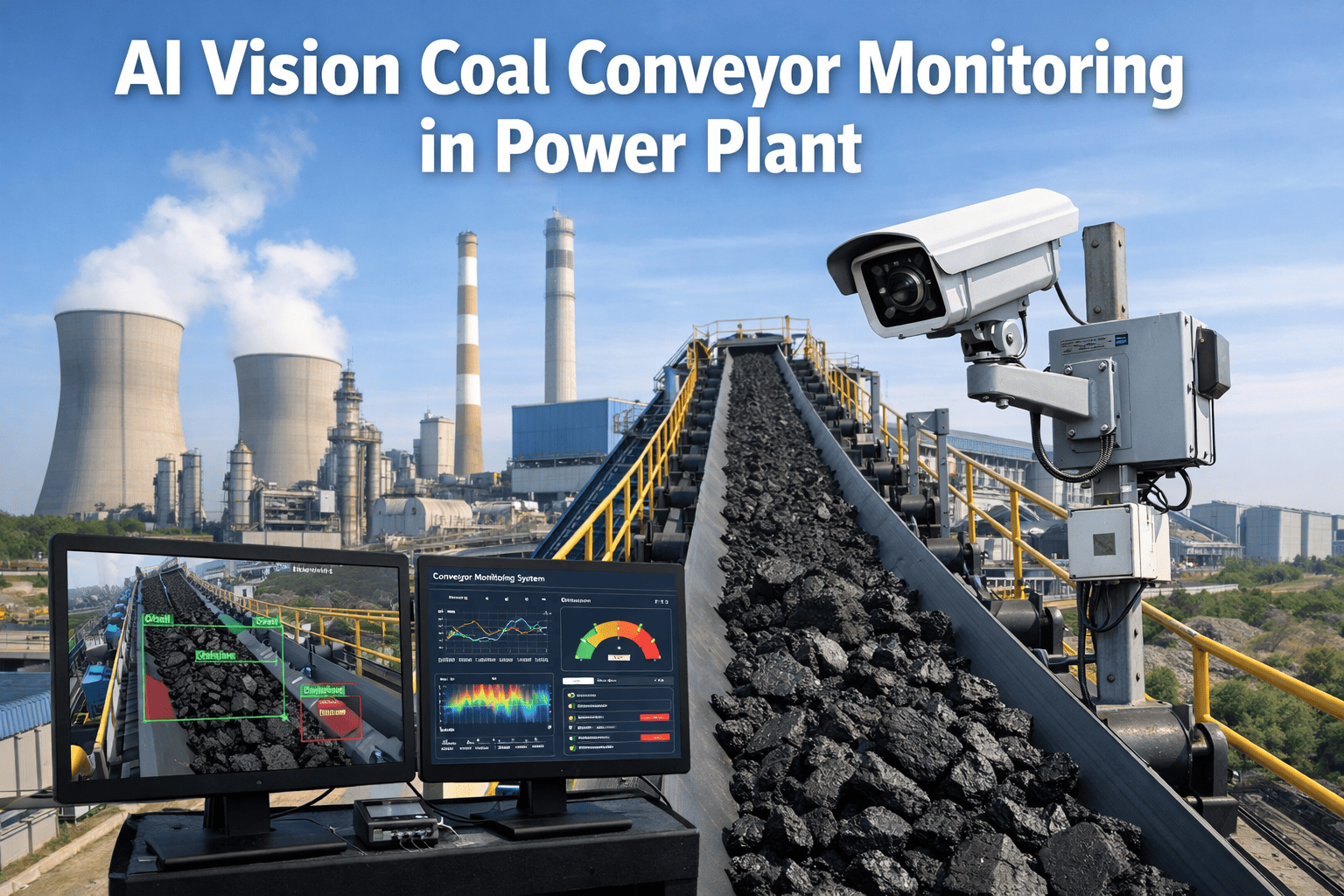
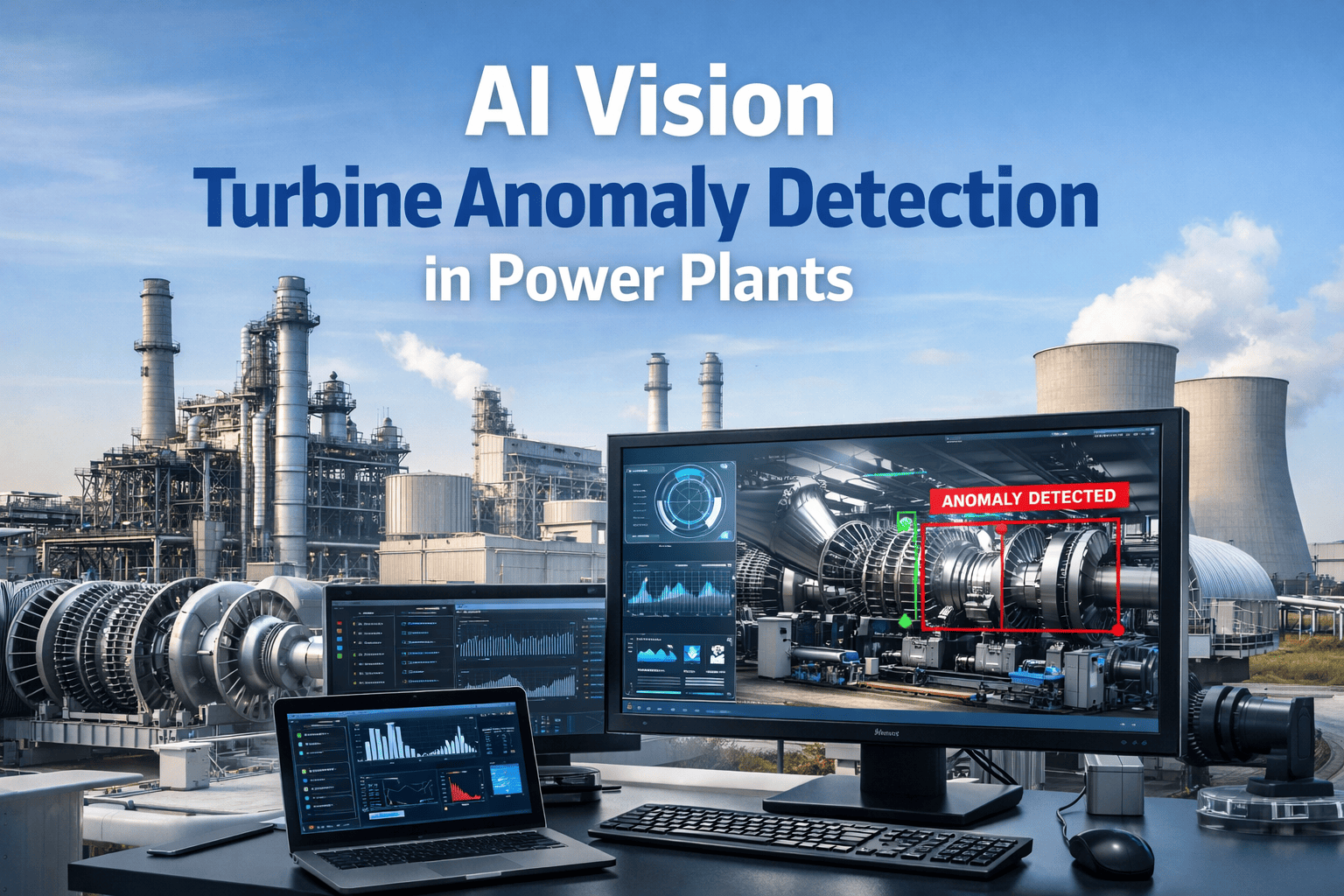
At 6:14 AM on a Thursday in 2024, a maintenance technician at a 600MW coal-fired power plant walked into a confined boiler maintenance area without his hard hat, safety harness, or gas detector. Two CCTV cameras recorded the entire entry. No one was watching the feeds. Forty-three minutes later, he lost consciousness from an undetected CO buildup. He was found 90 minutes after that — by a colleague who happened to walk by. He survived, but spent 11 days in the ICU. Total cost: $2.3 million in medical, legal, and operational impact. Six months later, the same plant deployed AI-powered vision monitoring. The system now tracks PPE compliance on every person entering every zone, 24/7. When a contractor entered the same boiler area without respiratory protection last month, the AI flagged it in 1.7 seconds. A zone-specific alarm sounded. The supervisor received a push notification with a timestamped image. The contractor was equipped and re-entered within four minutes. No injury. No incident report. No ICU bill. The cameras didn't change. The intelligence behind them did.
AI Vision for Industrial Safety
Your Cameras See Everything.
Your Team Catches Almost Nothing.
The average power plant has 80-200 CCTV cameras generating 4,800+ hours of footage per day. Humans monitoring live feeds miss up to 90% of safety violations after just 20 minutes of watching. AI vision never blinks, never fatigues, and catches violations in under 2 seconds — 24 hours a day, 365 days a year.
$24.7B
Computer vision market size, 2025
5,070
Fatal work injuries in the U.S., 2024
<2 sec
AI detection time for safety violations
90%
Violations missed by human monitors after 20 min
Sources: Global Market Insights 2025 · U.S. Bureau of Labor Statistics 2025 · KPMG VisionAI Report 2025
The Safety Blind Spots Hiding in Plain Sight
Power plants are among the most hazardous industrial environments on earth — high-voltage systems, extreme temperatures, confined spaces, rotating machinery, chemical exposure, and fall risks at every elevation. Traditional safety programs rely on manual inspections, safety audits, and human surveillance operators. But the gap between what safety rules require and what actually happens on the plant floor is enormous — and it's in that gap where injuries and fatalities occur.
72%
of workplace injuries involve human factors — wrong PPE, wrong zone, wrong procedure
90%
detection accuracy drop for CCTV operators after just 20 minutes of continuous monitoring
4,800+
hours of footage generated daily at a typical plant — virtually none reviewed in real time
43 min
average time to discover a safety incident when relying on manual monitoring alone
<2 sec
AI vision detection time for PPE violations, zone intrusions, and unsafe behaviors
24/7
continuous monitoring with zero fatigue, zero blind spots, zero attention drift
What AI Vision Detects Inside Your Power Plant
AI-powered computer vision transforms passive CCTV cameras into active safety sentinels. Using deep learning models trained on millions of industrial safety scenarios, the system analyzes every frame from every camera — detecting hazards, violations, and dangerous behaviors that no human monitoring team could consistently catch across an entire plant.
Hard Hat Detection
Identifies workers without head protection in mandatory hard hat zones, even in low-light or cluttered backgrounds
Safety Vest / Hi-Vis
Detects absence of high-visibility clothing in zones near moving equipment, vehicles, or crane operations
Safety Glasses & Face Shields
Monitors eye and face protection compliance in grinding, welding, chemical handling, and high-pressure areas
Respiratory Protection
Verifies mask and respirator usage in confined spaces, chemical storage, and areas with airborne particulate risk
Harness & Fall Protection
Detects workers at height without fall arrest harnesses — the leading cause of OSHA citations in FY2024
Restricted Zone Intrusion
Alerts when unauthorized personnel enter high-voltage areas, confined spaces, or active maintenance zones
Exclusion Zone Enforcement
Monitors crane swing radius, heavy lift perimeters, and equipment clearance zones in real time
Vehicle-Pedestrian Proximity
Detects dangerous proximity between workers and forklifts, loaders, or transport vehicles on plant roads
Lone Worker Monitoring
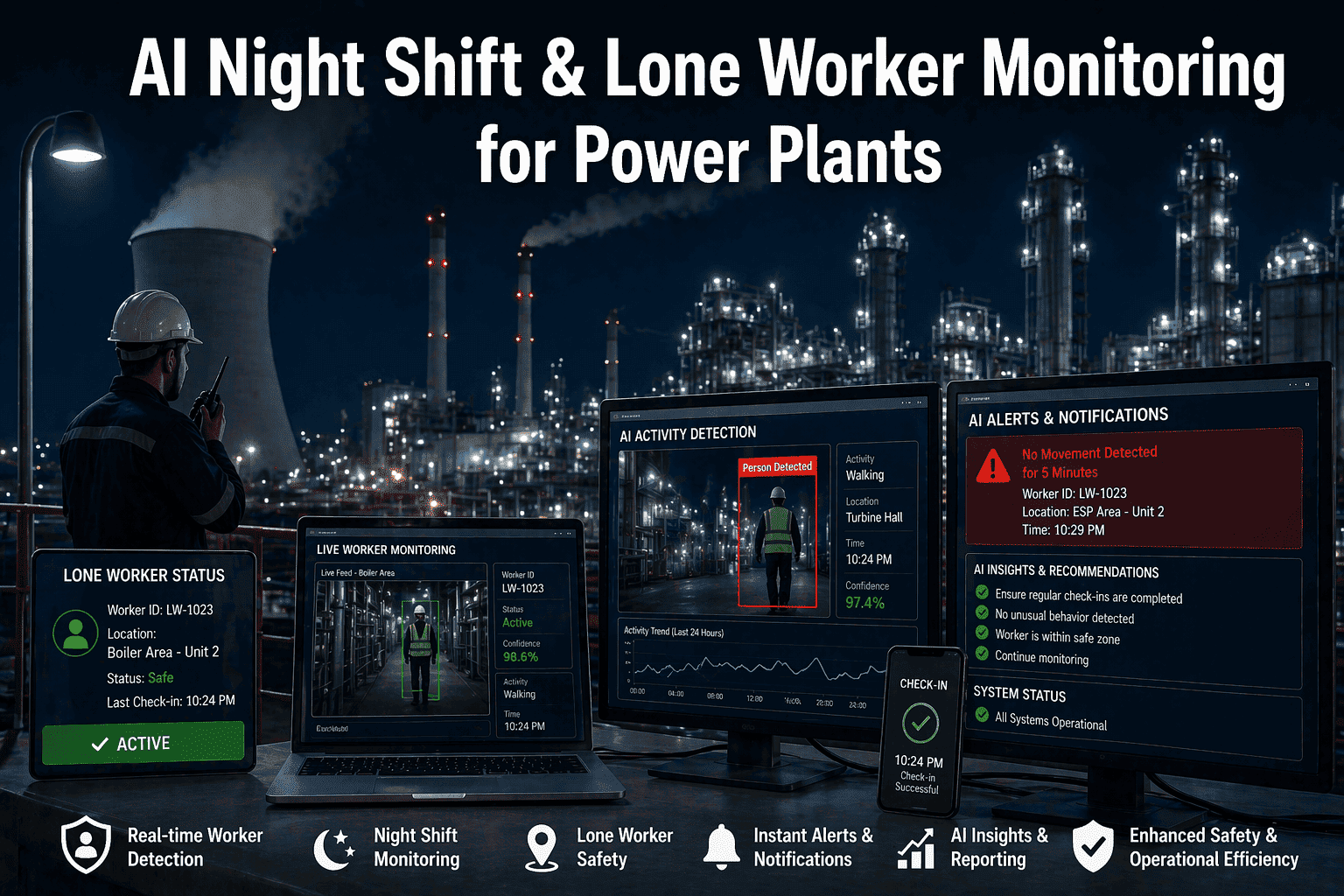
Tracks workers in isolated areas and triggers alerts if no movement is detected for configurable time thresholds
Headcount & Muster Verification
Instant personnel counting at assembly points during evacuation — eliminates manual roll-call delays
Smoke & Fire Detection
Visual smoke and flame recognition faster than conventional heat or ionization detectors — catches incipient fires
Spill & Leak Detection
Identifies oil, chemical, and water spills on floors, equipment, and containment areas before slip-and-fall incidents
Housekeeping Violations
Flags blocked egress routes, improperly stored materials, and obstructed safety equipment access points
Fall & Collapse Detection
Recognizes when a worker falls, collapses, or remains motionless — triggers immediate emergency response
Thermal Anomaly Correlation
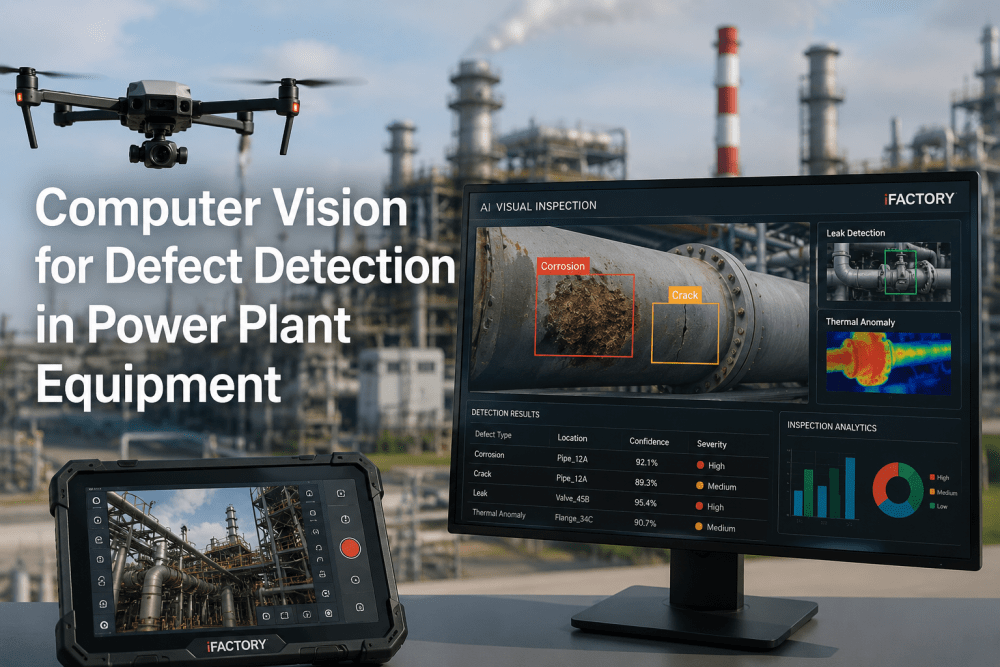
Pairs visual feeds with thermal camera data to detect hot spots on equipment, cables, and switchgear panels
How AI Vision Works — From Camera Feed to Safety Action
AI vision doesn't require new cameras or new infrastructure. It connects to your existing CCTV network and transforms passive recording into active, intelligent monitoring. Every frame is analyzed, every violation is flagged, and every alert is delivered to the right person in the right format — in under 2 seconds from detection to notification.
01
Camera Feed Ingestion
AI connects to your existing IP camera network via RTSP/ONVIF — no camera replacements needed. Edge processing units decode video streams at the source, eliminating bandwidth bottlenecks. Each camera feed is analyzed at 15-30 frames per second.
Continuous
02
Deep Learning Inference
Convolutional neural networks (CNNs) trained on millions of industrial images analyze each frame for PPE presence, body posture, zone boundaries, object classification, and behavioral patterns. Models run on edge GPUs — no cloud dependency for safety-critical detection.
50-200ms
03
Context-Aware Classification
The system doesn't just detect "no hard hat" — it knows which zone the worker is in, what rules apply to that zone, what time of day it is, and whether the area is under active maintenance permit. Context reduces false alarms by up to 85% compared to simple detection models.
100-300ms
04
Alert & Action
Violations trigger tiered responses: on-screen pop-ups for control room operators, push notifications to zone supervisors, audible alarms at the location, and auto-captured evidence packages with timestamped images. Every event is logged for compliance reporting and trend analysis.
<2 sec total
Your Cameras Are Already Installed. The Intelligence Isn't.
iFactory connects to your existing CCTV infrastructure and transforms passive surveillance into an AI-powered safety system that catches violations in under 2 seconds. No new cameras. No infrastructure overhaul. Just smarter safety from day one.
The Safety Dashboard: From Footage to Intelligence
AI vision doesn't just detect violations — it transforms safety from reactive incident management into a data-driven discipline. Every detection feeds a centralized safety intelligence dashboard that reveals patterns, quantifies risk, and measures the effectiveness of your safety program with hard numbers instead of gut feeling.
Real-Time Violation Feed
Live stream of every detected violation across every camera — filterable by zone, violation type, severity, and time. Each entry includes a timestamped snapshot, the AI's classification confidence, and the assigned zone supervisor. One screen replaces hours of footage review.
Heatmap Analytics
Spatial heatmaps show where violations cluster — which zones have the most PPE non-compliance, which corridors see the most near-misses, and which time slots are most dangerous. Target your safety interventions where the data says they'll have the most impact.
Trend Analysis & Leading Indicators
Track violation rates over weeks and months. A rising PPE non-compliance trend in Zone 3 is a leading indicator of future incidents — you see the risk building before the accident happens. Traditional safety programs only measure lagging indicators like injury counts.
Compliance Scoring
Every zone, every shift, every contractor team gets a quantified safety compliance score based on AI-observed behavior. Use scores for contractor performance reviews, safety incentive programs, and regulatory audit evidence. Objective data replaces subjective assessments.
Automated Compliance Reports
Generate OSHA-ready incident logs, near-miss reports, and zone-specific safety summaries automatically. Each report includes AI-captured evidence, violation classification, response time metrics, and corrective action documentation. Audit preparation drops from days to minutes.
ROI of AI Vision Safety
Workplace injuries don't just cost lives — they cost millions. OSHA penalties, medical expenses, legal liability, lost productivity, and insurance premium increases compound into staggering totals. AI vision pays for itself by preventing the incidents that generate these costs.
Cost Per Serious Injury
$42,000+
Average direct cost of a single workplace injury requiring medical treatment. Include indirect costs — lost productivity, investigation time, replacement labor — and the true cost reaches $120,000-$200,000 per incident.
OSHA Penalty Range
$16K-$165K
Per serious violation. Willful violations can reach $165,514 per instance. OSHA's instance-by-instance citation policy means a single inspection can generate millions in cumulative penalties for repeated violations.
Incident Reduction
60-80%
Plants deploying AI vision safety systems consistently report 60-80% reduction in recordable safety incidents within the first 12 months — driven by immediate violation detection and behavioral change from knowing AI is watching.
Response Time
43 min to 2 sec
Average incident discovery time drops from 43 minutes with manual monitoring to under 2 seconds with AI vision. For CO exposure, electrical contact, or fall incidents, that time difference is the difference between a near-miss and a fatality.
Insurance Savings
15-30%
Documented AI safety systems with compliance scoring and incident reduction data strengthen premium negotiations. Multiple insurers now offer discounts for facilities with AI-verified safety monitoring programs.
System Payback
3-6 Months
Preventing a single serious injury or a single OSHA willful-violation penalty covers the cost of deploying AI vision across an entire plant. Most facilities achieve full ROI within the first quarter of operation.
Why iFactory for Power Plant Safety Vision
01
Works With Your Existing Cameras
Any IP camera, any brand, any resolution — iFactory connects via standard RTSP/ONVIF protocols. Hikvision, Dahua, Axis, Bosch, Hanwha, or any ONVIF-compliant camera becomes an AI-powered safety sensor. Your existing CCTV investment is preserved; our intelligence layer adds on top.
02
Edge-First Processing — No Cloud Dependency
All safety-critical AI inference runs on edge hardware at your plant. Sub-2-second detection-to-alert times are guaranteed regardless of internet connectivity. Video feeds never leave your facility unless you explicitly configure cloud analytics. Data sovereignty and latency requirements are both satisfied.
03
Power Plant-Specific AI Models
Generic safety AI mistakes a welding mask for a face shield violation. iFactory's models are trained on power plant environments — boiler houses, turbine halls, switchyards, coal yards, cooling towers, and confined spaces. They understand the difference between a maintenance permit zone and a permanent exclusion zone.
04
Integrated With Your Safety Management System
iFactory connects to SAP EHS, Intelex, Enablon, Cority, and other EHS platforms via API. AI-detected violations automatically generate incident records, near-miss reports, and corrective action workflows in your existing safety management system — closing the loop from detection to resolution without manual data entry.
Every Second Without AI Vision Is a Second You Can't Get Back
iFactory transforms your passive CCTV network into an always-on, AI-powered safety guardian. Detect PPE violations in under 2 seconds, prevent zone intrusions before they become incidents, and build a data-driven safety culture backed by objective AI evidence.
Frequently Asked Questions
Do we need to replace our existing CCTV cameras?
No. iFactory works with any IP camera that supports RTSP or ONVIF protocols — which includes virtually all modern CCTV systems. The AI processing happens on edge compute units connected to your existing camera network, not inside the cameras themselves. If your cameras are analog, we can integrate via digital encoders. Most plants start generating safety insights from their existing camera infrastructure on day one.
How accurate is AI PPE detection in real plant conditions?
iFactory's PPE detection models achieve 94-98% accuracy in real-world power plant conditions — including low light, steam, dust, partial occlusion, and varying camera angles. Context-aware classification reduces false positives by up to 85% compared to basic detection models by understanding zone-specific rules, shift schedules, and maintenance permit status. The system continuously improves as it processes more frames from your specific environment.
Does AI vision raise privacy concerns for workers?
iFactory is designed for safety compliance, not individual surveillance. The system detects PPE and behavioral violations — it does not use facial recognition or track individual worker identities unless the facility explicitly enables personnel identification features. All video processing happens on-premise with no cloud transmission by default. The system can be configured to anonymize faces in dashboards while still flagging zone-level violations for supervisor review.
How many cameras can one edge unit handle?
A single iFactory edge compute unit processes 8-16 camera feeds simultaneously at full inference resolution, depending on the complexity of detection models enabled per feed. For a typical 200-camera power plant, 15-20 edge units provide full coverage. Units can be deployed incrementally — start with your highest-risk zones (boiler house, switchyard, confined spaces) and expand coverage over time.
Can AI vision detect hazards at night or in low-light conditions?
Yes. iFactory's models are trained on low-light, infrared, and thermal camera feeds in addition to standard visible-spectrum video. Night-shift safety monitoring performs at equivalent accuracy to daytime detection when paired with IR-capable cameras. For areas with extreme low light, pairing standard cameras with thermal imaging provides complete hazard detection coverage regardless of ambient lighting conditions.