In September 2024, a 660MW supercritical coal plant in Gujarat scheduled a turbine valve replacement during a planned outage. The engineering team estimated 14 days. On day 3, they discovered an unexpected rotor clearance issue that required redesigning the bearing assembly alignment. The outage extended to 29 days — 15 unplanned days at $380,000/day in lost generation. Total damage: $5.7 million. The root cause wasn't mechanical failure. It was a planning failure. The team couldn't see the rotor-bearing interaction under live thermal conditions from static engineering drawings. Eleven months later, the same plant built a digital twin. Before the next outage, engineers ran 47 virtual simulations of the valve replacement procedure on the twin — with live thermal expansion data, actual bearing wear measurements, and real-time clearance calculations. The simulation revealed the same rotor clearance conflict on attempt 12. The fix was designed, stress-tested, and validated — all virtually. The actual outage took 11 days. Three days ahead of the original estimate. Zero surprises. The plant didn't change. The ability to see its future did.
Digital Twin Technology for Power Generation
Stop Guessing What Your Plant Will Do.
Start Knowing.
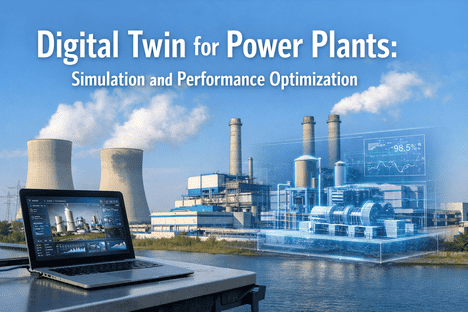
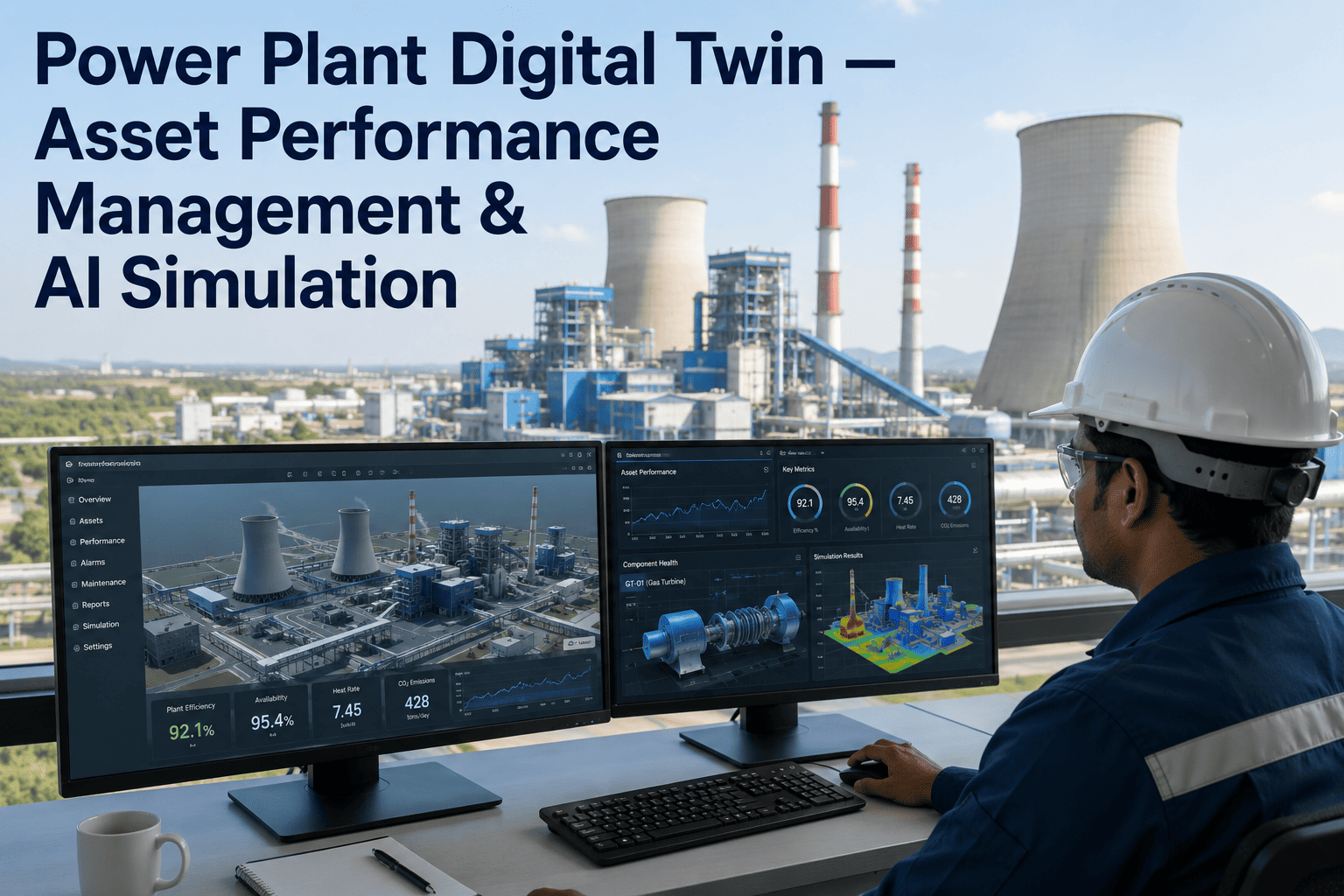
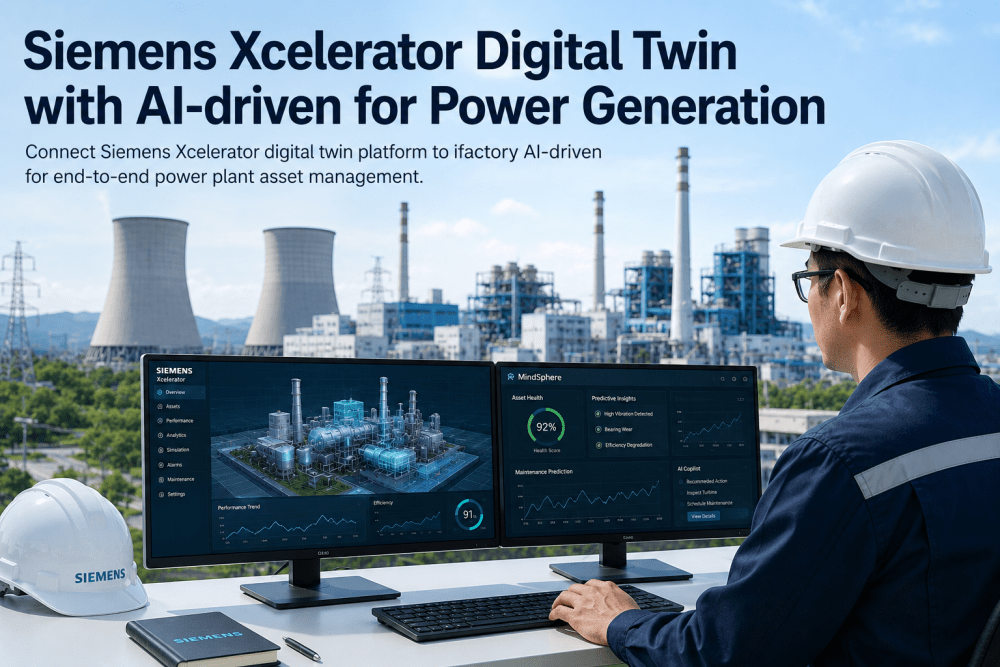
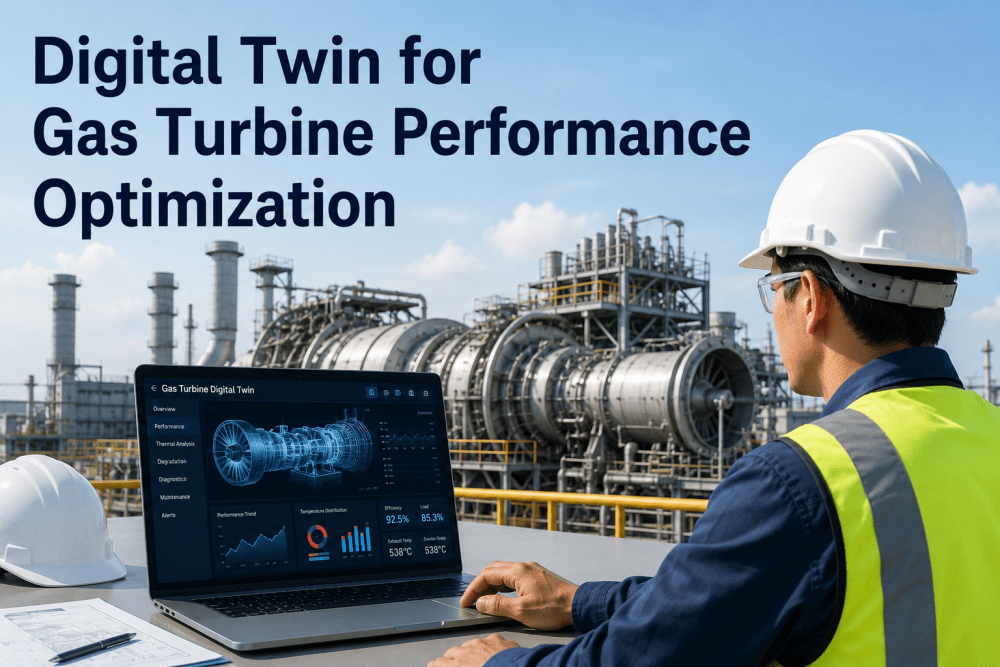
A digital twin is a living, breathing virtual replica of your entire power plant — synchronized with real-time sensor data, continuously learning from operational history, and capable of simulating any scenario before you execute it in the real world. It's the difference between reacting to problems and preventing them before they exist.
$1.88B
Digital twin power plant market, 2025
$35.8B
Global digital twin market size, 2025
41.4%
CAGR of global digital twin market to 2034
$1M+
Annual OPEX savings from boiler digital twins alone
Sources: Business Research Company 2026 · Grand View Research 2025 · Global Market Insights 2025 · TCS Research 2025
What a Digital Twin Actually Is — And What It Isn't
A digital twin isn't a 3D model. It isn't a dashboard. It isn't a SCADA screen with better graphics. A true digital twin is a physics-based, data-synchronized, continuously evolving virtual replica of your physical power plant that behaves exactly like the real thing — because it's built on the same thermodynamic equations, fed by the same sensor data, and updated in real time as your plant operates.
A static 3D CAD model that sits on a server
A dashboard showing live sensor values
A historian database with trend charts
A spreadsheet-based heat balance model
A one-time simulation built during commissioning
A living virtual replica synchronized with real-time plant data
A physics-based model that predicts plant behavior under any condition
A simulation engine that tests "what-if" scenarios risk-free
A continuously learning system that improves as your plant ages
A decision-support platform that quantifies every operational choice
The Three Layers of a Power Plant Digital Twin
A production-grade digital twin isn't a single model — it's a layered architecture where physics, data, and AI work together. Each layer adds a dimension of intelligence that the layers below it cannot achieve alone. Together, they create a virtual plant that doesn't just mirror what's happening — it predicts what will happen and prescribes what should happen.
Layer 3 — Prescriptive AI
Optimization & Decision Support
Machine learning models analyze thousands of simulated scenarios and recommend specific actions: "Reduce excess O2 to 3.1% on burner zone 3 to improve heat rate by 45 Btu/kWh." "Schedule condenser cleaning in 17 days — current fouling will cost $28K if delayed." The AI layer transforms prediction into prescription — not just what will happen, but what you should do about it.
Decisions with dollar values attached
Layer 2 — Predictive Analytics
Anomaly Detection & Forecasting
Compares real-time sensor data against the physics model's expected values. When actual behavior deviates from predicted behavior — bearing temperature 2.3°C above model expectation at current load — the system flags it as an anomaly weeks before any alarm triggers. Predicts remaining useful life of components based on observed degradation rates.
Weeks of early warning before failure
Layer 1 — Physics Engine
Thermodynamic & Mechanical Simulation
First-principles models of every subsystem — boiler combustion, steam cycle thermodynamics, turbine expansion, condenser heat transfer, generator electromagnetics, cooling systems. This layer calculates what the plant should be doing at any given operating point, based on the laws of physics — not historical averages or static design values.
Accurate to 0.1% of actual plant behavior
Real-Time Data Feed
DCS / SCADA
IoT Sensors
PI Historian
Weather Data
Fuel Analysis
Market Prices
What You Can Do With a Digital Twin That You Can't Do Without One
Scenario
Test Before You Touch
Simulate equipment modifications, setpoint changes, and operational procedures on the twin before executing them on the real plant. Discover problems virtually. Validate solutions virtually. Execute with confidence physically.
Example
Simulate a turbine valve replacement procedure with live thermal expansion data — catch clearance conflicts before the outage starts, not during it.
Scenario
Predict the Unpredictable
The twin continuously compares actual plant behavior against physics-based expectations. When reality diverges from the model, something is degrading — even if it hasn't triggered any alarms yet. Catch bearing wear, fouling, leaks, and insulation breakdown weeks before failure.
Example
Detect condenser tube fouling 22 days before it impacts heat rate — schedule cleaning during a planned weekend instead of a forced mid-week outage.
Scenario
Optimize Every Operating Hour
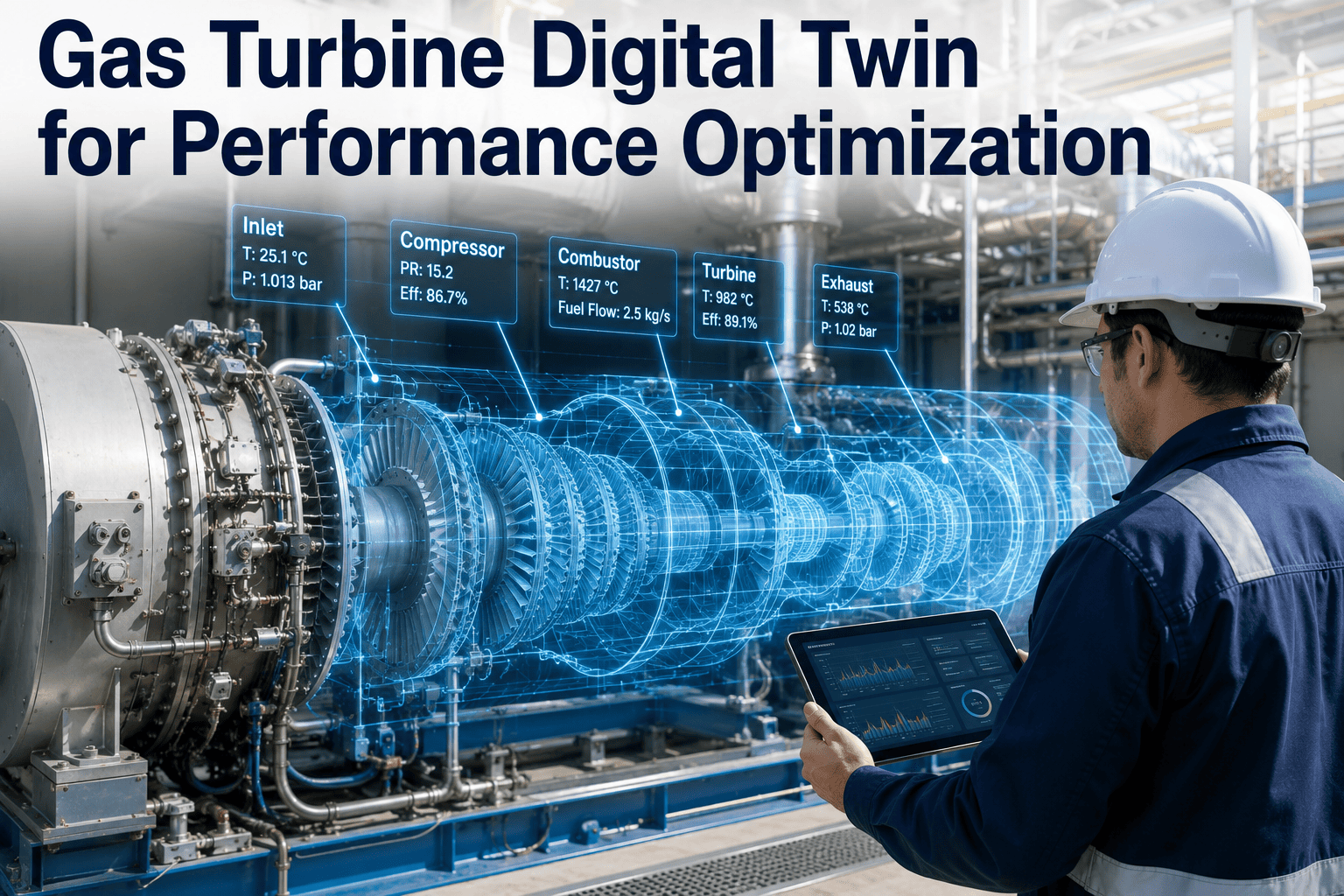
Run thousands of "what-if" simulations to find the optimal operating point for current conditions — fuel quality, ambient temperature, grid demand, equipment health. The twin calculates the best setpoints for heat rate, emissions, and output simultaneously — trade-offs quantified in dollars.
Example
Discover that shifting sootblowing from a fixed 4-hour schedule to condition-based timing saves 90 Btu/kWh and $1.2M annually — validated on the twin before implementation.
Scenario
Train Without Risk
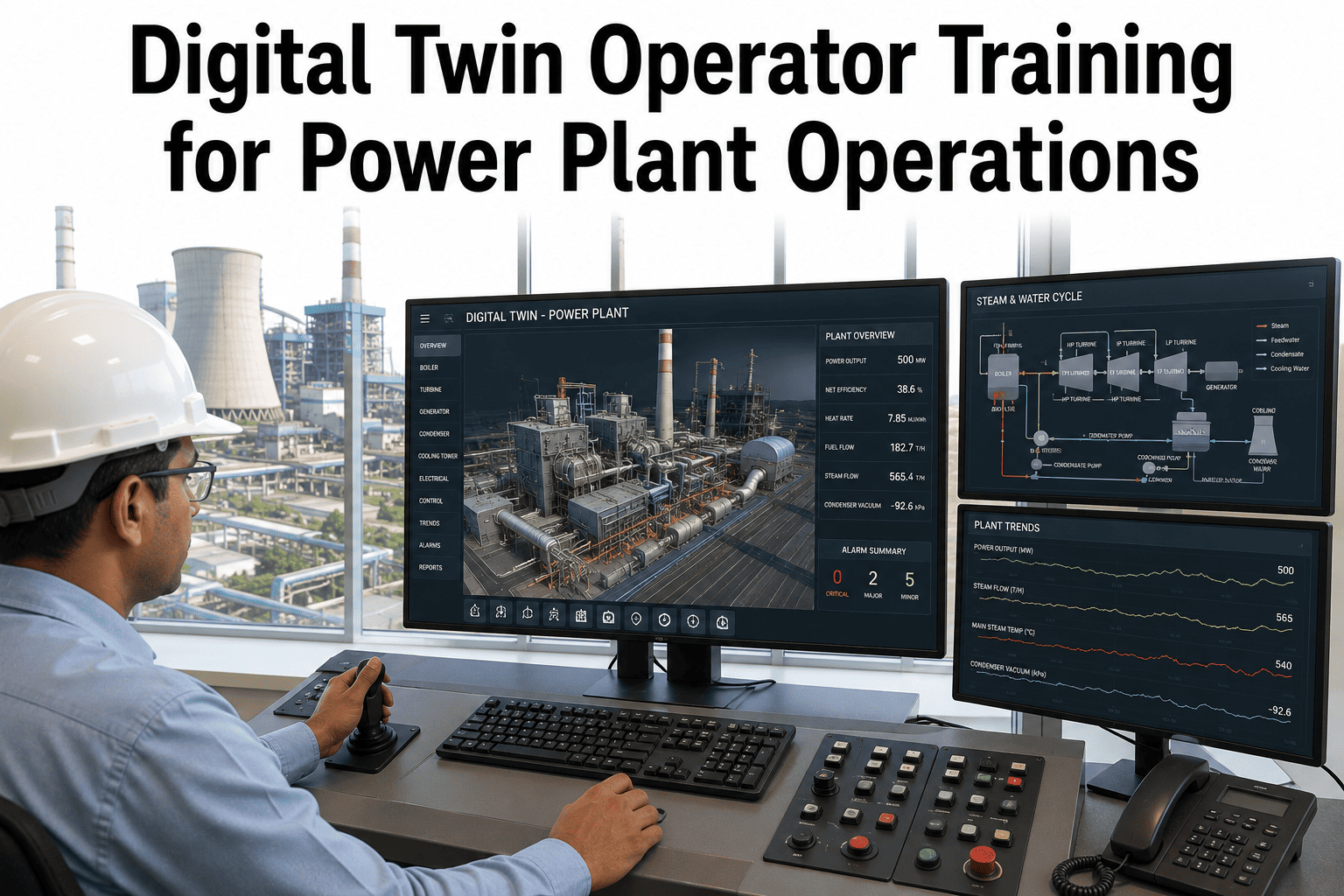
Use the twin as a high-fidelity training simulator. New operators practice emergency procedures, startup sequences, and abnormal operating conditions on a virtual replica that behaves exactly like the real plant — without any risk to equipment, personnel, or production.
Example
Train operators on turbine trip recovery using the actual plant's digital twin — with the plant's real response characteristics, not generic textbook scenarios.
Your Plant Exists in the Physical World. Its Potential Lives in the Digital One.
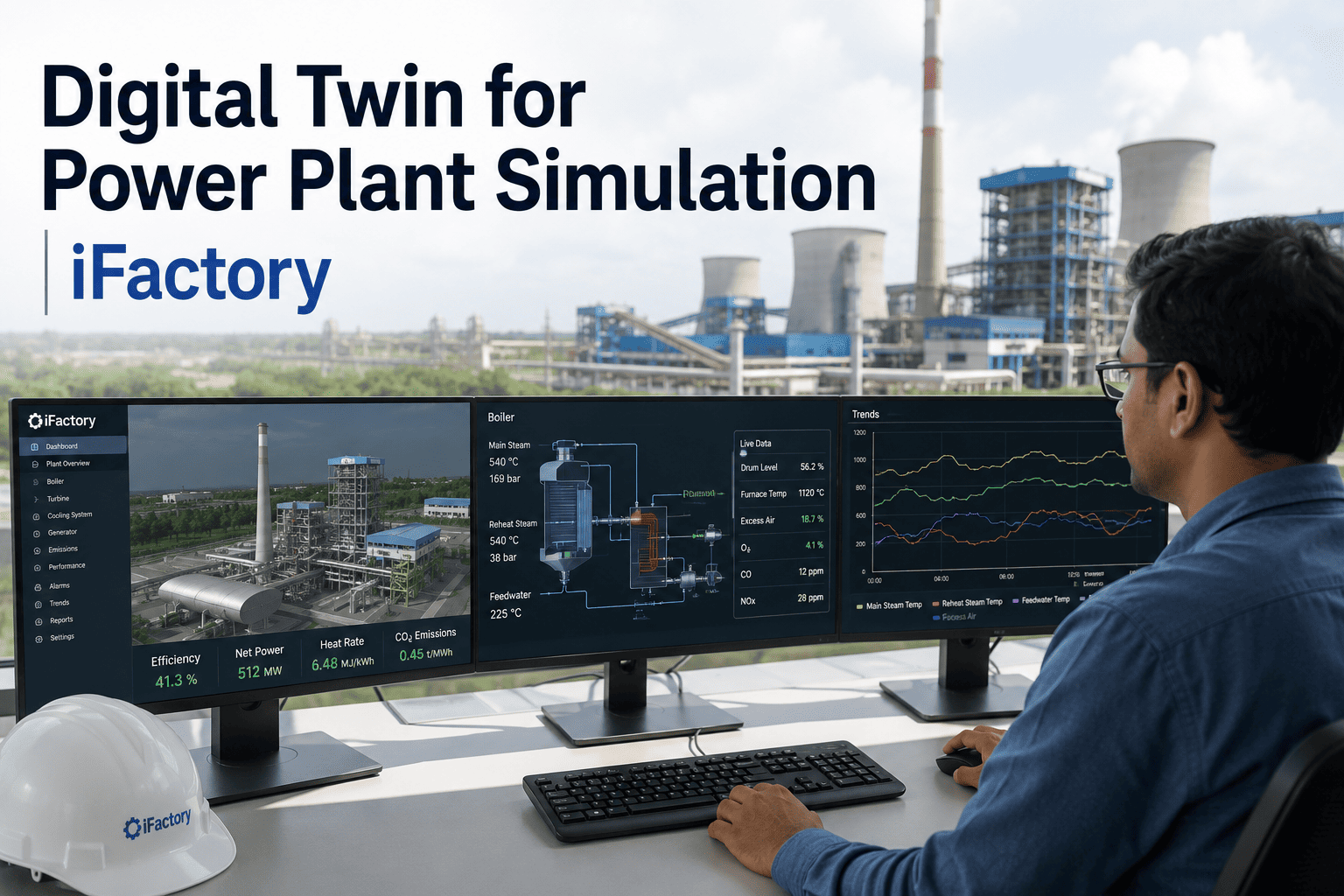
iFactory builds a living digital twin of your power plant — synchronized with your DCS, historian, and sensor network. Simulate any scenario, predict any failure, optimize every operating hour. Risk-free. Cloud or on-premise. From day one.
The ROI of a Power Plant Digital Twin
Heat Rate Savings
$400K-$1.2M/yr
Digital twin-driven optimization of combustion, sootblowing, and condenser performance typically recovers 150-400 Btu/kWh — validated virtually before deployment. Boiler twins alone cut coal consumption by approximately $1M annually.
Outage Time Reduction
30-50%
Virtual outage planning eliminates surprises. Every procedure is simulated with real thermal and mechanical data. Plants using digital twins for outage prep consistently finish 3-7 days ahead of schedule.
Unplanned Downtime
-35 to 50%
Physics-based anomaly detection catches degradation 2-8 weeks before failure. 95% of adopters report positive ROI from prevented forced outages alone.
Emissions Reduction
8-10% NOx
Optimized combustion parameters validated on the twin reduce NOx formation while maintaining or improving heat rate. Boiler digital twins reduce outgoing NOx by 8-10% while cutting reagent usage downstream.
Thermal Efficiency
+0.4-1.3%
Combined cycle plants gain 0.4-0.6% thermal efficiency from twin-optimized gas turbine operation. Coal plants achieve 1.3% improvement through comprehensive AI modeling and optimization analysis.
Full System Payback
6-12 Months
First-year value of $1.2M-$3M combining heat rate savings, prevented outages, and optimized maintenance — against platform investment of $150K-$350K/year. A 4-8x ROI in year one.
Why iFactory for Power Plant Digital Twins
01
Physics + AI Hybrid Architecture
iFactory combines first-principles thermodynamic models with machine learning — not one or the other. The physics engine ensures every simulation is physically valid. The AI layer learns patterns the physics equations don't capture — like fuel-specific fouling rates, operator-dependent startup curves, and seasonal performance variation. Hybrid models outperform pure physics and pure ML alone.
02
Connects to Any DCS, Any Historian, Any Vendor
OPC-UA, Modbus, PI Historian, OSIsoft, Honeywell PHD, GE Proficy, ABB 800xA, Siemens PCS 7 — iFactory integrates with every major control system and data historian. Your existing sensor infrastructure becomes the data backbone of the twin. No hardware replacement. No DCS modification. No vendor lock-in.
03
Built for Power Generation, Not Generic Assets
Generic digital twin platforms model a boiler the same way they model a warehouse. iFactory's models understand Rankine cycle thermodynamics, pulverized fuel combustion kinetics, HP/IP/LP turbine stage efficiencies, condenser heat transfer coefficients, and hydrogen-cooled generator thermal limits. Domain-specific models mean domain-accurate predictions.
04
Fleet-Wide Twin Management
Operating multiple plants? iFactory creates individual twins for each unit and a portfolio-level twin that benchmarks across your fleet. Compare heat rates, degradation rates, and maintenance effectiveness across units. Replicate optimization strategies from your best-performing plant to your worst — with twin-validated evidence that they'll work.
Build Your Plant's Future — Before It Happens
iFactory creates a living digital twin of your power plant that simulates every scenario, predicts every failure, and optimizes every operating hour. Connect your DCS data, deploy the twin, and start making decisions with perfect information.
Frequently Asked Questions
How long does it take to build a digital twin of our power plant?
Phase 1 (Weeks 1-4): Data integration with your DCS/historian and sensor mapping. Phase 2 (Weeks 4-8): Physics model calibration using design data and recent performance test results. Phase 3 (Weeks 8-12): AI model training on 6-12 months of historical operational data. Phase 4 (Week 12+): Live twin deployment with continuous model refinement. Most plants have a production-grade twin operational within 90 days, with accuracy improving continuously as the system processes more operating data.
What data does the digital twin need from our plant?
The twin ingests data from three sources: real-time sensor data from your DCS/SCADA (temperatures, pressures, flows, valve positions, electrical parameters), historical data from your PI Historian or equivalent (minimum 6 months, ideally 2+ years), and design data (heat balance diagrams, equipment specs, performance curves). Most plants already collect 90%+ of the data a twin needs — the gap is usually in how that data is used, not whether it exists.
Can a digital twin work for older plants without modern sensors?
Yes, with adaptation. Older plants typically have fewer sensor points, but the core measurements needed for a meaningful twin — steam temperatures, pressures, flow rates, flue gas composition, electrical output — are present in virtually any plant built after 1980. For sensor gaps, iFactory uses "soft sensors" — physics-based calculations that infer unmeasured parameters from available data. As you add sensors over time, the twin's accuracy improves incrementally.
What types of power plants can have digital twins?
iFactory supports digital twins for all major power plant types — coal-fired subcritical and supercritical, natural gas simple cycle and combined cycle (CCGT), oil-fired, biomass, waste-to-energy, hydroelectric, nuclear (non-reactor systems), and hybrid renewable plants. The physics models adapt to each plant's specific thermodynamic cycle, equipment configuration, and operational characteristics.
How does a digital twin differ from our existing plant performance monitoring system?
Traditional performance monitoring shows you what happened. A digital twin shows you why it happened, what will happen next, and what you should do about it. Monitoring systems display sensor values and trends. A digital twin compares those values against physics-based expectations, quantifies the efficiency impact of every deviation, simulates the outcome of corrective actions before you take them, and predicts equipment remaining useful life. It's the difference between a thermometer and a doctor.