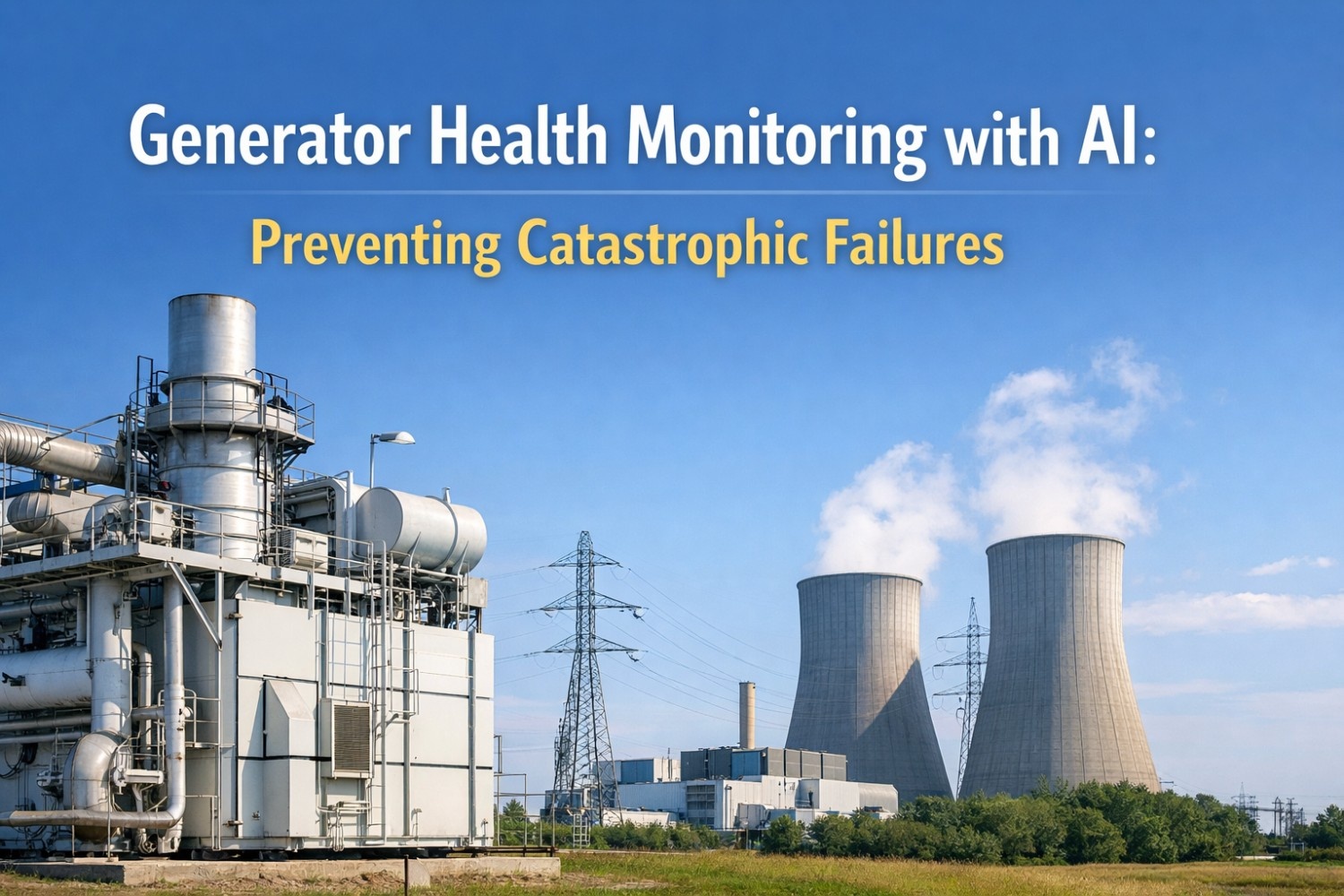
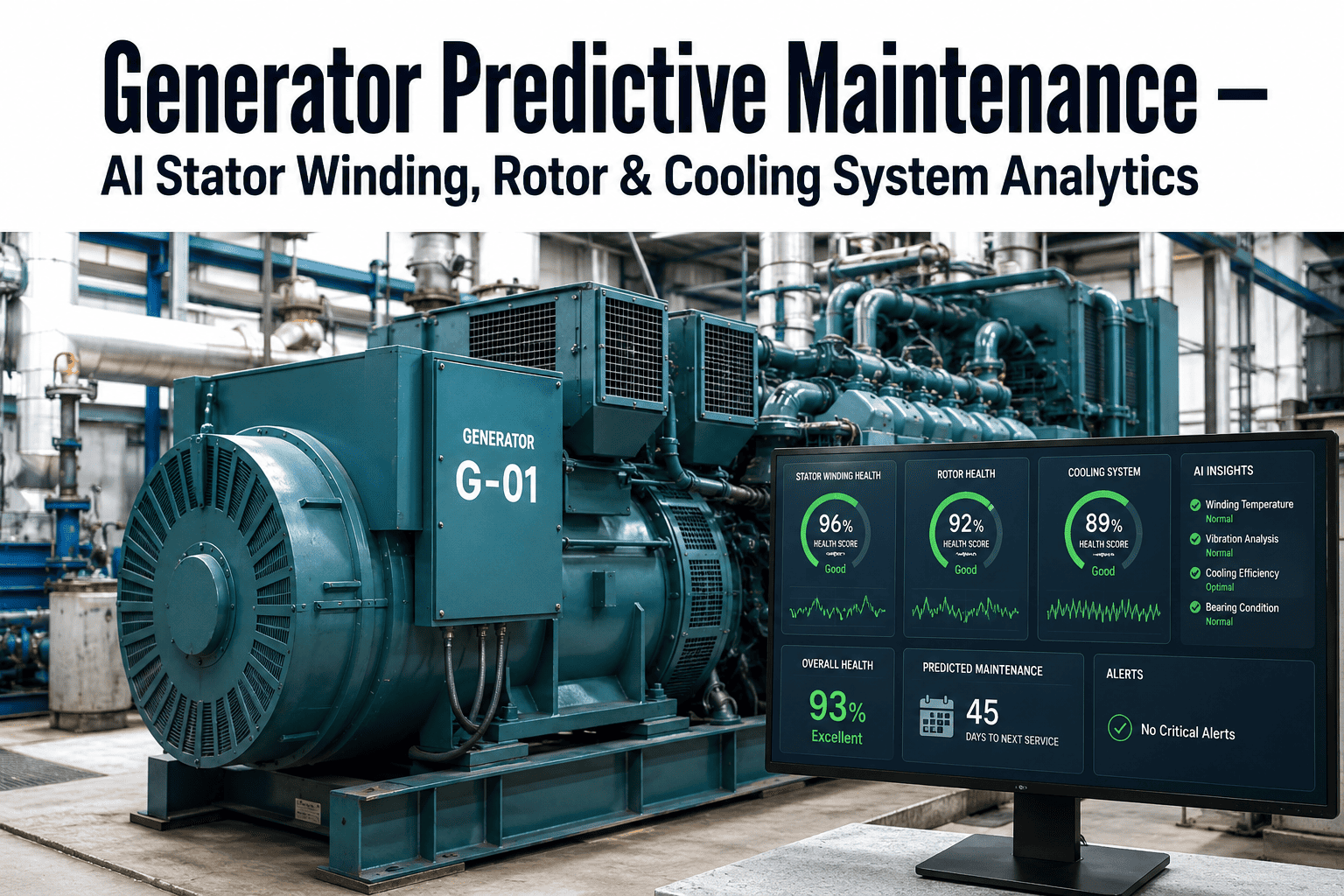
Generator Health Monitoring with AI: Preventing Catastrophic Failures
By shreen on March 9, 2026
A single generator failure costs power plants an average of $1.2 million per incident when factoring lost generation, emergency turbine-generator repairs, replacement power procurement, and regulatory penalties. Generator winding insulation breakdown, rotor eccentricity, and bearing degradation are among the most destructive — and most preventable — failure modes in power generation. AI-powered health monitoring detects these conditions 30–90 days before catastrophic failure, converting million-dollar emergencies into planned $50K maintenance windows. Sign up free to start monitoring your generator fleet today and see which assets are silently approaching failure thresholds right now.
Generator Reliability Crisis — 2026
12%
Of all generator failures result in catastrophic damage requiring full rewind or replacement
45 Days
Average lead time AI provides before generator winding insulation reaches critical failure
$1.2M
Average total cost of a single unplanned generator outage including downtime and repairs
85%
Of generator degradation patterns are detectable with continuous AI monitoring before symptoms appear
Why This Matters Now
The average age of installed generators in the U.S. power fleet now exceeds 30 years. As these assets push past their original design life, failure rates accelerate exponentially — particularly in stator windings, rotor insulation, and hydrogen seal systems. Traditional time-based inspection schedules were designed for younger equipment operating in baseload mode. Today's generators face aggressive cycling, higher thermal stress, and degraded insulation that demands continuous AI-driven monitoring. Plants that wait for the next scheduled outage to assess generator health are gambling with their highest-value rotating asset.
Traditional generator maintenance relies on periodic offline testing — partial discharge measurements during scheduled outages, visual inspections of accessible components, and oil analysis at fixed intervals. Between these snapshots, generators operate blind. Insulation degradation, rotor thermal asymmetry, bearing wear, and hydrogen seal leaks develop progressively — but remain invisible until they cross the threshold into catastrophic failure. By the time vibration alarms trigger or protection relays trip, the damage is already done.
Periodic testing misses progressive degradationWinding failures between outage cyclesNo real-time insulation trackingReactive response to protection trips
With AI Health Monitoring
What Continuous AI Surveillance Delivers
AI health monitoring systems ingest streaming data from partial discharge sensors, vibration accelerometers, temperature RTDs, hydrogen purity analyzers, and stator cooling water flow meters. Machine learning models build individualized behavioral baselines for each generator — not generic OEM thresholds, but models that learn your specific unit's operating signature. When parameters begin deviating from baseline, the system scores the anomaly and estimates time to actionable degradation, giving operations teams weeks of lead time to plan intervention.
Continuous partial discharge trending30–90 day failure forecastingAutomated severity scoringWork orders generated before alarms
Critical Failure Modes AI Detects
6 Generator Failure Patterns That AI Catches Early
Each failure mode below produces subtle data signatures that AI models detect weeks before conventional alarms or scheduled inspections. Sign up to deploy AI monitoring on your generators and catch these conditions while repair costs are still measured in thousands, not millions.
01
Stator Winding Insulation Degradation
Partial discharge activity increases gradually as insulation ages and develops voids. AI models trained on PD pulse patterns distinguish normal aging from accelerated degradation caused by thermal cycling, contamination, or mechanical loosening — flagging high-risk windings 45–90 days before failure.
Undetected cost: $800K–$2M full rewind
02
Rotor Thermal Sensitivity and Shorted Turns
Shorted turns in rotor windings cause thermal asymmetry that manifests as subtle changes in shaft vibration at specific load levels. AI correlates vibration spectra with load, temperature, and hydrogen pressure to detect turn-to-turn shorts that traditional vibration analysis alone misses.
Undetected cost: $500K–$1.5M rotor repair
03
Bearing Wear and Lubrication Breakdown
Generator bearings operate under extreme load at high speed. AI monitors vibration frequency spectra for bearing defect frequencies (BPFO, BPFI, BSF), cross-referencing with oil debris particle counts and temperature rise rates to detect early-stage race defects and lubrication film breakdown weeks before audible damage.
Undetected cost: $200K–$600K + secondary damage
04
Hydrogen Seal System Degradation
Hydrogen-cooled generators depend on seal oil systems to maintain gas pressure and purity. AI tracks hydrogen consumption rates, seal oil differential pressure trends, and purity analyzer readings to detect seal degradation patterns that precede major gas leaks — a safety-critical failure mode that can force immediate unit trips.
Undetected cost: $300K–$900K + safety risk
05
Stator Core Looseness and Hot Spots
Core lamination looseness creates localized hot spots that damage adjacent insulation and can ignite hydrogen gas in worst-case scenarios. AI monitors distributed temperature sensors and correlates thermal patterns with load and cooling parameters to identify core regions developing abnormal heating before damage spreads.
Undetected cost: $1M–$3M core restacking
06
Excitation System Anomalies
Voltage regulator instability, brush wear on older excitation systems, and thyristor degradation in static exciters all produce electrical signatures that AI detects through field voltage and current waveform analysis. Early detection prevents AVR hunting, power swings, and under-excitation trips that compromise grid stability.
Undetected cost: $150K–$400K + grid penalties
See AI Generator Monitoring in Action
Watch iFactory Detect a Stator Winding Fault 62 Days Before Protection Trip
In our 30-minute demo, we walk through real partial discharge trending data, show how anomaly scores escalate through informational → warning → critical stages, and demonstrate the automated work order workflow that gets the right crew mobilized before damage compounds.
How AI Generator Monitoring Works: The Detection Loop
This continuous cycle runs 24/7 across every monitored generator — converting raw sensor streams into prioritized maintenance actions without manual intervention.
Step 01
Multi-Sensor Data Ingestion
Partial discharge couplers, vibration accelerometers, RTD temperature arrays, hydrogen purity analyzers, stator cooling water flow sensors, and shaft voltage monitors stream data continuously. Each data point is time-stamped and tagged to the specific generator, bearing, or winding zone it represents.
Step 02
Individualized Baseline Modeling
Machine learning algorithms build a unique operating signature for each generator — accounting for your specific load profile, cooling configuration, ambient conditions, and historical maintenance state. The model learns what normal looks like for your unit, not a generic manufacturer spec, and continuously refines accuracy as more data accumulates.
Step 03
Anomaly Scoring and Failure Mode Classification
When sensor readings deviate from the established baseline, the AI assigns an anomaly score and classifies the probable failure mode — distinguishing between bearing degradation, insulation breakdown, rotor eccentricity, cooling system issues, and excitation faults. Each alert includes estimated severity, predicted time to actionable threshold, and recommended response.
Step 04
Automated Work Order and Outage Coordination
Critical alerts automatically generate work orders in the CMMS — pre-loaded with the diagnosed fault, required tooling, safety procedures, OEM bulletin references, and parts requirements. If the intervention requires a unit shutdown, the system recommends the optimal maintenance window based on market conditions, load forecast, and fleet availability to minimize revenue impact.
AI Monitoring vs. Traditional Generator Inspection
Side-by-side comparison of detection capability, response speed, and cost impact between conventional periodic inspection programs and continuous AI-powered health monitoring.
Detection and Response Comparison
Capability
Traditional Periodic Testing
AI Continuous Monitoring
Advantage
Insulation Assessment
Offline PD testing every 2–4 years
Continuous online PD trending 24/7
Real-time degradation tracking
Bearing Health
Quarterly vibration routes
Continuous spectral analysis with AI pattern recognition
Defects caught 60+ days earlier
Rotor Condition
Flux probe test during outages
Load-correlated vibration + thermal modeling
Shorted turns detected under load
Detection Window
0 days (condition unknown between tests)
30–90 days advance warning
Planned vs. emergency response
Cost per Major Save
N/A — failures not prevented
$50K–$100K planned repair
10–20x cost reduction per event
Hydrogen System Monitoring
Daily manual log readings
Continuous trend analysis with leak rate modeling
Seal failures predicted weeks early
Work Order Response
Manual creation after alarm or trip
Automated generation with fault diagnosis
Zero-delay maintenance dispatch
Documentation
Manual test reports, filed separately
Automated audit trail with full history
Compliance-ready at all times
Documented Results from AI Generator Monitoring Programs
These metrics represent verified outcomes from power generation facilities running iFactory's AI monitoring platform on generator assets for 12 months or more.
74%
Reduction in unplanned generator outages
45%
Lower total generator maintenance spend
62 Days
Average advance warning before critical threshold
92%
Anomaly detection accuracy after 6-month learning period
Sign up free and start building your generator health baselines today. Most facilities detect their first actionable anomaly within 60 days of sensor connection.
What iFactory's Generator Monitoring Platform Includes
Online Partial Discharge Analytics
Continuous PD monitoring with pulse pattern recognition that distinguishes slot discharge from internal voids, surface tracking, and end-winding arcing — each requiring different maintenance responses.
Stator Protection
Multi-Site Fleet Dashboard
Centralized health view across every generator in your fleet — ranking units by risk score, showing trending parameters, and enabling remote decision-making without dispatching crews for routine assessments.
Fleet Management
Automated Work Order Dispatch
When anomaly scores cross intervention thresholds, the platform generates CMMS work orders assigned to qualified electrical or mechanical technicians — pre-loaded with fault diagnosis, OEM procedures, and parts requirements.
Workflow Automation
Regulatory Compliance Documentation
Every sensor reading, anomaly alert, work order, and maintenance action is timestamped and stored in an audit-ready format — satisfying NERC, FERC, and insurance documentation requirements without manual report generation.
Compliance Ready
We had a 180MW generator that passed its last offline PD test with acceptable readings. Seven months later, iFactory's online monitoring flagged accelerating partial discharge in the phase B end-winding region. We planned a borescope inspection during a low-demand weekend, confirmed the deterioration, and completed a targeted repair for $68,000. The alternative — if that winding had failed in service — was a full rewind estimated at $1.6 million plus 45 days of lost generation. One detection paid for three years of platform licensing across our entire fleet.
Chief Electrical EngineerCombined Cycle Gas Plant, Southeast U.S. — 540MW Facility
Protect Your Highest-Value Rotating Asset
iFactory AI Generator Monitoring — Continuous Health Intelligence for Every Unit
iFactory connects to your generator's existing sensor infrastructure, builds individualized AI baselines for each unit, detects degradation patterns weeks before failure, and automates the maintenance response workflow from alert to work order to parts procurement. No rip-and-replace. No lengthy commissioning. Start monitoring your first generator today and convert the next catastrophic failure into a planned, low-cost intervention.
Continuous partial discharge, vibration, and thermal monitoring
30–90 day failure forecasting with severity scoring
Automated CMMS work orders with fault-specific procedures
How quickly does AI generator monitoring detect actionable conditions?
The system begins building behavioral baselines from the moment sensors connect — typically achieving reliable anomaly detection within 4–8 weeks as it accumulates enough operational data across different load levels and ambient conditions. Once baselines are established, the platform detects deviations in real time and provides 30–90 day advance warning for most progressive failure modes. Sign up free and start building your baselines today.
Does AI monitoring replace the need for offline generator testing?
AI monitoring complements offline testing — it does not replace it entirely. Certain tests like hi-pot, step voltage, and EL CID core tests still require offline access. What AI monitoring eliminates is the blind gap between scheduled tests. Instead of discovering that insulation has degraded significantly since the last outage, you have continuous visibility into the trajectory and can schedule offline testing based on actual condition rather than arbitrary time intervals.
What sensors does the system require, and can it use existing instrumentation?
iFactory integrates with most existing generator instrumentation — RTDs, vibration probes, hydrogen purity analyzers, seal oil pressure transmitters, and stator cooling water sensors. For partial discharge monitoring, online PD couplers may need to be installed if not already present. The platform is designed to work with your existing sensor infrastructure first, then recommend targeted additions only where monitoring gaps affect critical failure modes. Sign up to get a sensor gap analysis for your generators.
What size generator justifies the investment in AI health monitoring?
Any generator where a single forced outage costs more than the annual monitoring investment — which for most units above 50MW, the math works decisively in favor of monitoring. A single prevented winding failure on a 100MW+ generator saves $500K–$2M, while annual monitoring costs are a fraction of that. Start with your highest-criticality unit and expand as each prevented failure validates the ROI.
How does the system handle generators with different cooling types?
The AI models are cooling-type aware. Hydrogen-cooled, air-cooled, and water-cooled generators each have fundamentally different thermal signatures, failure modes, and critical parameters. The platform's baseline modeling accounts for cooling medium, flow rates, pressure differentials, and ambient conditions specific to each unit's configuration — ensuring anomaly detection is calibrated to the actual operating environment, not generic thresholds.
Can AI monitoring integrate with our existing DCS and historian systems?
Yes. iFactory provides standard interfaces for major DCS platforms (Emerson Ovation, ABB Symphony, Siemens SPPA-T3000, and GE Mark series) and data historians (OSIsoft PI, Honeywell PHD, and Aveva). The platform can ingest data through OPC-UA, Modbus, or direct historian queries — meaning it layers on top of your existing architecture without requiring changes to control system configurations. Book a demo to see integration options for your specific DCS platform.