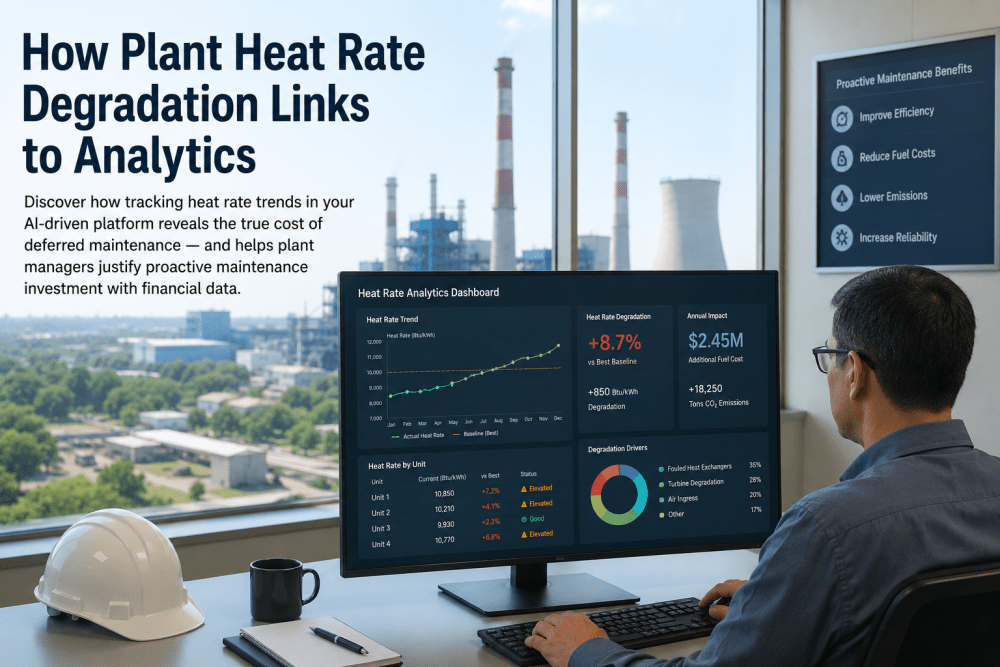
A 500MW coal-fired power plant in the American Midwest was burning through $130 million in fuel annually — and losing 64% of that energy as waste heat. Their heat rate had drifted to 10,800 Btu/kWh over five years of deferred optimization, but no one noticed because the degradation happened at 2-3 Btu/kWh per week. Invisible on daily reports. Devastating on annual budgets. When the plant deployed AI-driven heat rate optimization, the system identified 14 controllable inefficiencies across the boiler, turbine, and condenser systems within its first 30 days. Combustion air distribution was rebalanced. Sootblowing sequences were restructured. Condenser backpressure was reduced. Within 90 days, heat rate dropped by 380 Btu/kWh — a 3.5% improvement that saved $2.4 million in fuel costs in the first year alone. Same plant. Same coal. Same operators. The only thing that changed was the intelligence layer sitting on top of the data they were already collecting.
AI-Powered Thermal Intelligence
You're Burning Money.
AI Knows Exactly Where.
Fuel accounts for 55-75% of a thermal power plant's total operating cost. A 1% improvement in heat rate saves $700,000+ annually at a single 500MW plant. AI finds improvements that human operators and static control systems physically cannot see — because the optimization space has 200+ interacting variables changing every second.
$700K+
Annual savings per 1% heat rate improvement (500MW plant)
3-5%
Typical heat rate improvement achievable with AI optimization
40,000 t
CO2 reduction per year from 1% heat rate improvement
6-12 Mo
Typical payback period for AI optimization systems
Sources: EPRI · U.S. Energy Information Administration · Power Engineering 2025 · ScottMadden 2025
What Is Heat Rate — And Why Every BTU Matters
Heat rate measures how much fuel energy a power plant consumes to produce one kilowatt-hour of electricity. It's expressed in Btu/kWh and works like a golf score — lower is better. A plant with a heat rate of 10,300 Btu/kWh operates at roughly 33% thermal efficiency, meaning two-thirds of the fuel energy is lost as waste heat. Even small improvements unlock massive savings because the numbers compound across millions of megawatt-hours generated annually.
The Heat Rate Economics at a Glance
Coal Plant (Avg)
~33% efficient
Gas Turbine (Simple)
~39% efficient
Combined Cycle (Avg)
~46% efficient
Combined Cycle (Best)
~60% efficient
Theoretical Perfect
100% efficient
What 1% Improvement Actually Means
500MW Coal Plant
$700,000/yr
At 80% capacity factor, $2/MMBtu coal
500MW Combined Cycle
$580,000/yr
At 60% capacity factor, $3/MMBtu gas
850MW Supercritical
$1.29M/yr
At 75% capacity factor, $2/MMBtu coal
AI-driven optimization typically achieves 3-5% heat rate improvement — multiply the numbers above by 3-5x for realistic annual savings.
Where Your Plant Is Losing Energy Right Now
A thermal power plant is a chain of energy conversions — fuel to heat, heat to steam, steam to mechanical work, mechanical work to electricity. Losses accumulate at every link. The challenge isn't knowing that losses exist — it's knowing which losses are controllable, which are the largest right now, and what adjustments will reduce them without creating new problems elsewhere in the system.
The Energy Loss Chain — Where Every BTU Goes
-12%
Flue Gas & Stack Losses
AI optimizes excess air ratio and air preheat
-45%
Condenser & Cooling Losses
AI minimizes condenser backpressure dynamically
-4%
Turbine & Mechanical Losses
AI detects blade fouling and seal degradation
-3%
Auxiliary Power Consumption
AI optimizes fan, pump, and pulverizer loads
-2%
Radiation, Unburned Carbon, Other
AI adjusts combustion for complete burnout
Not all losses are equal. AI focuses on the controllable fraction — typically 5-8% of total input energy — and optimizes continuously across all subsystems simultaneously. That's where the $700K per percentage point comes from.
How AI Optimizes Heat Rate in Real Time
Traditional heat rate management relies on periodic performance tests, manual setpoint adjustments, and operator experience. AI transforms this from a quarterly exercise into a continuous, autonomous optimization loop that adjusts hundreds of parameters every few minutes based on real-time conditions — fuel quality changes, ambient temperature shifts, load demand variations, and equipment degradation.
01
Ingest & Model
The AI model ingests real-time data from 200+ sensors across the boiler, turbine, condenser, feedwater system, and auxiliaries. It builds a multi-dimensional thermal model of your specific plant — not a generic textbook model, but one trained on your equipment, your fuel, and your operating history.
Steam temperatures
Flue gas O2
Condenser vacuum
Feed water flow
Coal quality
Ambient conditions
02
Identify Deviations
Every minute, the AI compares actual heat rate against what the optimized heat rate should be at the current load, fuel quality, and ambient conditions. The gap between actual and optimal is the "recoverable loss" — the money your plant is burning unnecessarily right now.
50-400 Btu/kWh
Typical recoverable deviation found by AI in the first 30 days
03
Prescribe Adjustments
The system generates specific, actionable recommendations — not vague dashboards. "Reduce excess O2 from 3.8% to 3.2% on burner zones 2-4." "Increase feedwater heater 3 drain valve opening by 8%." "Shift sootblowing sequence to prioritize superheater section." Each recommendation includes the expected heat rate impact and confidence level.
<60 seconds
From deviation detection to actionable recommendation
04
Learn & Improve
After each adjustment, the AI measures the actual impact and refines its model. Seasonal fuel quality changes, equipment aging, and load pattern shifts are all absorbed into the model continuously. The system gets smarter every week — unlike static control logic that degrades as plant conditions drift from design.
Continuous
Model retraining captures equipment aging and seasonal variation
Every BTU You Waste Is a Dollar You Burn
iFactory connects to your existing DCS, historian, and sensor network — and delivers continuous heat rate optimization recommendations that typically save $400K-$800K in fuel costs within the first year. No hardware replacement. No control system changes.
The 7 Levers AI Pulls to Lower Your Heat Rate
AI doesn't improve heat rate through a single magic adjustment. It simultaneously optimizes across seven interconnected subsystems — balancing trade-offs that no human operator can compute in real time because changing one parameter affects all the others.
1
Combustion Optimization
Balances air-fuel ratio across burner zones to minimize excess oxygen while preventing CO formation. AI adjusts secondary air dampers and overfire air in real time based on flame scanner data and flue gas analysis.
30-90 Btu/kWh improvement
2
Intelligent Sootblowing
Replaces fixed-schedule cleaning with condition-based sootblowing driven by AI analysis of tube fouling, superheat spray flow, and flue gas temperatures. Cleans only when and where it matters.
30-150 Btu/kWh improvement
3
Condenser Performance
Monitors condenser backpressure, tube fouling, and cooling water flow to maintain optimal vacuum. Even 1 inHg of excess backpressure can cost 200+ Btu/kWh in heat rate.
20-80 Btu/kWh improvement
4
Feedwater Heater Train
Detects leaking drain valves, bypassed heaters, and level control issues that silently degrade feedwater temperature — and prescribes corrective actions with calculated heat rate impact.
10-60 Btu/kWh improvement
5
Steam Temperature Control
Optimizes main steam and reheat temperatures to stay as close to design limits as safely possible. Each 10°F below design costs roughly 15 Btu/kWh in cycle efficiency.
15-50 Btu/kWh improvement
6
Auxiliary Load Management
Optimizes fan speeds, pump operations, pulverizer loading, and other house loads. Variable-speed drive coordination alone can reduce auxiliary consumption by 15-20%.
20-70 Btu/kWh improvement
7
Cycle Isolation & Leak Detection
Identifies steam and water leaks through valve seats, drain lines, and vent systems using pressure, temperature, and flow correlations that manual inspections miss. Common leaks are invisible to operators but devastating to heat rate over time.
20-50 Btu/kWh improvement
Combined Potential
150-550 Btu/kWh
Equivalent to 1.5-5.5% heat rate improvement
The ROI of Heat Rate Optimization
Heat rate optimization is the highest-ROI investment available to most thermal power plants. Unlike capital equipment upgrades that require outages and millions in capex, AI-driven optimization works with your existing infrastructure and delivers measurable fuel savings from month one.
First-Year Fuel Savings
$400K-$2.4M
Depends on plant size, fuel type, and baseline efficiency. A 500MW coal plant saving 3% in heat rate recovers $2.1M in fuel costs. A 500MW combined cycle saving 1.5% recovers $870K.
CO2 Emission Reduction
40,000 t/yr
Per 1% heat rate improvement at a 500MW coal plant. That's measurable ESG reporting value and potential carbon credit revenue — before any hardware changes.
System Payback
4-8x ROI
Against a platform investment of $150K-$350K/year, the typical first-year value of $1.2M-$3M (combining heat rate and predictive maintenance) delivers 4-8x return on investment.
NOx & SO2 Reduction
3-5%
Less fuel burned means fewer emissions per MWh generated. Optimized combustion further reduces pollutant formation — helping plants meet compliance without additional scrubber capacity.
Dispatch Competitiveness
Higher
In deregulated markets, plants are dispatched from cheapest to most expensive. A 3% heat rate improvement directly lowers your marginal cost — meaning more operating hours and more revenue.
Equipment Life Extension
+15-30%
Optimized thermal cycling reduces thermal stress on boiler tubes, turbine blades, and other hot-gas-path components — fewer forced outages and longer intervals between major overhauls.
Why iFactory for Heat Rate Optimization
01
Connects to Your Existing DCS and Historian
OPC-UA, Modbus, PI Historian, OSIsoft, Honeywell PHD, GE Proficy — iFactory integrates with any DCS vendor and any data historian. Your existing control system and sensor network become the foundation for AI optimization. No rip-and-replace. No control system modifications required.
02
Physics-Informed AI — Not Just Pattern Matching
iFactory combines machine learning with thermodynamic first-principles — mass balance, energy balance, and cycle efficiency equations. This hybrid approach means the AI understands why adjustments work, not just that they correlate. The result: recommendations that are physically valid, not statistical artifacts.
03
Operator-Centric Design
iFactory delivers specific, actionable recommendations in plain language — not abstract model outputs. Each recommendation shows the expected heat rate impact, confidence level, and implementation steps. Your operators stay in control. The AI advises; humans decide.
04
Fleet-Wide Benchmarking
Operating multiple thermal units? iFactory normalizes performance data across your entire fleet — comparing heat rates at equivalent loads, fuel qualities, and ambient conditions. Identify which units have the most recovery potential and prioritize optimization investment where it delivers the highest ROI.
Your Plant Has a Hidden Efficiency Reserve. AI Finds It.
iFactory transforms your thermal power plant from a static heat rate to a continuously optimized efficiency curve. Connect your DCS data, deploy AI analytics, and start recovering fuel dollars that are currently going up the stack.
Frequently Asked Questions
What is heat rate and why does it matter financially?
Heat rate measures how much fuel energy (in Btu) your plant uses to generate one kWh of electricity. Lower heat rate means higher efficiency and lower fuel costs. Since fuel represents 55-75% of a thermal plant's total operating cost, even a 1% heat rate improvement at a 500MW plant saves $360,000-$700,000 annually. AI optimization typically achieves 3-5% improvement — meaning $1M-$3.5M in annual savings from fuel alone.
How quickly does AI optimization show measurable results?
The AI model requires 30-60 days of baseline data to learn your plant's specific operating characteristics. During this learning phase, the system often identifies "quick win" deviations — leaking valves, suboptimal setpoints, and combustion imbalances — that can be corrected immediately. Most plants see measurable heat rate improvements within 60-90 days of deployment, with full optimization realized within 6 months.
Does AI optimization work for both coal and gas plants?
Yes. iFactory's heat rate optimization works across all thermal generation technologies — coal-fired subcritical and supercritical plants, natural gas simple cycle and combined cycle plants, oil-fired units, and biomass plants. The AI models adapt to each plant's specific thermodynamic cycle, fuel characteristics, and equipment configuration. Combined cycle plants benefit from optimization across both the gas turbine and steam cycle simultaneously.
Will AI recommendations conflict with emissions compliance?
No — iFactory's optimization engine includes emissions constraints as hard boundaries. The AI will never recommend a combustion adjustment that improves heat rate at the expense of exceeding NOx, SO2, or particulate limits. In practice, heat rate optimization and emissions reduction are complementary: burning less fuel per MWh generated directly reduces total emissions, and optimized combustion typically produces fewer pollutants per unit of fuel burned.
What's the difference between AI optimization and combustion tuning?
Traditional combustion tuning is a periodic, manual process that optimizes a handful of parameters at a single operating point. AI optimization is continuous and covers the entire thermal cycle — boiler, turbine, condenser, feedwater, and auxiliaries — at every operating point simultaneously. While combustion tuning might improve heat rate by 30-60 Btu/kWh at full load, AI optimization typically recovers 150-550 Btu/kWh across all load ranges because it addresses interactions between subsystems that tuning cannot.