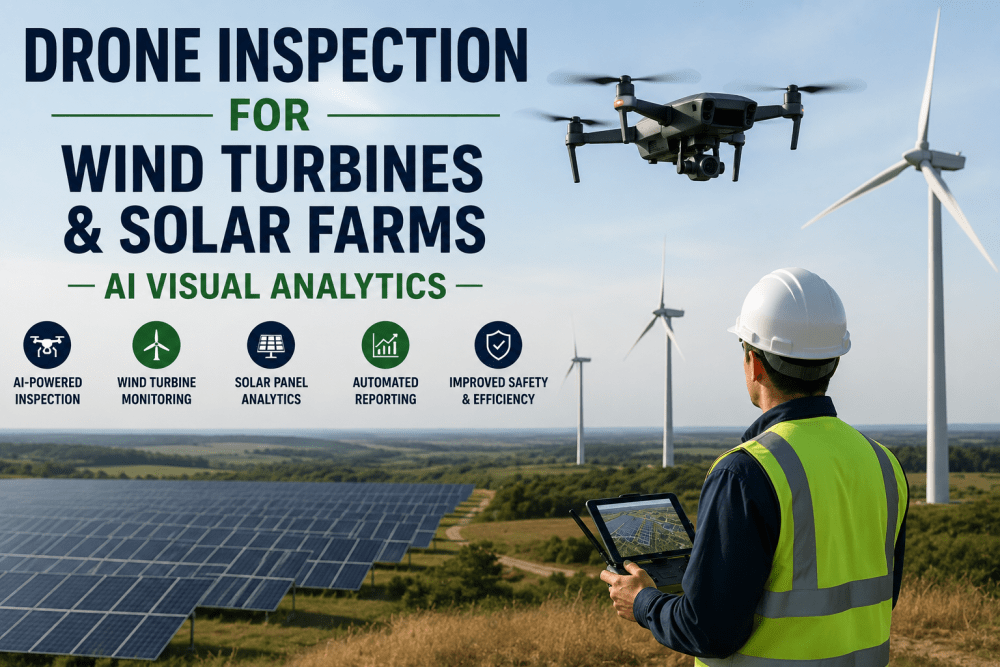
A single blade failure can ground a turbine for 15–30 days and cost over $1 million in repairs and lost generation. With 1,300+ GW of wind capacity now installed worldwide and fleets aging fast, the maintenance question is no longer if you automate inspections — it is how quickly you can connect inspection data to maintenance action. Drone and robotic inspection systems integrated with a CMMS close the loop between defect detection and work order execution in hours, not weeks. This guide covers the technology, the economics, and the workflow that leading wind operators use to keep blades spinning and revenue flowing. If your inspection reports still sit in PDF folders waiting for someone to act on them, you are leaving turbine uptime on the table. iFactory connects drone and robotic inspection data directly to maintenance workflows — book a 30-minute assessment to see how.
Wind Turbine Blade Inspection Robots & Drones
Smart Maintenance with CMMS Integration — Technology, ROI, and Predictive Workflows for 2026
$3.3B
Drone Blade Inspection Market (2025)
80%
Cost Savings vs. Traditional Rope Access
45%
Of All Turbine Failures Are Blade-Related
Why Blade Inspection Is the Highest-Stakes Maintenance Task in Wind Energy
Wind turbine blades are the most failure-prone and most expensive component in the entire turbine system. They face relentless environmental punishment — UV radiation, rain erosion, lightning strikes, ice accumulation, and millions of fatigue cycles per year. The consequences of missed defects are severe.
What the Data Shows
✗ Blade failures account for 40–45% of all wind turbine failures globally
✗ Downtime per blade incident averages 15–30 days — up to 3 months for full replacement
✗ A single blade replacement can exceed $1 million including crane, logistics, and lost generation
✗ U.S. blade repair spending alone exceeded $1 billion in 2025
✗ 10–15% of all turbines experience blade cracking during their lifetime
Catch It Early, Fix It Cheap
✓ Leading edge erosion repair costs $5K–$15K — vs. $200K+ if left to escalate
✓ Micro-cracks detected early can be repaired in-situ without crane mobilization
✓ Lightning damage caught within days prevents cascading delamination
✓ Semi-annual drone inspections reduce unscheduled failures by 30–50%
✓ Insurance and warranty compliance requires documented inspection records
Drone-Based Blade Inspection: Speed, Safety, and Data at Scale
Drones have fundamentally changed how wind farms approach blade inspections. Where rope-access teams once spent full days per turbine at heights above 100 meters, drones deliver higher-quality data in a fraction of the time with zero human risk at height.
Inspection Time per Turbine
3–6 hours (+ setup)
30–45 minutes
Up to 10x faster
Cost per Turbine
$1,000–$2,000
$300–$769
60–80% savings
Safety Risk
High (100m+ climbs)
Near zero
Technicians stay on ground
Turbines per Day
1–2 turbines
15–20 turbines
10x throughput
Turbine Downtime Required
Full day shutdown
Under 20 minutes
95% less downtime
Data Quality
Subjective notes + limited photos
4K imagery + thermal + AI analytics
Repeatable, quantified
For a 100-turbine wind farm, switching from rope access to drone inspection can save approximately $76,900 per inspection cycle — completing the entire farm in roughly 12 days instead of months. The real ROI compounds when this data feeds directly into a CMMS that triggers work orders automatically.
What Inspection Drones and Robots Actually Detect
Modern inspection systems combine multiple sensor technologies to catch defects that human eyes miss — including subsurface damage invisible from the outside.
Surface-Level Detection
✓ Leading edge erosion and pitting
✓ Surface cracks and coating damage
✓ Lightning strike damage and burn marks
✓ Gel coat peeling and UV degradation
Resolution
4K cameras achieving 1 mm/pixel — sufficient for warranty and insurance documentation
Internal Defect Detection
✓ Delamination between composite layers
✓ Water ingress into blade structure
✓ Adhesive bond line failures
✓ Overheating in nacelle components
Why It Matters
Subsurface damage progresses silently and is often missed by annual visual-only inspections
Precision Structural Analysis
✓ 3D surface mapping for erosion measurement
✓ Ultrasonic testing for internal voids
✓ Dimensional analysis for blade deformation
✓ Automated minor surface repairs in-situ
Best For
Deep structural assessments and digital twin creation for lifecycle management
The Missing Link: CMMS Integration That Turns Data into Action
Most wind farms collect inspection data. Very few convert that data into maintenance action fast enough to matter. The gap between "defect found" and "work order executed" is where turbine availability dies. A CMMS integration closes this gap automatically.
01
Capture
Drone or robotic crawler performs automated inspection flight. High-res imagery, thermal data, and LiDAR scans are captured in standardized formats.
02
Analyze
AI-powered defect classification automatically categorizes damage by type, severity, and location. No manual photo sorting required.
03
Upload to CMMS
Inspection results auto-sync to your asset management platform. Each defect is tagged to the specific turbine, blade, and location coordinates.
04
Generate Work Orders
Critical defects trigger automatic work orders with priority levels, repair procedures, and parts requirements — assigned to the right maintenance team instantly.
05
Track and Predict
Historical inspection data builds asset health scores and degradation curves. Predictive models forecast when the next repair will be needed — before failure occurs.
Connect Inspection Data to Maintenance Action
iFactory bridges the gap between drone inspection platforms and maintenance execution — automatically generating work orders, tracking asset health, and scheduling repairs before defects escalate. No more PDF reports sitting in inboxes.
Predictive Maintenance: From Reactive Repairs to Failure Prevention
When inspection data flows into a CMMS alongside operational data, the system shifts from reactive to predictive. Here is what that looks like in practice.
S
SCADA Integration
Real-time performance data from turbine control systems — power output deviations, pitch errors, and vibration anomalies — feeds into the same CMMS as inspection findings.
H
Historical Inspection Records
Every defect tracked over time creates a degradation baseline. The system learns how fast erosion, cracking, or delamination progresses per blade and environment.
V
Vibration and Condition Monitoring
Continuous vibration analysis on drivetrain, bearings, and blade roots detects subtle changes months before they become critical — complementing periodic drone inspections.
E
Environmental Exposure Data
Wind speed history, lightning frequency, salt spray exposure, and temperature cycling data informs which turbines need more frequent inspections and proactive repairs.
75% of asset owners rate their new turbines as only "fair" or "poor" for reliability. The industry is learning that even new turbines need proactive inspection — not just aging fleets. Predictive maintenance driven by CMMS-integrated inspection data is the only way to stay ahead of the failure curve across the full turbine lifecycle.
The Wind Energy Scale: Why Automation Is No Longer Optional
The math is simple. With over 340,000 turbines in operation worldwide and capacity projected to surpass 2 TW by 2030, the maintenance workforce cannot scale fast enough using manual methods. Automation is the only path to keeping pace with fleet growth.
Global Installed Wind Capacity
1,136 GW
1,320+ GW
2,000+ GW
New Capacity Added per Year
117 GW
150+ GW (record)
194 GW
Drone Blade Inspection Market
$2.9B
$3.3B
$9.1B
Market Growth Rate (CAGR)
—
—
11.9% through 2034
What the Future Looks Like: Autonomous Wind Farm Maintenance
The technology is evolving fast. Here is where the industry is heading — and what forward-thinking operators are investing in now.
1
Autonomous Drone Docking Stations
Permanently installed at wind farms, these stations allow drones to launch, inspect, recharge, and upload data without any human intervention. Scheduled inspections run on autopilot — literally.
Status
Deploying Now
2
AI Defect Classification
Machine learning models trained on millions of blade images now classify defects by type, severity, and urgency — delivering inspection reports in minutes, not weeks.
Status
Production Ready
3
Digital Twin Integration
3D models of every blade updated after each inspection cycle. Operators can visualize defect progression over time and simulate structural impacts before committing to repair.
Status
Early Adoption
4
Real-Time Blade Health Dashboards
Live dashboards combining inspection data, SCADA feeds, and condition monitoring into a single asset health view — accessible from anywhere, updated continuously.
Status
Growing Fast
5
Edge Computing for On-Site Analytics
Processing inspection data directly at the wind farm eliminates cloud latency. Critical defects are flagged and acted upon within minutes of capture — essential for remote and offshore sites.
Status
Emerging
Frequently Asked Questions
How much does a drone wind turbine blade inspection cost?
Standard visual drone inspections typically cost $300–$769 per turbine. Advanced inspections with thermal imaging or LiDAR can range from $500–$1,500. For comparison, traditional rope access inspections cost $1,000–$2,000 per turbine. At scale, drone inspections deliver up to 80% cost savings — a 100-turbine farm can be inspected for approximately $76,900 compared to significantly more with manual methods.
How often should wind turbine blades be inspected?
Most operators run visual drone inspections every 6–12 months. Turbines in harsh environments — coastal, offshore, high-lightning zones — should be inspected every 3–6 months. The low cost and speed of drone inspections makes semi-annual checks practical, and data shows this frequency reduces unscheduled failures by 30–50%.
What does CMMS integration actually do for inspection workflows?
A CMMS integration takes raw inspection data — images, defect classifications, severity scores — and automatically creates prioritized work orders assigned to the right maintenance team. It tracks defect progression over time, builds asset health scores, and enables predictive scheduling. Without integration, inspection data sits in reports. With integration, every defect becomes an action.
Can drones inspect turbines while they are still running?
For detailed blade inspections, turbines are typically parked with blades in a fixed position. However, modern drones complete the full inspection in under 20 minutes of downtime — compared to a full day for rope access. Some overview and tower inspections can be performed while the turbine operates, minimizing production loss further.
Is drone inspection data accepted for insurance and warranty claims?
Yes. Drone imagery that meets OEM resolution specifications (typically 1 mm/pixel or better) and is properly time-stamped is accepted by most insurers and OEMs. Automated drone inspections actually produce more consistent, comprehensive documentation than manual methods — making claims and compliance easier, not harder.
Turn Every Inspection into a Maintenance Action
iFactory integrates with drone and robotic inspection platforms to automatically generate work orders, track blade health over time, and schedule predictive repairs — so no defect ever falls through the cracks.