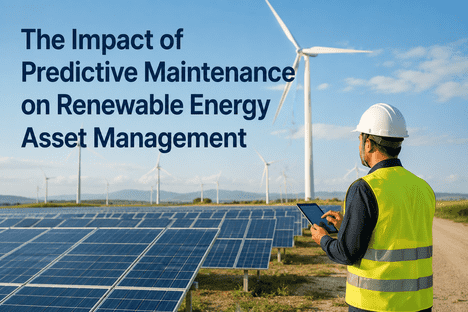
Renewable energy assets — wind turbines, solar photovoltaic arrays, and battery storage systems — operate under environmental conditions that accelerate wear in ways traditional industrial equipment does not. A single gearbox failure in a 5 MW wind turbine can cost $300,000 in replacement parts and crane rental, plus six weeks of lost production during peak wind season. Solar inverter failures and photovoltaic hot spots silently degrade energy yield by 15–25% before anyone notices. In 2025, leading renewable operators are replacing calendar-based maintenance schedules with predictive maintenance for renewable energy asset management deploying IoT sensors, AI analytics, and digital twin technology to anticipate failures, optimize energy production, and extend asset life across wind, solar, and storage fleets. To see how iFactory's predictive maintenance platform transforms your renewable energy operations, Book a Demo with our team today.
Is Your Renewable Fleet Maintenance Strategy Built for 2025 — or 2015?
iFactory's AI-driven predictive maintenance platform connects turbine vibration sensors, solar panel thermal data, and battery performance metrics with digital twin models to deliver real-time failure predictions — without relying on fixed calendar schedules or reactive break-fix cycles.
Why Traditional Maintenance Falls Short in Renewable Energy Operations
Wind turbines and solar installations present maintenance challenges that conventional run-to-failure and time-based approaches cannot adequately address. Unlike factory equipment in controlled environments, renewable assets are distributed across hundreds of square kilometers, exposed to thermal cycling, moisture ingress, lightning strikes, and constant mechanical fatigue. A wind turbine gearbox experiences torque variations with every gust of wind, while solar panels degrade at rates that depend on local soiling, hail impact, and microcrack propagation — none of which follow a calendar schedule. The National Renewable Energy Laboratory (NREL) estimates that unplanned downtime in wind farms costs operators $50,000–$100,000 per turbine per year in lost revenue, with gearbox and generator failures accounting for 60% of total maintenance expenditure. Solar farms face a different but equally costly problem: traditional manual thermography inspection cycles of 6–12 months leave thousands of panels operating at reduced efficiency between checks. Predictive maintenance in renewable energy solves both problems by answering two critical questions: when will this asset actually fail, and what is the optimal intervention window to minimize production loss? Book a Demo to see how iFactory's predictive engine answers these questions across your entire renewable fleet.
The Five Technology Pillars of AI Predictive Maintenance for Renewables
Modern predictive maintenance for renewable energy is not a single tool — it is an integrated stack of sensing, analytics, modeling, and workflow technologies designed for the unique challenges of wind, solar, and storage assets.
Vibration & Acoustic Monitoring
High-frequency vibration sensors on turbine main bearings, gearboxes, and generators capture fault signatures undetectable by SCADA alone. Acoustic emission sensors detect blade cracks and delamination at early stages. iFactory's AI models are trained on millions of hours of turbine operational data to classify faults by type and severity.
Thermal & IV Curve Analysis for Solar
Drone-mounted thermal cameras and string-level IV curve tracers identify hot spots, bypass diode failures, and soiling losses across solar arrays. iFactory's computer vision models analyze thermography images to classify defect types and estimate power loss, enabling targeted panel replacement rather than blanket module swaps.
AI Anomaly Detection & Power Curve Modeling
Machine learning models compare real-time power output against expected performance curves derived from weather data and historical production. Deviations in the power curve indicate blade degradation, yaw misalignment, or pitch system faults in wind turbines, and inverter clipping or module degradation in solar systems — often weeks before traditional alarms trigger.
Digital Twin for Renewable Assets
iFactory creates a digital twin of each turbine, solar inverter, and battery system that simulates behavior under varying weather conditions, load profiles, and degradation scenarios. Operators run what-if analyses to optimize maintenance timing around low-wind periods or low-irradiance seasons, maximizing revenue while preserving asset health.
CMMS & Workflow Automation for Fleet Management
Predictive insights trigger automated work orders in the CMMS, scheduling repairs during low-production windows. iFactory's platform prioritizes alerts by production impact, ensuring that maintenance teams address the highest-revenue-risk assets first — critical for fleets spanning multiple sites and time zones.
Manual vs. AI Predictive Maintenance for Renewable Energy Assets
The operational and financial differences between traditional and predictive maintenance are stark when measured across the dimensions that matter most to renewable operators: energy production, cost per megawatt, asset lifespan, and regulatory reporting.
| Dimension | Manual / Calendar-Based | AI Predictive Maintenance |
|---|---|---|
| Energy Production Impact | Unplanned outages during peak wind or irradiance — lost revenue of $50K–$100K per turbine per year | Maintenance scheduled during low-production windows — energy loss minimized to less than 2% of annual yield |
| Inspection Coverage | Manual thermography every 6–12 months — long periods of undetected degradation across thousands of panels | Continuous monitoring with drone and sensor data — every asset checked daily, anomalies flagged in real time |
| Fault Detection Speed | Days to weeks — faults discovered during scheduled visual inspections or after production drop is noticed | Sub-second — AI models detect vibration anomalies, power curve deviations, and thermal defects instantly |
| Asset Lifespan | Reduced — undetected vibration leads to cascading gearbox damage; thermal runaways destroy inverters prematurely | Extended by 20–40% — early intervention prevents secondary damage and preserves asset integrity |
| O&M Cost per MW | $15–$25 per MWh for wind; $8–$14 per MWh for solar — heavily driven by unplanned repairs | $10–$16 per MWh for wind; $5–$9 per MWh for solar — predictable cost with 30% fewer emergency events |
| Data & Reporting | Spreadsheet-based — fragmented records across sites, inconsistent formats, no trending capability | Unified digital platform — real-time dashboards, automated compliance reports, fleet-wide benchmarking |
| Crew Efficiency | Firefighting mode — 50–60% of technician time spent on emergency repairs and travel between sites | Planned interventions — technicians arrive with correct parts and procedures, completing 2–3× more planned work per shift |
The AI Predictive Maintenance Deployment Workflow for Renewable Fleets
Understanding how a predictive maintenance deployment unfolds across a renewable energy fleet helps operators evaluate integration complexity, resource requirements, and timeline to value. iFactory's implementation workflow is designed to deliver measurable improvements in availability and O&M cost within the first 90 days. Book a Demo to walk through a live deployment simulation with our renewable energy engineering team.
Turn Asset Data Into Production Predictability
iFactory integrates IoT sensors, AI anomaly detection, digital twin simulation, and fleet-wide CMMS automation into a single platform — delivering actionable failure predictions, optimized maintenance scheduling, and measurable availability improvement across every wind turbine, solar inverter, and battery system.
Impact Assessment — iFactory in Renewable Energy Operations
What Renewable Energy Operators Say About AI Predictive Maintenance
We deployed iFactory's predictive monitoring across our 200 MW wind fleet in phase one. Within the first 60 days, the system identified a main bearing anomaly in a 2-year-old turbine that our SCADA system had completely missed. The bearing was replaced during a scheduled low-wind window, avoiding what would have been a catastrophic gearbox failure and a $350,000 replacement cost. The ROI on the entire fleet deployment was realized in under four months.
The solar side was where we saw the biggest surprise. Our manual thermography inspections were finding maybe 40% of the hot spots. iFactory's AI analysis of IV curve data and string-level monitoring identified failing bypass diodes and microcrack clusters three months before they would have been visible on a thermal camera. We reduced our performance ratio degradation from 0.8% per year to 0.3% per year in the first 12 months.
Frequently Asked Questions: Predictive Maintenance for Renewable Energy
How does predictive maintenance differ for wind turbines versus solar panels?
Wind turbine predictive maintenance relies primarily on vibration analysis, acoustic monitoring, and power curve modeling to detect gearbox, bearing, and blade faults. Solar panel predictive maintenance uses thermal imaging, IV curve tracing, and string-level production monitoring to identify hot spots, bypass diode failures, and soiling losses. iFactory's platform supports both asset types within a single unified interface.
Can iFactory integrate with existing SCADA systems and turbine controllers?
Yes. iFactory sits above your existing SCADA, PLC, and controller layers, pulling data via standard protocols including OPC-UA, Modbus, and REST APIs. No rip-and-replace is required — the platform layers predictive intelligence on top of your current infrastructure.
How long does it take to see measurable results after deployment?
Early warning alerts for developing faults typically begin within 30 days of baseline learning. Measurable improvements in fleet availability and reductions in emergency repair events are observed within the first 90 days. Full ROI is typically achieved within 4–8 months depending on fleet size and existing maintenance practices.
Does predictive maintenance work for offshore wind farms with limited connectivity?
Yes. iFactory's edge computing architecture supports fully local processing on each turbine or platform, with data synchronization to shore during scheduled connectivity windows. Critical alerts are transmitted via satellite backup when primary connections are unavailable.
How does the system handle solar panel soiling detection and cleaning optimization?
iFactory analyzes string-level production data against expected output based on irradiance and temperature models. When soiling losses exceed a configurable threshold (typically 5–10% of expected yield), the system generates a cleaning work order, optimizing cleaning crew schedules for maximum production recovery.
Can iFactory support hybrid renewable sites with wind, solar, and battery storage?
Yes. iFactory's platform is designed for hybrid renewable assets, providing unified monitoring and predictive maintenance across wind turbines, solar inverters, and battery energy storage systems within a single fleet management dashboard.
From Reactive Repairs to Predictive Intelligence in Renewable Energy
The question facing renewable energy operators in 2025 is no longer whether AI predictive maintenance can outperform traditional methods — the data is conclusive across thousands of wind turbines and millions of solar panels. Operators using predictive maintenance achieve 30–50% fewer unplanned outages, 10–20% higher fleet availability, and O&M costs that are consistently predictable and controllable. The operators that are moving first are not doing so out of technology curiosity — they are moving because the operational math is unambiguous: lower cost per megawatt, higher energy production, extended asset life, and a maintenance workforce that spends its time on value-adding planned work instead of emergency repairs. iFactory's predictive maintenance platform brings IoT sensing, AI anomaly detection, digital twin simulation, and fleet-wide CMMS workflow automation under one operational roof — giving your renewable energy team a single source of truth for every turbine, inverter, and battery system in your portfolio. The transition from calendar-based, reactive maintenance to intelligent predictive maintenance is the most consequential improvement available to renewable energy operations today. Book a Demo to see exactly how iFactory fits your fleet's operational architecture.
Every Turbine. Every Panel. Every Prediction — Automatically.
iFactory builds your entire renewable energy predictive maintenance program into an autonomous, AI-driven workflow — from sensor deployment and anomaly detection to RUL modeling, production scheduling integration, and automated CMMS work order generation across your entire fleet.