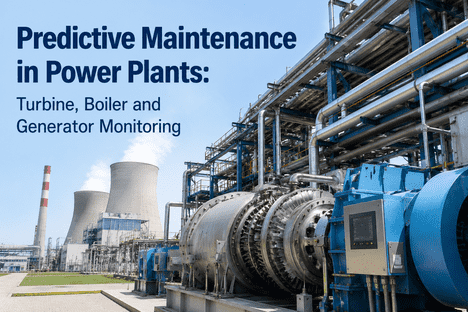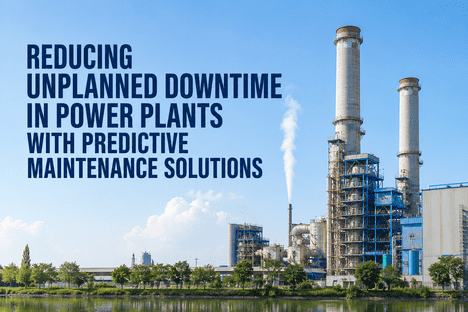
At 3:12 AM on a Tuesday at a combined-cycle gas turbine plant, the #2 feedwater pump begins to vibrate at 7.2 kHz — a frequency the vibration analyst would recognize as the onset of bearing fatigue. But the analyst won't see the data until the morning report, eight hours from now. By then, the bearing will have accumulated 4.7 million additional stress cycles, the pump will be running 18°F above normal bearing temperature, and the plant will be facing a choice: risk a catastrophic failure during peak demand at 6 PM, or perform an emergency shutdown that costs $340,000 in lost generation revenue. For power plant operators managing turbines, generators, pumps, and boilers that run 24x7 with availability targets of 94% or higher, unplanned downtime is measured in millions of dollars per day. Book a Demo to see how iFactory predicts rotating equipment failures 72–96 hours before they force an emergency outage.
Predictive Maintenance for Power Plants: Cut Unplanned Downtime by 51% Across Turbines, Pumps & Boilers
iFactory monitors your gas turbines, steam turbines, feedwater pumps, cooling towers, and boiler systems in real time — predicting failures 72–96 hours before they cause an outage. On-premise AI. Zero cloud dependency. Air-gapped from the internet.
What Predictive Maintenance Delivers in Power Generation
These are the actual ranges of outcomes across iFactory deployments in combined-cycle, coal, and biomass power plants — not projections from a white paper.
Why Unplanned Downtime Costs Power Plants $2.4M+ Per Unit Per Year
Power plants run on availability. Every hour of unplanned outage at a 500 MW combined-cycle plant operating at $70/MWh margin costs $35,000 in lost generation revenue — before penalties, replacement power costs, and repair expenses. Here is how that breaks down across a typical plant.
Gas Turbine Bearing Fatigue Goes Undetected Until Failure
A gas turbine #2 bearing develops a subsurface fatigue spall after 24,000 operating hours. Vibration amplitude increases gradually over 72 hours, but the plant's periodic walk-around inspections miss it. When the bearing finally fails, the turbine trips offline for 11 days — costing $1.2M in lost generation plus $480,000 in emergency repair and replacement power.
Feedwater Pump Cavitation Erodes Impellers Without Warning
A 3,000 hp boiler feedwater pump runs at partial load during low-demand periods, creating cavitation conditions that erode the impeller vanes by 0.008 inches per week. After 14 weeks, the impeller clearance exceeds spec, pump efficiency drops 11%, and the plant must choose between running inefficiently or performing an unscheduled 36-hour pump overhaul during peak season.
Cooling Tower Fan Bearing Failure Causes Vacuum Degradation
A cooling tower fan bearing seizes on a 95°F summer afternoon, reducing condenser vacuum from 2.5 inHg to 4.2 inHg. The resulting heat rate penalty increases fuel consumption by 8% for every hour the fan is down. At $3.50/MMBtu gas price and 500 MW output, the penalty costs $3,800 per hour — and the bearing replacement takes 14 hours.
Boiler Tube Leaks from Undetected Thermal Cycling
A startup/shutdown cycle on a coal-fired boiler causes differential expansion that weakens superheater tube welds. After 120 cycles, a hairline crack develops and grows unnoticed for three operating days. When the tube finally bursts, the plant is forced into a 14-day forced outage for tube replacement at a cost of $2.8M in lost generation and $620,000 in repair labor.
Maintenance Teams Are Trapped in a Break-Fix Cycle
Planned maintenance compliance averages 61% across power plants. The other 39% of maintenance hours are reactive — emergency repairs on pumps, fans, compressors, and valves that already failed. Reliability engineers report that 44% of their predictive maintenance budget goes to overtime and expedited shipping for unplanned failures that could have been predicted.
Reactive maintenance costs power plants $2.4M+ per unit per year. iFactory predicts rotating equipment failures 72–96 hours in advance. Book a 30-min walkthrough and see iFactory on your plant's vibration and temperature data.
From Sensor Data to Outage Prevention in 6–12 Weeks
iFactory connects to your existing vibration sensors, temperature probes, SCADA tags, and DCS historian — no new sensors required. The platform ingests data on your plant network, trains predictive models, and delivers alerts on an on-premise NVIDIA appliance.
Connect Your Plant Data Sources
We connect to your existing vibration monitors, RTD temperature probes, pressure transmitters, and DCS historian data — no new sensors or field wiring required. iFactory ingests data over your plant control network without any internet connectivity.
AI Trains on Your Asset Signatures
Our AI learns the normal operating envelope for each turbine, pump, fan, and compressor from 60–90 days of historical data — vibration signatures, bearing temperature profiles, motor current draws, and thermal gradient baselines.
Maintenance Gets 72–96 Hour Alerts
When the model detects a pattern that precedes a failure — bearing frequency shift, pump cavitation signature, tube wall thinning trend — it alerts the maintenance team via the plant dashboard, mobile device, or CMMS work order.
Close the Loop With Root Cause Correlation
Every alert links to the sensor data that triggered it. Engineers see "GT #2 bearing degradation detected — vibration amplitude trending up 14% over 48 hours — schedule inspection within 72 hours." No more hunting through historian data after the outage.
Predictive Maintenance Features for Power Generation
iFactory's AI-native platform delivers capabilities purpose-built for power plant rotating equipment and thermal systems — all running on-premise with zero cloud dependency and air-gapped deployment.
Gas & Steam Turbine Monitoring
iFactory models vibration signatures, bearing metal temperatures, shaft position, and exhaust temperature spread on every start, run, and coast-down. When bearing fatigue, blade rub, or thermal imbalance patterns emerge, the system alerts engineers 72 hours before a trip event.
Feedwater & Circulating Pump Diagnostics
By correlating pump vibration, motor current, suction pressure, and flow rate, iFactory predicts cavitation, impeller wear, and bearing fatigue 96 hours before performance degrades. No more running pumps into the efficiency cliff.
Cooling Tower & Heat Exchanger Monitoring
Fan bearing vibration, gearbox temperature, and condenser backpressure data feed iFactory's predictive models. A fan bearing failure or tube fouling trend triggers an alert 72 hours before vacuum degradation costs the plant thousands per hour in heat rate penalty.
Boiler Tube & Pressure Part Prediction
iFactory analyzes thermal gradients, startup/shutdown cycle counts, and wall temperature profiles to predict tube metal fatigue and creep damage. Engineers get advance warning of tube leak risk before it becomes a forced outage.
100% On-Premise Air-Gapped Deployment
iFactory runs on an NVIDIA appliance inside your plant control network. Zero data leaves the facility. No cloud connectivity required. Fully compliant with NERC CIP and nuclear security requirements.
6–12 Week Pilot to Live Model
iFactory's engineers connect to your DCS historian, train models on your critical assets, and deliver a working pilot in 6–12 weeks. No data science team required on your end. The pilot targets measurable availability improvement within the first quarter.
iFactory Delivers Predictive Maintenance Without the Headaches
End-to-End Turnkey Deployment
You provide data-source access to your DCS historian and vibration monitoring system. We deliver a working pilot on your critical assets in 6–12 weeks. No integration consultants, no custom code, no data scientists.
100% On-Premise — Air-Gapped & NERC CIP Compliant
iFactory runs on an NVIDIA appliance inside your plant control network. Zero data egress. No cloud connectivity. No internet dependency. Fully compliant with NERC CIP, nuclear 10 CFR Part 50, and utility cybersecurity requirements.
Pilot-to-ROI in One Quarter
Every deployment targets measurable availability and maintenance cost improvement within 90 days. If we don't hit the agreed targets, you don't pay for the pilot.
Works With Existing Plant Systems
iFactory connects to GE, Siemens, Emerson, ABB, Honeywell, and any OPC-UA or Modbus-compatible DCS and PLC. No rip-and-replace of your existing control or monitoring systems.
24x7 Managed Service Included
Our operations team monitors your predictive models and appliance infrastructure around the clock. If a model drifts or a data feed drops, we fix it before your next shift starts. You don't need an on-site data science team.
Scalable Across All Units and Plants
Once the model works on one gas turbine or pump train, iFactory replicates it across your entire fleet. Standardized predictive maintenance at every generating unit — gas, coal, biomass, and hydro.
Questions We Get from Every Power Plant Reliability Team
Stop Reacting to Equipment Failures. Start Predicting Them.
iFactory gives your reliability team a 72–96 hour look-ahead on turbine, pump, fan, and boiler failures — and saves your plant $1.2M+ per unit per year in avoided outage costs. The pilot takes 6–12 weeks. The ROI shows up in one quarter.