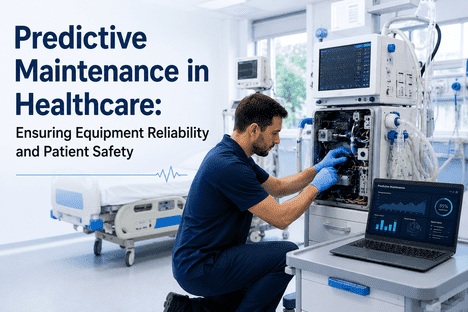
AI-Powered Predictive Maintenance for Healthcare Equipment: Improving Reliability
By Rebecca on June 1, 2026
Healthcare facilities operate some of the most complex and capital-intensive equipment in any industry — MRI and CT scanners, ventilators, infusion pumps, dialysis machines, anesthesia workstations, and laboratory analyzers — each with unique failure modes and regulatory compliance requirements. A single MRI scanner can cost $1–3 million, and unplanned downtime costs $5,000–$10,000 per hour in lost revenue plus delayed patient diagnoses and rescheduled procedures. The FDA, Joint Commission, and ISO 13485 all require documented evidence that medical equipment is maintained, calibrated, and validated. AI-powered predictive maintenance transforms reactive repair into proactive reliability, reducing unplanned failures by 18–35% and cutting energy consumption by 10–22% across imaging, monitoring, and sterilization equipment classes. Book a Demo
The 5-Stage Healthcare PdM Playbook
From Reactive Repairs to AI-Powered Reliability in Hospitals
Each stage produces audit-defensible evidence. None can be skipped. The 8–12 week timeline only holds when the stages run in sequence with clinical engineering engagement.
01
Asset Criticality
Risk-Based Inventory
Wk 1–2
02
Data Integration
CMMS + IoMT + EHR
Wk 2–4
03
Parallel Validation
Rule-Based + AI Shadow
Wk 4–8
04
Controlled Rollout
Phased Deployment
Wk 8–10
05
CSV Ongoing
Post-Migration Compliance
Wk 10–12+
Every stage generates Joint Commission-ready and FDA 21 CFR Part 820-compliant audit trail evidence.
Stage 01 — Asset Criticality Assessment Defines the Compliance Floor
Healthcare facilities cannot predictively maintain every asset with equal rigor. The first stage of the playbook classifies every piece of equipment by patient safety risk, regulatory requirement, and operational criticality. An MRI scanner and an infusion pump have different failure consequences, different regulatory standards (FDA 21 CFR 820 vs ISO 13485 vs Joint Commission), and different PdM data requirements. The VMP scope determines which assets get full validation, which get reduced validation, and which are excluded — and documents the rationale for each decision.
Risk Classification
Every asset tagged by risk level: life-safety (ventilators, defibrillators), diagnostic (MRI, CT, ultrasound), therapeutic (infusion pumps, dialysis), and ancillary (beds, monitors). Validation scope determined per category.
Regulatory Mapping
URS captures every regulatory requirement: FDA QSR 21 CFR 820 for medical devices, Joint Commission EC.02.04.01 for equipment management, ISO 13485 for quality systems, and HIPAA for data security.
Validation Lifecycle
IQ / OQ / PQ deliverables defined per asset class. Test scripts written before implementation. Traceability matrix linking URS line items — including Joint Commission and FDA requirements — to test cases established.
Acceptance Criteria
Measurable thresholds defined upfront: false alarm rate < 5%, positive predictive value > 90%, MTBF improvement of 20%+ over baseline, audit trail completeness at 100%, parallel validation statistical equivalence proven.
Stage 02 — Data Integration Maps the IoMT Data Chain
Predictive maintenance for healthcare equipment depends on ingesting data from multiple sources: CMMS maintenance records, IoMT sensor telemetry, equipment usage logs, and clinical event data from EHR systems. Every data source needs explicit mapping to the PdM platform with documented transformation logic and validation rules. Hospitals that rush this stage discover gaps during Joint Commission survey or FDA inspection when an auditor asks for the same data completeness they had pre-deployment.
Swipe horizontally to see each data mapping category
Data category
Legacy source
Target destination
Validation rule
Equipment master data
CMMS (Maximo, SAP, custom)
iFactory asset register
100% asset record parity verified
IoMT sensor telemetry
Equipment controllers, gateways
Time-series data store
Tag parity & sampling rate confirmed
Maintenance history
CMMS work order tables
iFactory work order store
Historical WOs mapped 1:1, no orphans
Usage & cycle data
Equipment logs, barcode scans
Usage-based model inputs
Per-asset usage continuity verified
Calibration records
CMMS calibration module
Calibration tracking in iFactory
Due-date and tolerance continuity
Safety incident reports
Risk management / QMS system
iFactory safety linkage
Incident-to-asset linkage maintained
Audit trail records
CMMS logs, equipment logs
21 CFR Part 11 tamper-evident store
Cryptographic chain-of-custody preserved
Want this mapping table populated against your specific equipment inventory? Book a Demo — the data mapping exercise is the most valuable single output of the workshop.
Stage 03 — Parallel Validation Proves AI Equivalence
Parallel validation is the period when both the existing rule-based maintenance system and the new AI-native PdM platform run concurrently on identical data streams. Both systems generate maintenance alerts, work orders, and audit trail entries. Statistical comparison proves equivalence between them — or surfaces gaps before full deployment. This stage is what Joint Commission and FDA inspectors will ask about in detail post-deployment. Hospitals that shorten parallel validation below 4 weeks expose themselves to findings that take quarters to remediate.
System A
Existing Rule-Based CMMS
Scheduled maintenance triggers firing
Threshold-based alerts as today
Work orders in existing CMMS
All HTM technician workflows unchanged
Production-of-record during validation
Statistical Comparison
Alert equivalence per rule
False positive rate delta
Lead time gain measured
Audit trail completeness
4–6 weeks
minimum parallel period
System B
AI-Native PdM
LSTM + Autoencoder anomaly detection
Multivariate sensor alerts logged
Shadow mode — no WO posting
HTM team sees both system outputs
Candidate — pending equivalence proof
Stage 04 — Controlled Rollout with Clinical Safety Net
Deployment only proceeds after parallel validation proves statistical equivalence and the hospital's Clinical Engineering change control board approves. AI-native PdM begins generating work orders in the live CMMS, but the legacy rule-based system continues in observation mode for 2–4 weeks as the rollback safety net. The first Joint Commission or ISO audit cycle after deployment often surfaces edge cases that benefit from the legacy comparison still being available.
Step 01
Change Control Board Approval
CCB reviews parallel validation report, signs off on equivalence proof, approves deployment date. Validation report becomes part of permanent Joint Commission readiness record.
Step 02
AI-Native PdM Goes Live
Predictive alerts, work orders, and audit trail entries flow live from AI-native PdM to the hospital CMMS via API. HTM technicians receive alerts on mobile devices with full evidence chain attached.
Step 03
Legacy System Observation Mode
Rule-based CMMS continues in observation mode for 2–4 weeks. Alerts logged for comparison. Rollback remains possible if unexpected behavior surfaces during the first clinical cycle.
Step 04
Legacy System Sunset
After 2–4 weeks of stable operation, rule-based maintenance rules retire formally. CCB documents the sunset. Production-of-record officially transitions to AI-native PdM with full audit trail.
Walk the 5-Stage Playbook Against Your Hospital Equipment Portfolio
iFactory's healthcare PdM practice runs a 90-minute workshop against your real equipment inventory, CMMS data, and regulatory audit posture. You leave with the asset criticality scope, data mapping template applied to your artifacts, and a defensible parallel validation protocol — ready to take to your CCB.
The Regulatory Evidence Matrix — What Each Stage Produces
Joint Commission and FDA inspectors do not accept "we're modernizing" as a substitute for evidence. Each stage of the playbook must produce specific artifacts that survive regulatory scrutiny. The matrix below maps the four major healthcare regulatory frameworks to the evidence each stage produces.
FDA 21 CFR Part 820
Quality System Regulation
Criticality StageScope statement covering all Class II/III devices
Generic AI vendors handle the math. Healthcare-compliant AI vendors handle the validation documentation and regulatory evidence. The difference between the two shows up during Joint Commission survey week. Eight criteria separate vendors who have done validated healthcare PdM deployments from vendors selling the demo without the paperwork.
01
Healthcare validation library
Ask:
"What pre-built healthcare validation documentation ships with the platform?"
Production-grade vendors ship IQ/OQ/PQ test scripts, traceability matrices aligned to Joint Commission requirements, and validation summary reports as baseline deliverables. Vendors expecting you to write all validation docs from scratch add 8–16 weeks to timeline.
02
21 CFR Part 820 / Part 11 readiness
Ask:
"Is the platform compliant with FDA QSR 21 CFR Part 820 and Part 11 out of the box?"
Computer-generated, time-stamped, tamper-evident audit trails for every record. Electronic signature capture per Part 11.10(e). Vendors logging to flat files or offering generic audit logs don't meet the standard for medical device maintenance records.
03
IoMT data integration depth
Ask:
"Does the platform integrate with DICOM, HL7, and IEC 80001 compliant IoMT gateways?"
Healthcare equipment data comes through modality worklists, PACS, IoMT gateways, and CMMS exports — not OPC UA. Vendors without healthcare protocol support require custom integration development that adds 8–12 weeks.
04
Parallel validation toolkit
Ask:
"Does the platform include automated side-by-side comparison tooling for parallel validation?"
Statistical equivalence proof requires automated comparison of legacy rule-based vs AI-native outputs over the 4–6 week parallel period. Vendors expecting your HTM team to build this from scratch make parallel validation impractical.
05
Change control integration
Ask:
"How does the platform handle model updates and threshold changes post-deployment?"
Every model update or threshold change must flow through documented change control with CCB approval. Vendors offering "auto-updating models" without change control integration create regulatory exposure under QSR and Joint Commission standards.
06
GAMP 5 alignment
Ask:
"Is the platform GAMP 5 category 4 ready for healthcare?"
Configured-product vendors (category 4) reduce validation effort 50%+ vs custom-built systems (category 5). Demand explicit GAMP 5 categorization documentation. Vendors avoiding this question are typically category 5 in disguise, converting the 8–12 week deployment into an 18–24 week project.
07
CMMS platform integration
Ask:
"Does the platform integrate with the top 5 hospital CMMS platforms?"
Hospital CMMS ecosystems include Maximo, SAP EAM, TMS, Nuvolo, and custom HTM systems. Vendors supporting one or two CMMS platforms leave the rest of the equipment portfolio in a manual gap. Production-grade platforms federate via REST API to all major CMMS systems.
08
Validated deployment timeline
Ask:
"Have you completed validated healthcare PdM deployments in 8–12 weeks?"
Demand references with documented timelines including parallel validation in hospital environments. Vendors who've only deployed in unregulated or manufacturing environments don't understand how Joint Commission and FDA validation extends timelines. The benchmark: 8–12 weeks including the 4-week parallel period.
Expert Perspective
"The single most common reason AI predictive maintenance projects exceed timeline in hospitals isn't technical complexity — it's underestimating the clinical validation documentation burden. A deployment that takes 8–12 weeks technically takes 18–24 weeks when validation discipline is treated as an afterthought rather than an embedded throughline. Hospitals that succeed start with asset criticality assessment in week one, run data mapping with documented validation rules in weeks 2–4, commit to a real 4–6 week parallel validation period with both rule-based and AI systems running side by side, and treat deployment as a CCB-approved event rather than an IT milestone. The discipline isn't harder than the technology — it's just more administrative, and the hospitals that respect it finish on time with a Joint Commission-ready audit record."
— Healthcare HTM and Regulatory Compliance Practice, 2026
98%
clinical asset uptime with evidence-based service strategy
4–6 wk
minimum parallel validation period for audit defensibility
18–35%
fewer unplanned failures with AI-enabled PdM in hospitals
Conclusion: The Playbook Is the Compliance Plan, Not a Layer On Top of It
AI-powered predictive maintenance for healthcare equipment is a regulatory compliance project that produces technology output, not the other way around. The 5-stage playbook — Asset Criticality, Data Integration, Parallel Validation, Controlled Rollout, CSV Ongoing — is not a regulatory wrapper around the technical work; it is the technical work, just disciplined. Hospitals that follow the playbook finish in 8–12 weeks with an audit record that survives FDA, Joint Commission, ISO 13485, and HIPAA scrutiny on day one post-deployment. Hospitals that don't follow it deliver working AI in 8–12 weeks then spend 12–18 months remediating regulatory findings. The vendor evaluation criteria, data mapping discipline, parallel validation protocol, and regulatory evidence matrix in this guide are the same playbook iFactory uses with every healthcare customer. The right starting point isn't the technology demo — it's the workshop that produces the asset criticality scope against your real equipment inventory. Book a Demo
Start with Stage 01 of the Playbook
iFactory's healthcare PdM practice runs the workshop that produces your asset criticality scope, data mapping template, and parallel validation protocol — everything you need to take to your CCB before week one of the technical deployment.
What is the typical ROI timeline for AI predictive maintenance in hospitals?
Published studies from the PartsSource evidence-based service strategy analysis across 25 health systems and 22,000 assets demonstrate 98% clinical asset uptime and 17.3% average savings versus prior service spend. First avoided failures appear within 30 days of deployment. Full fleet coverage delivers measurable cost reduction within 8–12 weeks. Category-specific outcomes compound: 18–35% fewer unplanned failures, 10–22% reduction in site electricity consumption through optimized equipment duty cycling, and 12–28% reduction in consumable waste and emergency part scrappage. Healthcare systems with multi-site deployments see 53% higher compounded savings in year three versus year one.
How does AI-native PdM comply with Joint Commission EC.02.04.01?
Joint Commission standard EC.02.04.01 requires hospitals to maintain a written inventory of all equipment, schedule and document maintenance activities, monitor equipment performance, and take action when performance deteriorates. AI-native PdM satisfies each requirement by maintaining a complete asset register with risk classification, auto-generating work orders with timestamps and technician sign-off, continuously monitoring equipment telemetry against multivariate baselines, and flagging degradation patterns 2–8 weeks before they would trigger a threshold-based alert in the legacy CMMS. The parallel validation protocol produces the equivalence proof that the AI system meets or exceeds the legacy system's Joint Commission compliance posture before any cutover occurs.
Does iFactory require replacing the existing hospital CMMS?
No. iFactory layers on top of existing CMMS systems — whether Maximo, SAP EAM, TMS, Nuvolo, or custom HTM systems. Integration is achieved via REST API at the data layer. The existing CMMS continues running exactly as today — work order management, inventory control, technician workflows. What changes is that the maintenance intelligence layer migrates from scheduled/task-based to AI-driven predictive, grounded in the same equipment data. Deployment runs 8–12 weeks because the platform is additive, not replacement. Vendors requiring CMMS replacement add 12–18 months to timeline and create integration risk that regulated healthcare facilities avoid.
What equipment types can iFactory predictively maintain?
iFactory ingests data from any clinical asset with measurable telemetry: imaging (MRI, CT, X-ray, ultrasound), patient monitoring (ventilators, infusion pumps, defibrillators, vital signs monitors), laboratory analyzers (hematology, chemistry, immunoassay), sterilization equipment (autoclaves, sterilizers, washer-disinfectors), and building infrastructure (HVAC, medical gas, boilers, chillers). Each asset class uses category-specific ML models — X-ray tube thermal cycling models for CT, battery degradation models for portable devices, vibration models for rotating equipment in sterilizers, and calibration drift models for analyzers. All alerts, work orders, and compliance records flow into a single CMMS interface.
How does iFactory handle medical device cybersecurity requirements?
iFactory deploys as a read-only data consumer from IoMT gateways and CMMS APIs — it never sends control signals to medical equipment. All data in transit is encrypted via TLS 1.3. All data at rest is encrypted with AES-256. Access controls follow role-based authorization aligned with the hospital's existing Active Directory structure. Audit trails capture every access and action per 21 CFR Part 11.10(e). The platform architecture is aligned with IEC 80001-1 (risk management of medical IT networks) and HIPAA Security Rule requirements. Book a Demo