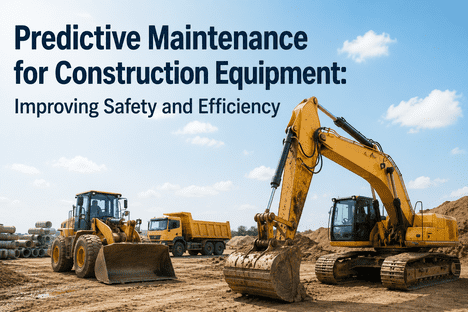
Construction equipment operates in some of the harshest conditions across any industry — dust, mud, extreme temperatures, high vibration, and continuous heavy loads. Excavators, bulldozers, cranes, loaders, and haul trucks accumulate wear at rates that vary dramatically by site conditions, operator behavior, and maintenance history. Traditional preventive maintenance based on engine hours or calendar intervals either over-services healthy machines or under-serves equipment approaching critical failure — and on a construction site, equipment failure means project delays, safety risks, and cost overruns. Predictive maintenance powered by AI and IoT telematics is transforming how construction fleets manage equipment health: vibration sensors detect drivetrain degradation, hydraulic pressure monitoring predicts pump failures, and engine telemetry identifies combustion issues before they cause catastrophic damage. iFactory AI's industrial software platform, including its Shift Logbook and predictive maintenance engine, enables construction fleets to deploy AI-native predictive maintenance without replacing existing telematics, CMMS, or ERP systems. Book a Demo to see how iFactory applies predictive maintenance for construction equipment. This guide explores the technology stack, the unique failure modes of construction machinery, and the practical deployment path for fleet managers evaluating modernization.
Construction Equipment · Fleet Safety · 2026
Predictive Maintenance for Construction Equipment
IoT telemetry · AI failure prediction · automated work orders — reducing unplanned downtime, improving jobsite safety, and extending equipment life across construction fleets.
Why Preventive Maintenance Is Hitting Its Ceiling in Construction
The traditional approach — oil changes every 250 hours, hydraulic service every 1,000 hours, comprehensive inspection every 3,000 hours — treats every machine identically regardless of operating conditions. A track loader moving rock on a demolition site wears undercarriage components at 3x the rate of the same model working topsoil on a residential grade. Ambient temperature, dust concentration, payload weight, and operator technique all influence component degradation rates. Fixed-interval preventive maintenance either over-serves healthy equipment (wasting parts, labor, and availability) or under-serves machines approaching failure (risking catastrophic breakdown and safety incidents). Four specific ceilings are visible in every mature construction fleet.
01
Hour-Based Schedules
Fixed-interval maintenance ignores actual wear. A hydraulic excavator working in granite quarry dust wears hydraulic seals and swing bearings far faster than the schedule suggests. AI models use load, vibration, and contamination data per component.
Gap: Interval-based vs Condition-based
02
No Cross-Fleet Learning
Each machine's maintenance history stays siloed. Patterns — a specific undercarriage model failing consistently in certain soil types, or an engine issue correlated with high-altitude sites — remain invisible. AI models learn across the entire fleet.
Gap: Siloed vs Site-wide
03
Reactive Breakdown Response
When a critical machine fails on-site, the project stops. Replacement equipment costs escalate, crews idle, and deadlines slip. AI predictive maintenance identifies degradation signals 7–21 days before failure, enabling planned service.
Gap: Reactive vs Predictive
04
Safety Incident Precursors
Brake system degradation, steering hydraulic leaks, and structural fatigue cracks have measurable precursors in sensor data that manual inspections miss. Predictive AI catches these safety-critical failure modes before they become incidents.
Gap: Manual inspection vs AI detection
What Predictive Maintenance Actually Adds to Construction Fleets
The misconception some fleet managers carry: predictive maintenance replaces existing telematics, CMMS, or ERP systems. It doesn't. Your CMMS continues handling work orders, parts inventory, and maintenance schedules — these are well-established capabilities. Your telematics system continues tracking location, fuel use, and utilization. What changes is the intelligence layer feeding those systems. Hour-based preventive schedules migrate to AI-driven condition-based predictions. Telematics dashboards gain predictive failure signals. The existing CMMS receives higher-quality input — not just "machine failed — repair" but "engine shows bearing degradation at 87% confidence — estimated 14 days remaining useful life — recommended parts pre-ordered." iFactory AI's Shift Logbook provides operators and site managers with a unified interface for equipment status updates, shift handovers, and AI-generated maintenance recommendations integrated with existing workflows.
Construction Equipment Failure Modes — What AI Catches That Manual Inspections Miss
Construction equipment fails through specific mechanical processes that leave identifiable signatures in sensor data before they become visible to operators or mechanics. AI models trained on these signatures detect degradation 7–21 days before failure — the window that separates planned service from emergency breakdown. Understanding the failure modes is essential for evaluating predictive maintenance vendors.
E
Engine & Powertrain
Cylinder misfire patterns, oil contamination trends, coolant temperature variance, fuel pressure degradation, turbocharger speed deviation. AI correlates 8+ sensor streams per engine to predict remaining life.
Predictive lead time: 7–14 days
H
Hydraulic Systems
Pump pressure degradation, cylinder drift rates, hose fatigue cycles, fluid contamination trending, valve response latency. Hydraulic failures cause 40% of unplanned excavator downtime.
Predictive lead time: 10–21 days
U
Undercarriage & Drivetrain
Track tension deviation, sprocket wear patterns, idler temperature rise, final drive vibration signature change. Undercarriage represents 20–30% of total ownership cost on tracked equipment.
Predictive lead time: 14–21 days
B
Brakes & Safety Systems
Brake pad wear rate, hydraulic pressure build time, pedal travel deviation, parking brake holding pressure. Safety-critical systems require continuous monitoring beyond inspection intervals.
Predictive lead time: 7–14 days
The Keep / Retire / Transform / Replace Decision Matrix
Migration discipline starts here. Every fleet maintenance artifact in your current operation falls into one of four categories. Getting the categorization right in week one of the workshop saves quarters of debate later.
Core fleet foundations
CMMS work order engine
Parts inventory & procurement
Telematics data streams
ERP financial integration
Operator qualification records
Established fleet capabilities. No business case to replace. AI predictive maintenance writes recommendations to these systems.
Legacy scheduling layers
Fixed hour-based PM schedules
Paper inspection forms
Standalone maintenance spreadsheets
Email-based breakdown notification
Manual parts ordering
Replaced by AI-driven condition-based predictions and unified mobile interface. 70–90% reduction in manual scheduling effort.
Alert & notification layer
Legacy telematics alert gateways
Manual escalation workflows
Email-based breakdown alerts
Paper-based shift logs
Standalone equipment logs
Event-driven AI alert engine replaces manual notification. Faster, context-aware, with automated work order creation.
Want this matrix applied to your specific fleet inventory in a working session? Book a Demo to walk through every equipment class and prioritize your predictive maintenance rollout.
Three Deployment Paths for Construction Fleet Predictive Maintenance
Same starting point, three valid destinations. The right path depends on fleet size, equipment criticality, site distribution, and current telematics integration. Fleets that pick the wrong path spend 12 months in pilot purgatory. Fleets that pick the right path deploy in 8–12 weeks.
Path A
Augment in Place
6–8 weeks
AI predictive monitoring runs alongside existing PM schedules. Shadow mode for 4 weeks. Alerts flow to CMMS for review. No legacy systems retired in this phase.
Best fit
Safety-regulated fleets · risk-averse operations · first AI deployment in equipment management
Wk 1–2 Telemetry federation
Wk 3–5 Shadow mode AI
Wk 6–8 CMMS integration live
Path B
Hybrid Migration
8–12 weeks
AI predictive layer replaces fixed PM schedules. Legacy telematics dashboards retire for unified mobile UX. CMMS and ERP systems preserved. Shift logs digitized.
Best fit
Mature construction fleets · moderate budget authority · sponsorship for digital transformation
Wk 1–3 Discovery · matrix
Wk 4–8 Deploy AI prediction layer
Wk 9–12 Mobile UX migration · cutover
Path C
Full Modernization
10–14 weeks
Legacy hour-based PM schedules retired entirely. iFactory platform provides full predictive capability. CMMS retained. All equipment classes covered against matrix.
Best fit
Large diverse fleets · siloed legacy systems · strategic platform consolidation goal
Wk 1–4 Full fleet inventory + matrix
Wk 5–10 Parallel build + test
Wk 11–14 Cutover + legacy sunset
Pick the Right Path for Your Fleet in a 90-Minute Workshop
iFactory AI's construction equipment practice runs a focused workshop against your specific equipment classes, telematics coverage, existing CMMS configuration, and site safety requirements. You leave with a defended path recommendation, a 12-week deployment plan, and a cost reduction projection grounded in your fleet maintenance history.
Vendor Evaluation Framework — Construction-Specific Questions
Generic predictive maintenance vendors handle the AI math. Construction-aware vendors handle the integration reality — multi-OEM telematics federation, site-based deployment, mobile-first field operations, safety-critical system monitoring, and zero-disruption deployment. Eight criteria separate vendors who've done construction fleet modernizations from vendors selling a demo.
01
Multi-OEM telematics integration
Ask:
"How does your platform connect to telematics from Caterpillar, Komatsu, Volvo CE, Deere, Hitachi, and JCB?"
Native API integration with major OEM telematics platforms and standard protocols (J1939, CAN bus). Vendors requiring proprietary hardware add per-machine cost and months to deployment.
02
Site-adaptive failure models
Ask:
"Do your failure models adapt to site-specific conditions like dust, grade, altitude, and temperature?"
A machine in Arizona copper mine wears differently than one in Pacific Northwest forest. Models must adapt per site automatically. One-size-fits-all models generate false positives on clean sites.
03
Safety-critical system coverage
Ask:
"Which safety-critical systems does your platform monitor — brakes, steering, ROPS, hoist, boom?"
Safety is the primary value driver in construction predictive maintenance. Platforms must cover brake wear, steering hydraulics, hoist chains, boom structural integrity, and roll-over protection system health.
04
Mobile-first field operations
Ask:
"Can mechanics and site managers access predictive insights from mobile devices in the field?"
Construction equipment is distributed across sites. Mobile-responsive dashboards, offline capability, and natural-language query are essential. iFactory Shift Logbook provides mobile-native equipment status and shift handover.
05
Remaining useful life per component
Ask:
"Which component types do you provide remaining useful life predictions for on construction equipment?"
Engines, transmissions, hydraulic pumps, final drives, undercarriage, brakes, AC systems, tires, and buckets are the minimum set. Single-component platforms deliver limited ROI for multi-equipment fleets.
06
Parts inventory integration
Ask:
"Does your platform integrate with parts inventory to pre-position components before planned service?"
Predictive maintenance without parts planning causes downtime even when failure is anticipated. Platforms that integrate with parts systems enable pre-positioned stock at the right site.
07
Total cost of ownership analytics
Ask:
"Does your platform provide TCO per machine, per component class, and per site profile?"
TCO is the primary fleet decision metric. Platforms correlating maintenance cost with site conditions, operator behavior, and machine age enable data-driven replacement and procurement decisions.
08
Deployment timeline commitment
Ask:
"When does the first AI-predicted maintenance alert reach our CMMS in production?"
8–12 weeks is the production-grade benchmark for hybrid migration. Path A is 6–8 weeks. Path C is 10–14 weeks. Vendors quoting 6+ months are building custom development.
Want to score your shortlisted vendors against this 8-criterion framework? Book a Demo to run a vendor evaluation working session with our team.
The ROI Math — What Predictive Maintenance Delivers for Construction
The business case for AI-native predictive maintenance in construction isn't about software cost — it's about cost avoidance on equipment failure that stops projects. Construction fleets moving from preventive to AI-native predictive maintenance see measurable improvements across four metrics in the first quarter post-deployment.
−35–55%
Unplanned downtime reduction
AI identifies equipment degradation 7–21 days before failure. Emergency breakdowns shift to planned service during scheduled maintenance windows.
−15–30%
Total maintenance cost per hour
Condition-based service eliminates unnecessary preventive work while catching failures before cascading damage inflates repair costs.
+20–40%
Equipment life extension
Timely intervention based on actual wear patterns prevents cascading damage. Undercarriage, engines, and hydraulics last longer before major rebuild.
6–12 mo
Typical ROI payback
Full investment recovery through downtime reduction, parts optimization, and extended equipment life across the fleet.
Expert Perspective
"The single biggest mistake construction fleets make in maintenance modernization is treating it as a CMMS replacement project. It isn't. Your work order engine, parts inventory, and procurement systems work as designed — there's no business case to replace them. What needs to change is the intelligence layer feeding those systems. Hour-based preventive maintenance schedules running fixed-interval triggers need to migrate to AI model invocations running remaining useful life predictions across every component class — engine, hydraulic, undercarriage, brake, powertrain. The architectural decision isn't CMMS-or-AI — it's CMMS-plus-AI. Construction fleets that frame it correctly deploy in 8–12 weeks. Fleets that frame it as rip-and-replace spend 12 months in pilot purgatory."
— Construction Equipment Practice, 2026 industry insight
8–12 wk
hybrid deployment with pre-configured construction templates
70–90%
reduction in custom deployment scope with templates
Zero rip
of existing CMMS, telematics, or ERP required
Conclusion: The Modernization Decision Has Three Right Answers
Hour-based preventive maintenance schedules aren't failing in construction — they're hitting an architectural ceiling that fixed-interval analysis can't cross. AI-native predictive maintenance adds the condition-based intelligence layer that traditional systems were never designed to deliver: remaining useful life predictions, cross-fleet pattern detection, self-updating models from mechanic confirmations, safety-critical system monitoring, and mobile-native operator interfaces grounded in real-time telematics data. The modernization conversation has three valid answers depending on fleet size, site distribution, and safety requirements — augment in place (6–8 weeks), hybrid migration (8–12 weeks), or full modernization (10–14 weeks). All three keep existing CMMS intact and reuse current telematics infrastructure. All three deliver 35–55% reduction in unplanned breakdowns within the first quarter. The decision worth making in 2026 isn't whether to modernize — it's which of the three paths fits your specific construction fleet context. Book a Demo to walk through your specific equipment classes and predictive maintenance requirements.
Run the Predictive Maintenance Workshop Built for Your Fleet
iFactory AI's construction equipment practice runs a 90-minute workshop against your real equipment classes, telematics coverage, and CMMS configuration. You leave with a defended path recommendation, the matrix applied to your fleet, and a cost reduction projection grounded in your maintenance history.
Frequently Asked Questions
Does predictive maintenance replace our existing telematics system?
No. Your telematics system continues tracking location, fuel use, utilization, and operator behavior — these are well-established capabilities. What changes is that telematics data now feeds AI models that predict component failures 7–21 days in advance, in addition to the real-time tracking your fleet already uses. The predictive layer sits on top of existing telematics through standard API and J1939 integration.
What construction equipment failure modes can AI actually predict?
Production-grade AI predictive maintenance covers engine systems (misfire, bearing wear, turbo degradation), hydraulic systems (pump pressure decay, cylinder drift, contamination), undercarriage (track wear, sprocket damage, idler failure), drivetrain (transmission slip, final drive vibration), brakes (pad wear, pressure build time, pedal deviation), and structural components (boom crack propagation, frame fatigue). Each failure mode has a characteristic sensor signature detectable 7–21 days before catastrophic failure.
Does deployment require new sensors on each machine?
No. Production-grade predictive maintenance platforms integrate with existing OEM telematics and CAN bus data streams already present on modern construction equipment. iFactory's federation layer reuses your current investment in factory-installed sensors, GPS trackers, and ECM data. For older equipment without factory telematics, aftermarket sensor kits can be added, but existing infrastructure is preserved.
How does remaining useful life prediction work for construction equipment?
Each component's telemetry stream feeds into a dedicated AI model trained on historical failure data across the fleet. Engine models analyze oil pressure, coolant temperature, RPM variance, load cycles, and fuel consumption to predict remaining bearing and seal life. Hydraulic models evaluate pump pressure curves, cylinder cycle times, and fluid contamination trending. Undercarriage models correlate track tension, vibration signatures, and operating surface conditions. Each model outputs remaining useful life estimates with confidence intervals — enabling planned service during scheduled downtime rather than emergency roadside or on-site response.
Which deployment path fits a safety-regulated construction fleet best?
Path A (Augment in Place) is the right starting point for fleets with strict safety compliance requirements. The platform runs alongside existing PM schedules for 4 weeks in shadow mode, generating predictions logged for review but not triggering work orders. Maintenance teams compare AI predictions against actual failure events and approve cutover with full traceability. No legacy systems retire in Path A — the existing stack continues running as a control comparison. After 6–12 months, most fleets progress to Path B or C to capture additional efficiency and cost reduction benefits.