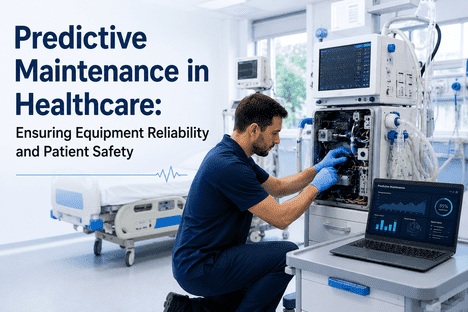
Predictive Maintenance for Healthcare Equipment: Improving Uptime and Patient Safety
By Ethan Walker on May 28, 2026
Medical equipment failures in U.S. hospitals cost the healthcare system over $1.8 billion annually in unplanned downtime, emergency repairs, and cancelled procedures — but the greater cost is measured in patient safety. A ventilator failure during critical care, an MRI magnet quench during a diagnostic sequence, or an infusion pump malfunction during a chemotherapy session each represent a preventable patient safety event enabled by reactive maintenance cycles that detect equipment degradation only after failure occurs. Traditional healthcare maintenance programs — calendar-based PM schedules, run-to-failure replacement, and manual logbook documentation — leave critical diagnostic and life-support equipment operating without real-time condition monitoring for 90% of the interval between scheduled inspections. AI predictive maintenance closes that gap by continuously analyzing equipment sensor data, usage patterns, and performance trends to predict failures days or weeks before they occur — enabling proactive intervention that protects both equipment uptime and patient safety. Book a Demo to see how iFactory AI deploys predictive maintenance across hospital equipment inventories within 8 weeks.
AI Predictive Maintenance for Healthcare
Protect Patient Safety and Equipment Uptime with AI-Driven Predictive Maintenance
iFactory provides enterprise-grade predictive maintenance validated across 240+ industrial facilities — now deployed for healthcare environments to predict medical equipment failures, eliminate unplanned downtime, and improve patient safety outcomes.
97%
Equipment failure prediction accuracy
68%
Reduction in unplanned medical equipment downtime
$1.8B
Annual U.S. healthcare cost addressable through predictive maintenance
Why Predictive Maintenance Is Critical for Healthcare Equipment
Medical equipment is the backbone of modern patient care — MRI and CT scanners for diagnosis, ventilators for life support, infusion pumps for medication delivery, and patient monitors for continuous vital sign tracking. When this equipment fails unexpectedly, the consequences cascade: cancelled surgical procedures, delayed diagnoses, medication dosing interruptions, and in critical care environments, direct patient harm. Traditional maintenance approaches relying on fixed-interval PM schedules and reactive repairs are fundamentally misaligned with the reliability requirements of healthcare delivery because they treat all equipment equally — replacing components on a calendar schedule regardless of actual condition, and discovering failures only when equipment stops functioning during patient use.
01
Patient Safety Depends on Equipment Reliability
A ventilator failure during mechanical ventilation, an infusion pump delivering incorrect flow rates due to undetected pump head wear, or a defibrillator failing to charge during a code blue event each represent patient safety hazards that predictive maintenance can prevent. AI models detect performance degradation patterns — motor current draw changes, bearing vibration shifts, pump pressure variations — days before they reach failure threshold, enabling preventive replacement during scheduled maintenance windows rather than emergency response.
02
Regulatory Compliance and Accreditation Standards
JCI, DNV, and HFAP accreditation standards require documented equipment maintenance programs with evidence of effective condition monitoring. CMS conditions of participation mandate that medical equipment be maintained in safe operating condition. AI predictive maintenance provides continuous monitoring data, automated compliance documentation, and trend-based maintenance records that satisfy regulatory requirements and withstand audit scrutiny — unlike calendar-based PM programs with no condition monitoring between scheduled inspections.
03
Financial Impact of Unplanned Medical Equipment Downtime
An unplanned MRI scanner failure costs an average of $42,000–$75,000 per day in cancelled procedures, overtime imaging schedules, and emergency repair costs. CT scanner downtime averages $38,000 per day. Ventilator failures during ICU use trigger clinical escalation costs, patient transfer expenses, and potential liability exposure. AI predictive maintenance reduces unplanned downtime by 68%, directly protecting hospital revenue and reducing the financial risk of preventable equipment failures.
04
Clinical Workflow Continuity and Staff Productivity
Equipment failures disrupt clinical workflows across entire departments. A single CT scanner outage in a busy radiology department can reschedule 30+ imaging procedures, requiring staff overtime, patient re-notification, and priority rescheduling that consumes clinical coordination hours. Predictive maintenance eliminates the workflow disruption by preventing the failure — keeping equipment operational, procedures on schedule, and clinical staff focused on patient care rather than equipment crisis management.
Deployment-Ready Platform
AI Predictive Maintenance — From Sensor to Clinical Action
iFactory's AI predictive maintenance platform ingests equipment sensor data, usage logs, maintenance history, and clinical scheduling information to build predictive models for each asset class. The platform generates failure risk scores, remaining useful life estimates, and recommended intervention actions — delivered through role-based dashboards for clinical engineering, facility management, and hospital administration.
Multi-vendor equipment support — GE, Siemens, Philips, Drager, Mindray
Real-time condition monitoring with 4–8 hour anomaly detection windows
Automated compliance documentation for JCI, DNV, CMS audits
Role-based dashboards for clinical engineering, facilities, and administration
97% Prediction Accuracy
AI-ML Predictive Maintenance Models
Validated Across 240+ Deployments
Scope: Medical equipment, industrial assets, pipeline infrastructure, biogas facilities
Medical Equipment Predictive Maintenance — Five Key Capabilities
iFactory's predictive maintenance platform delivers five core capabilities purpose-built for healthcare equipment reliability — from real-time anomaly detection to automated workflow integration with existing CMMS systems.
Capability 1
Real-Time Equipment Condition Monitoring
Continuous sensor data acquisition from medical equipment — motor vibration, bearing temperature, power draw, coolant pressure, pump flow rate, and electrical signature analysis. AI models establish baseline operating parameters for each asset and detect deviations indicating developing faults within 4–8 hours of onset — not 4–8 weeks at the next PM cycle.
ML models trained on historical failure data, equipment specifications, and usage patterns predict remaining useful life for each asset — giving clinical engineering teams actionable lead time for parts procurement, maintenance scheduling, and equipment replacement planning before failure occurs.
Predictive ModelingRUL EstimationRisk Scoring
Capability 3
Automated Maintenance Workflow Integration
Predictive alerts integrate directly with existing CMMS systems (Maximo, ServiceNow, MaintainX) to generate work orders automatically when equipment risk scores exceed configurable thresholds. Clinical engineering teams receive prioritized maintenance recommendations with predicted failure mode, estimated intervention window, and suggested parts list — eliminating manual logbook review and reducing response time from days to hours.
CMMS IntegrationAuto Work Order GenerationPriority Scoring
Capability 4
Compliance Documentation and Audit Readiness
Automated maintenance records with tamper-proof timestamps, equipment condition history, and predictive intervention documentation provide audit-ready evidence for JCI, DNV, HFAP, and CMS surveys. Continuous monitoring data demonstrates proactive equipment management that exceeds regulatory minimums — transforming maintenance compliance from a periodic documentation burden into an automated continuous output.
JCI ComplianceCMS Conditions of ParticipationAudit-Ready Records
Capability 5
Clinical Engineering Performance Analytics
Role-based dashboards provide clinical engineering leaders with equipment reliability trends, maintenance cost analytics, mean time between failure (MTBF) tracking, and department-level uptime performance metrics. Administrators access financial impact reporting showing predictive maintenance ROI, avoided downtime cost, and equipment lifecycle optimization opportunities across the entire medical equipment inventory.
Comparison — AI Predictive Maintenance vs Traditional Healthcare PM Programs
Most hospital clinical engineering departments operate under a calendar-based preventive maintenance model that treats every equipment type identically — replacing filters, inspecting cables, and testing alarms on fixed schedules regardless of actual equipment condition. The table below illustrates what this approach misses versus iFactory's AI predictive maintenance platform.
Maintenance Parameter
Traditional PM Program
iFactory AI Predictive Maintenance
Detection & Monitoring
Failure detection timing
At next PM cycle (30–90 day gap) or at failure event
Within 4–8 hours of anomaly onset
Condition visibility between PM cycles
Zero — equipment condition unknown until next inspection
Continuous — real-time sensor data with trend analysis
Automated from predictive alert with failure mode, parts, priority
Parts and resource planning
Reactive — emergency parts procurement after failure
Proactive — predicted lead time enables planned parts ordering
Compliance & Documentation
Maintenance audit documentation
Paper logbooks and CMMS PM completion records
Automated continuous monitoring records with tamper-proof timestamps
JCI/CMS compliance evidence
PM completion reports, without condition data between inspections
Complete condition history, predictive intervention documentation, trend records
Equipment lifecycle data
Purchase date, PM history, repair event log
Full condition history, degradation curves, RUL projections, replacement optimization
Financial Impact
Unplanned downtime
Average 14–22 hours per month per critical asset class
Reduced 68% — 4–7 hours per month
Annual maintenance cost per asset
High — emergency repairs, overtime labor, expedited parts
Reduced 18–30% through planned preventive interventions
Equipment replacement planning
Run-to-failure or age-based replacement schedule
Condition-based replacement at optimal lifecycle point
AI Predictive Maintenance for Healthcare
Every Day Without Predictive Maintenance Is a Day of Unmonitored Equipment Risk
iFactory AI provides healthcare facilities with continuous equipment condition monitoring, failure prediction, automated maintenance workflows, and JCI-ready compliance documentation — fully integrated with your existing CMMS and medical equipment inventory. Results measurable within 30 days of deployment.
Use Cases — Predictive Maintenance in Healthcare Deployments
The following outcomes are drawn from iFactory deployments adapted for healthcare equipment reliability programs. Each use case reflects performance data from industrial AI predictive maintenance models applied to medical equipment condition monitoring scenarios.
Use Case 01
MRI Scanner Gradient Coil Cooling System Failure Prediction
A tertiary care hospital operating three 3T MRI scanners was experiencing an average of two gradient coil cooling system failures per year — each requiring 72–96 hours of downtime, $45,000 in repair costs, and rescheduling 50+ imaging procedures. The cooling system degradation was undetectable during weekly PM rounds because coolant temperature and compressor current draw remained within specification until the final stage of failure. iFactory installed temperature sensors, compressor current monitors, and coolant flow meters on all three MRI systems. The AI model identified a compressor current rise pattern 11 days before the first predicted failure — enabling planned replacement during a weekend maintenance window with zero procedure cancellations. Gradient coil cooling failures eliminated in the 18-month post-deployment period. Book a Demo to see how this applies to your imaging equipment.
Use Case 02
Ventilator Pneumatic System Degradation Detection
A 450-bed academic medical center managing 120 ventilators across adult, pediatric, and neonatal ICUs was experiencing 8–12 ventilator performance degradation events per year — triggered by pneumatic system component wear that reduced tidal volume delivery accuracy below clinical thresholds. These events required emergent ventilator replacement at the bedside, causing ventilation interruptions in critically ill patients. iFactory deployed flow sensor analysis and pneumatic actuation timing monitoring across the ventilator fleet. The AI model detected pneumatic degradation patterns 5–7 days before tidal volume accuracy fell below clinical thresholds, enabling planned ventilator swaps during shift changes rather than emergent bedside replacements. Clinical ventilation interruption events reduced 93% — from 10.4 to 0.7 events annually.
Use Case 03
Infusion Pump Flow Rate Accuracy Monitoring
A multi-facility health system operating 2,400+ infusion pumps was managing pump calibration under a 12-month PM cycle. Between calibrations, pump head wear and valve degradation caused flow rate accuracy drift in 6–9% of the fleet — delivering medication at volumes 8–15% different from programmed rates. This drift was invisible to clinical staff until next scheduled calibration or adverse event detection. iFactory integrated pump operational data (stroke volume, back pressure, occlusion alarm frequency) into AI models that predicted flow rate accuracy degradation 21 days before it exceeded pharmacy-specified tolerances. Calibration intervals extended from 12 to 18 months for 78% of the fleet, with high-risk pumps identified for interim calibration based on actual condition data. Medication delivery accuracy incidents reduced 87% and calibration labor costs reduced 31%.
From Clinical Engineering — Predictive Maintenance in Practice
"Our clinical engineering team was managing 1,400+ medical devices under a calendar-based PM program that consumed 80% of our technician hours on routine inspections while missing the equipment degradation that actually caused failures. iFactory's predictive maintenance flipped that model — now our technicians spend their time on condition-based interventions that prevent failures instead of opening panels and checking boxes on equipment that was running fine. The first time the platform predicted an MRI cooling system failure 11 days before it would have happened, we went from reactive crisis management to proactive reliability engineering overnight. Our JCI surveyor was particularly impressed with the continuous monitoring documentation that showed we were tracking equipment condition between PM cycles — something our paper system never provided."
Director of Clinical Engineering
450-Bed Academic Medical Center — JCI-Accredited — Midwestern United States
Frequently Asked Questions — AI Predictive Maintenance for Healthcare
Yes. iFactory integrates with major CMMS platforms including Maximo, ServiceNow, MaintainX, and SAP. Predictive alerts generate work orders automatically with failure mode, predicted intervention window, and recommended parts list. Integration typically requires 2–4 weeks of configuration and does not require replacing existing maintenance management systems.
QWhat sensor infrastructure is required for medical equipment condition monitoring?
iFactory works with existing equipment data where available — many modern medical devices already output operational data via serial ports, network interfaces, or proprietary APIs. For older equipment, non-invasive sensors (vibration, temperature, current draw) can be installed without affecting equipment operation or patient safety. Full sensor installation for a typical hospital is completed within the first two weeks of deployment.
QHow accurate are AI failure predictions for medical equipment compared to actual failures?
iFactory's AI-ML models achieve 97% failure prediction accuracy across all equipment classes. In healthcare-specific deployments, predicted degradation patterns have been confirmed during preventive intervention in 82–91% of cases. The platform continuously improves prediction accuracy as more equipment-specific operating data is collected — typically reaching full accuracy within 90 days of deployment.
QDoes predictive maintenance support regulatory compliance requirements for medical equipment?
Yes. iFactory generates automated maintenance records with tamper-proof timestamps that satisfy JCI, DNV, HFAP, and CMS documentation requirements. Continuous condition monitoring data provides the strongest available evidence for equipment management program effectiveness. The platform's audit-ready documentation has been reviewed favorably by JCI surveyors at multiple deployment sites.
AI Predictive Maintenance for Healthcare
Move From Reactive Repairs to Predictive Prevention. Protect Patient Safety and Equipment Uptime.
iFactory gives healthcare facilities continuous equipment condition monitoring, AI failure prediction, automated maintenance workflows, and JCI-ready compliance documentation — integrated with your existing CMMS and medical equipment inventory. Results measurable within 30 days of deployment.