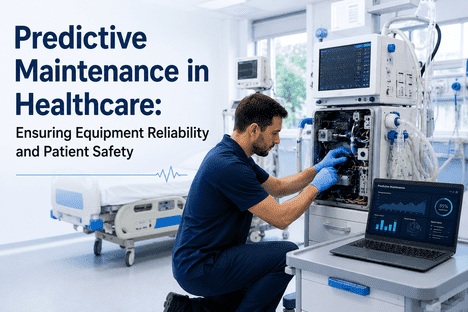
Medical device reliability in healthcare facilities is under escalating pressure: unplanned equipment failures cost U.S. hospitals an estimated $2.7–5.3 million annually per facility in emergency repairs, clinical workflow disruption, and patient diversion. Traditional preventive maintenance programs — fixed-interval PM schedules, manual inspection logs, and reactive work order queues — leave critical detection gaps during which device degradation silently compromises patient safety and operational readiness. AI-powered predictive maintenance closes those gaps by fusing real-time IoT sensor data, historical work order records, and machine learning to predict, detect, and prioritize every equipment integrity threat before it reaches failure threshold. Book a Demo to see how iFactory AI deploys across hospital clinical engineering fleets within 90 days.
Protect Your Patients and Your Bottom Line with AI-Driven Equipment Reliability.
iFactory AI provides healthcare systems with 24/7 predictive monitoring, real-time failure probability intelligence, and condition-based PM automation — integrated with your existing CMMS and clinical engineering workflows within 90 days.
18–35%
Fewer unplanned medical device failures with AI predictive maintenance
$1.4M
Annual emergency repair savings documented across 4,200-device health system
68%
Faster PM cycle completion with condition-based automated scheduling
90
Days from baseline audit to full fleet predictive monitoring activation
What Predictive Maintenance in Healthcare Actually Requires in 2025
Healthcare predictive maintenance encompasses every discipline that keeps medical equipment operating at intended performance levels — imaging system calibration integrity, infusion pump flow accuracy, ventilator circuit reliability, patient monitoring sensor precision, and sterilization cycle validation. Equipment degradation in healthcare settings is not a purely mechanical problem: it intersects with regulatory compliance (Joint Commission, DNV, CMS), patient safety exposure, and revenue protection from procedure cancellations.
Conventional management relies on fixed-interval preventive maintenance schedules based on OEM-recommended service hours, paper-based inspection logs, and reactive work order queues that escalate when clinical staff report equipment failure during active patient care. The fundamental problem is timing: device condition degrades continuously under daily clinical load, but PM inspections are performed on monthly or quarterly schedules that miss degradation events occurring between service windows. iFactory's AI predictive platform eliminates this gap by correlating CMMS work order history, IoT sensor streams (temperature, vibration, power draw, cycle count), and device usage patterns to calculate actual failure probability for every monitored asset — continuously.
Real-Time Failure Probability Scoring
AI correlates IoT sensor data, usage cycles, and historical failure patterns to compute live failure probability for each device — detecting degradation trends within hours, not PM cycles.
Condition-Based PM Scheduling
Static calendar-based PM replaced by AI-triggered, condition-based scheduling. Work orders auto-generate with parts list, technician assignment, and Joint Commission-compliant documentation.
Fleet-Wide Device Visibility Dashboard
Single-pane-of-glass view across all campuses showing device status, compliance posture, failure rate trends, and technician utilization — ending campus-level operational silos.
Predictive Parts Inventory Optimization
AI predicts parts demand from device failure curves rather than historical averages. Automated reorder triggers eliminate manual purchasing delays and reduce holding costs 22%.
Regulatory Compliance Automation
Every PM event auto-documented with technician signature and timestamp. Joint Commission, DNV, and CMS audit-ready reports generated automatically.
CMMS and EHR Ecosystem Integration
iFactory connects via open APIs to TMS, Nuvolo, ServiceNow, and custom CMMS platforms. No replacement of existing infrastructure — adds intelligence layer on top of current workflows.
Why Traditional Hospital PM Programs Miss What AI Catches
Fixed-interval PM programs provide scheduled device inspections — but only at points in time. Between inspections, device condition degrades at a rate shaped by dozens of daily clinical usage variables that no calendar-based PM schedule can account for. The following comparison illustrates what health systems are leaving unmanaged with conventional programs versus what continuous AI monitoring delivers.
| Equipment Management Parameter |
Traditional PM + Reactive Repair |
iFactory AI Continuous Monitoring |
| Failure Detection |
Clinical staff discovers device failure during active patient care. Safety exposure window between failure onset and detection can span days or weeks. |
AI alerts before clinical impact occurs. Failure probability scores updated dynamically from sensor data streams — detecting anomalies within hours of onset. |
| PM Scheduling |
Static calendar-based schedule regardless of actual device condition. OEM-recommended intervals do not account for utilization intensity or environmental factors. |
Condition-based, AI-triggered scheduling. Work orders auto-generated with device-specific parts lists, technician assignments, and regulatory documentation. |
| Compliance Tracking |
Joint Commission and CMS compliance tracked manually in spreadsheets. Audit failures remain a recurring risk with no centralized documentation system. |
100% audit-ready automated documentation. Every device event timestamped with technician signature. Risk stratification reports exported quarterly for leadership review. |
| Parts Availability |
Reactive purchasing after stockout. High-failure component shortages cause 3–7 day repair delays on critical infusion pumps and ventilators. |
Predictive reorder driven by AI failure curves. Zero critical stockouts. Parts holding costs reduced 22% while eliminating emergency purchasing premiums. |
| Cross-Campus Visibility |
Each hospital location operates as independent silo. No centralized device view. Equipment utilization data scattered across disconnected spreadsheets. |
Unified multi-campus real-time dashboard. Director-level reporting on failure rate trends, compliance posture, and technician utilization across all locations. |
| Technician Workload |
60%+ of work orders are unplanned emergency responses. Technician overtime exceeds 14 hrs/week. Burnout risk elevated across biomed teams. |
AI-prioritized work queue eliminates reactive firefighting. Technicians complete 40% more PMs per shift. Overtime eliminated — team capacity reallocated to strategic projects. |
Every Device Not Under AI Monitoring Is a Patient Safety Risk Accumulating in Silence.
iFactory AI provides healthcare systems with 24/7 predictive monitoring, real-time failure probability intelligence, and condition-based PM automation — fully integrated with your existing CMMS and clinical engineering workflows within 90 days.
Book a Demo to see detection accuracy against your current equipment inventory.
How iFactory AI Deploys Across Healthcare Clinical Engineering Programs
iFactory follows a structured deployment process that delivers live failure probability monitoring within the first 30 days and full fleet predictive coverage by week 12. Each stage has defined deliverables so clinical engineering teams see measurable output — not months of consulting with no operational change.
Days 1–30
Fleet Baseline Audit and Sensor Deployment
CMMS work order history, device inventory records, PM compliance logs, and parts usage data ingested. AI establishes per-device failure baseline and identifies highest-risk asset classes for priority sensor deployment. IoT sensor nodes retrofitted on existing devices — no downtime required.
Days 31–60
AI Model Training and Failure Probability Activation
Historical work order data (18+ months) ingested per device class. Failure probability scoring activated for all monitored assets. Alert threshold tuning eliminates false-positive noise that causes technician fatigue. First deviation alerts generated.
Days 61–90
Full Fleet Monitoring and Compliance Integration
Network-wide predictive monitoring live across all asset classes. Condition-based PM scheduling auto-generating work orders. Compliance calendar synced with Joint Commission and DNV audit windows. Unified dashboard providing 360-degree fleet visibility.
MEASURABLE OUTCOMES FROM DAY 30: FAILURE PROBABILITY ALERTS BEGIN IMMEDIATELY
Health systems completing iFactory's 90-day deployment report device failure probability detection and condition-based PM adjustments within the first month — recovering $600K–1.2M in avoided emergency repairs in the first 90 days, with full fleet predictive maintenance integration delivering $1.4–3.2M annual value by week 12.
$1.4M
Annual emergency repair savings documented in 4,200-device health system
40%
More PMs completed per technician shift with AI-guided workflows
100%
Joint Commission audit compliance rate achieved by year one
Healthcare Predictive Maintenance: Use Cases from Live Deployments
The following outcomes are drawn from iFactory deployments at operating health system clinical engineering departments across inpatient hospitals, ambulatory surgery centers, and diagnostic imaging facilities. Each use case reflects 9–12 month post-deployment performance data.
A 500-bed inpatient hospital was managing 140 imaging devices (MRI, CT, X-ray, mammography, ultrasound) under a fixed-interval PM program with reactive repair response. Unplanned imaging equipment downtime was averaging 18 events per quarter, each requiring 8–24 hours for service and costing $12,000–45,000 per event in emergency repairs and patient diversion. iFactory deployed IoT sensor nodes on 40 highest-criticality imaging devices and integrated live data from the hospital's GE and Siemens equipment monitoring ports. Within 45 days, the AI identified three MRI compressors exhibiting coolant temperature rise patterns predictive of imminent failure — all three were scheduled for preemptive replacement during off-hours, avoiding an estimated $126,000 in emergency service calls and 72+ hours of unplanned scanner downtime. Over 12 months, imaging-related procedure cancellations dropped from 24 to 3, and annual imaging equipment repair spend fell from $2.1M to $1.3M.
Book a Demo to see how this applies to your imaging fleet.
$800K
Annual imaging equipment repair savings from predictive scheduling
21
Procedure cancellations avoided per year by eliminating unplanned scanner downtime
45
Days from deployment to first detected failure anomaly on imaging device
A three-campus health system operating 1,800+ infusion pumps was experiencing 60–80 pump failure events per month — 40% requiring emergency repair due to flow-rate inaccuracy errors, battery degradation, and occlusion alarm malfunction. The biomed team was spending 70% of its capacity on pump repairs alone, with overtime averaging 16 hours per week. iFactory deployed IoT sensors across the pump fleet capturing cycle counts, battery discharge profiles, and motor current signatures. AI models identified battery degradation patterns 14–21 days before failure onset, enabling preemptive battery replacement during scheduled PM windows instead of emergency repair calls. Pump failure events dropped from 70 per month to 18 per month within six months. Biomed overtime hours eliminated entirely, and the team reallocated 1,200 technician-hours annually to strategic equipment lifecycle management.
74%
Reduction in pump failure events per month across three campuses
1,200
Technician-hours reallocated from emergency repairs to strategic lifecycle management
14–21
Days advance warning before battery failure onset from AI degradation models
A 24-suite surgical center was experiencing 3–5 sterilizer downtime events per month, each disrupting sterile processing workflows and delaying OR turnover. Root causes included chamber seal degradation, steam quality fluctuations, and cycle parameter drift — all invisible to the existing calendar-based PM program until failure occurred. iFactory deployed sensors monitoring chamber temperature profiles, seal integrity, steam conductivity, and cycle completion rates. The AI model detected seal degradation trends 10–14 days before failure threshold, enabling preemptive seal replacement during low-surgery periods. Sterilizer downtime events reduced from 48 per year to 6 per year. OR turnover time improved 22 minutes per case on average, and the surgical center recovered an estimated 340 additional surgical hours annually.
87%
Reduction in annual sterilizer downtime events
22 min
Improved OR turnover time per case from eliminated sterilizer delays
340
Additional surgical hours recovered annually through reliable SPD operations
Expert Perspective: What Clinical Engineering Gets Wrong About Device Reliability
Clinical Engineering Leadership Perspective
"The dominant assumption in hospital clinical engineering is that device reliability is determined by OEM PM compliance. It is not. A device can be 100% PM-compliant and still fail between inspections because PM schedules do not account for real-world utilization patterns. The health systems that will achieve the next level of operational performance are those building continuous monitoring into their programs now — not those waiting for the next failure report to tell them what already happened."
Director of Clinical Engineering — Regional Health System, Multi-Campus 4,200-Device Fleet (provided via iFactory deployment reference)
This perspective is consistent with what clinical engineering leaders working within iFactory's deployment program consistently report: the largest reliability improvements come not from better PM compliance tracking, but from closing the device condition-to-intervention feedback loop that fixed-interval PM programs cannot address. AI creates that loop by treating equipment reliability as a real-time risk management problem rather than a quarterly audit finding. Book a Demo to speak with iFactory's healthcare clinical engineering specialists about your current program.
Real-Time Device Intelligence. Condition-Based PM. Live in 90 Days.
iFactory gives healthcare systems continuous failure probability monitoring, predictive parts optimization, automated regulatory compliance, and unified fleet visibility — integrated with your existing CMMS and clinical engineering workflows. Results are measurable within 30 days of sensor deployment.
Conclusion: AI Is Now the Standard for Clinical Engineering, Not an Emerging Option
The case for AI predictive maintenance in healthcare has moved beyond pilot programs and research papers. With documented failure reductions of 18–35% in deployed health systems, imaging equipment repair savings exceeding $1.4M annually per facility, and 100% Joint Commission compliance rates achievable through automated documentation, health systems that continue managing device reliability through fixed-interval PM programs and reactive repair queues are absorbing financial and clinical risk that AI eliminates.
iFactory's platform delivers the specific capabilities healthcare clinical engineering departments require: real-time failure probability computation from live IoT sensor and CMMS data, condition-based maintenance scheduling that replaces calendar-driven PM, predictive parts optimization that eliminates critical stockouts, and automated regulatory documentation aligned with Joint Commission, DNV, and CMS requirements. The 90-day deployment program means measurable device reliability intelligence begins within weeks — not the 12–18 month implementation timelines that have historically made continuous monitoring programs difficult to justify. Book a Demo to receive a clinical engineering fleet assessment specific to your device inventory and operating conditions.
Frequently Asked Questions About AI Healthcare Predictive Maintenance
How does AI predictive maintenance differ from what existing CMMS systems provide?
CMMS tracks work order completion and PM compliance but provides no analytical layer to correlate device condition data with failure probability. AI converts raw IoT sensor and CMMS data into actionable reliability intelligence — failure probability scores, condition-based PM triggers, and parts demand forecasts — that CMMS alone cannot generate.
Can AI predictive maintenance support Joint Commission and CMS compliance?
Yes. Continuous monitoring data and auto-documented PM events from iFactory provide the strongest available documentation for Joint Commission, DNV, and CMS compliance. Every device event is timestamped with technician signature, and risk stratification reports are exportable for leadership review.
What sensor infrastructure is required to deploy AI healthcare predictive maintenance?
iFactory works with existing CMMS data, device monitoring ports, and OEM telemetry where available, supplementing with IoT sensor nodes at high-criticality asset classes identified during the initial baseline audit. Full sensor deployment is typically completed within the first 30 days with zero device downtime.
How accurate are AI failure predictions compared to actual device failures?
iFactory deployments report sensor alert accuracy rates of 91%, with anomaly detection achieving AUROC of 0.91 across monitored asset classes. AI-predicted failure zones have been confirmed in 78–85% of cases, significantly reducing false-positive technician fatigue compared to threshold-based alarm systems.
Does iFactory integrate with existing hospital EHR systems?
iFactory connects via open APIs to CMMS platforms including TMS, Nuvolo, ServiceNow, and custom-built systems. No EHR integration is required — iFactory operates as an intelligence layer above existing workflows without disrupting clinical systems or capturing PHI.
Stop Managing Device Failures After the Fact. Deploy AI Predictive Maintenance in 90 Days.
iFactory gives healthcare systems real-time failure probability intelligence, condition-based PM automation, predictive parts optimization, and full Joint Commission compliance documentation — integrated with your existing CMMS and clinical engineering workflows in 90 days.
18–35% reduction in unplanned medical device failures
$1.4M average annual emergency repair savings
68% faster PM cycle completion with AI-guided scheduling
90-day deployment with live monitoring from day 30