A European automotive tier-1 supplier had to double battery module capacity within 18 months. Two paths sat on the boardroom table. Path A: build a brand-new 400,000 sq ft greenfield plant on a purchased site outside Munich — full design freedom, no legacy constraints, but a 24-month build timeline and a €120 million budget. Path B: acquire and retrofit a recently closed electronics factory 40 km away — existing structure, utilities already in place, 12-month conversion timeline, €68 million total. They chose the brownfield route. Production started in 11 months. But within 18 months, the legacy building's column spacing prevented optimal AGV routing, ceiling height limited future expansion of a vertical storage system, and the electrical infrastructure required a €4.2 million upgrade the assessment had missed. Meanwhile, a competitor chose greenfield for the same capacity. They started production 8 months later — but hit 95% OEE in month three versus the brownfield plant's 71%. Neither choice was wrong. Both were incomplete without the right data-driven analysis.
iFactory Industrial Project Intelligence
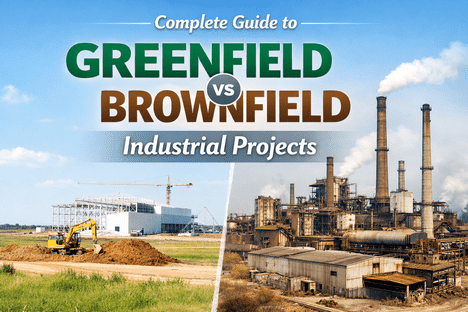
Complete Guide to Greenfield vs Brownfield Industrial Projects
The definitive comparison — costs, risks, timelines, ROI, and the data-driven framework for choosing the right path for your next facility
86%
Of manufacturers face the greenfield vs brownfield decision
70%
Of capital projects exceed budget
40–60%
Higher upfront cost for greenfield builds
6–12mo
Faster deployment for brownfield retrofits
What Greenfield and Brownfield Actually Mean
In industrial manufacturing, greenfield and brownfield are not just project types — they are fundamentally different investment philosophies that shape your facility's performance for decades. Understanding the distinction clearly is the first step toward making the right choice.
Greenfield
Build From Scratch on Undeveloped Land
A greenfield project involves designing and constructing a brand-new facility on previously undeveloped land. There are no existing structures, no legacy systems, and no inherited constraints. You start with a blank canvas — total design freedom, but total responsibility for every element from foundations to commissioning.
New gigafactory construction, new refinery builds, new pharmaceutical manufacturing plants, new distribution centres on purchased land
Brownfield
Retrofit, Expand, or Repurpose Existing Facilities
A brownfield project involves acquiring, renovating, expanding, or repurposing an existing industrial facility. The structure, utilities, and some infrastructure are already in place. You gain speed and cost savings — but inherit the constraints, limitations, and hidden surprises of someone else's design decisions.
Factory expansions, production line retrofits, facility conversions, plant modernisation projects, acquired site redevelopments
The Head-to-Head Comparison
Every greenfield vs brownfield decision comes down to trade-offs across seven critical dimensions. Here is how they compare — with the actual numbers, not generalities.
40–60% higher
Land acquisition, full construction, utility installation, permitting. Typical large project: $50M–$200M+
20–40% lower
Existing structure reuse. But hidden costs from legacy infrastructure frequently cause 12+ day schedule overruns in 68% of retrofits
12–24 months
Design, permitting (3–6 months alone), construction, commissioning. Longer, but production starts at peak efficiency
6–12 months
Faster market entry by leveraging existing structure. But ramp-up to full efficiency takes longer due to inherited constraints
Complete
Optimal layout, equipment placement, material flow, utility routing, expansion reserves — all designed to your exact specifications
Constrained
Column spacing, ceiling heights, floor load capacity, and utility locations limit equipment placement and expansion options
45% faster
Full Industry 4.0 integration from day one — IoT, AI, digital twins, automated material handling designed into the facility DNA
Retrofit required
Legacy systems require integration layers. Performance ceiling at 60–80% of potential without significant additional investment
Built-in
Expansion reserves, modular layout, future-proofed utilities. Growth requires adding capacity, not reworking constraints
Limited
Existing footprint, structural limitations, and utility capacity constrain growth. Over 60% of manufacturers face costly modifications within 3 years
Budget & timeline risk
Permitting delays, cost overruns (70% exceed budget), supply chain disruptions, and labour shortages during construction
Hidden complexity risk
Undocumented infrastructure, environmental remediation, structural surprises, legacy system incompatibilities
Higher ceiling
Purpose-built for optimal material flow and equipment sequencing. Achieves target OEE faster and sustains it longer
Lower ceiling
Inherited layout compromises limit peak performance. Smart technology can close the gap but rarely eliminates it entirely
Not sure which path delivers better ROI for your specific project? Get a free project assessment from our industrial engineers.
When to Choose Greenfield
Greenfield is the right choice when long-term operational performance outweighs the need for speed-to-market — and when the investment horizon justifies higher upfront capital.
Greenfield Is the Right Choice When:
You need a purpose-built facility optimised for a specific production process, product, or technology
The 10–20 year operational efficiency gain justifies 40–60% higher initial investment
Full Industry 4.0 integration — IoT, AI, digital twins, automated material handling — is a strategic priority from day one
Future expansion is planned and must be accommodated without reworking the original design
Regulatory, cleanroom, or hygienic requirements demand purpose-built compliance infrastructure
No suitable existing facility exists within the required geography or with the required specifications
Brownfield Is the Right Choice When:
Speed-to-market is the primary constraint — you need production running within 6–12 months
Available capital is limited and the 20–40% cost saving is critical to project viability
An existing facility with suitable structure, utilities, and location is available and well-documented
Production requirements fit within the existing building's constraints without major structural modification
Government incentives for brownfield redevelopment (up to 50% of cleanup costs subsidised) significantly improve the financial case
Operational continuity matters — phased conversion allows production to continue during the transition
The Hidden Costs Most Teams Miss
The most expensive mistakes in facility projects are the costs that never appear in the initial feasibility study. Both greenfield and brownfield projects have hidden cost categories that can derail budgets — and they are different for each path.
Hidden Greenfield Costs
Permitting Delays
Environmental impact assessments, zoning approvals, and construction permits add 3–6 months and $500K–$2M+ in carrying costs
Scope Creep
A blank canvas invites expansion. 70% of projects exceed budget — the average capital project overruns by $1.3 billion on large builds
Talent & Labour Shortages
Skilled construction labour shortages inflate contractor costs 15–30% and extend timelines, especially in competitive regions
Utility Connection Lead Times
Power, gas, water, and data connections to undeveloped land can take 6–18 months depending on local infrastructure capacity
Hidden Brownfield Costs
Undocumented Infrastructure
68% of brownfield retrofits exceed schedule by 12+ days due to discovering undocumented electrical, plumbing, or structural conditions
Environmental Remediation
Former industrial sites may contain contaminated soil, asbestos, or hazardous materials requiring specialist disposal and regulatory compliance
Legacy System Integration
Connecting modern automation, IoT, and MES systems to inherited PLCs, wiring, and protocols creates technical debt that compounds over time
Structural Limitations
Column spacing, floor load ratings, ceiling heights, and loading dock positions constrain equipment placement — often requiring costly workarounds
How AI and Smart Technology Change the Equation
The greenfield vs brownfield calculus has shifted significantly in the last two years because smart manufacturing technology — IoT sensors, AI analytics, digital twins, and predictive maintenance — can now be deployed in both environments, dramatically changing the ROI profile of brownfield projects while making greenfield builds even more powerful.
AI's Impact on Both Project Types
For Greenfield
AI layout simulation tests 2,000+ configurations before construction — finding the optimal layout conference rooms never could
Digital twins validate throughput, material flow, and capacity before a single foundation is poured
Full IoT and predictive maintenance integration designed into the building's DNA — not bolted on later
Smart energy management, automated scheduling, and real-time OEE monitoring from day one of production
For Brownfield
Retrofit IoT sensors connect to legacy PLCs via standard protocols — even equipment from the 1960s–1980s
Predictive maintenance on aging, failure-prone assets delivers some of the highest ROI in any deployment
Digital twins of the existing facility reveal hidden bottlenecks and optimisation opportunities within weeks
Pilot deployments on 10–20 assets cost $50K–$500K with ROI visible in 45–90 days
Whether you are building new or retrofitting existing — iFactory's AI platform accelerates your ROI timeline. Talk to our architects.
The Decision Framework — A Structured Approach
The right choice is never obvious from a spreadsheet alone. Use this weighted framework to evaluate your specific situation across the dimensions that matter most for your business.
Greenfield vs Brownfield Decision Scorecard
Decision Factor
Favours Greenfield
Favours Brownfield
Time to production needed in under 12 months
Budget is the primary constraint
20+ year operational horizon planned
Full Industry 4.0 integration required
Suitable existing facility available nearby
Future expansion of 50%+ capacity planned
Cleanroom or hygienic compliance required
Government redevelopment incentives available
Strong fit
Partial fit
Weak fit
Frequently Asked Questions
What percentage of manufacturers choose greenfield vs brownfield?
Only about 14% of manufacturers choose pure greenfield construction. The remaining 86% work with some form of brownfield — expansions, retrofits, conversions, or modernisation of existing facilities. This reflects the reality that most manufacturers already have operational facilities and need to balance new capacity with existing infrastructure investments.
Can a brownfield facility achieve smart factory capabilities?
Yes. Modern IoT sensors and AI platforms connect to legacy PLCs and equipment from any era using standard industrial protocols like Modbus and OPC UA. A brownfield smart factory pilot typically costs $50K–$500K for 10–20 assets, with ROI often visible within 45–90 days. Digital twins, predictive maintenance, and real-time OEE monitoring can all be retrofitted into existing facilities without disrupting production.
How do I estimate the true cost of a brownfield retrofit?
Start with a thorough facility assessment that goes beyond the building shell — inspect electrical capacity, structural load ratings, column spacing, ceiling heights, utility routing, environmental condition, and existing equipment state. Add a 15–25% contingency for undocumented conditions. 68% of brownfield retrofits discover surprises that extend schedules by 12+ days. A digital twin of the existing facility can reveal constraints and optimisation opportunities before physical work begins.
What is the typical ROI timeline for each approach?
Brownfield projects typically achieve faster initial ROI due to lower upfront investment and shorter time-to-production — often 12–18 months to payback. Greenfield projects have a longer payback window of 24–36 months but deliver higher long-term returns through superior operational efficiency, scalability, and lower ongoing maintenance costs. Smart technology integration accelerates both timelines significantly.
Is a hybrid approach possible?
Absolutely. Many manufacturers use a hybrid strategy: start production in a brownfield facility for speed-to-market, then plan and build a greenfield facility for long-term capacity. This approach captures early revenue while designing the optimal future-state facility. AI simulation can model both phases simultaneously, ensuring the brownfield investment remains productive even after the greenfield plant comes online.
Building New or Retrofitting Existing?
The Right Facility Decision Starts With the Right Data. Not the Loudest Opinion.
iFactory's AI simulation and digital twin platform helps you evaluate both paths with real data — testing layouts, simulating throughput, and projecting ROI before you commit capital. Whether greenfield or brownfield, your facility is optimised from day one.
2,000+
Layout configs tested by AI
90%
Issues caught pre-build