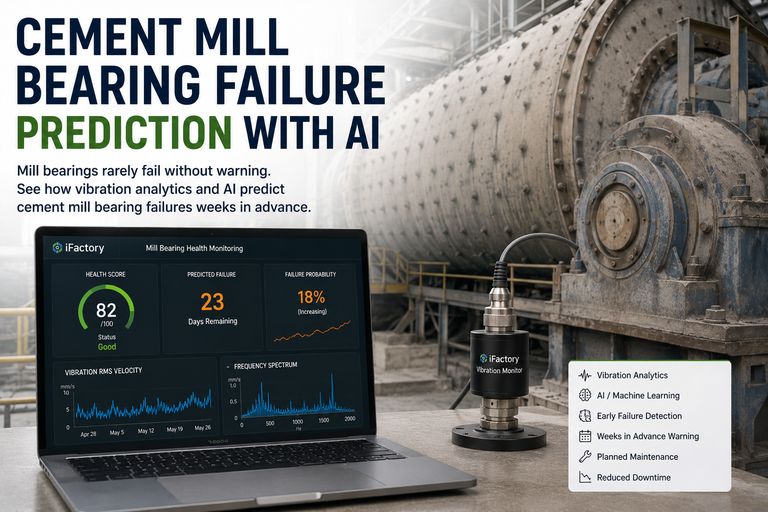
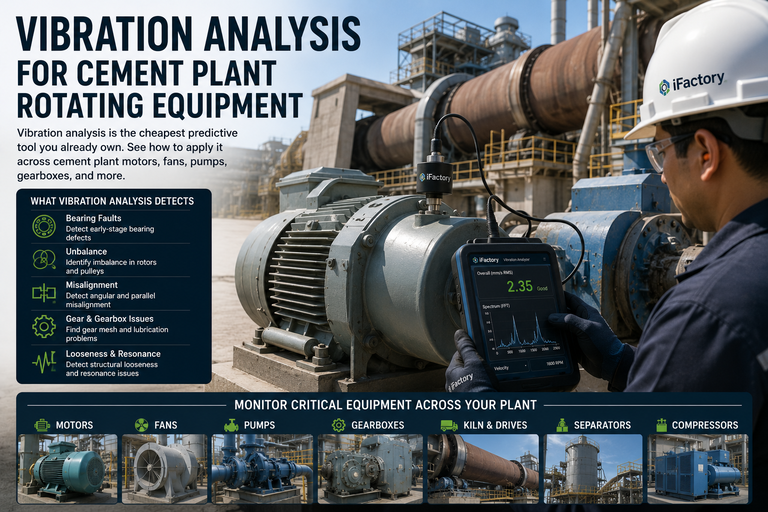
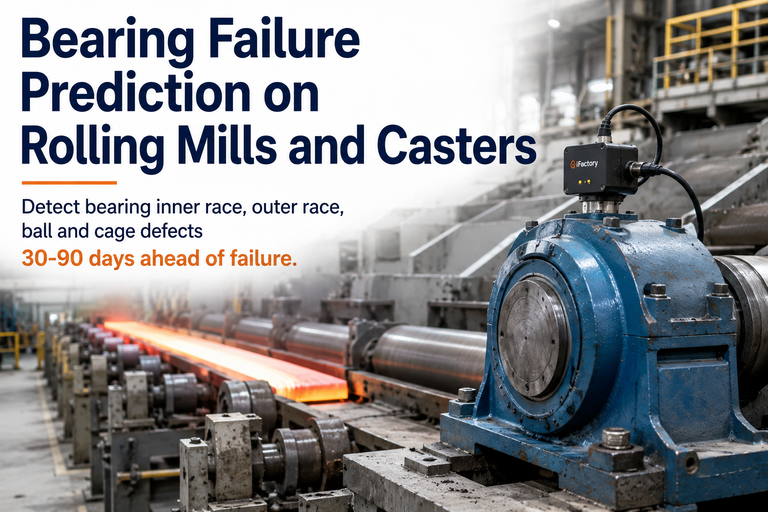
At 3 a.m. on a Saturday, a cement plant's ball mill gearbox seized. The post-mortem was brutal in its clarity: the vibration signatures had been deteriorating for eighteen days — a bearing cage defect frequency climbing from 1.2 to 4.8 mm/s, temperature creeping from 52 to 68 degrees — and with manual quarterly inspections, nobody saw it. The single grinding line went down, and the catastrophic failure cost the plant millions in emergency replacement, expedited freight, and lost clinker production. This is the defining truth of mill bearings: they almost never fail without warning. White metal degradation, oil-film collapse, and misalignment each leave measurable signatures in vibration and temperature weeks before seizure. The only failure is in watching for them. A cement mill condition monitoring system is how a reliability team turns those eighteen silent days into a scheduled, planned reline.
iFactory Reliability Intelligence
Cement Mill Bearing Failure Prediction with AI
Mill bearings rarely fail without warning. Vibration analytics and AI catch trunnion, gearbox, and roller-bearing degradation weeks in advance — turning a catastrophic seizure into a planned replacement.
Mill main bearings are the highest-consequence assets a cement plant runs. A seized trunnion bearing can take a 5,000-tonne-per-day mill offline for ten to twenty-one days, with total losses — emergency repairs, expedited parts freight, lost clinker — routinely exceeding two million dollars per incident. And because the mill is often the only grinding line, that failure cascades through the entire operation. The cruelest part is that nearly every bearing that reaches seizure was preventable; the warning was there, unwatched.
Route-Based Inspection
Quarterly Checks Miss the Ramp
Handheld readings monthly or quarterly miss the rapid deterioration between visits
A fault that develops over 18 days is invisible to a 90-day inspection cycle
"Sounds different at 3 a.m." is the detection system — too late, too subjective
Data outside the CMMS adds 3 to 6 weeks between anomaly and action
Continuous AI Monitoring
Watches the Trend Every Second
Accelerometers stream FFT data continuously, catching the deterioration ramp live
AI flags bearing defect frequencies 2 to 4 weeks before catastrophic failure
Anomaly auto-generates a CMMS work order — no manual translation delay
Failure converts to a planned reline in a scheduled maintenance window
The Deterioration Ramp You Can Watch
Bearing failure is not a cliff — it is a ramp. Vibration climbs and temperature rises along a measurable curve as the fault progresses, and that curve is what gives you the warning window. The chart below traces the real signature of a developing failure against the ISO 10816 severity zones that define healthy, alarm, and shutdown.
Vibration & Temperature Climb to Failure — the Warning Window
A vibration spectrum is a fingerprint. Each failure mode produces a specific frequency signature, and AI trained on historical cement-plant failures recognizes the pattern long before the overall level breaches an alarm. These are the modes that account for the bulk of mill bearing downtime.
Trunnion Bearing
White metal fatigue and oil-film collapse under load. Low-frequency signatures below 2x RPM; misalignment concentrates load on one pad edge, accelerating white-metal fatigue 3 to 5 times.
Cage / Race Defect
Bearing defect frequencies — cage defect near 0.43x RPM, plus inner and outer race signatures — appear early in the spectrum, well before the RMS level climbs into alarm.
Lubrication Failure
80% of ball-mill bearing failures are lubrication-related, not fatigue. Oil cleanliness (ISO 4406) predicts bearing life better than operating hours — oil-particle trends correlate with the vibration signal.
Gearbox / Gear Mesh
Gear mesh frequency sidebands flag tooth wear and misalignment in VRM and ball-mill gearboxes — multi-stage bearings whose failure means a 2-to-4-week reline if missed.
Want to see the spectrum from one of your mill bearings read for early defect frequencies? Book a 30-minute reliability walkthrough and we'll analyze a live signature from your mill.
Why Vibration Alone Isn't Enough
The strongest predictions come from fusing signals, not relying on one. Vibration catches the mechanical defect; temperature confirms the friction; oil analysis reveals the root cause. AI correlates all three, which is how it reaches 88 to 92% prediction accuracy and tells you not just that a bearing is failing, but why.
Vibration (FFT)
Continuous accelerometers capture defect frequencies at high sample rates — the primary early-warning channel for cage, race, and gear-mesh faults.
Temperature
Rising bearing temperature confirms increasing friction — in the real case, 52 to 68 degrees tracked the same 18-day window as the vibration climb.
Oil Analysis
Particle counters detect metal debris and viscosity sensors track lubricant degradation, pinpointing the lubrication root cause behind most failures.
From Signature to Scheduled Reline
The point of prediction is to move the repair from a 3 a.m. emergency into a planned window. AI does not just alarm — it identifies the component, the failure mode, the severity, the estimated time to failure, and the optimal maintenance window, then auto-generates the work order.
The Bearing Prediction Loop
1
Sense
Continuous FFT
Accelerometers on trunnion, gearbox, motor, and shell stream vibration and temperature
2
Baseline
Learn Normal
60 to 90 days of known-good readings set each point's healthy signature and thresholds
3
Predict
Match Pattern
AI matches the live signature to historical failures and estimates time to failure
4
Act
Auto Work Order
Component, mode, severity, and window land as a scheduled CMMS work order
What Prediction Is Worth
The economics of mill bearing prediction are among the most decisive in heavy industry, because a single prevented seizure can cover the entire monitoring program many times over. These figures come from cement-plant condition-monitoring deployments and industry analysis.
2-4 wk
Warning lead time
enough to schedule a reline into a planned shutdown
15-20%
Fewer unplanned shutdowns
with AI condition monitoring in place
8 hr
Planned vs 10-21 days
failures converted from catastrophic to scheduled windows
$32K
Daily clinker margin saved
per day of downtime avoided at a mid-sized plant
Every save starts with continuous sensing on the bearings that matter most. Want the monitoring plan scoped to your mills? Talk to our reliability engineers.
Frequently Asked Questions
How far ahead can AI really predict a mill bearing failure?
Typically 2 to 4 weeks, and sometimes longer — bearing failures often show an 18-to-25-day deterioration ramp in vibration and temperature. That window is the whole point: it's enough to order parts, plan labor, and schedule the reline into a maintenance shutdown instead of reacting to a seizure at 3 a.m. AI on continuous data reaches 88 to 92% prediction accuracy on these patterns.
Why isn't quarterly route-based vibration enough?
Because the failure develops faster than the inspection interval. A fault that ramps over 18 days is completely invisible to a 90-day handheld route — the deterioration happens entirely between visits. Continuous monitoring catches the rising slope as it happens; route-based checks only tell you the bearing's condition on the one day someone happened to measure it.
Our bearings keep failing on lubrication, not wear — does this help?
Especially then. Around 80% of ball-mill bearing failures are lubrication-related rather than fatigue, and oil cleanliness predicts bearing life better than operating hours. Fusing oil analysis with vibration and temperature is what pinpoints a lubrication root cause — oil-particle and viscosity trends correlated against the vibration signal — so you fix the actual cause, not just replace the bearing.
Can we use our existing vibration hardware and sensors?
Generally yes. The platform integrates with vibration systems over standard interfaces like OPC-UA and accepts temperature and manual oil-analysis data, so existing instrumentation can feed the models. Where coverage is thin, continuous wireless accelerometers are added on the critical points — trunnion DE/NDE, gearbox input/output, and main motor — to close the gaps.
How long before the system is predicting reliably?
It needs a baseline first — typically 60 to 90 days of known-good readings to learn each measurement point's healthy signature and calculate deviation thresholds. Models then sharpen as they see more of your mill's specific signatures and any maintenance events. Alarm thresholds start from ISO 10816 for vibration and OEM specs for oil, then calibrate to your equipment.
Catch the Ramp, Not the Seizure.
See Bearing Prediction Running on Your Mill — in 30 Minutes
Bring the mill bearing that worries you most. We'll show how continuous vibration, temperature, and oil signals build its healthy baseline, how AI flags the defect-frequency ramp weeks out, and how the reline lands as a scheduled work order instead of a 3 a.m. emergency.