At 2:17 a.m., a caster operator in a flat-rolled mill hears the telltale screech from segment #7 — a bearing that was "fine" on the last vibration reading 72 hours ago. The crew scrambles, the caster slows to 0.8 m/min, and the slab quality degrades across the next 17 tons before they can swap the segment. That one event costs $340,000 in lost throughput and scrapped material. Now multiply that across work rolls, backup rolls, MORGOIL oil-film bearings, table rolls, cooling fans, and pump motors — a typical integrated steel mill runs over 8,000 rotating assets. Most bearing failures are preventable. The problem isn't that bearings fail — it's that traditional vibration analysis can't see the defect frequencies early enough to plan a controlled stop.
Predict Bearing Failures 30–90 Days Ahead — Across Every Rotating Asset in Your Mill
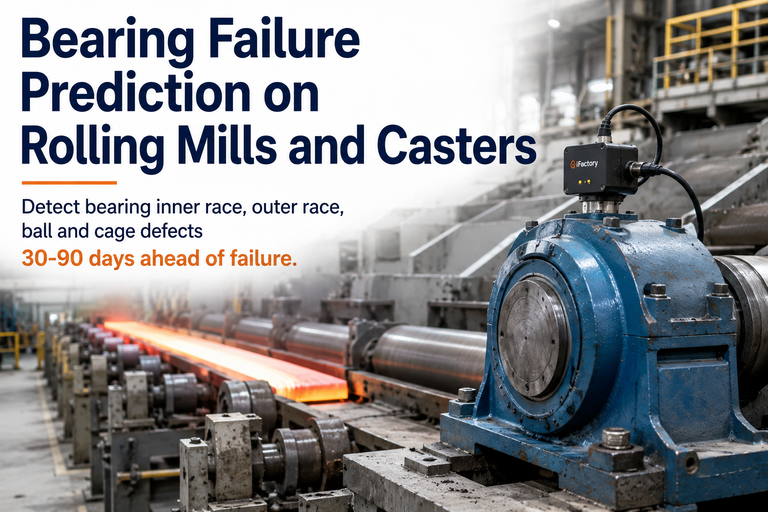
iFactory detects inner race, outer race, ball, and cage defects on work rolls, backup rolls, caster segments, MORGOIL bearings, fans, pumps, and motors — with defect-specific frequency analysis deployed on-premise in 6–12 weeks.
One AI That Sees Every Bearing Defect Frequency in Your Mill
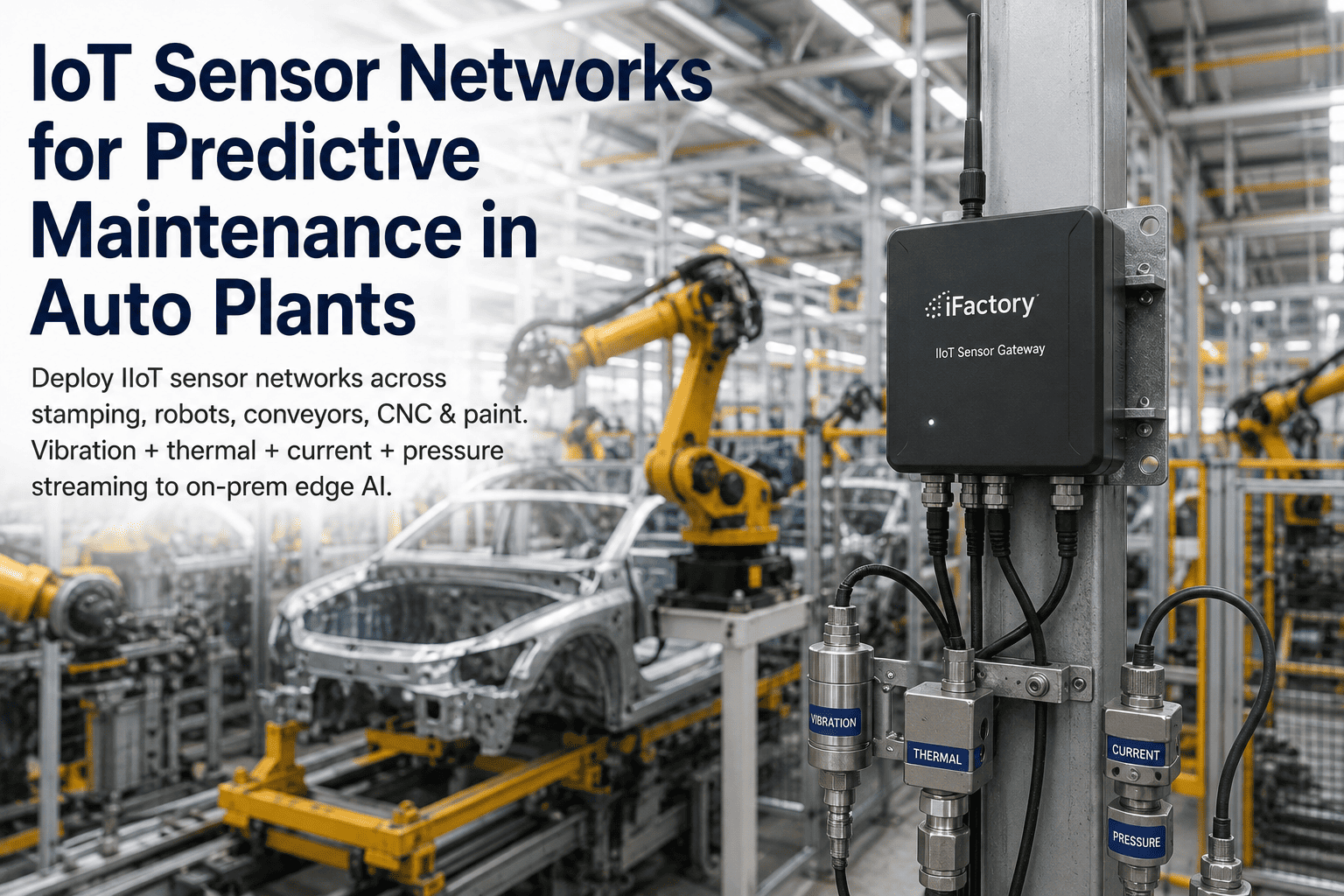
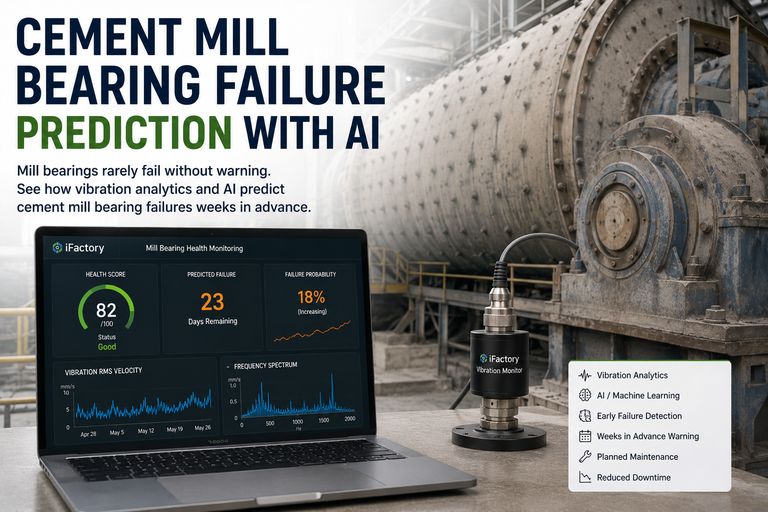
Traditional vibration analysis relies on periodic manual routes — a technician with a handheld sensor hitting 200 measurement points per shift. Between readings, a bearing can progress from a minor BPFI (ball pass frequency inner race) defect to a catastrophic cage failure. iFactory ingests continuous high-frequency vibration data from every sensor you already own — or we deploy our own — and runs envelope analysis on every bearing, every minute. The AI learns the specific defect signatures for BPFO, BPFI, BSF, and FTF for each bearing model in your mill: SKF 22328s on table rolls, Timken 239/530s on backup rolls, MORGOIL oil-film bearings on work rolls, and custom spherical rollers on caster segments. It doesn't just flag "high vibration" — it tells you which defect, which race, and how many operating hours remain before failure.
And because iFactory runs on a fully on-premise NVIDIA appliance inside your plant network, there is zero data egress, no cloud dependency, and no IT security review. The model trains on your mill's specific load profiles, speed regimes, and operating conditions — not on generic factory data. You hand over data-source access, and we deliver a working pilot in one quarter.
Complete Bearing Defect Detection — From Work Rolls to Cooling Fans
iFactory covers every bearing type and application in your steel mill with a single AI platform. Each capability is deployed as a pre-built model tuned to your specific equipment.
MORGOIL & Four-Row Tapered
Detect inner and outer race defects on work roll bearings operating at 300–800 RPM under heavy radial loads. The AI separates rolling element pass frequencies from structural resonance, giving you 45+ days of warning before a spall propagates.
Spherical & Cylindrical Roller
Monitor the massive 1,500 mm diameter backup roll bearings that carry 2,000+ tons of separating force. iFactory tracks cage defect frequencies (FTF) and ball spin frequencies (BSF) that analog filters miss, preventing catastrophic journal damage.
Segment Roll & Pinch Roll
Segment bearings operate in a 1,400 °C radiant heat zone with constant water spray. iFactory's envelope analysis penetrates the noise floor to detect BPFO and BPFI defects on the 80–120 bearings per caster strand, allowing segment swaps during planned downturns.
Induction Motor, Cooling Fan, ID Fan
Cover the 500+ motors and 200+ fans in a typical melt shop and rolling mill. The AI detects ball defects on 3,600 RPM fan bearings and inner race defects on mill motor bearings — the two most common failure modes that cause unplanned production stops.
Cooling Water, Hydraulic, Lube Oil
Hydraulic and lube oil pump failures account for 15% of all mill downtime events. iFactory detects cage and ball defects on pump bearings 60 days before oil contamination or seal failure occurs, preserving your critical fluid systems.
Runout Table, Transfer Table, Coil Conveyor
Table roll bearings — often the most neglected assets in a mill — fail with little warning. iFactory monitors the 2,000+ bearings on runout tables and conveyors, flagging outer race defects that cause roll skew and cobbles.
From Sensor to Shutdown Schedule in Four Steps
iFactory's bearing prediction pipeline runs continuously on your plant floor, with no manual intervention required after deployment.
Ingest Vibration Data
Connect to your existing vibration sensors, accelerometers, or install iFactory's wireless nodes — each asset streams 10–20 kHz raw vibration data at 60-second intervals.
Envelope Analysis & FFT
The on-premise AI performs real-time envelope analysis on each bearing, isolating BPFO, BPFI, BSF, and FTF from background noise and structural harmonics.
Defect Classification & Severity
The model classifies each defect by type (inner race, outer race, ball, cage) and assigns a severity score from 1 (healthy) to 5 (critical) with estimated remaining useful life in operating hours.
Actionable Alert & Schedule
When a bearing crosses the severity threshold, iFactory sends an alert with the specific defect, location, and a recommended shutdown window — integrated directly into your CMMS or maintenance schedule.
What Every Day of Missed Bearing Defects Costs Your Mill
When a bearing fails catastrophically, the costs cascade far beyond the replacement part. Here is what a single undetected defect costs in a typical integrated steel mill.
Unplanned Caster Segment Failure
A bearing spall on one segment forces a caster slowdown from 1.5 m/min to 0.6 m/min for 3 hours while the crew swaps the segment. Lost production: 180 tons of slab at $1,200/ton.
Work Roll Bearing Catastrophic Failure
An undetected BPFI defect propagates to a full spall, locking the roll and damaging the chock and housing. Replacement includes bearing, chock repair, and 8 hours of mill downtime.
Cooling Fan Bearing Failure in Melt Shop
A fan bearing cage failure causes rotor rub, destroying the fan assembly and shutting down the baghouse for 12 hours. Lost melting capacity: 900 tons of liquid steel.
What Steel Mills Achieve With iFactory Bearing Prediction
Across 12 steel mill deployments, iFactory has delivered measurable reductions in unplanned bearing failures and maintenance costs. Here is the aggregate performance data.
Every day you wait, a bearing defect is growing inside your mill. Book a 30-min walkthrough and we'll show you live bearing defect detection on your equipment — before your next unplanned stop.
Bearing Prediction Questions From Steel Mill Operations Leaders
Stop Reacting to Bearing Failures. Start Predicting Them.
iFactory gives you 30–90 days of warning on every bearing defect in your mill — work rolls, backup rolls, caster segments, MORGOIL bearings, fans, pumps, and motors. Deployed on-premise in 6–12 weeks. No cloud dependency. No data egress. One quarter to ROI.