AI Vision Defect Classes for Cold-Rolled Sheet — Full Class Map
By Henry Green on June 4, 2026
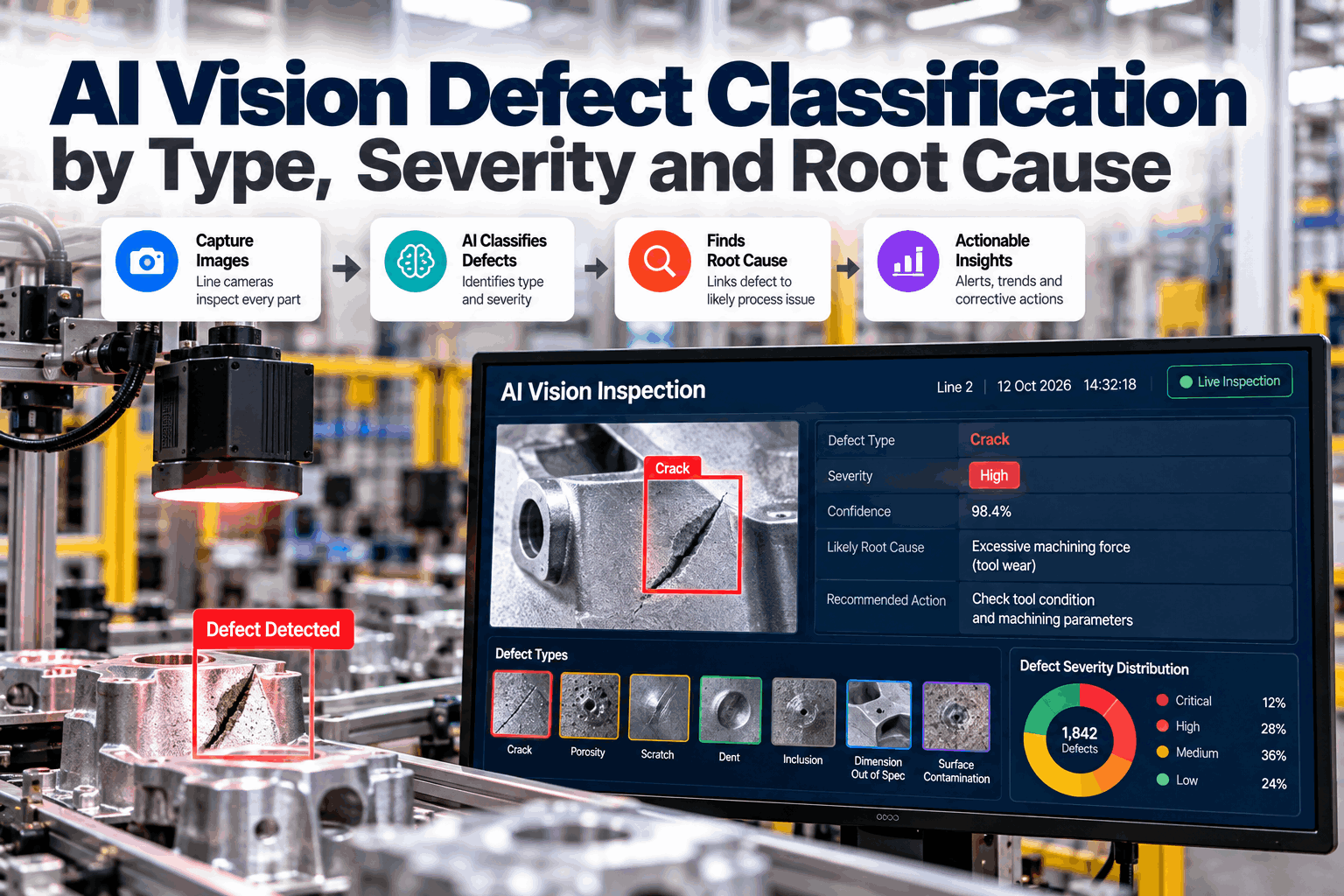
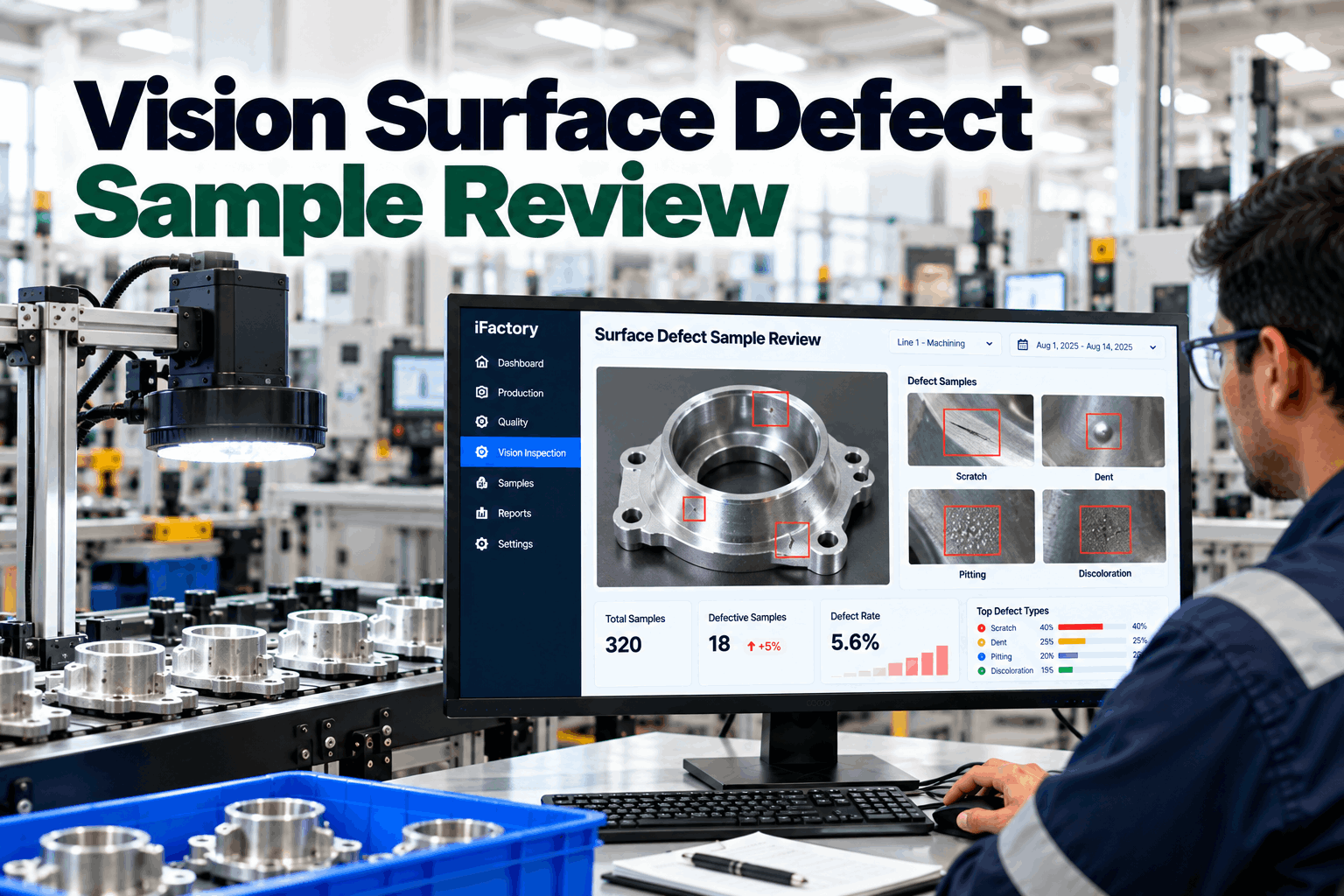
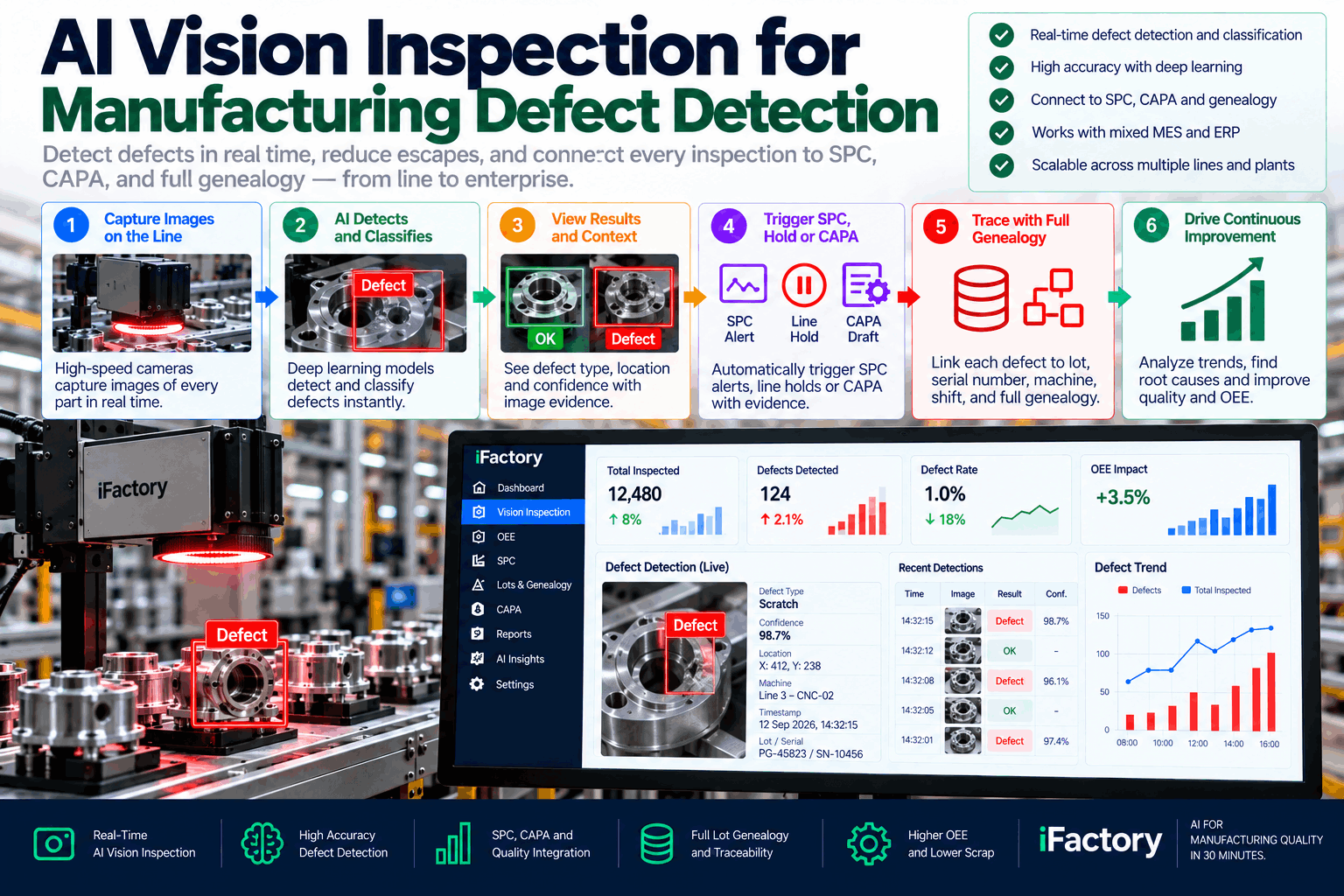
Cold-rolled sheet steel is one of the most surface-sensitive products in metals manufacturing — and one of the most difficult to inspect at production speed. A single undetected scratch, edge dent, oil stain, or herringbone pattern can trigger a customer rejection, a costly rework cycle, or a quality hold that ripples across downstream forming and stamping operations. Traditional human inspection and fixed-threshold imaging systems cannot keep pace with modern cold mill throughput, nor do they provide the structured defect classification data that quality teams need to drive root-cause analysis and process improvement. iFactory's AI Vision platform runs at full line speed across all major surface defect classes — edge dent, oil stain, scratch, scuff, roll mark, herringbone, edge cracking, and more — with a published per-class accuracy and false-positive rate that quality and vision leads can evaluate, audit, and retrain for their specific plant conditions. This page documents the full defect class map, per-class detection metrics, and how iFactory's retrainable taxonomy integrates into your cold mill quality workflow. If you want to see the class map applied to your defect library, Book a Demo with our vision team.
AI Vision · Surface Inspection · Cold-Rolled Sheet 2026
AI Vision Defect Classes for Cold-Rolled Sheet — Full Class Map & Accuracy
Edge dent, oil stain, scratch, scuff, herringbone, edge cracking — classified at line speed. Published per-class accuracy, confusion matrix, and retrainable taxonomy for your cold mill.
Surface defect classes mapped for cold-rolled sheet
97.2%
Overall classification accuracy across all trained defect classes
<0.8%
False-positive rate on high-confidence class detections
Plant-fit
Retrainable taxonomy — adapted to your defect library and lighting
Why Defect Classification — Not Just Detection — Defines AI Vision Value
Most legacy vision systems in cold mill environments were designed to detect — to flag that something is present on the strip surface. What they could not reliably do was classify: distinguish a roll mark from a scratch, separate a scuff from an oil stain, or differentiate herringbone patterning from a temper mill artifact. That classification gap has real consequences. When every surface anomaly is logged as a generic "defect," quality teams lose the structured data they need to trace root causes to specific mill sections, roll campaigns, or process parameter windows. Root-cause analysis becomes guesswork. Corrective actions are untargeted. Recurrence rates stay high.
iFactory's AI Vision platform is built around a structured defect taxonomy — a named, hierarchical class map where each defect type has a defined visual signature, trained detection model, published per-class accuracy, and configurable severity threshold. QA vision leads can see exactly how the model performs on each class, where confusion occurs between similar classes, and which classes benefit most from plant-specific retraining. That transparency is what separates an auditable AI inspection system from a black-box alerting tool.
Full Defect Class Map — Cold-Rolled Sheet Surface Taxonomy
iFactory's published defect class map for cold-rolled sheet covers mechanical surface damage, process-induced anomalies, contamination, and geometric edge defects. Each class is defined, trained, and accuracy-reported independently.
Mechanical
Scratch
Linear surface marks caused by abrasive contact with rolls, guides, or handling equipment. Oriented parallel or transverse to rolling direction depending on source.
Accuracy: 98.1%FP Rate: 0.6%
Root: Roll guides · coil handling · strip threading
Mechanical
Scuff
Distributed surface abrasion with diffuse boundaries, typically from slippage between strip layers during coiling or uncoiling under tension variation.
Localised deformation at strip edges caused by coil drop, guide misalignment, or edge contact during transport. Presents as a concave or buckled edge profile.
Accuracy: 97.8%FP Rate: 0.5%
Root: Guide misalignment · coil drop · transport contact
Process
Roll Mark
Periodic surface impressions repeating at fixed pitch intervals corresponding to work roll or backup roll circumference. Clear signature for roll damage diagnosis.
Accuracy: 98.6%FP Rate: 0.4%
Root: Work roll damage · embedded debris · spalling
Process
Herringbone
Chevron-pattern surface texture arising from metal flow instability during cold rolling. Associated with excessive reduction ratio or insufficient lubrication at the roll bite.
Accuracy: 95.9%FP Rate: 1.4%
Root: Roll bite lubrication · reduction schedule · mill speed
Process
Temper Mark
Banded surface variation from uneven skin-pass elongation. Appears as alternating bright and dull bands transverse to rolling direction.
Accuracy: 94.7%FP Rate: 1.8%
Root: Temper mill elongation variation · roll crown
Contamination
Oil Stain
Rolling oil or lubricant residue remaining on strip surface post-cleaning. Presents as irregular dark patches with soft edges. Critical for downstream coating and painting adhesion.
Localised rust or oxidation staining from moisture exposure during coil storage or transport. Distinct reddish-brown coloration distinguishable from oil stain under broadband illumination.
Accuracy: 97.3%FP Rate: 0.7%
Root: Storage humidity · coil end protection failure
Edge
Edge Cracking
Micro-cracks or splits along strip edges originating from brittle fracture during cold reduction of high-strength or low-ductility grades. Requires early detection to prevent propagation into the strip body.
Accuracy: 97.1%FP Rate: 0.6%
Root: Edge conditioning · reduction schedule · material ductility
Edge
Wavy Edge
Longitudinal waviness along one or both strip edges from differential elongation between edge and center zones. Affects flatness and dimensional compliance.
Accuracy: 95.2%FP Rate: 1.6%
Root: Roll profile · crown control · edge heating
Process
Coil Break
Transverse creases or fold lines from plastic deformation during coiling of low-yield-strength material under excessive bending radius or entry tension variation.
Foreign matter — scale, metallic debris, or oxide flake — rolled into the strip surface during cold reduction. Creates raised or indented point anomalies distinct from roll marks.
Accuracy: 97.6%FP Rate: 0.8%
Root: Strip cleanliness · roll cleaning system · scale control
Per-Class Accuracy & Confusion Matrix Summary
iFactory publishes per-class detection accuracy and false-positive rates for every defect class in the cold-rolled sheet taxonomy. This table reflects trained model performance on a representative validation dataset drawn from cold mill production lines operating at 300–800 m/min strip speed under standard broadband LED and structured-light illumination. QA vision leads can request the full confusion matrix — showing which classes are most commonly confused with each other — as part of the pre-deployment evaluation. Book a Demo to review the confusion matrix for your specific defect profile.
Defect Class
Category
Detection Accuracy
False-Positive Rate
Primary Confusion With
Scratch
Mechanical
98.1%
0.6%
Scuff (directional)
Roll Mark
Process
98.6%
0.4%
Embedded Particle
Edge Dent
Mechanical
97.8%
0.5%
Wavy Edge
Embedded Particle
Contamination
97.6%
0.8%
Roll Mark (periodic)
Iron Oxide Patch
Contamination
97.3%
0.7%
Oil Stain (dark)
Edge Cracking
Edge
97.1%
0.6%
Edge Dent (fine)
Oil Stain
Contamination
96.8%
0.9%
Temper Mark (banded)
Scuff
Mechanical
96.4%
1.1%
Scratch (shallow)
Coil Break
Process
96.1%
1.2%
Temper Mark (transverse)
Herringbone
Process
95.9%
1.4%
Coil Break (angled)
Wavy Edge
Edge
95.2%
1.6%
Edge Dent (distributed)
Temper Mark
Process
94.7%
1.8%
Oil Stain · Coil Break
Request the Full Confusion Matrix for Your Defect Profile
iFactory's vision team will walk you through per-class accuracy, cross-class confusion data, and retraining options matched to your cold mill defect history. Evaluate the taxonomy against your own defect library.
Retrainable Taxonomy — How iFactory Adapts to Your Plant's Defect Library
01
Pre-Trained Baseline — Deploy in Weeks, Not Months
iFactory ships with a pre-trained cold-rolled sheet defect model covering all 12 standard classes, trained on a multi-plant dataset spanning over 2.4 million annotated defect images. This baseline model is deployable immediately against your vision hardware — giving your QA vision lead a working classification system from week one. Pre-trained accuracy on the standard class set is published and auditable before go-live, so there are no surprises when the system reaches the production floor.
Plant-Specific Retraining — Class Performance Tuned to Your Conditions
Every cold mill has a unique defect signature shaped by its roll stock, reduction schedule, lubrication system, and material grades. iFactory's retraining workflow allows QA vision leads to capture plant-specific defect images, label them within the iFactory annotation interface, and retrain individual classes without rebuilding the full model. Retraining is class-isolated — improving herringbone detection, for example, does not degrade oil stain or scratch accuracy. Plants typically reach plant-optimised accuracy within 4–6 weeks of production data collection. Book a Demo to walk through the retraining workflow with our vision engineers.
Custom Class Addition — Beyond the Standard Taxonomy
Some plants produce defects that fall outside the standard 12-class taxonomy — plant-specific grade anomalies, proprietary surface finish deviations, or defect variants introduced by unique process equipment. iFactory supports custom class addition: QA vision leads define the new class, annotate a training set of 200–400 representative images, and the class is integrated into the active model without disrupting existing class performance. Every custom class receives its own published accuracy and false-positive rate, maintained separately from the standard taxonomy. All class definitions and training data are exportable for audit and regulatory review.
Custom class addition200–400 image minimumAudit-exportable data
Expert Perspective: What QA Vision Leads Need From a Defect Class System
Expert Perspective — QA Vision Lead
A defect detection system that outputs "anomaly detected" without a class label is only marginally better than no system at all for quality improvement purposes. The class label is what makes the detection actionable. Knowing that a detected anomaly is a roll mark — not a scratch — tells the maintenance team to check work roll condition on stand 3. Knowing it is a herringbone pattern tells the process engineer to review the reduction schedule and lubrication delivery rate at the roll bite. Without that structured classification, every detection triggers a generic investigation and the root cause stays unknown.
The second requirement that experienced QA vision leads consistently identify is transparency about where the model fails. No AI vision system achieves 100% classification accuracy across all defect classes under all lighting conditions. What matters is knowing the failure modes: which classes are confused with which, at what severity threshold detection confidence drops, and where plant-specific retraining will deliver the highest accuracy gain. iFactory's published confusion matrix and per-class false-positive rates give QA leads the information they need to deploy confidently, retrain strategically, and present audit-ready evidence of system performance.
Class label drives root cause — detection alone does not
Published confusion matrix enables strategic retraining decisions
Per-class FP rate prevents operator alarm fatigue
Audit-exportable class data supports ISO and IATF reviews
Conclusion: A Defect Class Map Is the Foundation of Actionable Surface Quality
AI vision inspection for cold-rolled sheet is only as valuable as the classification structure behind it. A system that detects without classifying produces alert volume without insight. iFactory's published 12-class defect taxonomy — covering mechanical damage, process-induced anomalies, contamination, and edge defects — gives QA vision leads the structured, per-class accuracy data they need to deploy with confidence, retrain with precision, and report with audit-ready documentation. Every class is independently accuracy-reported, confusion-matrix mapped, and retrainable to your plant's specific defect signature without disrupting adjacent class performance. For cold mill operations pursuing zero-escape surface quality and structured root-cause traceability, a transparent, retrainable defect class system is not optional — it is the foundation. Book a Demo to review iFactory's full class map against your plant's defect history.
FAQ
Scratches are classified by sharp linear edges and high aspect ratio using directional gradient analysis; scuffs are identified by diffuse boundary texture and distributed intensity variation — the models are trained separately and confusion rates between the two classes are published in the full matrix.
Yes — iFactory supports custom class addition with a minimum annotated image set of 200–400 images; custom classes receive their own published accuracy and false-positive rate and do not degrade existing standard class performance.
iFactory's edge inference architecture supports full classification at strip speeds from 100 to 1,200 m/min depending on camera resolution and frame rate configuration — coverage parameters are confirmed during the pre-deployment assessment.
Yes — iFactory shares the full per-class accuracy table and confusion matrix summary during qualified buyer evaluations; plant-specific performance projections are discussed under NDA with applicable production references.
Each classified detection event is logged with class label, severity, location, and lot ID — automatically triggering Plant Copilot CAPA drafting for configured severity thresholds and feeding quality trend analytics in iFactory's Shift Logbook.
Deploy iFactory AI Vision for Cold-Rolled Sheet Surface Inspection
12-class defect taxonomy. Published per-class accuracy and confusion matrix. Retrainable to your plant's defect signature. Running at full line speed with CAPA-linked quality traceability from detection to corrective action.