SAP ME and SAP PCo Migration — A Practical 12-Week Modernization Path
By Henry Green on June 10, 2026
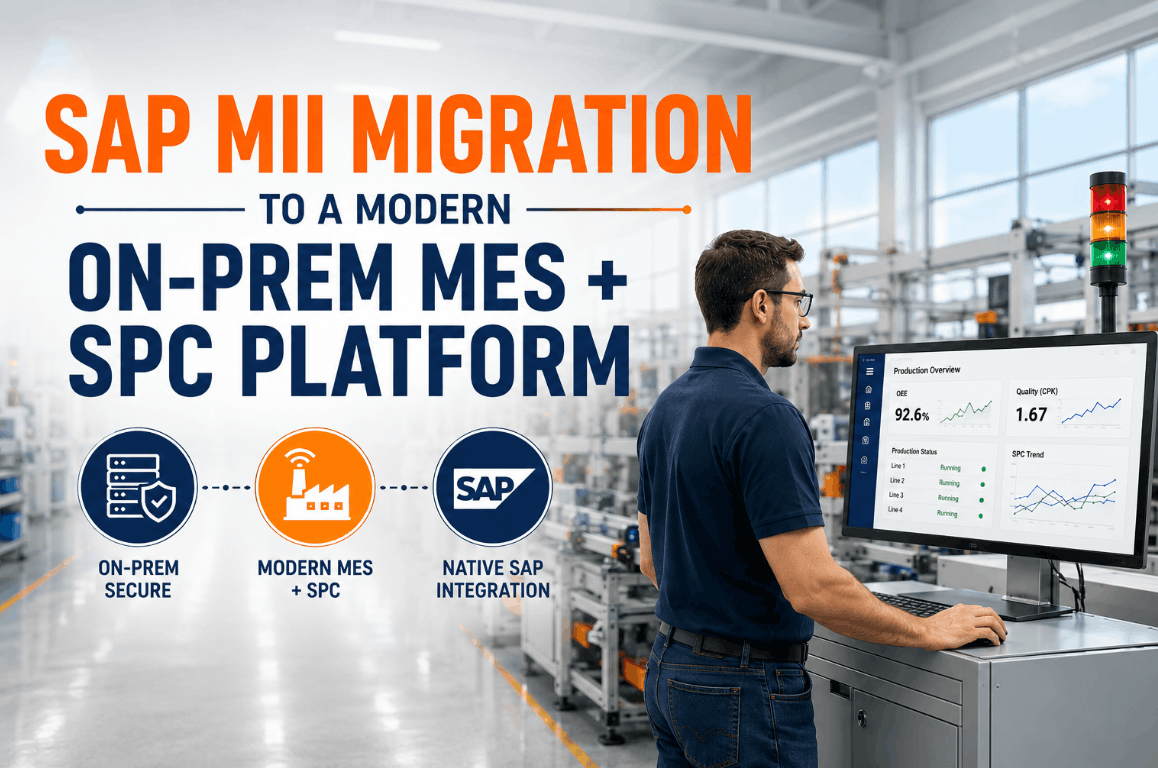
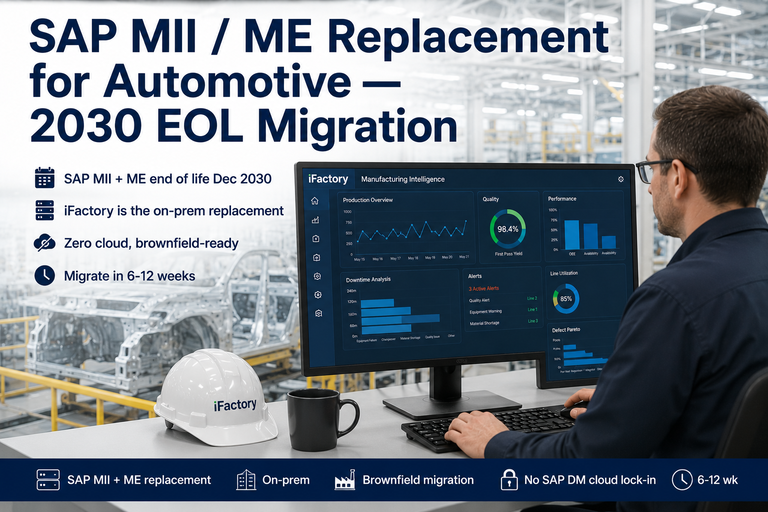
SAP Manufacturing Execution (ME) and SAP Plant Connectivity (PCo) have been the shop-floor backbone for manufacturing plants worldwide since the early 2000s — ME handling production order execution, work instruction delivery, and quality recording, while PCo translated OPC, OLE DB, Modbus, and MSMQ traffic from PLCs and SCADA systems into something SAP could consume. SAP has confirmed that mainstream maintenance for both platforms ends December 31, 2027, with extended support available only through approximately 2030 at premium cost. This is not a routine upgrade cycle. The entire NetWeaver Java stack that underpins ME and PCo is sunsetting, and SAP has no ME 2.0 or PCo successor that preserves the existing on-premises architecture. For U.S. manufacturing plants running both systems, this is a forced migration event — and programs of this scope require 12 to 24 months from assessment to stable production cutover. iFactory's SAP ME + PCo migration path absorbs both functions in a single on-premises deployment, preserving your MSMQ message queuing, re-mapping your PCo OPC UA and REST connections natively, and adding AI-driven SPC from day one — with a structured 12-week parallel-run framework that keeps production running throughout. To understand how iFactory maps to your current ME transaction inventory and PCo agent configuration, Book a Demo with our migration engineering team.
SAP ME + PCo END OF LIFE — 2027
Both Systems Are Sunsetting. One Migration Replaces Both.
iFactory absorbs SAP ME execution logic and PCo connectivity in a single on-prem platform — MSMQ bridge, OPC UA, REST, and native S/4HANA integration included. AI SPC added from day one, no bolt-on required.
Dec 2027SAP ME and PCo mainstream maintenance cutoff — programs take 12–24 months to complete
~2030Extended support end — after which both platforms receive no security fixes or feature updates
12 WeeksiFactory's structured parallel-run migration path from ME + PCo to full production cutover
Zero ABAPNative S/4HANA + ECC integration via OData, RFC, IDoc — no custom ABAP development required
What You Are Actually Replacing — ME, PCo, and the NetWeaver Stack
Why This Is a Platform Replacement, Not a System Upgrade
Most plants running SAP ME and PCo today are running a tightly coupled, three-layer architecture: PCo sits in the plant network as a Windows service, converting machine-level protocols (OPC DA/UA, Modbus, OLE DB, MSMQ) into SAP-consumable messages. SAP ME receives those messages and executes production order confirmations, work instruction routing, quality recording, and SFC (Shop Floor Control) tracking. Both communicate through the NetWeaver Java application server, which is the layer SAP is retiring. When mainstream support ends in 2027, the first consequence is not that the system stops running — it is that every adjacent SAP system release (S/4HANA updates, ECC patches, Windows security updates) becomes a potential break point, with no SAP patch coming to stabilize it. Plants that run ME and PCo on extended support through 2030 face increasing fragility, not a stable runway. The correct migration framing is: both ME's execution logic and PCo's connectivity layer need to be replaced, simultaneously, by a platform that handles both functions natively — so you are not re-integrating two separate replacement systems. iFactory's migration path is built around this dual-function replacement model, which is why the 12-week parallel-run is achievable. To see how this maps to your current architecture, Book a Demo and walk through your ME and PCo configuration with our integration team.
SAP ME vs. SAP DM Cloud vs. iFactory — What the Migration Comparison Actually Looks Like
Understanding the Architecture Gap Before Committing to a Migration Path
SAP ME + PCo (Legacy)
SAP DM Cloud + ProdCon
iFactory On-Prem
Deployment Architecture
On-prem (NetWeaver Java)
Cloud-only (SAP BTP)
On-prem (NVIDIA hardware)
Plant Floor Connectivity
PCo — OPC DA/UA, MSMQ, Modbus
ProdCon (blocks Proficy Historian, MSMQ)
OPC UA, MSMQ bridge, REST, Modbus, MQTT
S/4HANA Integration
IDoc + BAPI (custom NetWeaver)
Native SAP BTP integration
OData, RFC, IDoc — no ABAP required
Data Sovereignty
On-prem (full control)
Cloud (limited on-prem control)
Full on-prem, behind firewall
SPC Capability
Rules-based, static
Static SPC paradigm
AI-driven adaptive SPC (native)
ME Logic Preservation
Native (legacy)
Full re-architecture required
ME transaction re-mapping with bridge layer
Parallel-Run Migration Path
N/A
Not supported for MSMQ/PCo configurations
12-week structured parallel run
AI Copilot
None
Limited / roadmap
Native (included in deployment)
The 12-Week iFactory ME + PCo Migration Framework
A Parallel-Run Path That Keeps Production Running Through Full Cutover
Weeks 1–2
Phase 1 — ME Transaction & PCo Agent Inventory
Catalog every ME SFC routing, work instruction configuration, and production order confirmation flow. Simultaneously document every PCo agent — data source type (OPC UA, OLE DB, Modbus, MSMQ), notification process, and machine model entity mapping. Most missed integrations surface here. Plants typically discover 20–40% more PCo agent configurations than IT records show.
Weeks 3–5
Phase 2 — iFactory Edge Connectivity Deployment
Deploy iFactory's on-prem edge layer alongside the live PCo environment. Configure the MSMQ bridge to mirror existing PCo notification processes. Establish OPC UA connections to PLCs and SCADA systems in read-only mode — no disruption to active PCo agents. Validate that all machine-level data streams are being received by iFactory before any PCo agent is touched.
Weeks 4–7
Phase 3 — S/4HANA and ERP Integration Re-mapping
Configure iFactory's ERP bridge layer using OData, RFC, and IDoc interfaces against your S/4HANA or ECC system. Re-map existing ME production order download, SFC confirmation, and quality notification IDoc flows to iFactory's integration layer. Run in shadow mode alongside live ME — all ERP transactions validated against ME output before any live traffic is switched over.
Weeks 6–9
Phase 4 — Operator UI, Work Instructions & SFC Migration
Rebuild ME operator POD screens and work instruction delivery in iFactory's UI layer. Migrate SFC routing configurations and shop floor control logic. Conduct user acceptance testing on representative production lines while ME continues to run production — no operator switchover until UAT is complete and signoff obtained from the ME Migration Owner.
Weeks 8–10
Phase 5 — AI SPC Activation and Baseline Calibration
Activate iFactory's AI-driven SPC on critical process lines using historical ME quality data as the baseline. Configure adaptive control limits by product family, process condition, and shift pattern. This replaces SAP ME's static rules-based quality monitoring with dynamic process capability tracking — and it runs on the same platform, not a separate analytics layer. Book a Demo to see AI SPC configured on a representative process from your plant.
Weeks 10–12
Phase 6 — Parallel Run, Final UAT, and ME/PCo Decommission
Run iFactory and ME/PCo in full parallel on production lines. Compare production order confirmations, quality records, and OEE outputs between systems. Once parallel-run tolerance is met — typically 5 consecutive production days with zero discrepancy — execute the final PCo agent cutover and ME decommission on a planned maintenance window.
The PCo Migration Problem SAP Doesn't Lead With
Why ProdCon Blocks Specific PCo Configurations — and What That Means for Your Plant
SAP's official successor to PCo is the Production Connector (ProdCon) — a re-architected edge connectivity layer that pairs with SAP Digital Manufacturing Cloud instead of ME. The migration guide makes ProdCon look like a straightforward swap, but several PCo configurations block the installer outright. Plants using GE Proficy Historian as a PCo data source cannot proceed with ProdCon until that integration is removed. Plants with MSMQ-based notification processes lose that queuing capability entirely in the ProdCon architecture, because ProdCon cloud-based agents do not use MSMQ persistence. Plants that have PCo and ProdCon running simultaneously cannot activate cloud management on both — SAP explicitly does not support two cloud-service endpoints configured concurrently. For plants where any of these conditions apply, ProdCon is not a migration path; it is a re-architecture project that eliminates existing connectivity infrastructure and requires rebuilding it from scratch. iFactory's edge layer handles all of these scenarios natively: MSMQ bridge maintained, Proficy Historian integration preserved, and the full PCo agent inventory re-mapped without forcing a connectivity architecture change. The table below summarizes the migration blockers and how iFactory addresses each.
PCo Configuration
ProdCon Migration Status
iFactory Migration Path
GE Proficy Historian data source
Blocks ProdCon installer
Native Proficy Historian federation — no removal required
MSMQ notification process queuing
Not supported in ProdCon cloud agents
MSMQ bridge layer preserved and re-pointed to iFactory
OPC DA legacy source systems
Requires OPC DA wrapper or source replacement
OPC DA supported natively; migration to OPC UA optional
PCo + ProdCon parallel-run requirement
Explicitly unsupported by SAP
12-week parallel run with full iFactory shadow operation
Modbus source systems (older PLCs)
Limited ProdCon Modbus support
Full Modbus TCP/RTU support — no PLC firmware changes needed
Multi-plant PCo agent estate (10+ agents)
Complex per-agent migration, no bulk tooling
Bulk agent re-mapping from PCo configuration export
"We had 34 active PCo agents — a mix of OPC UA, OLE DB, and MSMQ notification processes — feeding SAP ME across three production buildings. When we evaluated ProdCon as the migration path, our integration architect flagged that the MSMQ queuing on 11 of those agents would have no equivalent in the ProdCon architecture, and we were also running Proficy Historian on two of the lines, which blocks the ProdCon install entirely. iFactory's edge layer connected to every one of our 34 agents without requiring us to retire or rebuild any of them first. We ran iFactory in parallel to ME and PCo for eight weeks, confirmed everything was matching, and cut over during a planned weekend outage. The AI SPC that came with it identified a process drift issue on one of our press lines in the first two weeks that our static ME quality records had been missing for over a year."
SAP ME Migration OwnerTier-1 Industrial Components Manufacturer, Ohio
What iFactory Adds That SAP ME Never Had
The Capability Gap That Makes This Migration an Upgrade, Not Just a Replacement
AI-Driven Adaptive SPC
Control limits recalibrate dynamically per product grade, tooling state, and process condition. SAP ME's static Shewhart charts generated excessive false alarms on tight-tolerance products and missed genuine drift on stable lines. iFactory eliminates both failure modes.
Digital Twin of the Shop Floor
Real-time digital twin built from OPC UA, MSMQ, and ERP data streams — giving process engineers a live, integrated view of machine state, production order status, and quality signals in a single interface that ME's siloed POD screens never provided.
Predictive Maintenance Integration
Condition monitoring analytics applied to critical equipment using the same OPC UA data streams that feed production execution — no separate PdM platform or additional integration required. SAP ME had no predictive maintenance capability.
Real-Time OEE at Machine Level
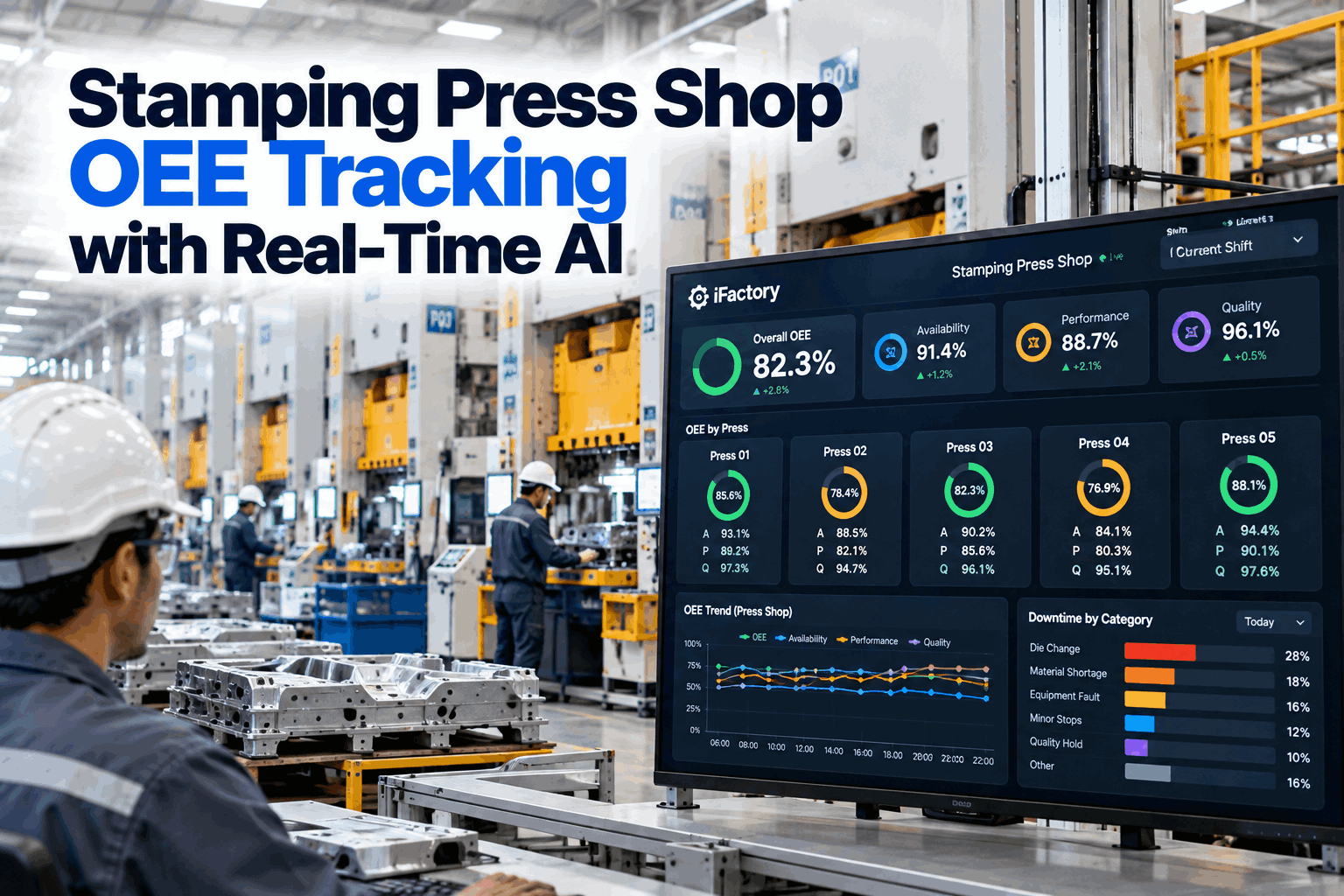
OEE calculated per machine, per shift, per product in real time from direct PLC data — not reconstructed from ME SFC confirmation timestamps. Availability, Performance, and Quality breakdowns available at the equipment level, not just the line level.
AI Copilot for Process Engineers
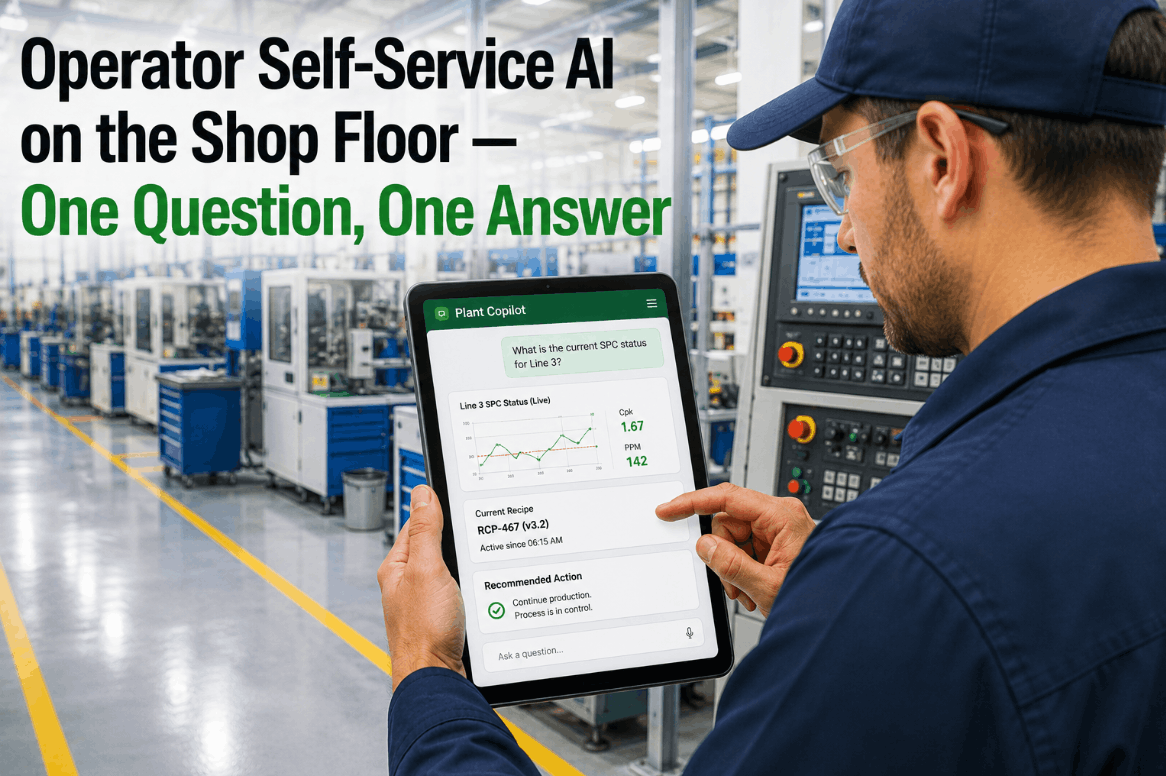
iFactory's AI Copilot surfaces root-cause recommendations, process drift alerts, and production anomaly explanations in plain language — giving process engineers actionable intelligence directly from the platform, not from manual data exports and spreadsheet analysis.
Modern Operator UI Without POD Constraints
iFactory's operator interface is configurable without SAP POD Designer constraints — role-based screens built to match actual operator workflow, not SAP's screen architecture. Work instruction delivery, SFC tracking, and quality recording consolidated in a single responsive interface.
MIGRATION READINESS ASSESSMENT
Is Your ME + PCo Configuration Ready for Migration?
iFactory's migration engineering team will map your PCo agent estate, ME transaction inventory, and ERP integration interfaces — identifying the blockers, gaps, and risks before your program plan is locked. Assessment delivered in 2 weeks. Book a Demo to begin.
Mainstream maintenance ends December 31, 2027. Premium extended support runs to approximately 2030, after which both platforms receive no security patches or functional updates and operate without SAP coverage.
Can iFactory replace both SAP ME and PCo in a single deployment?
Yes. iFactory's on-prem platform absorbs ME's execution and quality recording functions and PCo's connectivity layer in one deployment — MSMQ bridge, OPC UA, REST, and ERP integration handled natively without separate middleware.
What PCo configurations block the SAP ProdCon migration path?
GE Proficy Historian data sources block the ProdCon installer outright. MSMQ notification processes lose queuing capability. Running PCo and ProdCon in parallel with cloud management active on both is explicitly unsupported by SAP.
How does the 12-week parallel-run work without disrupting production?
iFactory deploys in shadow mode alongside live ME and PCo — all data streams, ERP transactions, and quality records validated against ME output before any traffic is switched. Production cutover happens on a planned maintenance window only after 5 consecutive days of clean parallel-run data.
Does iFactory require custom ABAP to integrate with S/4HANA or ECC?
No. iFactory integrates with S/4HANA and ECC using standard OData, RFC, and IDoc interfaces — no custom ABAP development is required, and no SAP Basis changes are needed on the ERP side.
START YOUR ME + PCo MIGRATION TODAY
Get a Structured SAP ME + PCo Migration Readiness Review
Our integration engineering team will catalog your ME transaction inventory, map your PCo agent configuration, and deliver a 12-week migration plan — including identification of any ProdCon blockers and a full ERP interface re-mapping — before you commit to a platform decision.