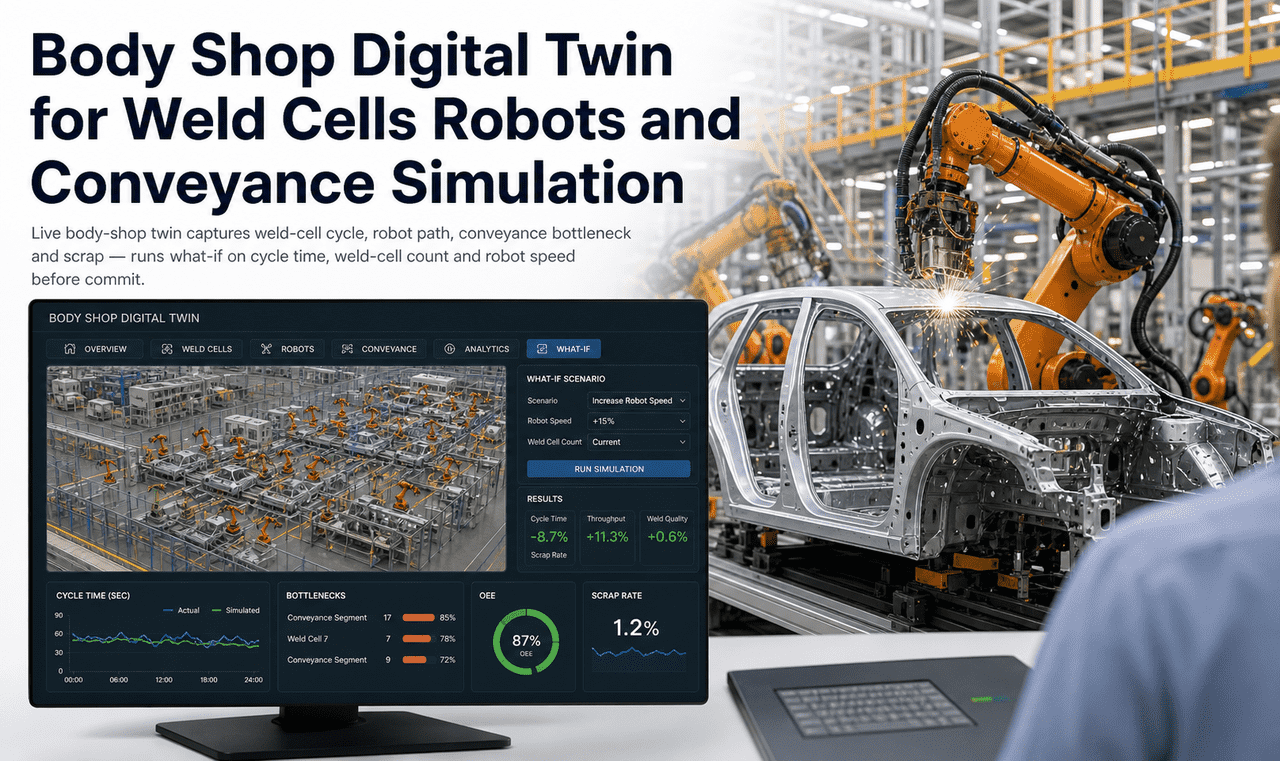
A finished car body rolls off the line at 60 vehicles per hour. Behind it sit four shifts of inspectors, 1.5 million spot welds per shift, 240 paint parameters, and an assembly line where a single missing fastener becomes a $1,200 warranty claim or a $45,000 truckload reject. The legacy answer was more inspectors, more rework loops, and more hope. The 2026 answer is different. Audi runs 100 robots through cloud-coordinated PLCs in its Neckarsulm body shop. AI inspection of 1.5 million spot welds at scale. ProcessGuardAI catching paint anomalies before they become rejects. IRIS scaling to ten VW Group plants this year. And IATF 16949:2027, the new automotive QMS standard, finally accepting AI-generated traceability as audit-compliant. The plants that close the gap aren't the ones with bigger AI budgets — they're the ones running AI as a turnkey, plant-wide operating system from press shop to EV battery line. This is what that platform looks like, and what it does to your numbers.
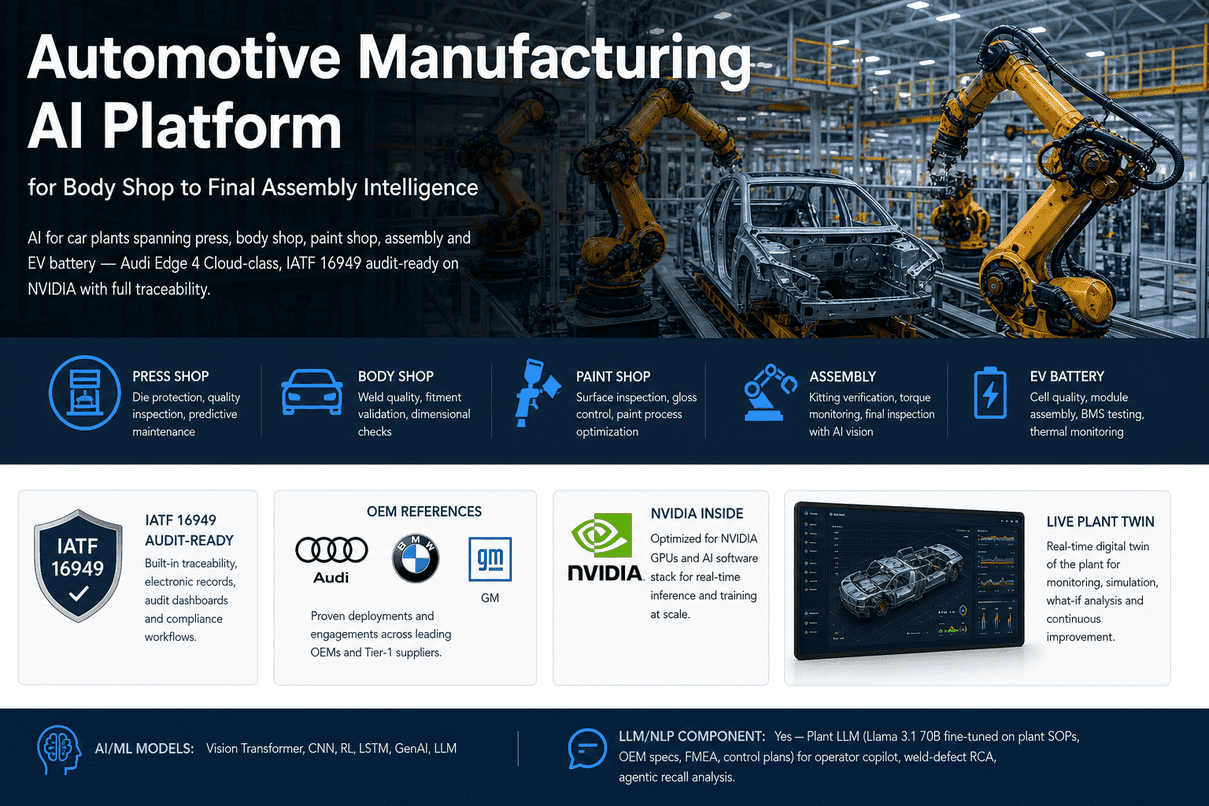
Automotive Manufacturing AI Platform
From Press Shop to EV Battery Line — One AI Platform, Five Plant Zones, Zero Pilots Stuck in Limbo.
A turnkey, NVIDIA-powered automotive AI platform delivered as fully-loaded servers, plant LLM, vision QC, and IATF 16949 traceability. Live in 6–12 weeks. Pre-configured. Globally deployed. Built for OEMs and Tier-1s ready to move past pilot purgatory.
98.7%
Defect detection accuracy at line speeds up to 240 ppm
6–12 wk
Hardware ships racked, software pre-loaded, AI live
5 zones
Press, body, paint, assembly, EV battery — one platform
$2.3M/hr
Cost of automotive line failure AI prevents
What You Get — A Turnkey Automotive AI Platform, Not a Build-It-Yourself Toolkit
Most automotive AI projects fail in the gap between proven models and plant-wide deployment. Solidigm's research surfaced the problem cleanly: the technology isn't broken, but the tooling assumes specialist AI engineers who don't exist on most plant floors. iFactory closes that gap with a fully-loaded delivery model — hardware, software, integration, training, and 24×7 monitoring all in one signed contract.
Hardware
Pre-Configured NVIDIA AI Server
Ships racked and ready, software pre-loaded. No NVIDIA procurement cycle, no system integrator quote, no "weeks of staging." Land it on the floor, plug in line power and Ethernet, AI is live.
Software
Plant LLM + Vision Stack
Llama 3.1 70B fine-tuned on automotive SOPs, OEM specs, FMEA, and control plans. Vision Transformer + CNN models for press, body, paint, assembly. Operator copilot, weld-defect RCA, agentic recall analysis — pre-loaded.
Integration
Cabling, Network, PLC/SCADA
Field technicians dispatched globally — US, EU, UAE, India, Japan. We handle structured cabling, OT network segmentation, PLC and SCADA integration, MES handshakes, and OPC UA bridges to your existing stack.
Training
Operator & Quality Engineer Onboarding
Mobile-first operator copilot training. Quality engineer playbooks for MSA studies, Gage R&R validation, and PPAP integration. Shift supervisors trained on real-time twin dashboards.
Support
24×7 Remote Monitoring
99.9% platform uptime. Continuous model performance monitoring, drift detection, automated retraining triggers. Calibration drift alerts protect PPAP compliance. Fully managed service.
Compliance
IATF 16949 Audit-Ready From Day One
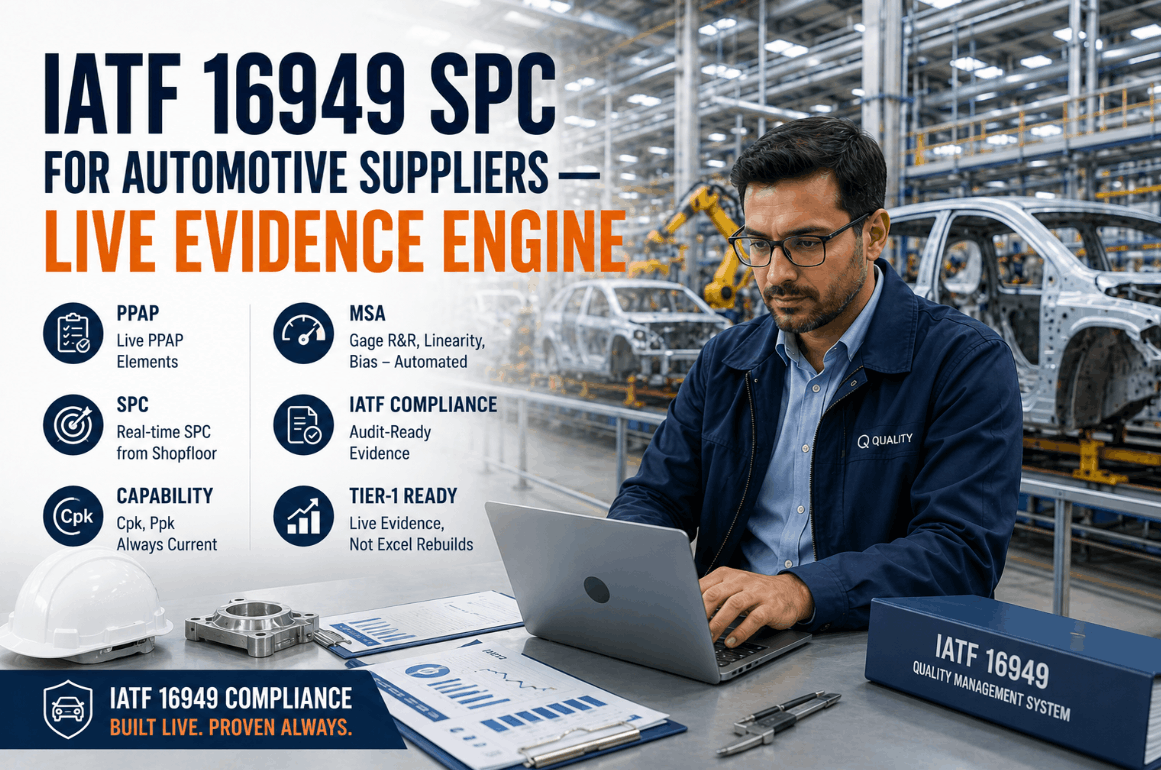
Automated control plan generation, real-time SPC, MSA documentation, and complete defect-to-VIN traceability. Major certification bodies now accept AI-generated quality documentation as IATF compliant.
No procurement cycle, no specialist hiring, no pilot purgatory. Get a turnkey quote with 12-week delivery commitment.
The Five Plant Zones — One Platform, Distinct AI Per Zone
Stamping a fender is not the same problem as inspecting a battery module. Press shop AI fights tonnage anomalies and die crack propagation. Body shop AI grades 1.5 million spot welds. Paint shop AI catches orange peel under specific lighting. Assembly AI verifies fastener torque sequences. EV battery AI projects 2D defects onto 3D CAD models for millimetre-scale repair localization. The platform is unified — the model stack per zone is purpose-built.
Z1
Press Shop
Vision Transformer · CNN · LSTM
Real-time tonnage anomaly detection on stamping presses. Die crack propagation prediction from acoustic and vibration signatures. Coil-to-part traceability. Surface defect classification on stamped panels — doors, hoods, fenders — at 0.2mm anomaly resolution.
97% scratch detection accuracy on stamped panels
Z2
Body Shop
CNN · Vision Transformer · RL
AI grading of 1.5M+ spot welds per plant per shift — incomplete fusion, porosity, spatter, geometric irregularity. Thermal imaging integration for heat-affected zone analysis. RL-driven robot path optimization. Cloud-coordinated robot timing with virtual PLCs.
96% weld defect detection · 78% structural warranty claim reduction
Z3
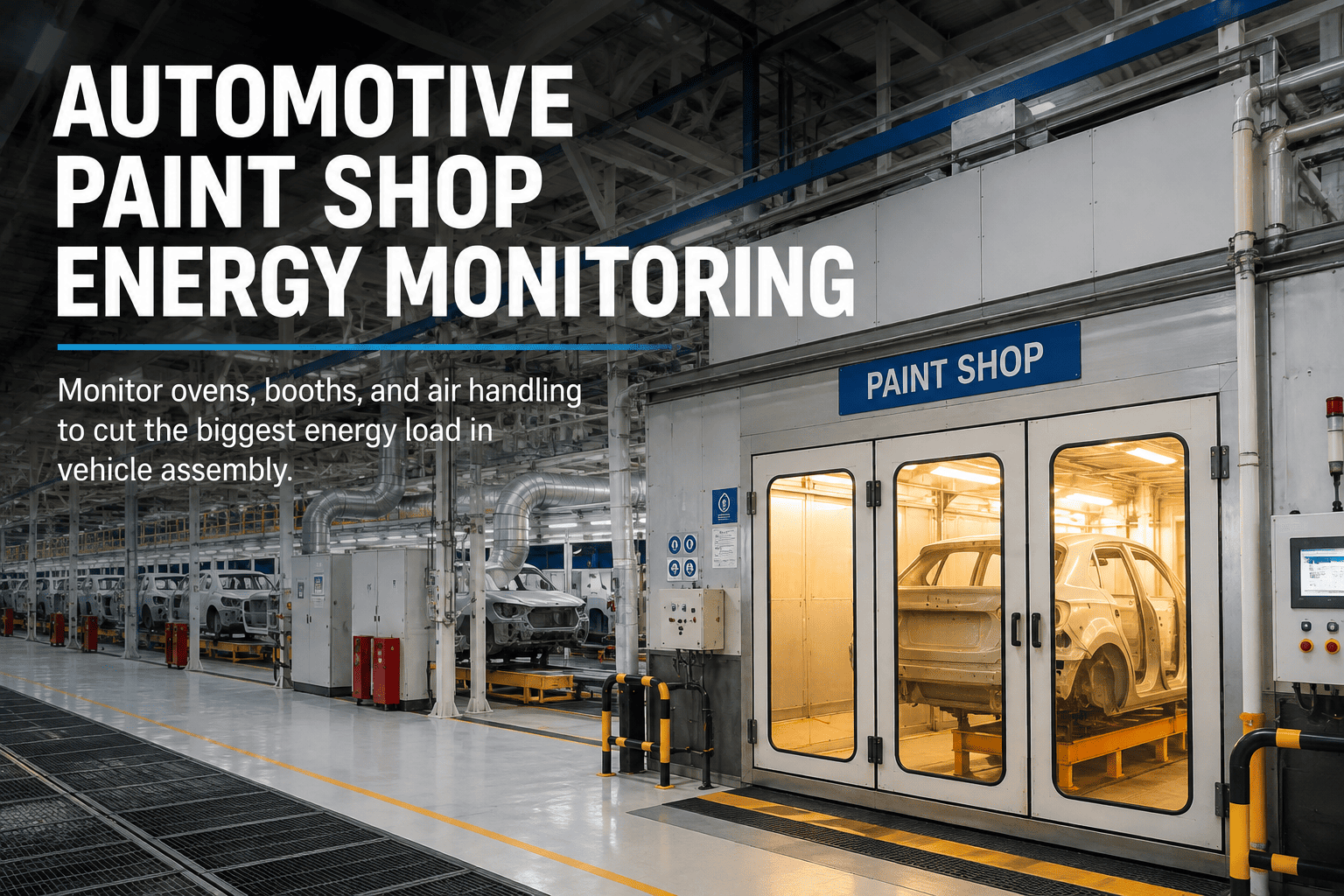
Paint Shop
CNN · GenAI · LSTM
Anomaly detection on cathodic dip coating. Dosage optimization in pretreatment. Orange peel, runs, sags, dirt contamination, color delta-E variation. Spectrophotometry integration for L*a*b* validation. AI-supported dryer operation tunes temperature and air volume against line speed in real time.
98% paint defect detection · 84% rework reduction
Z4
Final Assembly
CNN · LLM · Vision Transformer
Component installation, orientation, and positioning verification. Missing fastener and reversed-part detection. Wire routing and label placement validation. MES handshake to validate sequence completion. Operator copilot answers SOP questions, surfaces FMEA history, and creates work orders by voice.
99% assembly error detection · 67% installation warranty reduction
Z5
EV Battery Line
Hybrid CNN · 3D CV · GenAI
2D defect detection on cells and modules, then projection onto 3D CAD models with single-image depth completion for millimetre-scale repair localization. GenAI synthetic defect augmentation for rare failure modes. Cell-to-module-to-pack genealogy for full battery traceability.
Millimetre 3D localization · full cell-to-pack genealogy
The Plant LLM — Operator Copilot That Speaks Your SOPs, Your FMEA, Your Control Plans
Generic LLMs hallucinate when asked about your plant. The iFactory plant LLM is a Llama 3.1 70B model fine-tuned on your specific OEM specifications, customer-specific requirements, control plans, FMEAs, and historical CAPA records. It grounds every answer in your documents, with citations. Here's what it sounds like on the floor.
Body Shop · Station 14 · Shift B · 02:47
Operator
Spot welds on left B-pillar showing porosity for last 6 cycles. What's the call?
Plant AI
Pattern matches FMEA-BIW-0142: electrode tip wear at >180k cycles. Tip counter on RG14 reads 184,200. Recommend tip dressing now, then 4-cycle requalification. Per control plan CP-BIW-3.4.1, this is operator-clearable. Work order WO-25871 created. Quality alerted. Continue?
Operator
Yes — also adjust electrode pressure setpoint per the standard RCA?
Plant AI
Setpoint adjusted to 4.2 kN per CP revision 3.4.1-B. PLC tag RG14_PRESS updated. Logged to MES with VIN range. PPAP-impact: none, within validated window. Full event in audit trail.
Stop Pitching AI to Your Board. Ship a Plant That Already Runs On It.
Pre-configured NVIDIA AI server, plant LLM trained on your SOPs, vision QC across 5 zones, IATF audit-ready traceability — all delivered, installed, and operating in 6–12 weeks. Outcome contracts available.
The 12-Week Deployment Path — From PO to Live AI
Most automotive AI projects burn 9–18 months on procurement, integration scoping, and pilot debate before production sees a single inference. Turnkey delivery collapses that timeline. Here's the actual phase plan iFactory commits to in writing — including a documented mini-case where a steel-stamping Tier-1 went from contract to first-pass yield improvement in 12 weeks.
WEEK 1–4
Ship · Network · Data
Pre-configured NVIDIA AI servers ship globally — US, EU, UAE, India, APAC. Field techs install racks, structured cabling, OT network segmentation. PLC and SCADA tags mapped. Historical data ingestion begins. CMMS, MES, ERP integration handshakes complete.
Output: AI hardware live on plant network
WEEK 5–8
Model Train · Pilot Line
Vision models fine-tuned on your defect library and OEM specs. Plant LLM grounded in your SOPs, FMEAs, and control plans. Pilot zone goes live with shadow inference — running alongside existing QC, building confidence without production risk.
Output: pilot zone running AI in shadow mode
WEEK 9–12
Go-Live · Training · Audit Pack
Pilot zone moves from shadow to closed-loop. Operators trained on copilot. Quality engineers complete MSA and Gage R&R validation. IATF audit pack assembled — control plans, SPC charts, traceability records all auto-generated.
Output: AI in production · IATF audit-ready
QUARTER 2+
Scale Across Zones & Plants
Replicate pilot pattern across remaining zones — press, body, paint, assembly, EV battery. Roll out to additional plants in network. 24×7 remote monitoring active. Quarterly model retraining cycles, drift detection, and CAPA closure feedback loops.
Output: enterprise-wide AI · network effects
Mini-case: A 4-line steel-stamping Tier-1 in the US went from contract signature to first-pass yield improvement in 12 weeks — closing the gap between manual inspection (12–18% defect escape rate) and AI-driven inspection (<1.3% escape) on their highest-volume program. ROI in months, not years.
The Numbers That Actually Move — Automotive AI Outcomes At Scale
OEM and Tier-1 budgets don't move on theory. They move on validated outcomes against IATF benchmarks and warranty exposure. Here's what plants running this platform deliver in the field — sourced from automotive deployments and 2026 industry benchmarks.
$45,000
Per-truckload cost of micro-scratch defects shipping to OEMs — eliminated by 0.2mm AI surface anomaly detection at 240 parts per minute
iFactory automotive Tier-1 AI vision data 2026
$2.3M/hr
Industry-benchmark cost of automotive production line failure — predictive maintenance + AI vision typically prevents 70% of incidents
Jinba AI manufacturing benchmarks 2026
4.2% to 0.8%
Scrap reduction across stamping, welding, paint, and assembly with AI-driven inspection and root-cause feedback to process control
iFactory cross-plant validation data
12–18%
Defect escape rate from manual visual inspection — replaced by 98.7% AI accuracy at line speed, eliminating customer escapes
iFactory computer vision platform data
95%
Of predictive maintenance adopters report positive ROI; 27% achieve payback in less than a year on automotive AI deployments
Smart factory adoption survey 2026
$115.76B
AI in manufacturing market size by 2030 from $17.44B in 2025 — 46% CAGR with automotive holding 22%+ of digital twin market
Manufacturing AI market projections 2026
How The Platform Looks Inside — AI Capability Map Per Zone
Each zone uses a different mix of AI techniques. The map below shows which model classes run in which zone, and which capability they unlock. This is what lives behind the dashboard — not for buzzword density, but because OEM procurement teams ask exactly this question.
Capability
Press
Body
Paint
Assembly
EV Battery
Vision Defect Detection
CNN+ViT
CNN+ViT
CNN
CNN
3D CNN
Predictive Maintenance
LSTM
LSTM
LSTM
—
LSTM
Process Optimization (RL)
RL
RL
RL
—
RL
Operator Copilot (LLM)
LLM
LLM
LLM
LLM
LLM
Synthetic Data (GenAI)
—
GenAI
GenAI
—
GenAI
IATF 16949 Traceability
Auto
Auto
Auto
Auto
Auto
Why OEMs and Tier-1s Pick Turnkey Over Build-It-Yourself
The choice isn't theoretical anymore. Audi standardized on Edge 4 Cloud. VW Group is scaling IRIS to ten plants in 2026. Solidigm launched Lucetta in March 2026 specifically because the gap between proven models and plant deployment was killing pilots. Build-vs-buy stopped being a debate the moment IATF 16949 began accepting AI-generated traceability records — because building that audit trail in-house takes 18 months that automotive timelines no longer permit.
Build-It-Yourself
9–18 months to first production inference
Specialist AI hires required (data scientist, MLOps, vision)
NVIDIA hardware procurement cycle 12–20 weeks
Custom IATF documentation pipeline — 6–9 months to assemble
Pilot purgatory: 80% of automotive AI pilots stall
Maintenance burden lives on your team forever
iFactory Turnkey
Live in 6–12 weeks, contractually committed
No new AI hires — fully managed service
Pre-configured NVIDIA AI server ships racked and ready
IATF 16949 audit pack auto-generated from day one
1000+ industrial clients · 99.9% uptime · proven scale
24×7 remote monitoring · drift detection · auto-retrain
Frequently Asked Questions
Do we buy NVIDIA servers separately?
No. iFactory supplies and installs fully-loaded NVIDIA AI servers as part of the turnkey delivery. Hardware ships racked and ready, software pre-loaded — including the plant LLM, vision models, and integration agents. You provide line power, internet, and floor space. We provide everything else, including field technicians dispatched globally for cabling, OT network segmentation, and PLC/SCADA integration.
How does the platform meet IATF 16949 measurement system analysis requirements?
Every AI inspection model undergoes documented MSA studies including repeatability, reproducibility, and accuracy validation against destructive analysis or CMM measurements. Gage R&R studies demonstrate measurement capability with documented GRR percentages below 10% for critical characteristics. The platform monitors inspection performance continuously, detects calibration drift, and triggers recalibration alerts to ensure ongoing PPAP compliance. Major certification bodies have begun accepting AI-generated quality documentation as IATF 16949 compliant.
Can the platform handle our existing brownfield equipment?
Yes — that is the design center. Most automotive plants run a mix of decades-old presses, modern robotic body shops, and brand-new EV battery lines. iFactory's vision systems integrate via off-the-shelf cameras and existing PLCs. The platform speaks OPC UA, Ethernet/IP, Profinet, and Modbus. No equipment replacement required. The plant LLM ingests your existing SOPs, FMEAs, and control plans — it does not require you to rewrite them.
What about EV battery production specifically?
The EV battery zone uses a hybrid CNN-driven 3D defect localization pipeline. 2D defects are detected on cells and modules via standard CNN, then projected onto a dense 3D CAD model with single-image depth completion in regions of limited dual-view coverage. This delivers true millimetre-scale localization on the battery's physical surface for automated repair routing. GenAI methods generate synthetic defect variations to handle rare failure modes — a known challenge in EV battery datasets where some defects are statistically scarce.
How long until we see measurable ROI?
Most automotive AI deployments show measurable improvement on the pilot zone within 90 days of go-live. First-pass yield improvements, scrap reduction, and warranty exposure decline appear early because the highest-volume defect classes — surface anomalies, weld porosity, paint variation — are the most data-rich and the fastest to optimize. Industry benchmarks confirm 27% of predictive maintenance adopters achieve full payback in under a year, and automotive use cases consistently outperform that average due to the high per-incident cost of failure.
What about cybersecurity and software assurance for software-defined vehicles?
The platform aligns with the upcoming IATF 16949:2027 enhancements including ISO/SAE 21434 and UNECE R155 frameworks for embedded software quality and cybersecurity in vehicle systems. OT network segmentation, encrypted data-in-transit, and role-based access control are built in. The platform supports SBOM generation for software-defined vehicle programs and is compatible with type approval requirements emerging in major automotive markets.
ROI in Months, Not Years. Live in 6–12 Weeks. Built for Automotive From Day One.
Pre-configured NVIDIA AI server, plant LLM fine-tuned on your SOPs, vision QC across press, body, paint, assembly, and EV battery — IATF 16949 audit-ready, 1000+ industrial clients, 99.9% uptime, 24×7 fully managed. Get a contractually committed delivery date.