A Tier-1 automotive harness assembler in Pune was shipping 4.2% warranty defects on a flagship product line. The plant ran a tight floor — capable processes, trained operators, calibrated tools. Engineering was certain the problem was internal. A six-week root-cause investigation eventually pointed somewhere unexpected: 71% of those field failures traced back to one connector supplier whose lots had been passing receiving inspection on a static AQL plan never updated since 2019. The supplier had quietly changed their plating chemistry eighteen months earlier. Incoming inspection sampled the same way it always had, signed off the lots, and pushed contamination straight into final assembly. The fix was not better inspection — it was a smarter receiving function that watched supplier patterns over time, tightened sampling automatically when risk rose, and connected dock data to line failures. Within ninety days of going live, the supplier defect escape rate dropped from 4.2% to 0.3%, and warranty claims fell off the cliff. Most quality problems do not start on your floor. They walk in through your receiving dock.
iFactory Supplier Quality Intelligence
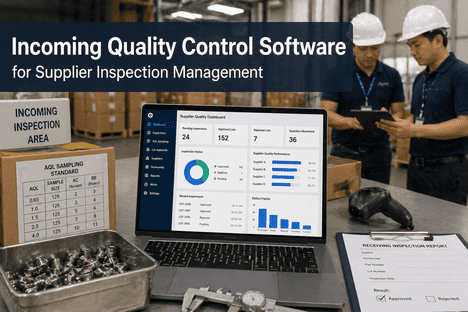
Incoming Quality Control Software for Supplier Inspection Management
AQL sampling that adapts to supplier risk. Lot approvals tied to live performance data. Vendor scorecards that update with every shipment. Catch defective lots before they touch your line.
70%
Of product defects trace to supplier issues
5–30%
Of revenue lost to cost of poor quality
50%
Of defects originate in incoming materials
ISO 2859
2026 AQL standard fully supported
Why Receiving Inspection Is the Highest-Leverage Quality Gate You Have
Industry research consistently shows that roughly 50% of all product quality issues trace back to incoming materials, and approximately 70% of all defects can be linked to supplier performance. Yet most plants spend ten times more on end-of-line inspection than on incoming. Receiving is the cheapest place to catch a defect — and the most expensive place to miss one. A bad part caught at the dock costs pennies to reject. The same part caught after assembly costs hundreds. After it ships, thousands.
The 1-10-100-1000 Rule of Quality Cost
Reject the lot. Replace at supplier cost. Hours, not days.
Stop the line, segregate WIP, sort, rework. Capacity hit and missed schedules.
Full assembly scrapped or reworked. Material, labor, and overhead all sunk.
Warranty claims, recalls, brand damage, lost customer trust. The number that ends careers.
The Five-Step Lot Journey — From Truck to Production
Every shipment that arrives at your dock walks through the same five gates inside iFactory. What separates a modern incoming QC system from a clipboard-and-spreadsheet operation is that every gate is timestamped, traceable, and connected to supplier history.
1
Receive
Lot Logged & Linked to PO
Shipment arrives, lot is scanned, automatically linked to the originating purchase order, supplier, and part specification. The system pulls historical lot data for the same part-supplier combination instantly.
2
Plan
Sampling Plan Auto-Selected
Based on supplier risk score, lot size, and AQL level for each characteristic, the system calculates sample size and acceptance number using ANSI Z1.4 / ISO 2859 / C=0 / MIL-STD or your custom plan.
3
Inspect
Measurements Captured Digitally
Inspector pulls samples, measurements stream from CMMs, digital calipers, vision systems, or tablet entry. Every reading auto-validated against drawing tolerances in real time.
4
Decide
Accept, Reject, or Hold
System applies acceptance criteria. Approved lots release to production. Rejected lots quarantined and NCR auto-created. Borderline lots routed to engineer review with full data context.
5
Update
Supplier Scorecard Refreshed
Lot result feeds supplier scorecard, recalculates risk score, triggers switching rules (Normal / Tightened / Reduced / Skip-lot), and closes the loop with procurement and engineering.
Want to see what your lot journey looks like with iFactory? Book a 30-minute walkthrough — bring a real PO, we will show you the full flow on your data structure.
AQL Sampling — How the Math Actually Works
AQL (Acceptable Quality Limit) is the maximum percentage of defective items considered acceptable in a lot. ISO 2859-1:2026 and ANSI/ASQ Z1.4 use AQL to determine how many parts to sample and how many defects can be found before the lot is rejected. Get this right, and you inspect 4% of a 5,000-piece lot instead of 100%. Get it wrong, and either bad parts walk through, or you choke receiving with unnecessary work.
Critical Defects
0.065
AQL Level
Safety-related defects. Almost zero tolerance — failures here can hurt people or violate regulation.
Used for: medical device components, airbag inflators, infant products, electrical safety parts
Major Defects
0.65
AQL Level
Functional failures. Part does not work, fails to assemble, or fails performance. Very few allowed.
Used for: automotive sub-assemblies, electronics functional parts, structural components
Minor Defects
2.5
AQL Level
Cosmetic or minor appearance issues. Some level allowed because rejection cost outweighs impact.
Used for: surface finish, color uniformity, label placement, packaging cosmetics
Worked Example: 5,000-Part Lot at AQL 2.5, Inspection Level II
Accept If
10 or fewer defects
Reject If
11 or more defects
Inspecting 200 parts (4% of the lot) gives statistical confidence about the remaining 4,800. iFactory does this calculation automatically per characteristic, per AQL level, per sampling plan — no spreadsheet required.
Switching Rules — Inspection That Adapts to Supplier Performance
Static inspection plans are the silent killer of supplier quality. They cost too much on suppliers who consistently deliver good parts, and they fail to catch a supplier who quietly slips. ISO 2859 and ANSI Z1.4 both define switching rules — Normal, Tightened, Reduced, and Skip-lot — that automatically adjust inspection rigor based on recent lot history. iFactory enforces these rules continuously so receiving capacity flows toward the suppliers who actually need it.
Tightened
When 2 of 5 recent lots were rejected
Larger sample sizes, lower acceptance numbers. Catches a slipping supplier before damage spreads.
Normal
Default starting state for any new supplier-part combination
Standard sample size per ISO 2859 master table. The baseline rigor.
Reduced
After 10 consecutive lots accepted with stable performance
Smaller sample sizes, lower receiving load. Rewards consistent suppliers without abandoning verification.
Skip-lot
After sustained world-class performance and supplier audit pass
Inspect every Nth lot only. Reserved for dock-to-stock approved suppliers. Maximum efficiency, controlled risk.
Anatomy of a Live Supplier Scorecard
A supplier scorecard is only useful if it updates automatically and reflects what is happening this week — not last quarter. iFactory builds the scorecard from the same lot data flowing through receiving, so every shipment refreshes the picture in real time. Here is the metric stack we recommend, and what world-class targets actually look like.
Supplier Scorecard — Live Metric Stack
Metric
Formula
World-Class Target
Risk Trigger
Defect Rate
Defective units ÷ Total received × 100
< 1%
> 5%
Lot Acceptance Rate
Accepted lots ÷ Total lots received × 100
> 98%
< 92%
PPM Defective
Defective parts ÷ Total received × 1,000,000
< 100 ppm
> 1,000 ppm
On-Time Delivery
On-time lots ÷ Total lots × 100
> 95%
< 85%
SCAR Response Time
Avg days from issue to 8D closure
< 14 days
> 30 days
Line Defect Correlation
Production defects traced to supplier ÷ Total
< 5%
> 20%
Composite Risk Score
Weighted blend of all metrics + audit results
A or B grade
D or F grade
The Lot Decision Tree — What Happens at the Reject Path
Accepting a good lot is easy. The hard work — and where most paper systems break down — is what happens when a lot fails. iFactory routes every reject through a structured disposition path so nothing falls through the cracks, and every decision is timestamped for audit.
Pass
Release to Stock
Lot tagged accepted, scorecard updated, available for pick
Fail
Quarantine + Auto NCR
Lot tagged hold, nonconformance report generated automatically
Reject & Return
Send back to supplier at supplier cost. SCAR issued for root cause and 8D response.
Sort 100%
Inspect every part to recover good ones. Cost charged back to supplier.
Rework
In-house or supplier rework with re-inspection before release.
Use-as-is
Engineering deviation with documented justification. Used sparingly.
What Modern IQC Connects To — And Why That Matters
The reason paper-based IQC fails is not the inspection itself. It is that the data dies in the binder. The receiving inspector knows the lot has rising defects. Production never finds out. Procurement never adjusts the supplier rating. Quality engineering never closes the loop. Real-time IQC software succeeds because every dock event flows into the systems where decisions actually get made.
ERP / MRP
Pulls open POs, supplier master, part specs. Pushes lot status, GRN, and disposition.
QMS / NCR
Auto-creates nonconformance reports, routes SCARs to suppliers, tracks 8D closure.
CMM / Vision
Pulls measurement data via Q-DAS, DMIS, or REST. Auto-validates against drawing tolerances.
MES / Production
Correlates incoming defects with downstream line failures. Closes the loop on root cause.
Procurement
Feeds supplier scorecards, sourcing decisions, and contract negotiations with hard data.
Audit Systems
Provides ISO 9001 / IATF 16949 / FDA 21 CFR Part 11 compliant records and signatures.
Curious what an IQC platform looks like wired into your existing ERP and QMS? Talk to our integration engineers for a no-pressure architecture walkthrough.
What Real Customers See After 90 Days
The case for incoming QC software is not philosophical. It is measured in escaped defects prevented, receiving labor saved, and warranty claims that never happened. These are typical outcomes from iFactory deployments at automotive, electronics, FMCG, and medical-device manufacturers in 2025–2026.
87%
Reduction in defect escapes
to production within first 90 days
42%
Less receiving labor
via skip-lot for proven suppliers
3.4x
Faster lot disposition
vs paper-based processes
100%
Audit-ready records
ISO 9001 / IATF 16949 / FDA Part 11
Frequently Asked Questions
What sampling standards does iFactory IQC support?
All the standards real plants actually use: ANSI/ASQ Z1.4, ISO 2859-1:2026 (attribute), ISO 3951 (variable), MIL-STD-1916, MIL-STD-105E (legacy), C=0 zero-acceptance plans, and fully custom sampling plans you define yourself. The system auto-calculates sample size and acceptance number for each characteristic per the chosen plan, lot size, and AQL level — no manual table lookup required.
How does dynamic switching actually work in practice?
When a new supplier-part combination starts, the system uses Normal inspection. After 10 consecutive accepted lots with stable performance, it auto-switches to Reduced. If 2 out of 5 recent lots get rejected, it switches to Tightened. Suppliers who pass formal audit plus 20+ consecutive accepted lots can qualify for Skip-lot inspection. Every switch is timestamped and reversible — if a Reduced supplier slips, the system pulls them straight back to Normal automatically.
Can we still do 100% inspection for critical parts?
Yes — and you should, where the math justifies it. 100% inspection is right for low-volume high-value parts, safety-critical components, and parts coming from unproven suppliers. iFactory supports 100% inspection workflows alongside sampled inspection, with the same digital data capture and traceability. The platform helps you decide where 100% is genuinely needed and where AQL sampling is more cost-effective.
Does the system handle First Article Inspection (FAI)?
Yes. FAI workflows are built in for AS9102, PPAP, and custom formats. Suppliers can submit FAI data digitally, your engineers review and approve through the same platform, and approved FAIs link directly to the part record so receiving inspectors can verify against the approved baseline. Ballooned drawings and bubble-numbered characteristic lists flow through end to end.
How long does an IQC implementation typically take?
A focused pilot covering 10–15 critical parts and 3–5 key suppliers typically goes live in 4–6 weeks: one week for system setup and ERP connection, two weeks for part specs and supplier master data load, then training and parallel running. Full plant rollout depends on part count and supplier complexity — most sites cover their full critical material list within 3–4 months and see measurable defect-escape reduction within the first 60–90 days.
Is iFactory IQC compliant with ISO and FDA standards?
Yes. Every deployment ships audit-ready for ISO 9001, IATF 16949 (automotive), AS9100 (aerospace), ISO 13485 (medical device), and FDA 21 CFR Part 11 electronic records and signatures for regulated environments. Audit packs include time-stamped lot history, signed acceptance records, capability data, supplier scorecards, and full traceability from PO to production line.
Stop Letting Defects Walk Through Your Dock
See Live Lot Decisions on Your Real Supplier Data — In 30 Minutes
Bring a supplier you suspect is slipping. We will load a few real lots, show you the AQL math live, fire the switching rules on their history, and build a working scorecard in front of you. No slides — just your suppliers, on a real IQC platform.
87%
Less defect escape at 90 days
42%
Lower receiving labor
4–6 wk
Pilot to live inspections
5+
Sampling standards supported
incoming-quality-control-software-supplier-inspection-management