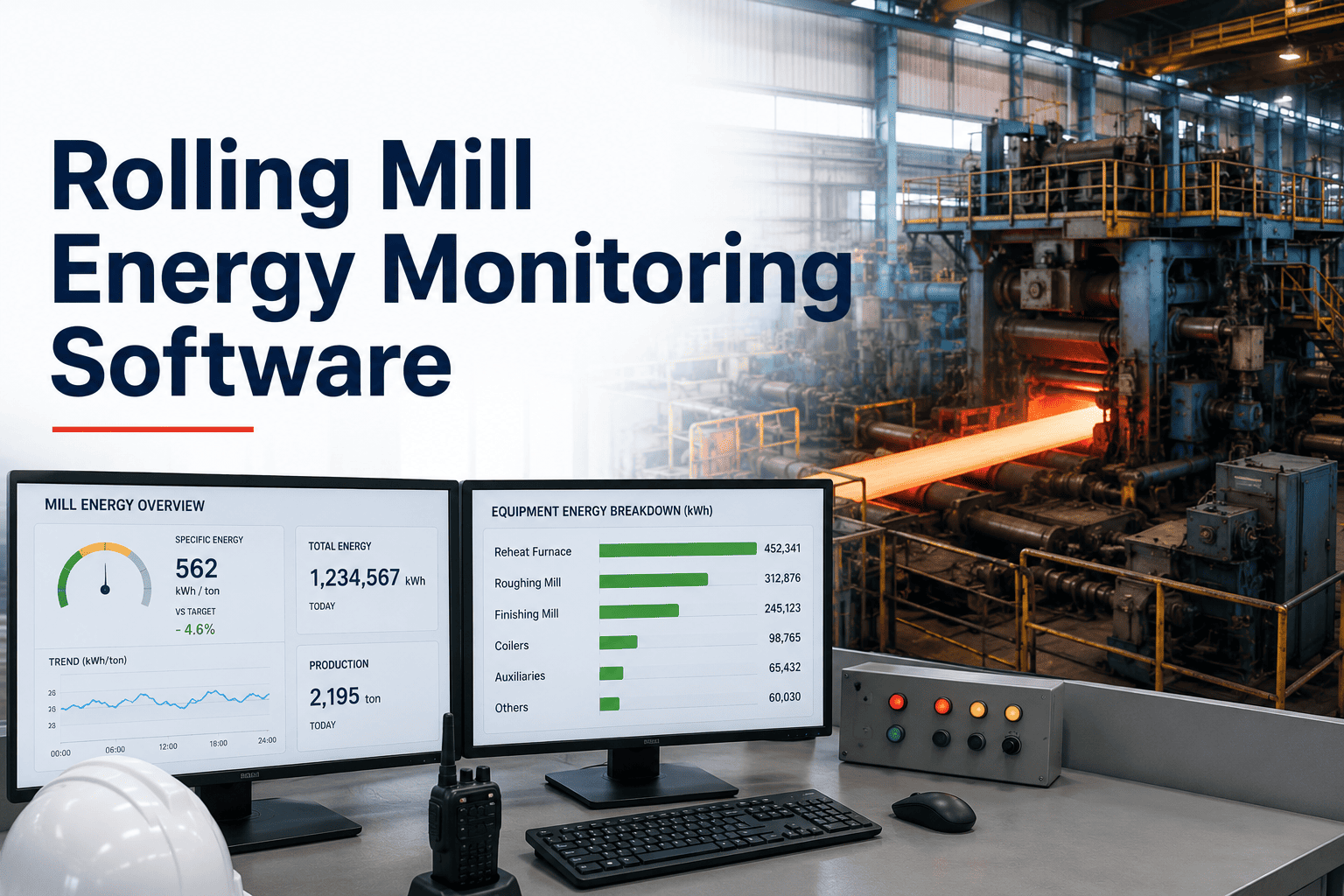
A 2 million tonne per year integrated steel plant in Odisha was reviewing its monthly performance report. The headline number said OEE was 73%. The maintenance team saw that and relaxed. Three weeks later, a consultant walked the same plant with real-time data pulled from Level 1 PLCs and found the actual OEE was 61%. The 12-point gap wasn't fraud — it was invisibility. Micro-stoppages under 5 minutes were never logged. Speed losses on the caster were buried inside "available" status. Three shifts were posting wildly different numbers from the same equipment because each team measured from a different source. Every single OEE point at that plant was worth roughly ₹10 crore in annual revenue. Twelve hidden points meant ₹120 crore of production capacity that nobody could explain, because the KPIs everyone trusted were built on data that arrived too late to act on. Modern steel plants don't need more KPIs. They need the right KPIs measured the right way — in real time, from the source, with zero argument about what the number actually is.
Steel Plant Performance Intelligence
The KPIs Your Dashboard Shows Are Probably Wrong.
Here's What to Track Instead.
World-class steel plants operate at 85%+ OEE. Most operate between 60–75%. The gap isn't capacity — it's measurement. Track these KPIs the right way, and you expose the lost tonnes your monthly reports hide.
85%
World-class OEE target for steel plants
60–75%
Typical OEE range across integrated steel plants
97–98%
Yield rate at top-quartile steel producers
24.2 GJ
Energy per ton — BF-BOF route global avg
Why Most Steel Plant KPIs Miss the Point
Every steel plant tracks KPIs. The problem isn't absence of metrics — it's the lag between an event happening and someone knowing about it. Monthly production reports average across 180 unplanned stoppages under five minutes each. Maintenance pulls availability from one system. Quality pulls yield from another. Operations pulls throughput from a third. When three teams report three different OEE numbers from the same plant, the KPI stops being a decision tool and becomes a source of argument.
The Three Gaps That Kill Steel Plant Performance Visibility
GAP 01
The Micro-Stoppage Gap
180+ stoppages under 5 minutes per line per month are never logged because they feel too brief to document. They collectively erase 11 hours of production and 3–5 OEE points that no monthly report can explain.
11 hrs/month
GAP 02
The Speed Loss Gap
A caster running at 92% of rated speed still shows "available" in every report. Over two weeks of mold copper wear, that 8% speed loss silently costs $40K/day in reduced throughput — visible only in real-time performance trending.
$40K/day
GAP 03
The Source-of-Truth Gap
Maintenance says 75% availability. Quality reports 91% yield. Operations claims 80% performance. Each team measures from a different source, at a different time, with different downtime definitions — monthly reviews become disputes instead of decisions.
20-pt shift gap
Know which of your KPI numbers are actually trustworthy? See a live steel plant dashboard in 30 minutes.
The 12 KPIs Every Steel Plant Should Track
Not every metric deserves dashboard space. These 12 KPIs — organized across four categories — are the ones that actually move the needle on tonnage, cost, and margin. Each comes with its world-class benchmark and the typical range most plants operate in.
01
Production Performance
3 KPIs
02
Equipment Reliability
3 KPIs
Overall Equipment Effectiveness (OEE)
Availability × Performance × Quality
The single KPI that combines downtime, speed loss, and defects into one honest number. A 2 MTPA steel plant operating at 65% OEE is losing 35% of its capacity — and every 1-point improvement is worth roughly ₹10 crore annually.
World-class:85%+
Industry avg:60–75%
Danger zone:Below 55%
Throughput (Tonnes per Hour)
Actual good tonnes ÷ Production hours
Raw output speed measured against both rated capacity and customer takt. Tracking actual tonnes/hour per line exposes the gap between designed capacity and demonstrated capacity — usually 15–25% at most plants.
Benchmark:Against rated line speed
Track:Per line, per shift, per grade
Watch:Gap vs. best-ever shift
Capacity Utilization
(Actual output ÷ Max capacity) × 100
Measures how effectively installed capacity is actually used. For high-volume steel lines, utilization below 80% signals either demand issues or chronic availability losses — both solvable with the right data.
Target:80–90%
Overloaded:>95%
Underused:<70%
Availability
Run time ÷ Planned production time
The foundation of OEE. Direct PLC signal tracking separating planned from unplanned downtime. Anything below 85% on production-critical equipment flags a serious reliability gap that's costing tonnes every day.
World-class:95%+
Acceptable:90–95%
Red flag:Below 85%
MTBF — Mean Time Between Failures
Total operating time ÷ Number of failures
How long equipment runs between breakdowns. Rising MTBF = improving reliability. Falling MTBF = a degradation trend that will surface as unplanned downtime in 2–3 months unless intercepted through condition monitoring.
Target:Rising trend
Stops/week:Below 2
Warning:Declining 3+ months
MTTR — Mean Time to Repair
Total repair time ÷ Number of repairs
How fast equipment returns to production after a failure. Pre-diagnosed fault codes, pre-staged spare parts, and AI-driven root cause reduce MTTR by 40–70%. Every hour cut from MTTR is straight tonnage back on the table.
High-OEE lines:Under 30 min
Critical equipment:Under 2 hrs
Red flag:Over 4 hrs
Your KPIs Should Fight For You — Not Each Other
iFactory consolidates availability, performance, quality, energy, and maintenance KPIs into one live dashboard — pulled directly from PLC, SCADA, LIMS, and ERP data every 30–60 seconds. One source of truth. One dashboard. Every shift, every line, every asset.
Manufacturing Yield Rate
(Good steel produced ÷ Raw material input) × 100
The single highest-leverage metric in steelmaking economics. A 1% yield improvement at a 1.5 million tonne plant saves over ₹80 crore annually through reduced raw material, energy, and processing waste. Top-tier plants hit 97–98%.
Top-tier:97–98%
Industry avg:92–95%
Red flag:Below 90%
First-Pass Yield (FPY)
Right-first-time units ÷ Total produced
Units that pass spec without any rework. Rework is hidden waste — it inflates labor cost, consumes capacity, and still produces a lower-grade product. Lean Six Sigma plants typically achieve FPY of 95%+ with real-time SPC.
World-class:95%+
Typical:85–92%
Warning:Below 80%
Scrap & Cobble Rate
(Scrap units ÷ Total produced) × 100
Every cobble in the rolling mill traces back to an equipment condition — worn bearings, misaligned guides, roll pass degradation. Scrap and rework alone cost the average manufacturer 2.2% of annual revenue. Track it per shift, per line, per cause.
Mature plants:<2%
Typical:3–5%
Red flag:>5%
Energy Intensity (GJ per Tonne)
Total energy consumed ÷ Crude steel produced
The single biggest lever on operating cost and carbon footprint. BF-BOF route averages 24.2 GJ/ton globally, DRI-EAF around 23.1 GJ/ton, and scrap-based EAF as low as 10 GJ/ton. Benchmark against your route — not the industry average.
BF-BOF best:~20 GJ/t
Global avg:19–20 GJ/t
EAF (scrap):~10 GJ/t
Cost Per Tonne
Total manufacturing cost ÷ Tonnes produced
Roll up raw material, energy, labor, maintenance, and overhead into one number. Track it weekly per grade and route. When cost/tonne drifts upward without input price changes, you have a process efficiency problem hiding in the data.
Track:Weekly by grade
Alert:Drift >3% without input change
Compare:Vs. best-ever month
On-Time Delivery (OTD)
On-time shipments ÷ Total committed shipments
The final downstream consequence of every upstream KPI. Improving OTD sustainably means fixing equipment reliability, quality, and throughput first — because OTD doesn't lie when downstream processes slip.
Automotive tier 1:98%+
General mfg:95%+
Red flag:Below 90%
The Dollar Value of Measuring KPIs the Right Way
Every KPI category has a hard-dollar impact when measured correctly. Here's what each improvement is actually worth at a typical 2 million tonne per year integrated steel plant — with sources you can verify against your own data.
KPI Improvement
Annual Revenue Impact
Benchmark Source
1 point of OEE improvement
~₹10 crore (£10M)
At a 2 MTPA steel plant — every point = recovered tonnes
1% yield improvement
₹80+ crore ($10M+)
At a 1.5 MTPA plant — less raw material, energy, rework
10% scrap/rework reduction
0.22% of revenue recovered
EASE benchmark — scrap/rework is 2.2% of revenue
40–70% MTTR reduction
Hours back per breakdown
iFactory — via pre-diagnosed faults, pre-staged spares
5% energy intensity reduction
1–2% of total cost/tonne
Energy = 20–40% of total steel production cost
Eliminating 180 micro-stoppages/month
11 hours + 3–5 OEE points
Per-line data from integrated steel plants
Want to see what each of these KPIs is worth at your plant? Let's map your KPI-to-revenue link together.
How iFactory Turns KPIs Into Real-Time Decisions
01
One Source of Truth
Maintenance, quality, and operations all pull from the same PLC, SCADA, LIMS, and ERP feed — ending the "whose OEE number is right?" argument permanently. Every role sees the same number, updated every 30–60 seconds.
02
Micro-Stoppage Detection
Automated capture of every downtime event under 5 minutes through direct automation integration — exposing the 3–5 OEE points that monthly shift logs never surface. No manual entry required.
03
Per-Area OEE, Not Just Plant-Wide
Blast furnace, BOF/EAF, caster, and rolling mill each have different OEE drivers. iFactory tracks OEE per area, revealing which unit is the true bottleneck — because the bottleneck determines total plant throughput.
04
KPI-to-Root-Cause Linkage
Every OTD miss linked back to the downtime event or quality issue that caused it. Every cobble traced to the equipment condition that generated it. Every energy spike tied to the process deviation behind it. Numbers that explain themselves.
Frequently Asked Questions
Which KPI should we prioritize if we can only track one?
OEE. It's the only KPI that combines availability, performance, and quality into a single honest number that exposes the gap between your plant's theoretical capacity and its actual saleable output. For a 2 MTPA steel plant, every 1-point improvement in OEE is worth approximately ₹10 crore in additional annual production. That said, OEE only works if it's measured correctly — real-time, from the source, with micro-stoppages captured. OEE calculated weekly from manual entries is almost always 5–10 points higher than the actual number.
What's a realistic OEE target for an integrated steel plant?
World-class OEE is 85%+. Most integrated steel plants operate between 60–75%, with some below 55%. The realistic target for any plant currently measuring OEE depends on where you're starting from — a plant at 62% should target 70% in 12 months, not 85%. Sustainable OEE improvement typically moves 8–12 points over 12–18 months through systematic elimination of micro-stoppages, speed losses, and quality issues, in that order. Trying to jump to world-class in under a year usually means the data is wrong, not that the plant transformed overnight.
Do we need new sensors to track these KPIs, or can we use existing infrastructure?
In most cases, your existing infrastructure already has the data. Level 1 PLCs record every machine stop. Level 2 process control captures speed and performance data. LIMS databases store quality results. SCADA historians hold energy and environmental data. The problem isn't collection — it's connection. iFactory pulls from these existing layers through standard industrial protocols (OPC-UA, Modbus, MQTT) without requiring new sensors for baseline KPI tracking. Additional sensors are only recommended where genuine measurement gaps exist.
How often should steel plant KPIs actually be reviewed?
Review cadence matches decision speed. Real-time dashboards (updated every 30–60 seconds) drive shift-level operational decisions. Daily reviews at the supervisor level track shift-over-shift variation and catch emerging issues before they become chronic. Weekly reviews at the management level identify trends and prioritize improvement projects. Monthly executive reviews should focus on trajectory — not raw numbers, because raw numbers three weeks old are already history. The goal is that no KPI review is the first time someone sees a problem.
Can AI-driven KPI tracking replace our existing MES or ERP systems?
No — it sits on top of them. iFactory isn't a replacement for MES, ERP, CMMS, or LIMS systems you've already invested in. It's a unification layer that pulls KPI-relevant data from all of them, normalizes definitions, and presents it in one real-time dashboard. This means your MES still runs production, your ERP still handles orders, your CMMS still manages work orders — but leadership, plant managers, and shift supervisors finally see one number for OEE, yield, availability, and energy intensity that everyone agrees is correct.
Every Hour Your KPIs Are Late, Your Tonnes Are Gone
Monthly reports explain yesterday's losses. Real-time KPI intelligence prevents tomorrow's. iFactory consolidates your existing PLC, SCADA, LIMS, and ERP data into one live steel plant performance dashboard — with first insights in 30 days and measurable OEE gain in 90.