In 2019, a mid-sized FMCG plant in Coimbatore was running 14 production lines with paper-based work orders, WhatsApp photos of maintenance issues, and an ERP system that got updated by hand every Friday afternoon. The plant manager knew it wasn't working — but every vendor pitch felt like being sold a $2 million problem to solve a $200,000 pain point. Five years later, the same plant runs an integrated stack: a mobile CMMS on every operator's phone, SCADA feeding real-time production data into a unified dashboard, AI models flagging equipment anomalies 48 hours before failure, and an ERP that closes financials in three days instead of twelve. Unplanned downtime is down 61%. OEE improved from 64% to 82%. Emergency repair spend dropped 44%. Yet none of this happened because the plant bought "digital transformation." It happened because the plant built a structured, phased roadmap that matched digital capability to operational readiness — one layer at a time, measurable at every step. That's the real story of FMCG digital transformation in 2026. The winners aren't the brands with the biggest technology budgets. They're the ones who figured out the right sequence.
FMCG Modernization Playbook
Digital Transformation Isn't a Technology Project.
It's an Operations Strategy With Technology as the Instrument.
FMCG plants achieving 60–70% downtime reduction, 15–25% OEE improvement, and 4–8× maintenance ROI in 2026 don't have the biggest tech budgets — they have the clearest implementation roadmap. This guide breaks down how that roadmap actually works.
78%
Of FMCG companies accelerating digital transformation
50%
Forecasting error reduction with AI supply chains
$36K/hr
Cost of equipment failure in FMCG
26%
Higher profitability at digitally mature firms
Why FMCG Digital Transformation Is Different
Every industry is pursuing digital transformation, but FMCG sits at a uniquely tough intersection. Production runs 24/7 at razor-thin margins. SKU proliferation demands constant changeovers. Consumer behavior shifts faster than ever. Retail geography is being rewritten by quick commerce. Supply chains are under constant pressure from raw material volatility and sustainability mandates. You can't pause operations for a multi-year IT overhaul. And legacy systems — ERP, MES, SCADA, CMMS, LIMS — were never designed to talk to each other.
The FMCG Digital Transformation Reality Check
Production Continuity
FMCG lines run 24/7. Transformation has to happen without stopping production — which means legacy systems and new systems must coexist for extended periods.
Data Interoperability
37% of manufacturers now identify data interoperability as their primary transformation roadblock. ERP, MES, SCADA, and quality systems rarely speak the same language natively.
Speed vs. Depth
Full transformation takes 30–42 months. Plants that try to compress below 24 months invariably skip foundational depth and pay for it in later phases.
Change Management
Over one-third of manufacturing executives rank equipping workers with smart factory skills as their top human capital concern — ahead of budget or technology.
The 4 Pillars of FMCG Digital Transformation
Every successful FMCG transformation we've analyzed rests on the same four pillars — and failure in any one pillar collapses the other three. These aren't abstract strategy slides; they're the concrete domains where transformation happens.
Pillar 01
Smart Manufacturing & Quality
Turn the factory floor into a real-time decision system.
Connected production lines with PLC, SCADA, and IoT sensor integration
Predictive maintenance driven by vibration, temperature, and current signatures
Computer vision quality inspection on packaging, labeling, and fill levels
Real-time OEE dashboards visible to every shift supervisor on mobile
Outcome: 50% downtime reduction, 66% fewer quality defects
Pillar 02
Connected Supply Chain & Planning
Compress the distance between consumer signal and production action.
AI-powered demand forecasting reducing errors by up to 50%
Real-time inventory visibility across plants, warehouses, and dark stores
Automated replenishment tied to quick commerce and modern trade signals
End-to-end traceability for raw materials through finished goods
Outcome: 20% inventory cost reduction, 25% faster time-to-market
Pillar 03
Digital Commerce & Consumer Engagement
Own the direct relationship with the end consumer.
D2C storefronts integrated with quick commerce and social commerce
Dynamic pricing engines adjusting thousands of SKUs daily
AI-driven segmentation and personalized campaign execution
Real-time sentiment analysis and voice-of-customer feedback loops
Outcome: 20% higher customer retention, 22% lifetime value lift
Pillar 04
Enterprise Systems & Data Foundation
Build the integrated data layer everything else runs on.
Unified cloud ERP replacing fragmented legacy systems
Integration of ERP, MES, SCADA, CMMS, and LIMS through standard APIs
Automated invoice processing, order management, financial reconciliation
Real-time analytics dashboards for cross-functional decision-making
Outcome: 10–15% revenue growth, 16% faster market entry
Wondering which of the four pillars your plant should start with? Book a 30-minute readiness assessment.
The 4-Phase Transformation Roadmap
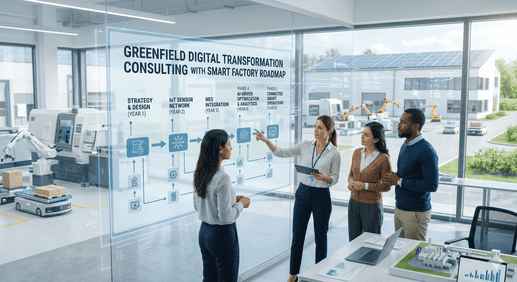
Technology doesn't fail most FMCG plants. Sequence does. The plants achieving measurable ROI follow a 4-phase path — each phase builds operational competency the next phase depends on. Skipping a phase doesn't speed things up. It costs you 12–18 months of rework later.
Phase 01
0–9 Months
Foundation
Digitize the Basics
Replace paper work orders, WhatsApp photos, and Excel trackers with mobile CMMS and core digital workflows. Get every asset tagged, every work order in a system, every operator on a mobile interface. No AI yet — just clean, connected data at the source.
Key Deliverables
Mobile CMMS deployment · Asset hierarchy and tagging · Digital work orders · Operator autonomous maintenance checklists · Baseline KPI capture
Exit criteria: 100% digital work orders, 90%+ operator adoption, complete asset register
Phase 02
9–18 Months
Integration
Connect the Systems
Integrate ERP, MES, SCADA, CMMS, and LIMS through standard APIs. Deploy IoT sensors on highest-impact assets. Establish edge computing for real-time data processing. Unified data platform becomes the single source of truth across operations, maintenance, quality, and finance.
Key Deliverables
ERP–MES–SCADA integration · IoT sensor deployment · Unified data lake · Condition-based maintenance · Real-time OEE dashboards · Protocol gateways for legacy equipment
Exit criteria: Zero data silos, unplanned downtime below 8%, OEE above 75%
Phase 03
18–30 Months
Intelligence
Deploy AI Layer
Activate AI on the integrated data foundation. Predictive maintenance. Computer vision quality inspection. AI-driven demand forecasting. Dynamic pricing engines. Each AI use case is validated against pre-defined KPIs before being scaled across lines and sites.
Key Deliverables
Predictive maintenance models · Vision AI quality systems · AI demand forecasting · Anomaly detection · Role-based decision-support dashboards · AR-guided training
Exit criteria: Unplanned downtime below 5%, OEE above 82%, AI coverage on 80%+ critical assets
Phase 04
30–42 Months
Autonomy
Autonomous Operations
Closed-loop automation where AI recommendations trigger actions without manual intervention. Digital twins simulate interventions before physical deployment. AMR/AGV integration for material handling. The plant becomes a self-optimizing system with humans in oversight rather than in the loop.
Key Deliverables
Digital twin deployment · AGV/AMR integration · Closed-loop maintenance · Generative AI for R&D · Autonomous quality decision-making · Full smart factory integration
Exit criteria: Unplanned downtime below 4%, OEE above 88%, maintenance cost/unit down 40%+
The Plants Reaching Phase 4 Started Phase 1 Three Years Ago
iFactory helps FMCG plants accelerate every phase of the transformation — from mobile CMMS deployment to AI-driven predictive maintenance to full smart factory integration. Clear sequence. Measurable ROI at each phase. No rip-and-replace.
The FMCG Digital Stack — Layer by Layer
Digital transformation is easier to plan when you can see the layers. Every FMCG digital stack has the same basic architecture. Here's what each layer does, and where the ROI lives.
L6
Intelligence & Decision Layer
AI/ML models · Digital twins · Generative AI · Autonomous decision engines
Where the platform learns, predicts, and acts. Self-optimizing production, predictive quality, autonomous replenishment.
L5
Analytics & Visualization Layer
Real-time dashboards · BI tools · Role-based interfaces · Mobile analytics
Where humans see what the platform knows. Shift supervisors, plant managers, and executives all see the same numbers at the right granularity.
L4
Unified Data Platform
Data lake · APIs · Integration middleware · Master data management
The single source of truth. Breaks down silos between ERP, MES, SCADA, CMMS, LIMS — and makes all operational data queryable.
L3
Enterprise Business Systems
ERP (SAP S/4HANA, Oracle) · MES · CRM · SCM · CMMS · LIMS
The systems running finance, planning, maintenance, and quality workflows. Modernization here focuses on integration flexibility, not replacement.
L2
Automation & Control Layer
SCADA · DCS · PLCs · HMI · Process automation
The existing control infrastructure running production lines today. Transformation augments this layer — it doesn't replace it.
L1
Physical & Sensor Layer
IoT sensors · Cameras · Barcode/RFID · Edge devices · AGVs
The eyes and ears of the digital plant. Every production asset instrumented to generate continuous, real-time data at the source.
The Case Studies That Prove the Model
The transformation pattern is consistent across FMCG. Different categories, different geographies, same playbook — foundation first, then integration, then intelligence, then autonomy.
Mondelez International
Replaced over 80 legacy ERP systems with SAP S/4HANA as a unified global platform across 150+ countries. Automated invoice processing, order management, and financial reconciliation — streamlining operations and improving supply chain agility with real-time analytics.
Result: Simplified global coordination, reduced IT overhead, faster disruption response
Tata Consumer Products
Deployed AI-driven product development, launched D2C digital platforms, and integrated sustainability metrics into its digital supply chain. Expanded automation into finance and procurement as part of a phased cloud-first transformation.
Result: Long-term resilience, accelerated innovation cycles, measurable ROI across functions
Procter & Gamble
Deployed smart factories with advanced robotics and automation, utilized big data for deep market and consumer analysis, and integrated sustainable technologies into production. Unified consumer insights layer feeds product development, packaging, and retail execution simultaneously.
Result: Faster innovation, operational efficiency, sharper consumer targeting
Nestlé
Continuing digital expansion focused on sustainability and eco-friendly innovations for a waste-free future. Building AI-driven tools for personalized consumer experiences and automated production processes across global operations.
Result: Improved efficiency, stronger consumer engagement, innovation velocity
The ROI Map for FMCG Digital Transformation
Digital transformation ROI isn't abstract — it shows up in specific, measurable line items across operations, working capital, and margin. Here's what each domain is delivering for FMCG plants in 2026.
Predictive Maintenance
50% downtime reduction
70% fewer breakdowns via ML-monitored sensor data (vs. reactive or scheduled maintenance)
AI Quality Inspection
66% defect reduction
Vision AI yields over $1M annual savings through improved first-pass yield
AI Demand Forecasting
50% forecasting error drop
20% inventory cost reduction with simultaneously improved availability
Digital Twins
25% faster time-to-market
Virtual asset models cut innovation cycles, delivering 9% revenue uplift
RPA in Order Processing
10% revenue/employee lift
Automated workflows eliminate manual tasks and compress order-to-cash cycles
CRM Integration
20% retention improvement
22% customer lifetime value increase via unified consumer data
5G Logistics
40% delivery time cut
15% sales velocity increase through faster, more reliable fulfillment
Edge Computing Pricing
5% margin expansion
Real-time pricing adjustments yield 11% revenue growth in dynamic markets
The 5 Mistakes That Kill FMCG Digital Transformations
M1
Skipping Phase 1 to get to AI faster
AI models trained on incomplete data produce unreliable predictions. Plants that rush to Phase 3 without Phase 1 depth end up with "predictive maintenance" systems that nobody trusts — and the entire program stalls.
M2
Treating transformation as an IT project
When transformation is owned by IT rather than operations, operators revert to old workflows the moment the pilot ends. Ownership must sit with the plant, with IT as an enabler — not the other way around.
M3
Buying ERP/MES upgrades without redesigning processes
New ERP on top of old processes locks inefficiencies into the new system. The question isn't "what does the new system do?" — it's "what processes does the new system let us eliminate?"
M4
Piloting everywhere, scaling nowhere
Most failed FMCG transformations have 6+ successful pilots and zero scaled deployments. Defining clear KPIs and governance structures before deployment separates scaling from perpetual piloting.
M5
Underinvesting in change management and skills
One-third of manufacturing executives rank smart factory skills as their top human capital concern. Technology adoption fails when operators aren't trained with role-based dashboards, AR guidance, and AI decision-support tools.
Frequently Asked Questions
How long does FMCG digital transformation actually take?
A complete four-phase transformation from paper-based operations to smart factory maturity takes 30–42 months for a mid-size FMCG plant of 8–14 production lines. The timeline isn't determined by technology deployment speed — it's determined by the time required to build genuine operational competency at each phase before advancing to the next. Plants that try to compress below 24 months invariably sacrifice Phase 1 depth, and those compounding costs appear in Phase 3 and Phase 4 as AI models with insufficient training data and automation systems reporting to incomplete asset databases.
What's the single best place to start?
Deploy a mobile CMMS and establish foundational OEE tracking. This delivers measurable wins in 60–90 days (work order digitization, reduced paperwork, shift-over-shift variation visibility), builds the data foundation every later phase depends on, and creates organizational momentum without requiring large capital investment. The most consequential technology decision in the entire roadmap is Phase 1 CMMS selection — because a CMMS that can't ingest IoT data will block Phase 2, and a CMMS with no AI layer will require a separate platform at Phase 3, creating exactly the data silos you're trying to eliminate.
Do we need to replace our ERP to transform digitally?
Not necessarily. Mondelez replaced 80+ legacy ERPs with a unified SAP S/4HANA deployment because fragmentation was the core problem. But for plants with stable, well-integrated ERPs, modernization efforts often focus on improving integration with shop-floor systems and increasing flexibility rather than full system replacement. The decision comes down to whether your current ERP can serve as an integration anchor or whether it's blocking data flow. Either way, ERP replacement is a multi-year initiative and should never be the first step in transformation — it's Phase 2 work at earliest.
What ROI should we expect, and by when?
Phase 1 deployments typically deliver 4–8× maintenance ROI within 12 months — primarily through reduced emergency repair spend, eliminated manual paperwork, and better spare parts discipline. Phase 2 integration adds 15–25% OEE improvement and 20% inventory cost reduction. Phase 3 AI deployment compounds these gains with 50% downtime reduction, 66% fewer quality defects, and 50% forecasting error reduction. The specific number matters less than the pattern: ROI is cumulative across phases, not front-loaded. Plants that only measure Phase 1 ROI underestimate total transformation value by 5–10×.
How do we justify the investment to the CFO?
Tie every phase to specific P&L impact, not activity metrics. "We deployed 200 IoT sensors" doesn't move a CFO. "We reduced unplanned downtime from 11% to 5%, recovering 6 percentage points of OEE worth ₹12 crore in additional annual production" does. The CFO-friendly framing is cumulative — each phase builds on the previous phase's ROI, so the business case gets stronger as you progress. Present digital transformation as working capital optimization plus production capacity recovery plus margin expansion — three financial outcomes the CFO already measures — rather than as a technology initiative seeking budget.
The FMCG Plants Winning in 2026 Started in 2023. The Ones Winning in 2029 Are Starting Now.
iFactory provides the unified AI-powered manufacturing intelligence layer FMCG plants need at every phase — from CMMS foundation through predictive AI through autonomous operations. Measurable ROI at each phase. No rip-and-replace. Purpose-built for the margin pressure and speed of modern FMCG.