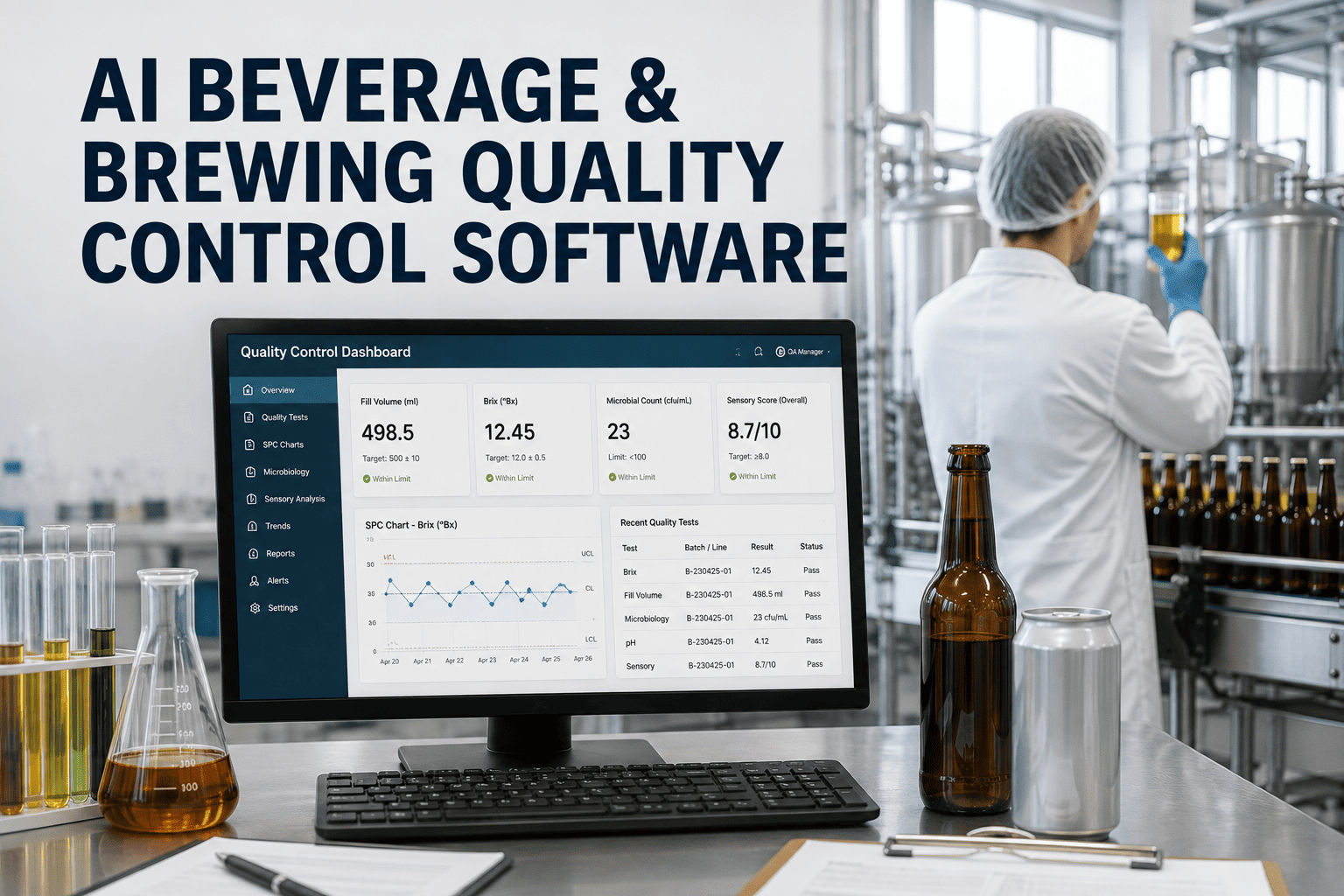
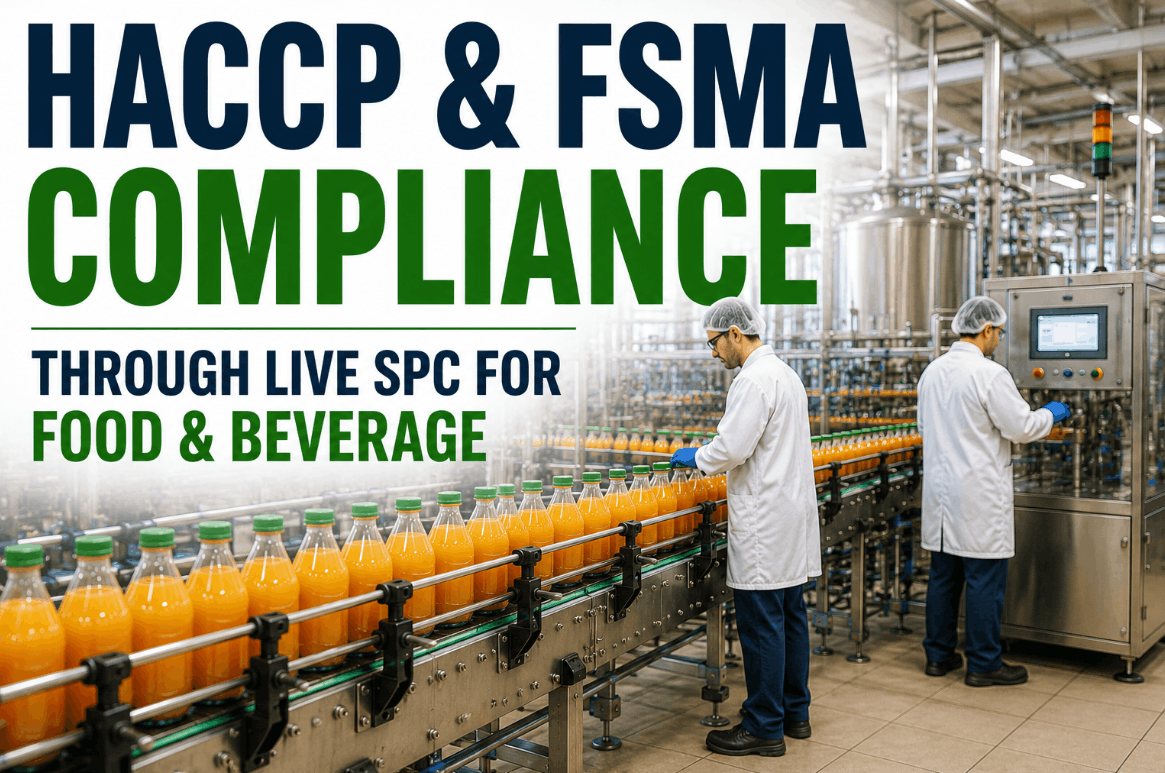
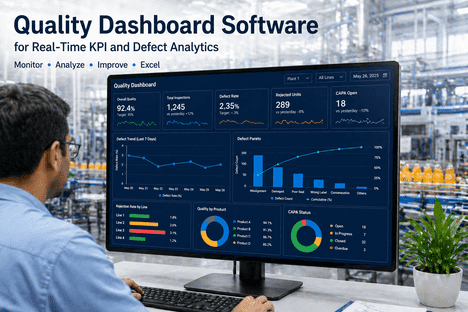
For nearly two decades, the quiet Windows service running in a back corner of every SAP-shop F&B plant has been doing the unglamorous work — translating OPC tag traffic from fillers, cappers, CIP skids, and palletizers into something SAP MII could actually understand. That service is SAP Plant Connectivity, or PCo. And on December 31, 2027, the platform it lives on, alongside SAP MII and SAP ME, reaches end of mainstream maintenance. The replacement, SAP Production Connector (ProdCon), pairs with SAP Digital Manufacturing and SAP BTP — not with MII. The migration is real, the timeline is short, and for an F&B plant manager juggling CIP cycles, allergen changeovers, and a January-2026 FSMA-204 traceability mandate, the question isn't whether to migrate. It's whether the migration is just a connector swap or a chance to put a real AI-native layer on the plant floor — one that catches a label misprint, a fill-level drift, or a seal-bar defect before the carton ever leaves the line. This page is the practical migration path, written for F&B operators who have to keep the line running while the SAP stack gets rebuilt underneath them.
SAP PCo Migration · Food & Beverage · 2027 EOL
From SAP PCo to AI-Native Edge — Without Breaking the Line.
A practical migration path for F&B operators. Move off SAP PCo on schedule, layer iFactory's AI-native vision inspection, predictive SPC, and FSMA-204-ready traceability on top — on-premise or cloud, 6 to 12 weeks per plant. No rip-and-replace of your existing PLCs, SCADA, or historians.
Dec 2027
SAP MII, ME, and PCo reach end of mainstream maintenance
Jul 2028
FSMA-204 Food Traceability Rule new compliance date
6–12 wk
iFactory turnkey AI-native edge — on-prem or cloud
24 hr
FDA-required record production window — automated, image-evidenced
What's Actually Happening — Three Deadlines, One Plant Floor
For an F&B operations leader, 2026 to 2028 isn't one project. It's three deadlines colliding on the same plant floor. SAP is sunsetting the connectivity layer. The FDA is mandating digital traceability with a 24-hour electronic record window. And the AI capabilities the line actually needs — vision inspection, predictive SPC, microstop visibility — were never going to come from PCo in the first place. The migration window is the moment to handle all three at once.
2026 onward
SAP PCo Stack Sunsetting
SAP MII, ME, and PCo end mainstream maintenance December 31, 2027. Extended paid support runs to roughly 2030 — but no new features, no roadmap, growing technical debt. PCo's NetWeaver-based architecture is being replaced by ProdCon on SAP BTP.
F&B implication · Every plant on SAP MII is on the migration clock
July 20, 2028
FSMA-204 Compliance Date
The FDA Food Traceability Rule requires Key Data Elements and Critical Tracking Events for every product on the Food Traceability List, with the ability to produce records within 24 hours of an FDA request. Originally set for January 2026, now extended.
F&B implication · Manual recordkeeping fails the 24-hour test
Now
AI-Native Capability Gap
SAP DM ships baseline MES execution, but the AI capabilities F&B plants actually need — packaging vision inspection, predictive SPC across fillers and cappers, CIP cycle optimization, microstop Pareto, operator AI guidance — don't ship deeply in SAP DM. The gap is real and growing.
F&B implication · A separate AI-native layer is required
The PCo Architecture, In Plain Language
Before walking through what changes, here's what PCo actually does in an F&B plant today. It's the connector layer between the plant floor and SAP — a Windows service that reads from your PLCs, SCADA, historians, and lab systems through standard protocols, then writes that data into SAP MES and ERP. Four moving parts, all configured in the Plant Connectivity Management Console.
PCo Source Systems
What it reads from
OPC standards (UA, DA, HDA, A&E)
OLE DB, ODBC databases
File monitor (batch records, CSV)
Modbus RTU and TCP
MQTT industrial brokers
Industry standards (food, plastics, semi)
PCo Agent Instance
The actual connection
SAP PCo Service
.NET Windows service in plant network
Source System
Target System
Agent Instance
Notification rule
PCo Target Systems
What it writes to
SAP Manufacturing Execution (ME)
SAP MII (Integration & Intelligence)
SAP ERP / S/4HANA
SAP EWM (warehouse)
SAP IoT Cloud Platform
Third-party via Enhanced Notification
The PCo stack is leaving. The plant floor isn't. Walk a migration assessment with our team — we'll map your tag library, identify blockers, and quote a 6 to 12 week per-plant timeline.
What Replaces PCo — and Where iFactory Plugs In
The new SAP architecture moves the design surface to the cloud (SAP Digital Manufacturing on BTP) and keeps a thinner runtime at the plant edge (ProdCon). That solves the connectivity problem. What it doesn't solve is the AI-native production intelligence the F&B plant actually needs — vision inspection, predictive SPC, CIP optimization, operator AI guidance. That's where iFactory layers in — on either the old MII path or the new DM path.
Sunsetting
SAP PCo + MII / ME
.NET Windows service, NetWeaver-aligned, MII as the integration target
Tightly coupled to SAP MII and ME
Configuration done locally in PCo Console
Targets ME, MII, ERP, EWM, IoT Cloud
OPC UA, DA, HDA, A&E + OLE DB, Modbus, MQTT, sockets
Runs on NetWeaver-aligned support timeline
Post-2027 risks: no new features, accumulating tech debt, shrinking PCo engineering pool, eventual security exposure
Successor
SAP ProdCon + Digital Manufacturing
Cloud-design, edge-runtime, paired with SAP DM and BTP
On-premise Windows service in plant network
Equipment models, tags, triggers configured in SAP DM
Connects to SAP BTP via SAP Cloud Connector tunnel
OPC UA as the gold standard, MQTT, industrial protocols
Design Time in DM, Runtime executes in ProdCon at the edge
Strengths: SAP-native, cloud-managed config, aligns with S/4HANA strategy, modern outbound-only network model
Where iFactory Plugs In — On Top of Either Path
iFactory is the AI-native production intelligence layer that sits above your SAP stack — old MII or new DM — and delivers what neither was designed to deliver natively.
AI Vision Inspection
Real-time defect detection on fillers, labelers, cappers, cartoners. Label verification, fill-level check, seal integrity, foreign object detection. Every reject logged with image evidence.
Predictive SPC
Live SPC charts on every critical CCP. Drift detection before tolerance breach. Adaptive control limits per SKU, per shift, per line. CPK and PPK rolling automatically.
CIP & Changeover Intelligence
CIP cycle duration tracking with SMED baselines. Caustic and rinse phase verification. SKU-pair changeover signatures. Allergen cleanout audit trail.
FSMA-204 Traceability
Automated KDE capture from PLCs, scales, scanners. CTE event chain for every batch. 24-hour electronic record production. Recall-scope query in minutes, not days.
Microstop & OEE Pareto
Sub-minute jam detection across the line. Live Pareto across lines, shifts, SKUs. 15–30% of hidden capacity recovery — the loss bucket PCo and SAP MII never surfaced.
Operator AI Assistant
Andon-style alerts with suggested next action — not just red lights. Tribal knowledge captured in the system, available on every shift, regardless of which operator is on the line tonight.
The F&B Migration Path — Six Practical Steps
SAP ships a migration utility that handles some PCo configuration carryover automatically. The realistic migration is broader than running an installer. Below is the F&B-tuned version of the path — the same six steps, with the additions a food or beverage plant actually has to handle.
01
Inventory your current PCo footprint
Catalog every source system, agent instance, target system, and notification rule. Mark the F&B-specific agents — batch record feeds, lab LIMS integrations, weighbridge taps. This becomes the migration scope document. Most mid-size F&B plants have 50–500 tag mappings, 10–50 agent instances, 5–20 notification rules per line.
02
Identify blocking agents before installing ProdCon
Specific PCo agents block the ProdCon installation outright. The most common blocker is the GE Proficy Historian agent — widely used in F&B plants for batch history. If you're on Proficy, the ProdCon installer will refuse until you reconfigure. Other edge cases exist; check the SAP compatibility matrix before booking any production change window.
03
Decide on coexistence vs hard cutover
SAP does not support running PCo with active Cloud Management and ProdCon side-by-side against the same cloud endpoint. The supported model is uninstall PCo, install ProdCon — or operate them temporarily with PCo's cloud features disabled. For multi-line F&B plants, plan a per-line cutover schedule. Big-bang migrations during peak season are operationally suicidal.
04
Move design-time configuration to SAP Digital Manufacturing
Equipment models, tag mappings, and trigger rules that lived in the PCo Management Console now move into SAP DM's Production Connectivity apps. The shift is conceptual, not just technical — configuration leaves the edge and lives in the cloud. Plan for tag standardization while you're in there; this is the right moment to clean up 20 years of inconsistent naming.
05
Run a per-line cutover with monitored fallback
Cutover one line at a time, with the iFactory edge appliance and the new ProdCon runtime live in parallel for the first 48–72 hours per line. Watch OEE, first-pass yield, batch-record completeness, and KDE capture continuity. The iFactory appliance acts as a second source of truth during cutover, surfacing any data gaps in real time.
06
Activate the AI-native layer in parallel
Vision inspection, predictive SPC, microstop tracking, CIP optimization, FSMA-204 KDE capture — switched on as the ProdCon migration completes per line. The point of doing the migration is not just to swap connectors; it's to come out the other side with capabilities the old PCo stack was never going to deliver.
Migrate Once. Get an AI-Native F&B Plant Floor Out of It.
A PCo-to-ProdCon swap fixes the support timeline. It doesn't deliver vision inspection, predictive SPC, microstop visibility, or FSMA-204 KDE automation. iFactory layers above either path — on-premise NVIDIA appliance or fully managed cloud, your choice — and goes live in 6 to 12 weeks per plant.
What an AI Vision Inspection Line Looks Like in Practice
The single most consequential capability iFactory adds to an F&B plant is real-time AI vision inspection on every packaging line — fill level, seal integrity, label accuracy, allergen declaration, foreign object detection. Every reject is logged with image evidence, defect category, lot code, and timestamp, feeding directly into FSMA-204 KDE records without manual entry.
Bottling Line · Live AI Inspection Feed · Shift B
11:42:08
Label PASS · 500ml Cola · Position OK · Lot LB-2026-08471
Print darkness within spec · barcode readable · allergen declaration present
PASS
11:42:11
Fill REJECT · 500ml Cola · Fill level 482ml (spec 495–505ml) · Lot LB-2026-08471
Auto-rejected at station 4 · image saved · KDE record appended · CCP flagged to QA
REJECT
11:42:14
Seal PASS · 500ml Cola · Cap torque 1.42 Nm · Lot LB-2026-08471
Cap orientation correct · tamper-band intact · no visible defects
PASS
11:42:18
Label REJECT · 500ml Cola · Misaligned by 4.2mm · Lot LB-2026-08471
Pattern: 3rd misalignment in last 15 min · root-cause flag raised · labeler maintenance triggered
REJECT
11:42:21
SPC ALERT · Filler head 3 · Fill drift +0.8% in last 100 units
Trending toward spec limit · suggested: verify dosing valve calibration before next CIP cycle
WARN
What an F&B Operator Gets, Day One After Cutover
A
Every Reject is FSMA-204 Ready
Image evidence, defect classification, lot code, timestamp — auto-captured into the KDE record. The 24-hour FDA window stops being a panic project and becomes a query.
B
Microstops Stop Hiding
15 to 30% of plant downtime sits in sub-minute filler jams, label feeder hiccups, capper resets. Operators don't log them. PCo and MII didn't surface them. iFactory does, with one-second sensor sampling.
C
CIP Cycles Become a Live KPI
Caustic, rinse, sanitize phase durations tracked against SMED baselines. Overrun flagged the moment it starts trending. Allergen cleanout verified before next SKU starts running.
D
Predictive SPC, Not Just Reactive
Fill, weight, viscosity, temperature, brix — every critical parameter charted live with adaptive limits per SKU. Drift detected before spec breach, not three batches later in the QA lab.
E
Recall Scope in Minutes
Which finished products contain ingredients from this lot, and where are they now — answered in minutes through the CTE chain, not days of spreadsheet archaeology.
F
Operator-First UI on Every Shift
Andon screens show the line, the loss, the suggested fix in two taps. Designed for the reality that the operator on shift tonight may be different from yesterday — the system carries the context.
On-Premise or Cloud — Choose By Plant Reality
iFactory ships in two deployment models, and the choice is operational, not philosophical. Some F&B plants need data to stay on-site for IP, audit, or sovereignty reasons. Others need a single corporate dashboard across 8 plants and prefer a cloud tenant. Both work, both deploy in 6 to 12 weeks, both layer above either the legacy PCo path or the new ProdCon path.
Option A
On-Premise AI Appliance
Pre-loaded NVIDIA AI server, racked and shipped ready. All processing on-site. Zero cloud round-trip.
Best when data sovereignty, IP-sensitive recipes, branded F&B, audit-restricted environments
What ships NVIDIA appliance, line connectors, dashboard system, Andon screens
Integration OPC-UA, EtherNet/IP, Modbus TCP, MQTT, REST adapters
Compliance Meets FSSC 22000, BRC, SQF, FDA 21 CFR Part 11 data-residency requirements
Timeline 6–12 weeks per plant from order to live floor
Option B
iFactory Cloud Tenant
Single multi-plant cloud tenant. Corporate dashboards, cross-plant Pareto, fleet benchmarking. Edge nodes at each plant for low-latency capture.
Best when multi-plant networks, corporate visibility, lean plant IT, group-ops benchmarking
What ships Edge node per plant, cloud tenant, shared dashboard layer
Integration Same protocols, plus SAP BTP bridge for DM-native customers
Compliance SOC 2 Type II, ISO 27001, regional data-residency options
Timeline 6 weeks per plant in parallel; fleet-wide rollout in one quarter
Frequently Asked Questions
Do we have to migrate off SAP PCo if our plant is running fine today?
Eventually, yes. SAP MII, ME, and the PCo connectivity layer reach end of mainstream maintenance on December 31, 2027. Premium extended support is available at higher cost through roughly 2030, but no new features, no roadmap, and a shrinking pool of PCo engineers means the operational risk grows every year. The practical question isn't whether to migrate — it's whether you migrate in 2026–2027 on your own schedule, or in 2029–2030 under pressure with fewer qualified engineers available.
Why layer iFactory on top instead of just running ProdCon and SAP DM?
Because ProdCon is a connectivity layer, not an AI-native production intelligence layer. SAP DM ships strong MES execution and the Production Connectivity apps that replace PCo's design surface. What it does not ship deeply is AI vision inspection at line speed, predictive SPC with adaptive limits per SKU, sub-minute microstop tracking, CIP and changeover intelligence, or operator AI guidance. These are the capabilities that actually move OEE, first-pass yield, and FSMA-204 readiness — and they're not in ProdCon's scope by design. iFactory layers above either path and delivers them.
Will the migration disrupt our running lines?
Not if it's planned correctly. The recommended model is per-line cutover with monitored fallback — meaning one line at a time, with the iFactory edge appliance and the new ProdCon runtime live in parallel for 48–72 hours per line. OEE, first-pass yield, batch-record completeness, and KDE capture are watched continuously during the cutover window. Big-bang migrations during peak season are operationally risky and we don't recommend them. The right scheduling lets you cut over during planned maintenance windows or shoulder-season production.
What about our existing GE Proficy Historian or other industry agents?
This is the #1 migration blocker we see in F&B plants. The GE Proficy Historian PCo agent specifically blocks the ProdCon installer from proceeding. If your plant uses Proficy — common for batch history in beverage, dairy, and processed-food operations — you'll need to reconfigure the historian integration before ProdCon can install. iFactory can read directly from Proficy as a parallel data source during the migration window, so historical data continuity is maintained even while the SAP path is being rebuilt. Other industry-specific agents have similar workarounds; we map them in the Step 02 inventory assessment.
How does this help with FSMA-204 compliance specifically?
FSMA-204 requires Key Data Elements and Critical Tracking Events for every product on the Food Traceability List, with the ability to produce records within 24 hours of an FDA request. Manual recordkeeping fails the 24-hour test — the data exists across spreadsheets, paper logs, and disconnected systems. iFactory captures KDEs automatically from PLCs, scales, scanners, and vision systems, links them into the CTE chain (growing, receiving, transforming, creating, shipping), and stores them in a queryable record format. Every AI vision reject is auto-logged with image evidence, defect classification, lot code, and timestamp — meeting the FDA electronic record requirement without operator intervention. The transforming CTE — where most manufacturers fail — is linked automatically by the production engine.
Do we go on-premise or cloud?
The honest answer is "it depends on the plant." On-premise NVIDIA appliances are right for plants with IP-sensitive recipes, branded F&B operations where competitive data exposure is a concern, single-site deployments, and audit environments that mandate data residency (FSSC 22000, BRC, SQF, FDA 21 CFR Part 11). Cloud tenants are right for multi-plant networks where corporate visibility, cross-plant benchmarking, and lean plant IT are priorities. Many of our F&B customers run a hybrid — on-premise edge for line data, cloud tenant for corporate analytics. We scope this in the migration assessment based on your specific plant reality.
How quickly can we go live?
6 to 12 weeks per plant from order to live floor. Weeks 1–4: appliance ships pre-loaded, field techs connect PLCs and SCADA via OPC-UA, EtherNet/IP, Profinet, Modbus TCP — alongside or independent of the SAP path. Weeks 5–8: plant-specific OEE definitions, SKU library, CIP signatures, and vision models tuned. Pilot on 2–3 highest-volume lines. Weeks 9–12: full plant rollout, Andon alerts live, daily review cycles begin. Multi-plant networks typically roll out at 3–4 plants per quarter after the first pilot stabilizes.
Your PCo Migration Window Is Also Your AI-Native Opportunity.
Every F&B plant running SAP MII has a migration deadline approaching. Most plants will treat it as a connector swap. The plants pulling ahead will treat it as the moment to put real AI vision inspection, predictive SPC, microstop tracking, CIP intelligence, and FSMA-204 KDE automation on the line — once, while the stack is open anyway. iFactory ships as a turnkey appliance or a cloud tenant, layers above either SAP path, and goes live in 6 to 12 weeks per plant. Let's walk through your specific plant footprint together.