A global electronics distributor ran a wall-to-wall physical inventory count across its three largest warehouses. The result: a $2.3 million discrepancy between system records and actual stock — representing 4.6% of total inventory value. The root causes were mundane but devastating: mispicked SKUs shelved in wrong locations, inbound pallets stored without bin assignment, and returns processed without system updates. Every one of these errors had been invisible to manual processes. A computer vision system running on the warehouse ceiling would have caught each discrepancy the moment it occurred — not 90 days later during an audit. AI vision does not forget, does not fatigue, and does not approximate. It counts.
Inventory Intelligence
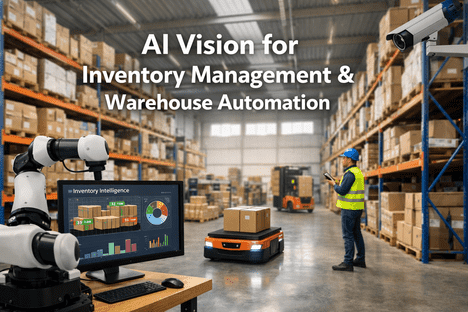
AI Vision for Inventory Management & Warehouse Automation
How computer vision transforms warehouse operations — from manual counts and guesswork to real-time, autonomous inventory intelligence
$1.77T
Global annual cost of inventory distortion
Stockouts + Overstock
99.5%+
Inventory accuracy achievable with AI vision
vs 63% Manual Average
The Problem With Manual Inventory Management
Most warehouses still rely on periodic physical counts, handheld barcode scanners, and human memory to track millions of dollars in inventory. The result is a permanent gap between what the system says and what actually exists on the shelf. That gap silently erodes margins, disrupts fulfillment, and destroys demand forecast accuracy — every single day.
How Inventory Blind Spots Become Million-Dollar Losses
1
The Accuracy Gap
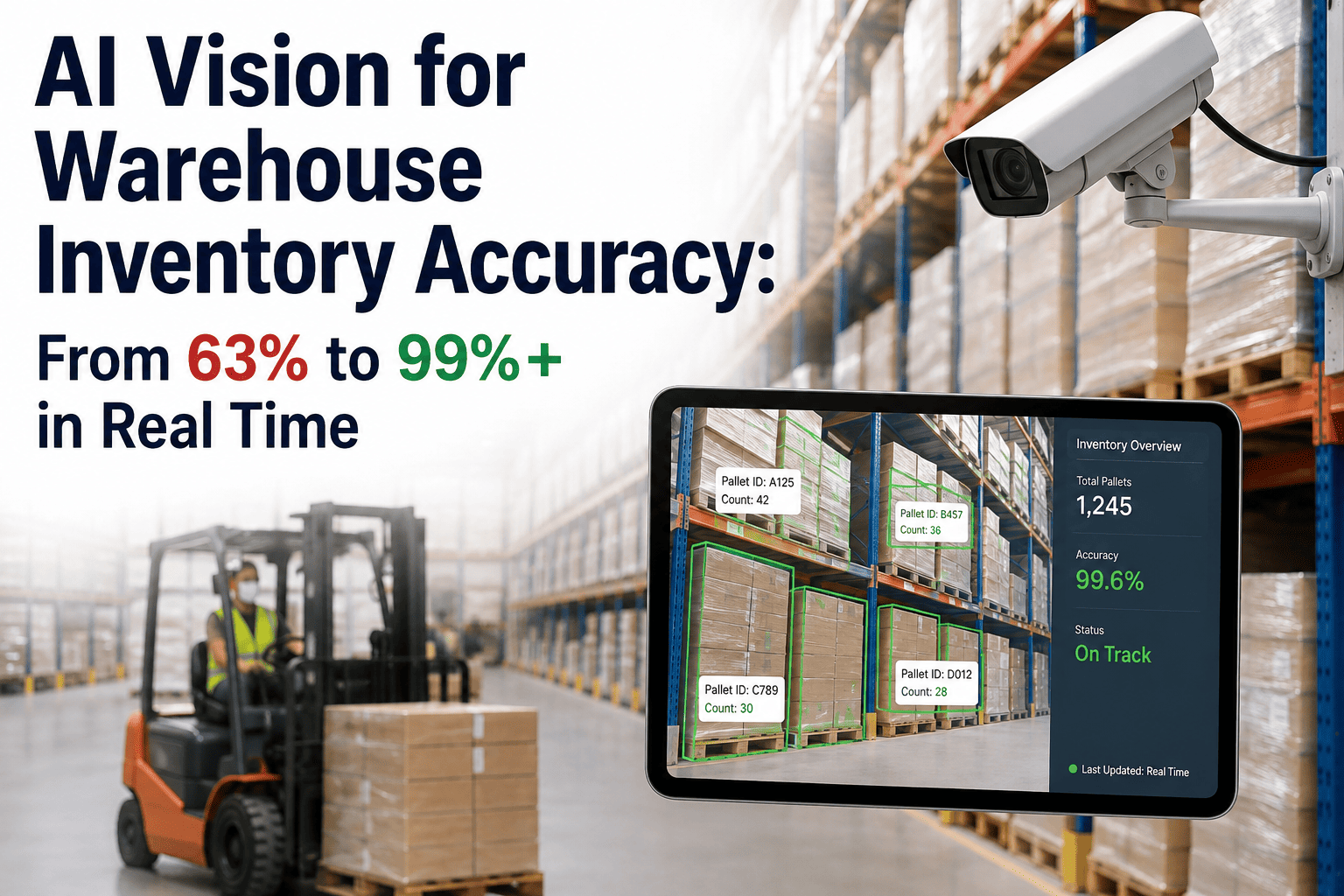
The average warehouse maintains only 63% inventory record accuracy. Even operations targeting 95% accuracy still carry a 5% error rate — on $10M of inventory, that is $500,000 in misallocated, misplaced, or phantom stock at any given time.
2
The Shrinkage Drain
Inventory shrinkage costs retailers an average of 1.44% of sales annually — translating to nearly $100 billion in industry-wide losses. Administrative errors, misplaced stock, and process failures account for more shrinkage than theft in most warehouses.
3
The Stockout Cascade
Stockouts from inaccurate records cost global retail over $1 trillion in missed sales annually. When your system shows stock that does not physically exist, orders fail, customers leave, and 30% of them never come back.
4
The Labour Cost Trap
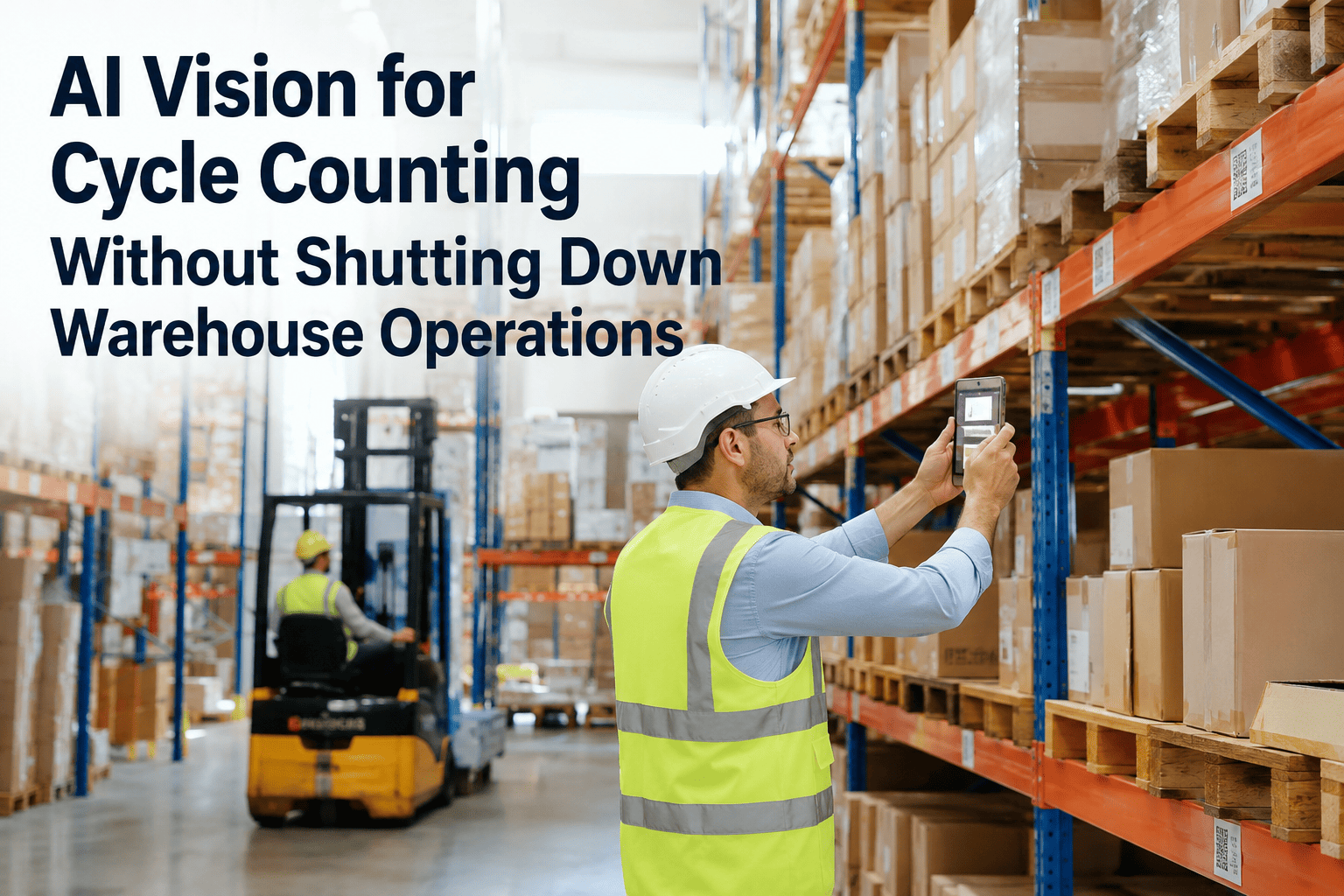
Manual cycle counts consume thousands of labour hours annually and still only sample a fraction of inventory. Annual wall-to-wall counts shut down operations for days. Even after all that effort, accuracy degrades within weeks as daily errors re-accumulate.
What is inventory inaccuracy really costing your operation? Book a demo to see AI vision count your warehouse in real time.
What AI Vision Monitors in Your Warehouse
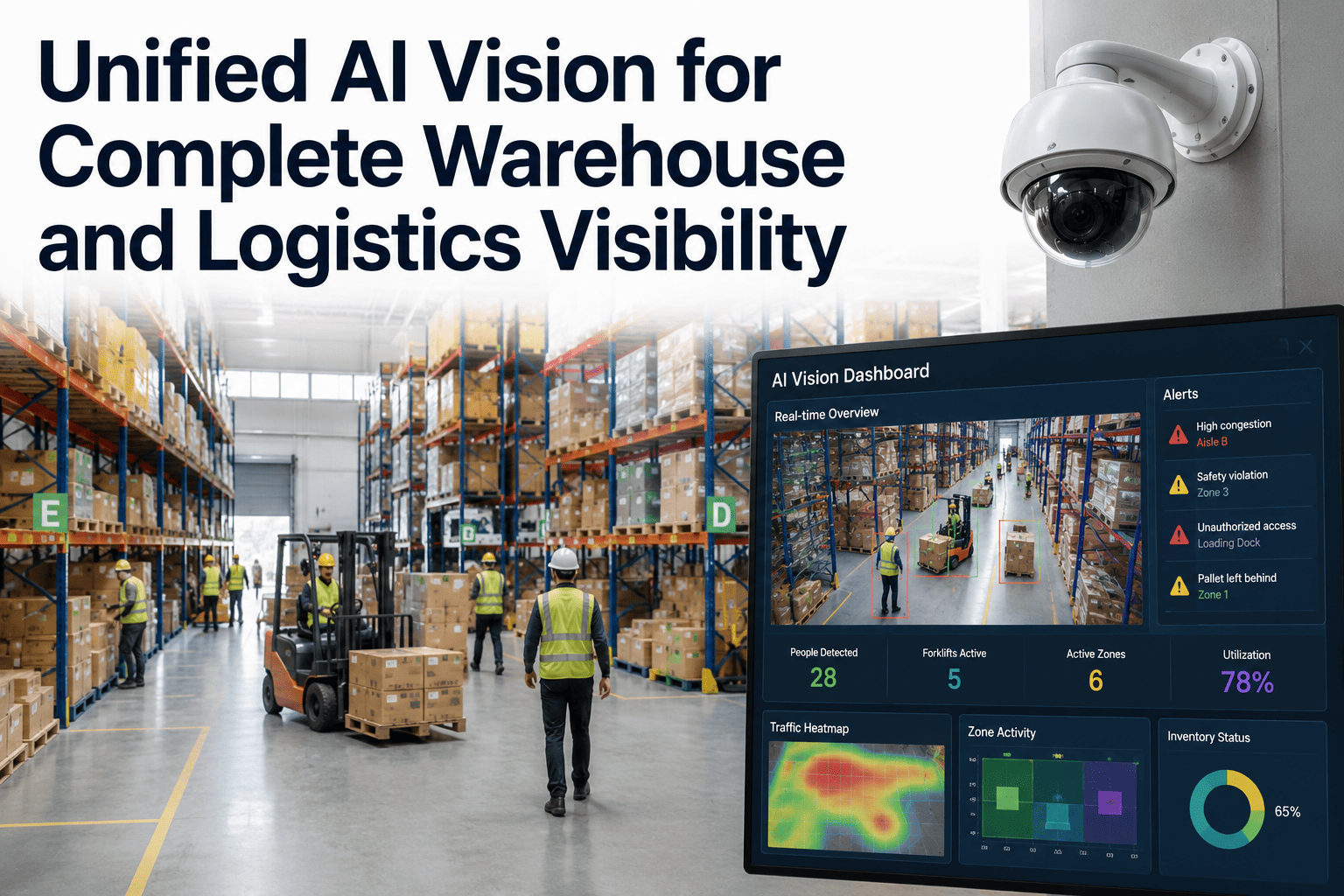
AI-powered camera systems mounted across your warehouse continuously monitor inventory movement, storage accuracy, and operational activity — replacing periodic counts with perpetual, real-time visibility. The system sees everything that humans cannot track at scale: every pallet placed, every pick made, every location that drifts from its record.
Pallet counts
Bin fill levels
Shelf occupancy
Empty location detection
Overstock alerts
What AI Sees
Overhead and aisle cameras continuously count pallets, cartons, and bin fill levels across every storage location — updating inventory records in real time without manual scanning
Impact
Eliminates periodic cycle counts — inventory accuracy maintained continuously at 99.5%+
Putaway verification
Misplaced SKU detection
Bin assignment validation
Zone compliance
Slotting drift alerts
What AI Sees
Vision systems verify that every item is placed in its assigned location, detecting misplacements the moment they happen — not weeks later during a physical count
Impact
Reduces mis-picks by 80%+ and eliminates phantom inventory from misplaced stock
Inbound count validation
ASN matching
Outbound order accuracy
Load verification
Damage detection
What AI Sees
Cameras at dock doors automatically count and verify inbound and outbound shipments against purchase orders and pick lists — catching discrepancies before they enter the system
Impact
Eliminates receiving errors that create 25%+ of all inventory inaccuracies
Pick verification
Quantity validation
SKU confirmation
Pack completeness
Label accuracy
What AI Sees
Vision at pick stations and pack benches validates that the right product, right quantity, and right label go into every order — catching errors before shipment, not after customer complaint
Impact
Reduces mis-ships to near zero — protecting customer satisfaction and preventing costly returns
Aisle congestion
Dead stock detection
Space utilisation heatmaps
Velocity-based slotting
Seasonal rebalancing
What AI Sees
Continuous monitoring of how warehouse space is used — identifying underutilised zones, congestion bottlenecks, dead stock, and slotting opportunities that optimise throughput
Impact
Increases effective storage capacity 15–25% without expanding facility footprint
Forklift traffic monitoring
PPE compliance
Aisle obstruction alerts
Hazmat zone monitoring
Emergency exit clearance
What AI Sees
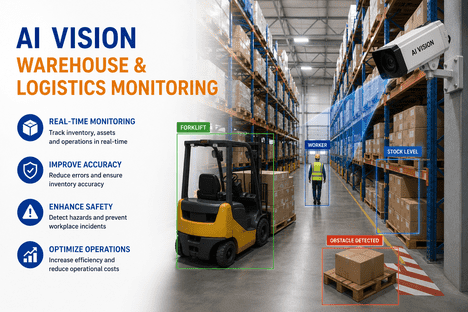
Vision systems monitor safety compliance in real time — detecting blocked aisles, missing PPE, unsafe forklift operation, and zone violations that create liability and injury risk
Impact
Reduces workplace incidents and ensures continuous regulatory compliance without manual audits
From Counting to Intelligence: The AI Inventory Loop
Traditional inventory management is a snapshot — a periodic count that is outdated the moment it is complete. AI vision creates a continuous loop: watching, recording, reconciling, and optimising in real time. The warehouse system of record is always accurate because it is always being updated.
AI Vision Inventory Intelligence Pipeline
See
Continuous Visual Monitoring
Cameras across the warehouse capture every movement — inbound receipts, putaway, picks, replenishment, and shipments — creating a visual record of all inventory transactions.
Count
Autonomous Inventory Counting
AI models count pallets, cartons, and items in every monitored location continuously. No manual counts, no cycle count schedules, no operational shutdowns.
Reconcile
Real-Time Record Matching
Vision data is compared against WMS records in real time. Any discrepancy is flagged instantly — wrong location, wrong quantity, missing item — with timestamp and visual evidence.
Optimise
Intelligent Warehouse Actions
System generates slotting recommendations, replenishment triggers, dead stock alerts, and space utilisation insights — turning raw visibility into operational intelligence.
Stop Counting. Start Knowing.
iFactory's AI vision platform gives your warehouse real-time inventory accuracy without manual counts, barcode dependencies, or operational shutdowns. See every item, every location, every movement — continuously.
The True Cost of Inventory Inaccuracy
Inventory errors do not stay in the warehouse. They cascade through every function — purchasing buys what you already have, sales promises what you do not, finance reports assets that do not exist, and customers receive the wrong order or no order at all. Here is the full cost picture.
Shrinkage Losses
Misplaced stock, administrative errors, damage, and theft consume 1.4–2% of total inventory value annually. For a $20M inventory, that is $280K–$400K vanishing from the balance sheet every year.
1.4–2% of inventory
Stockout Revenue Loss
When system records show stock that does not physically exist, orders fail at fulfillment. 30% of affected customers switch to competitors permanently. Globally, stockouts cost retail over $1 trillion annually.
$1T+ globally/year
Overstock & Carrying
Inaccurate data triggers safety stock inflation and unnecessary reorders. Storage costs increase 20–30% with excess inventory — tying up working capital in products that sit rather than sell.
20–30% cost inflation
Total Inventory Distortion
Combined cost of shrinkage, stockouts, overstock, mis-ships, and returns driven by inaccurate inventory records — the largest preventable cost in warehouse operations.
$1.77T globally/year
How the Technology Works
AI vision for inventory management deploys industrial cameras across key warehouse zones — receiving docks, storage aisles, pick stations, and shipping lanes — connected to edge-deployed deep learning models that understand what inventory looks like, where it belongs, and when something is wrong.
Layer 1
Strategic Camera Placement
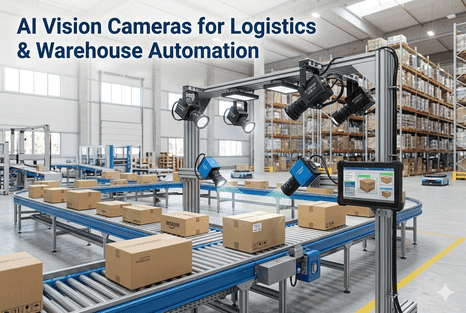
Overhead, aisle-level, and dock-mounted cameras provide full warehouse coverage. A single overhead camera can monitor an entire storage bay. Dock cameras verify every inbound and outbound load. Pick station cameras validate every order.
Layer 2
Object Recognition & Counting
Deep learning models trained on warehouse environments recognise pallets, cartons, individual SKUs, labels, and barcodes. The system counts inventory visually — no RFID tags, no barcode dependency, no contact scanning required.
Layer 3
Edge Processing
GPU-accelerated edge computing processes visual data locally in real time. No dependency on cloud connectivity for core operations. Sub-second processing ensures inventory updates happen as movements occur — not hours later in batch uploads.
Layer 4
Anomaly & Discrepancy Detection
AI compares visual inventory state against WMS records continuously. Any mismatch — wrong location, unexpected quantity change, unrecorded movement — triggers an instant alert with timestamp, location, and visual evidence for rapid resolution.
Layer 5
WMS & ERP Integration
Bi-directional integration with your WMS, ERP, and order management systems. AI-verified inventory data flows into existing workflows — updating stock levels, triggering replenishment, adjusting allocations, and feeding demand forecasting with accurate inputs.
See how AI vision integrates with your existing WMS. Schedule a live demonstration.
Proven Results from AI Inventory Deployments
Where AI Vision Transforms Warehouse Operations
Every warehouse handling physical goods faces the same fundamental challenge: knowing exactly what you have, where it is, and whether it matches your records. AI vision solves this across every industry vertical and warehouse type.
E-Commerce & Retail Fulfilment
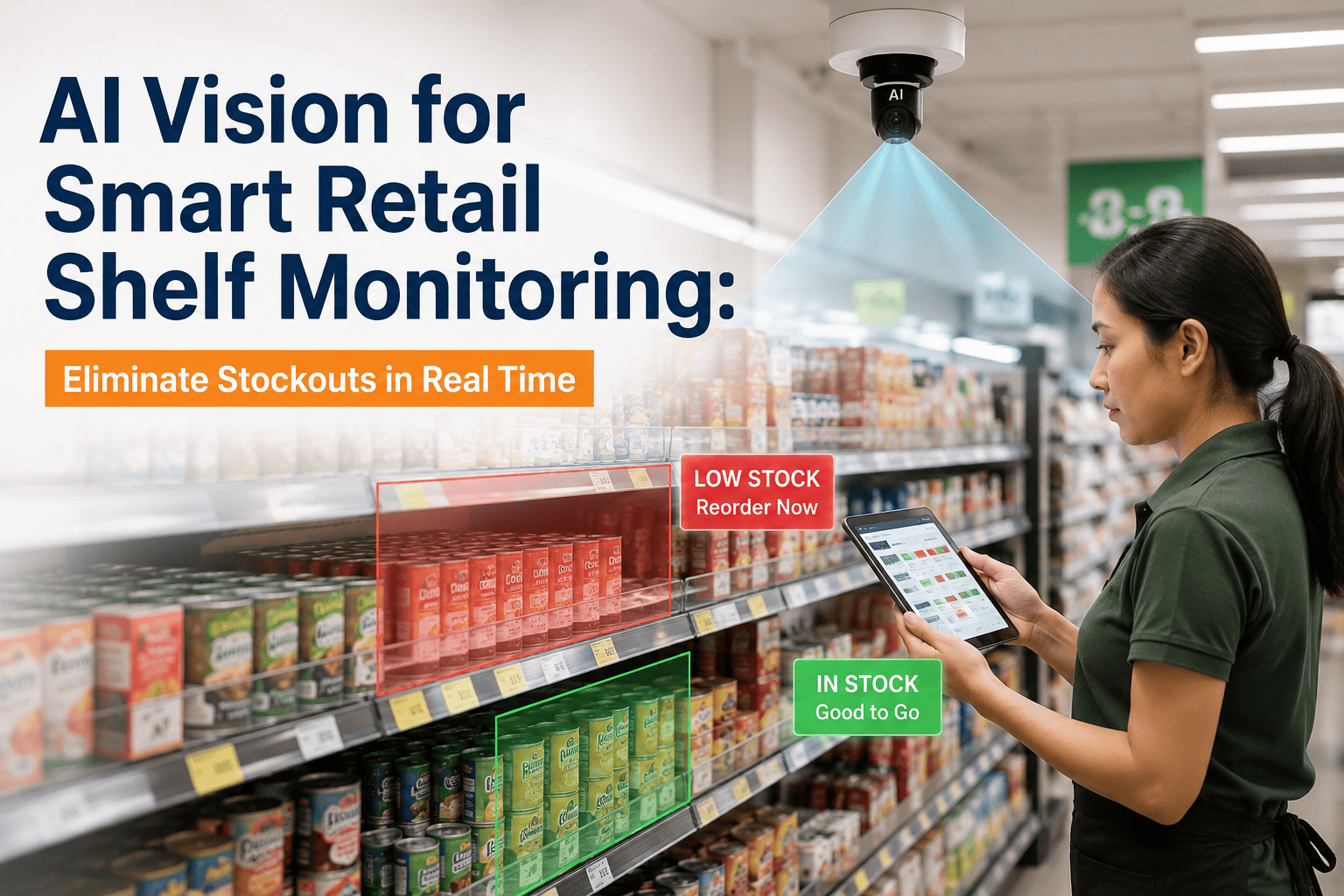
High-velocity picking environments where mis-ships destroy customer trust. AI validates every pick, every pack, and every shipment against the order — at speeds that manual QC cannot match.
Mis-ship rates reduced to near zero — protecting ratings, reviews, and repeat business
Manufacturing & Industrial
Raw material and WIP inventory feeding production lines. AI tracks component consumption, monitors buffer stock levels, and prevents line stoppages from stockouts that manual counts miss.
Production lines fed continuously with accurate BOM-level inventory visibility
3PL & Distribution
Multi-client warehouses where accuracy is contractual. AI provides client-specific inventory visibility, automated receiving verification, and shrinkage tracking that protects SLA compliance.
Shrinkage tracked to root cause — reducing variance claims and protecting margins
Pharma, Food & Cold Chain
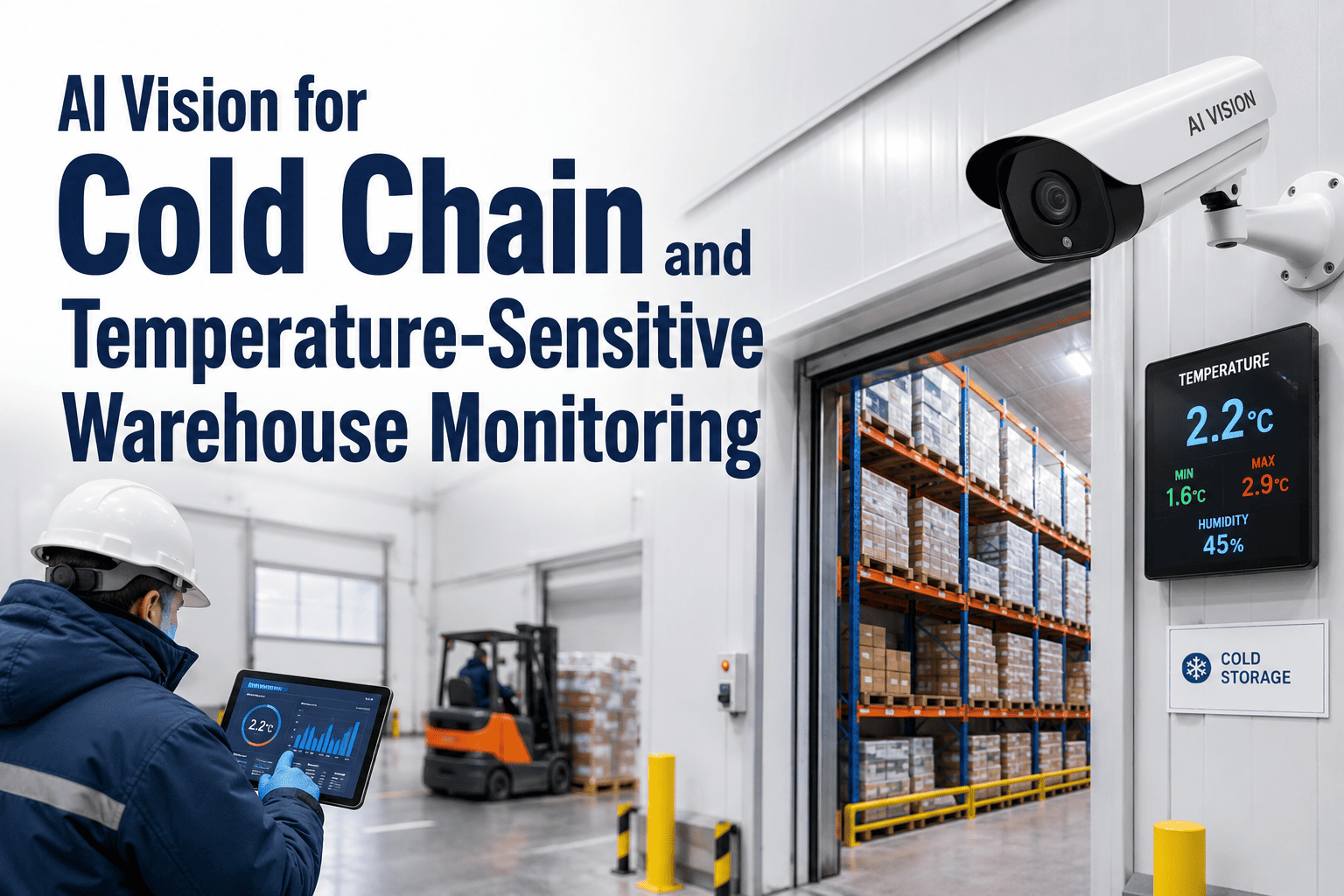
Regulated environments requiring full traceability, FEFO/FIFO compliance, and batch-level tracking. AI monitors expiry rotation, temperature zone compliance, and lot segregation automatically.
Full regulatory traceability maintained autonomously without manual audit overhead
Frequently Asked Questions
Does AI vision replace barcode scanning?
AI vision works alongside or independent of barcode systems. It can read barcodes and labels optically, but more importantly, it recognises products, pallets, and locations visually — meaning it works even when labels are damaged, missing, or obscured. This provides a redundant layer of accuracy that barcode-only systems cannot achieve.
How much warehouse area can one camera system cover?
A single overhead camera can monitor an entire storage bay or aisle section. Typical deployments use 15–30 cameras for a 50,000 sq ft warehouse, with strategic placement at docks, high-value zones, pick faces, and shipping lanes. The system is modular — you start with highest-impact zones and expand as ROI is proven.
What is the ROI for AI inventory vision?
Most warehouses achieve payback within 6–9 months. ROI comes from eliminated cycle count labour (90% reduction), reduced shrinkage (50% reduction), fewer mis-ships and returns, improved space utilisation (15–25% gain), and the downstream revenue protection from accurate stock availability data feeding your sales channels.
Does this integrate with our existing WMS?
Yes. The platform integrates bi-directionally with all major WMS, ERP, and order management systems. AI-verified inventory data syncs into your existing workflows in real time — updating stock levels, triggering replenishment, and feeding demand planning without requiring WMS replacement or major system changes.
Can AI vision work in cold storage and dark warehouses?
Yes. Industrial camera systems operate in temperatures from -30°C to +60°C with infrared and low-light imaging capabilities. Cold chain warehouses, dark stores, and automated facilities benefit particularly because AI vision works without human presence — monitoring inventory in environments where manual counting is impractical or unsafe.
See Every Item. Know Every Location. Trust Every Record.
Your warehouse records are wrong right now. AI vision fixes that — continuously, autonomously, in real time. Find out what your current inventory system is missing.