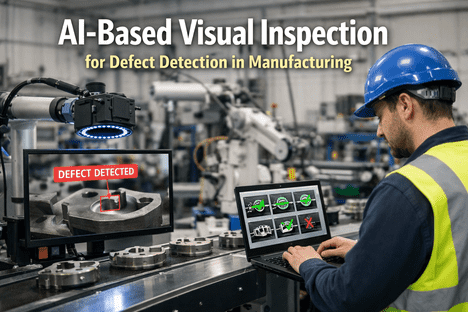
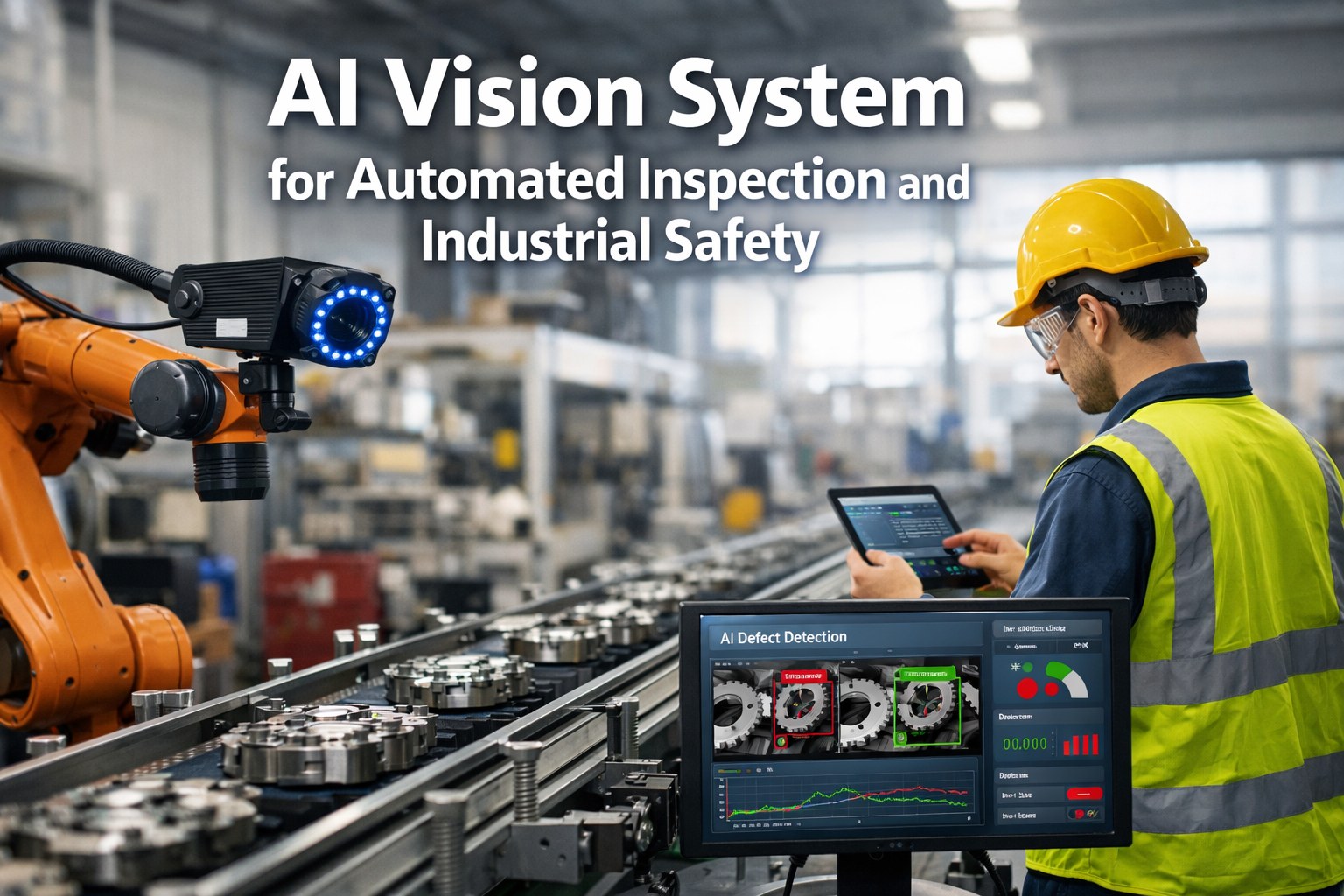
An automotive battery manufacturer was rejecting 6.3% of cells coming off its assembly line — a loss of $8.7 million annually in scrapped material and rework labour. Human inspectors could not detect the micro-level electrode misalignments and coating inconsistencies causing the failures. Within four weeks of deploying computer vision cameras at three inspection points, the system identified the specific coating head drift causing 73% of rejects, detection accuracy reached 99.2%, and the reject rate dropped to 1.1%. The cameras did not just find defects. They found the cause. That is the difference computer vision makes in industrial automation.
AI Vision
How Computer Vision Is Transforming Industrial Automation
From inspection and guidance to monitoring and decision-making — how AI-powered vision is becoming the eyes of the modern factory
$20.7B
Global computer vision market in 2025
Growing to $72.8B by 2034
42%
Of machine vision revenue from quality inspection
Largest Application
Why Industrial Automation Needs Eyes
Traditional automation is blind. PLCs execute fixed programmes, robots follow pre-set paths, and conveyors move materials on timers. This works for simple, repetitive tasks — but it breaks the moment anything varies. A part arrives slightly rotated. A surface defect appears in an unexpected location. A pallet is stacked differently. Without vision, automation cannot adapt. Computer vision gives machines the ability to see, interpret, and act on visual information — turning rigid automation into intelligent, adaptive systems.
The Limitations of Blind Automation
1
Inspection Without Insight
Human inspectors catch 60–70% of defects. Legacy rule-based AOI systems generate up to 50% false positives. Neither can see sub-millimetre anomalies at production speed, and neither learns from what it misses. The result is quality escapes that cost 10–100x more when found by customers.
2
Robots That Cannot See
Traditional robots pick from fixed positions and follow rigid paths. If a part shifts 2mm or arrives in a different orientation, the robot fails. Vision-guided robotics adapts to part variation in real time — enabling bin picking, flexible assembly, and mixed-product handling.
3
Monitoring Without Understanding
SCADA dashboards show numbers. Operators watch screens. But nobody can visually monitor every machine, every process, and every safety zone 24/7. Computer vision watches everything continuously — detecting anomalies, tracking conditions, and alerting before problems escalate.
4
Data Without Context
Sensor data tells you a temperature is rising. Vision tells you why — the bearing is discoloured, the belt is fraying, the coolant is leaking. Computer vision adds the visual context that transforms raw data into actionable intelligence.
What could your automation achieve if it could see? Book a demo to see computer vision on your production floor.
The 6 Ways Computer Vision Transforms Industrial Operations
Computer vision is not a single application — it is a capability layer that transforms every function it touches. From quality inspection to robot guidance to safety monitoring, vision gives industrial automation the intelligence it has always lacked. Here are the six areas where the impact is greatest.
Surface analysis
Dimensional check
Assembly verification
Label accuracy
Colour matching
How Vision Transforms This
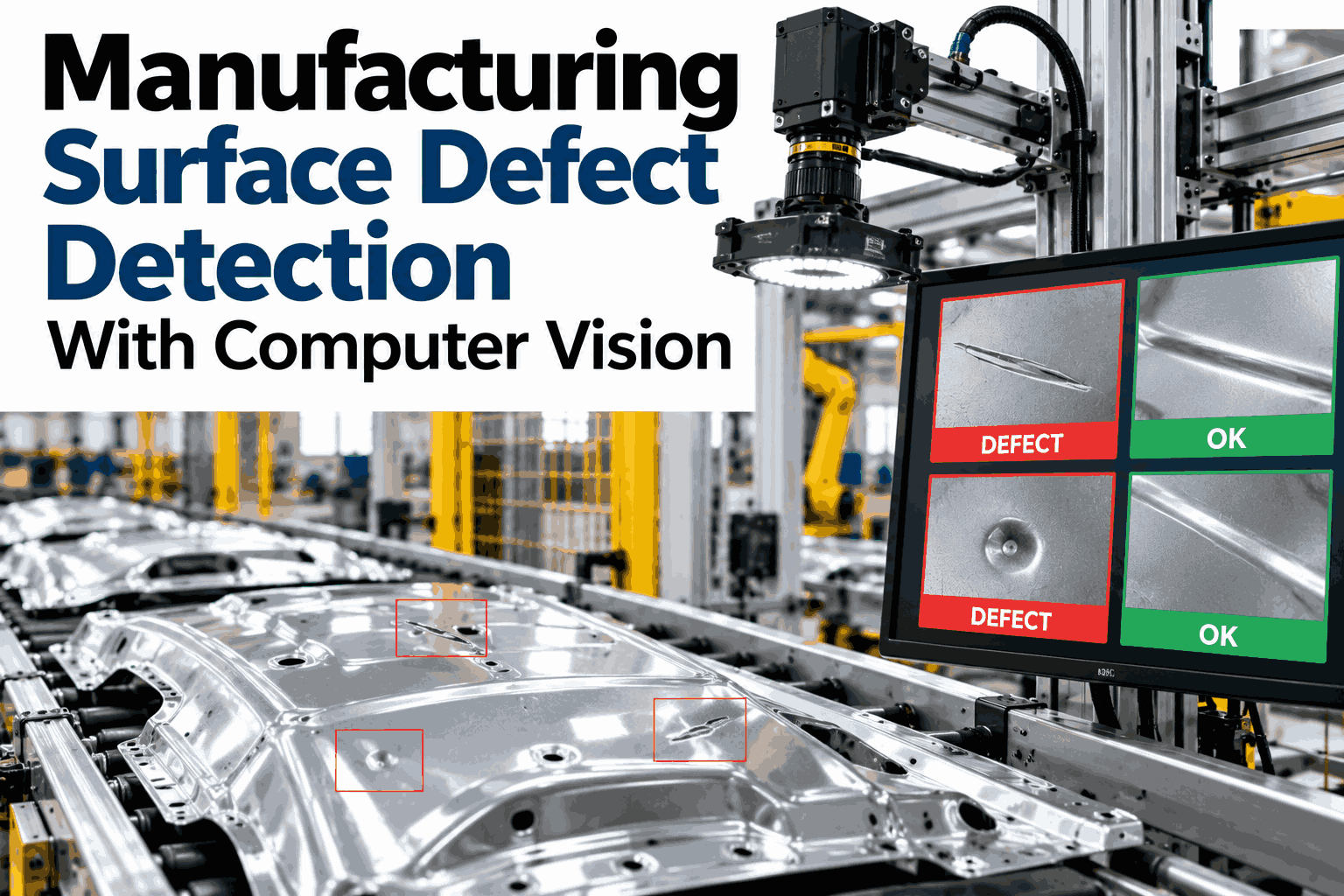
Deep learning models inspect every unit at production speed, detecting scratches, cracks, mis-assemblies, and dimensional deviations with 97–99% accuracy — replacing statistical sampling with 100% inline verification.
Documented Impact
35% quality improvement. Customer complaints reduced 40–65% post-deployment.
Bin picking
Part localisation
Seam tracking
Adaptive placement
Tool alignment
How Vision Transforms This
2D/3D cameras give robots real-time spatial awareness — locating randomly oriented parts, guiding weld seams, and adapting placement to part variation without reprogramming or fixed jigs.
Documented Impact
Enables flexible manufacturing — robots handle product changeovers in minutes, not hours.
Thermal anomalies
Wear tracking
Vibration signatures
Leak detection
Corrosion progression
How Vision Transforms This
Thermal and visual cameras continuously monitor equipment health — detecting bearing overheat, belt degradation, fluid leaks, and electrical faults weeks before failure, without contact sensors.
Documented Impact
50% reduction in unplanned downtime. 4–8 weeks failure warning lead time.
Pallet counting
Location tracking
Receiving verification
Shipping validation
Space utilisation
How Vision Transforms This
Overhead cameras autonomously count and track inventory across warehouse locations — maintaining 99.5%+ accuracy continuously without manual cycle counts, barcode scanning, or operational shutdowns.
Documented Impact
90% reduction in cycle count labour. 50% shrinkage reduction documented.
Fill level monitoring
Flow analysis
Colour consistency
Coating uniformity
Weld pool tracking
How Vision Transforms This
Vision systems monitor process parameters visually in real time — detecting drift in coating thickness, fill levels, colour consistency, and weld quality that discrete sensors cannot capture holistically.
Documented Impact
Closed-loop process control — vision data feeds directly into parameter adjustment.
PPE detection
Zone intrusion
Forklift tracking
Spill detection
Emergency response
How Vision Transforms This
AI cameras monitor safety zones, PPE compliance, vehicle traffic, and hazard conditions continuously — replacing periodic manual audits with real-time automated enforcement and incident prevention.
Documented Impact
Workplace injuries reduced 50–70%. Continuous compliance without audit overhead.
The Computer Vision Intelligence Loop
Computer vision does not just capture images. It creates an intelligence loop — seeing, understanding, acting, and learning — that transforms raw visual data into autonomous operational decisions at the speed of production.
How Vision Creates Industrial Intelligence
Capture
Industrial Image Acquisition
High-speed 2D, 3D, thermal, and hyperspectral cameras capture visual data at 40,000+ lines per second across production lines, equipment, and facility spaces.
Understand
Deep Learning Inference
Edge-deployed CNNs process images in under 50ms — classifying defects, identifying objects, reading text, measuring dimensions, and detecting anomalies in real time.
Act
Automated Response
Vision insights trigger immediate actions — reject defective parts, guide robot movements, alert operators, adjust process parameters, update inventory records — all without manual intervention.
Learn
Continuous Improvement
Every image processed trains the model further. False positives decrease, edge cases resolve, and accuracy improves continuously — the system gets smarter with every production cycle.
Give Your Factory the Ability to See
iFactory's computer vision platform delivers inspection, monitoring, guidance, and analytics through a single AI-powered system — turning blind automation into intelligent, adaptive operations.
The ROI of Computer Vision in Industry
Computer vision delivers measurable returns across every application — from the first camera installed. The economics are straightforward: vision catches problems that cost you money, and the savings compound across quality, maintenance, labour, and throughput simultaneously.
Quality Savings
99% defect detection eliminates customer escapes that cost 10–100x more than in-plant catches. Scrap reduction, fewer warranty claims, and maintained premium customer relationships compound savings annually.
35% quality lift
Downtime Prevention
Visual condition monitoring detects equipment degradation weeks before failure — eliminating the $125K–$260K per hour cost of unplanned downtime and the 5–10x premium of emergency repairs versus planned maintenance.
50% downtime cut
Labour Efficiency
Autonomous inspection, counting, and monitoring eliminate thousands of manual labour hours annually. Vision-guided robots handle tasks that previously required dedicated operators — without shifts, breaks, or fatigue.
90% count labour saved
Typical System Payback
Computer vision systems deployed across inspection, monitoring, and guidance applications consistently achieve full ROI within 6–12 months through combined quality, downtime, and labour savings.
6–12 months
The Technology Stack
Production-grade computer vision requires five integrated layers — from ruggedised cameras on the factory floor to the AI models that interpret what they see and the integrations that turn insights into action.
Layer 1
Industrial Cameras & Sensors
Line-scan, area-scan, 3D structured-light, thermal (LWIR/MWIR), and hyperspectral cameras in ruggedised IP67 housings. Water-cooled and air-purged options for extreme environments. Resolutions from micron-level to wide-area coverage.
Layer 2
Precision Lighting
Application-specific LED arrays — bright-field for surface analysis, dark-field for scratch detection, structured light for 3D measurement, backlight for silhouette inspection. Lighting is often 50% of vision system performance.
Layer 3
Edge AI Computing
GPU-accelerated edge servers deliver sub-50ms inference latency. 74% of industrial vision deployments run on-premise for deterministic performance and data security. Processing 2–8 GB of image data per second without cloud dependency.
Layer 4
Deep Learning Models
CNNs for classification, object detection, and segmentation. Transfer learning enables deployment with 50–100 training images per class. Continuous learning improves accuracy with every production cycle. Models adapt to new products without re-engineering.
Layer 5
MES, SCADA & ERP Integration
Bi-directional integration with production systems. Vision data feeds quality disposition, maintenance scheduling, inventory updates, and process control — closing the loop between what the camera sees and what the factory does about it.
See the full vision stack running on live industrial data. Schedule a live demonstration.
Results from Computer Vision Deployments
Industries Being Transformed by Computer Vision
Computer vision applies across every industry that makes, moves, or inspects physical things. The adoption is broadest in automotive and electronics — but the fastest growth is now in food, pharma, and logistics where regulatory pressure and labour shortages are driving rapid deployment.
Automotive & EV Manufacturing
Weld inspection, paint defect detection, battery cell verification, dimensional measurement, and vision-guided assembly. Automotive accounts for 48.75% of industrial machine vision revenue — the largest single vertical.
Largest adopter — driving zero-defect mandates across EV and autonomous vehicle lines
Electronics & Semiconductor
Solder joint inspection, component placement verification, wafer defect detection, and wire bond analysis. Vision achieves the sub-micron precision that electronic miniaturisation demands and human eyes cannot deliver.
100% inline inspection replacing statistical sampling in high-volume fabs
Pharma, Food & Packaging
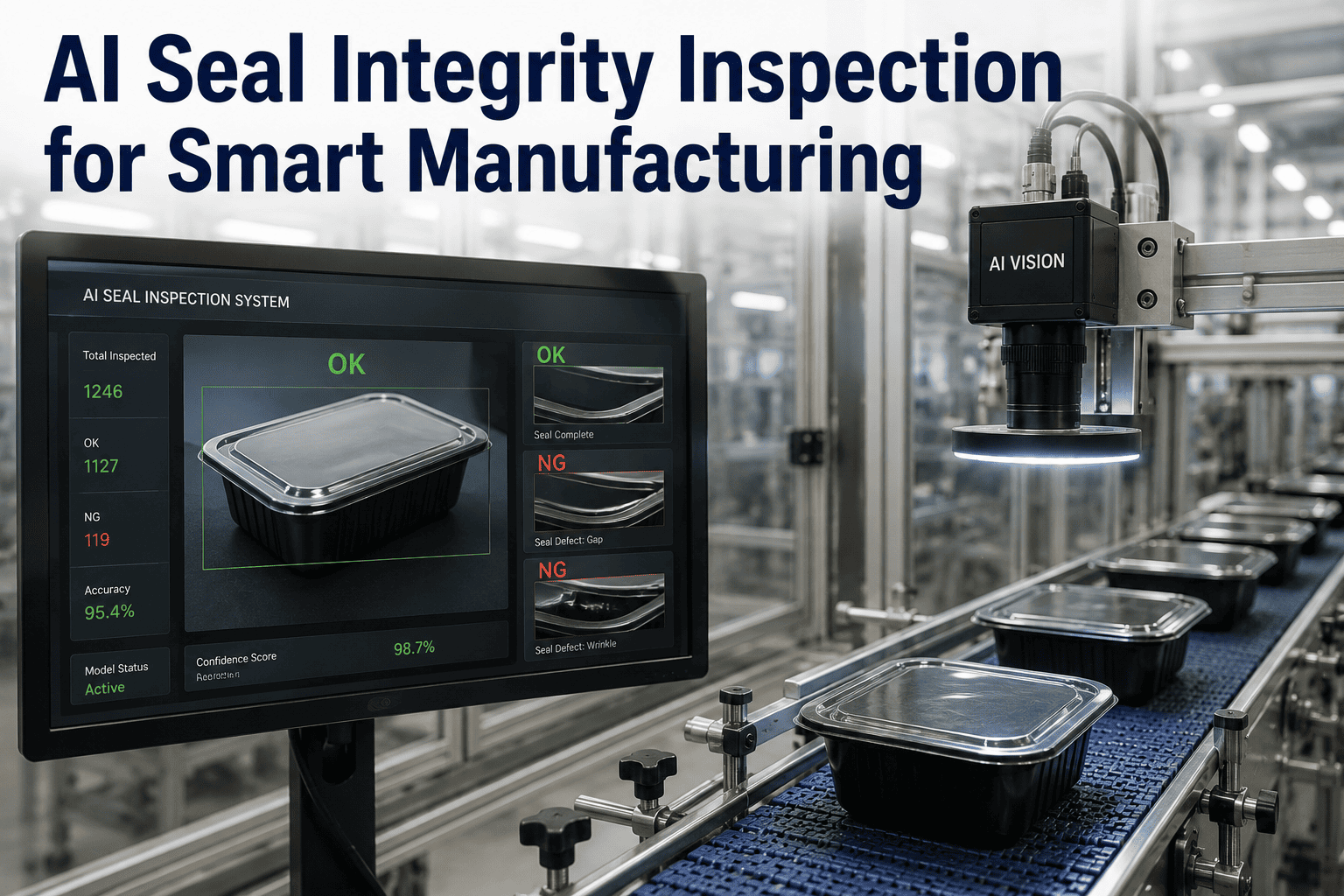
Label verification, fill-level monitoring, foreign particle detection, seal integrity, and batch traceability. Vision ensures regulatory compliance at full production speed with complete audit trails.
Fastest-growing segment — pharma vision projected to grow at fastest CAGR to 2030
Steel, Energy & Heavy Industry
Surface defect detection on rolling mills at 900+ m/min, thermal monitoring of transformers and turbines, corrosion progression tracking, and pipeline inspection. Vision works in extreme heat, dust, and vibration.
98.5% detection accuracy in environments where human inspection is physically impossible
Frequently Asked Questions
How is computer vision different from traditional machine vision?
Traditional machine vision uses hand-coded rules to analyse images — bright pixel equals pass, dark pixel equals fail. These systems break when lighting changes, materials vary, or new defect types appear. AI-powered computer vision uses deep learning models that learn from examples, adapt to variation, and improve with every image processed. The result is dramatically higher accuracy, lower false positive rates, and the ability to handle the complex, variable conditions of real production environments.
How much training data does computer vision need?
Modern transfer learning requires as few as 50–100 labelled images per defect class or object type to achieve production-ready accuracy. Pre-trained models that have learned from millions of industrial images adapt to your specific products quickly. Initial deployment takes 2–4 weeks, with accuracy improving continuously as the system processes more production data.
Can computer vision work in harsh industrial environments?
Yes. Industrial vision systems are engineered for factory conditions — extreme temperatures, steam, dust, vibration, and moisture. Cameras use IP67-rated protective housings with water cooling and air purge systems. Thermal cameras operate in complete darkness. Edge computing eliminates dependence on network connectivity. These systems run continuously in environments where human inspection is dangerous or impossible.
What is the ROI for computer vision in manufacturing?
Most deployments achieve full payback within 6–12 months. ROI comes from multiple simultaneous sources: reduced scrap and rework, fewer customer quality claims, eliminated inspection labour, prevented downtime, and improved throughput. A single avoided hour of downtime ($125K–$260K) can justify the cost of an entire vision system installation.
Does computer vision replace our existing automation?
No — it enhances it. Computer vision integrates with your existing PLCs, robots, MES, and SCADA systems through standard industrial protocols. It adds an intelligence layer on top of your current automation — giving existing machines the ability to see, decide, and adapt. You do not replace what works. You make everything work smarter.
Your Automation Is Running Blind. Computer Vision Fixes That.
Every defect your system misses, every failure it does not predict, every part it cannot adapt to — computer vision solves. See what intelligent automation looks like for your operation.