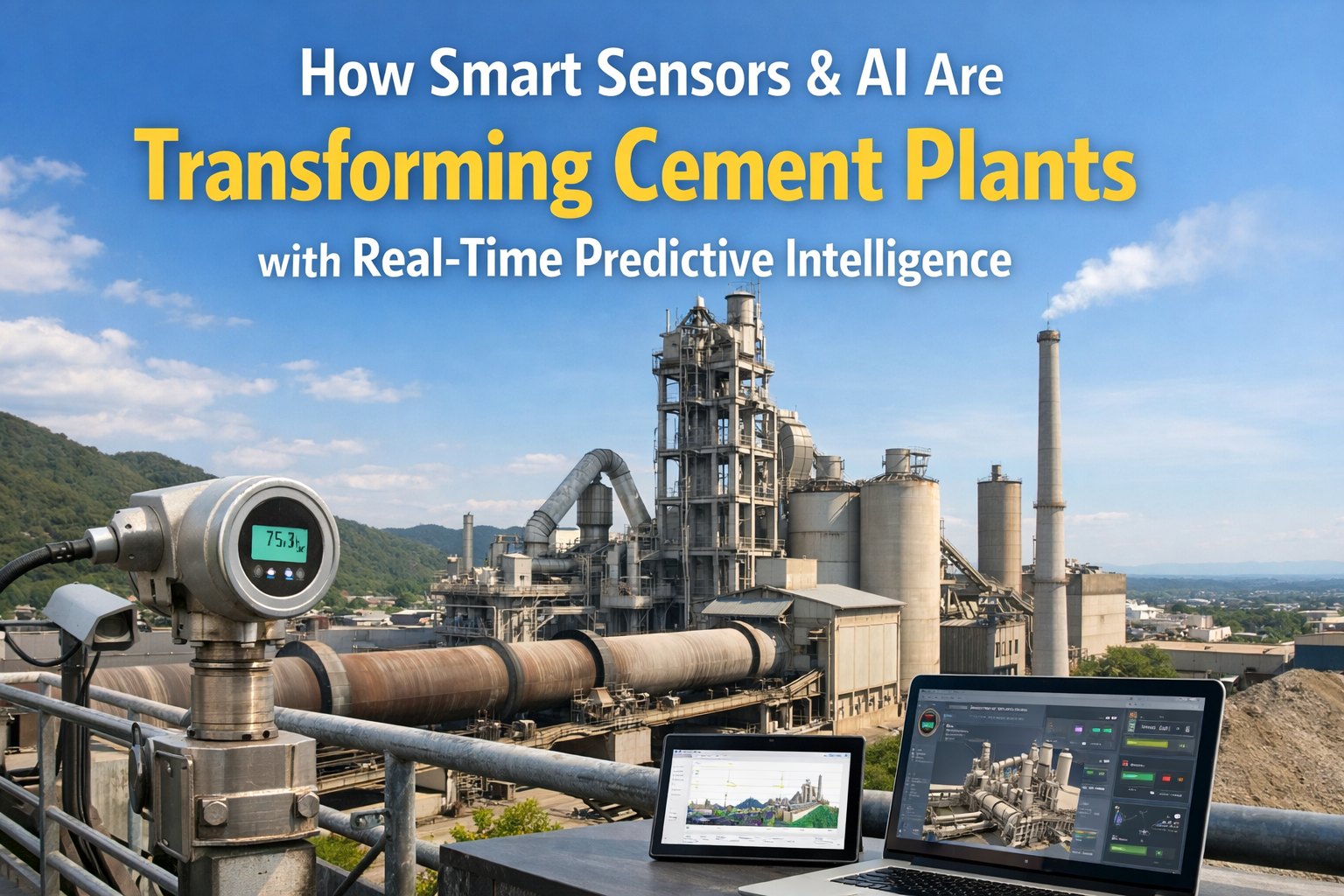
A mid-size automotive parts manufacturer in Ohio ran 14 CNC machines across two shifts for nine years. The operations manager knew production was inconsistent — some days output hit targets, other days it fell 20% short — but nobody could explain why. The data existed somewhere inside each machine's PLC, but it stayed locked inside, invisible to everyone except the machine itself. When the plant connected those 14 machines to an Industrial IoT platform with vibration, temperature, and power-draw sensors feeding a unified dashboard, the answer appeared within three weeks: two machines were running 18% below optimal spindle speed due to a firmware drift nobody had noticed, and a third was losing 47 minutes per shift to a coolant flow restriction that only showed up under heavy load. Total cost to connect 14 machines: $42,000. Annualised production recovery: $1.3 million. The machines had been trying to tell them for years — they just needed a way to be heard.
iFactory Connected Intelligence
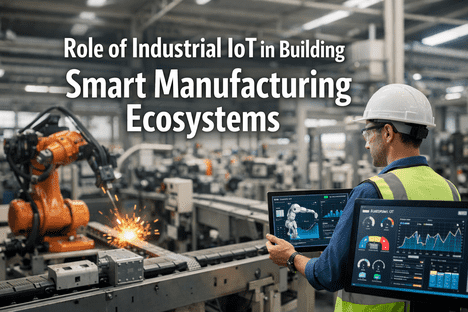
Role of Industrial IoT in Building Smart Manufacturing Ecosystems
How connected sensors, edge computing, and real-time data are turning isolated machines into intelligent, self-aware production networks
$389B
IoT in manufacturing market size, 2026
17B+
Connected industrial devices worldwide
72%
Of large manufacturers have IIoT deployments
$3.3T
Projected factory IoT value by 2030
What Industrial IoT Actually Means for a Factory
Industrial IoT is not a product you buy — it is a capability you build. At its core, IIoT means connecting physical machines, equipment, and infrastructure to a digital layer that collects, transmits, and analyses operational data in real time. Instead of operators walking the floor checking gauges, or maintenance teams reacting to alarms, the factory itself becomes aware of its own condition — and communicates it continuously.
The practical impact is enormous. When every critical asset streams live data — vibration signatures, temperature curves, power consumption, cycle times, pressure readings — plant teams move from guessing to knowing. Decisions that used to take days of investigation now take minutes. Problems that used to surface as breakdowns now surface as early warnings. And performance gaps that were invisible for years become visible the moment the data starts flowing.
Traditional Factory vs IIoT-Connected Factory
Traditional Factory
Machines operate as isolated islands — data stays locked inside each PLC
Equipment condition checked manually on scheduled rounds
Production data compiled in spreadsheets hours or days after shifts
Quality issues discovered at end-of-line inspection
Energy usage billed monthly with no visibility into consumption by machine
Maintenance is reactive or calendar-based regardless of actual condition
IIoT-Connected Factory
Every machine streams data to a unified platform — plant-wide visibility in real time
Sensors monitor condition continuously — anomalies detected in milliseconds
Live dashboards show OEE, throughput, and downtime as they happen
In-process sensors catch deviations before defective parts are produced
Per-machine energy tracking identifies waste and optimises consumption in real time
AI-driven predictive maintenance triggers work orders based on actual degradation
Still running disconnected machines with no visibility? See what a connected plant looks like in a live demo.
The Five Layers of a Smart Manufacturing Ecosystem
A smart manufacturing ecosystem is not built from a single technology — it is an integrated stack where each layer depends on the one below it. Understanding these layers helps you plan implementation in the right sequence and avoid the most common mistake: buying sensors before building the infrastructure to use their data.
IoT Sensors & Edge Devices
Vibration, temperature, pressure, acoustic, current, and flow sensors deployed on critical assets. Modern multi-modal sensors capture thousands of data points per second at a fraction of the cost of five years ago. Edge devices pre-process data locally for sub-millisecond response.
Smart sensors
Edge gateways
Actuators
RFID/RTLS
Industrial Connectivity & Protocols
Data moves from sensors to platforms via wired (Ethernet/IP, Modbus, PROFINET) and wireless (5G, Wi-Fi 6, LoRaWAN) connections. Private 5G networks now support over 1 million connected devices per square kilometre. OPC UA and MQTT are the standard protocols unifying multi-vendor environments.
OPC UA
MQTT
Private 5G
Wi-Fi 6
Modbus
IIoT Platform & Unified Namespace
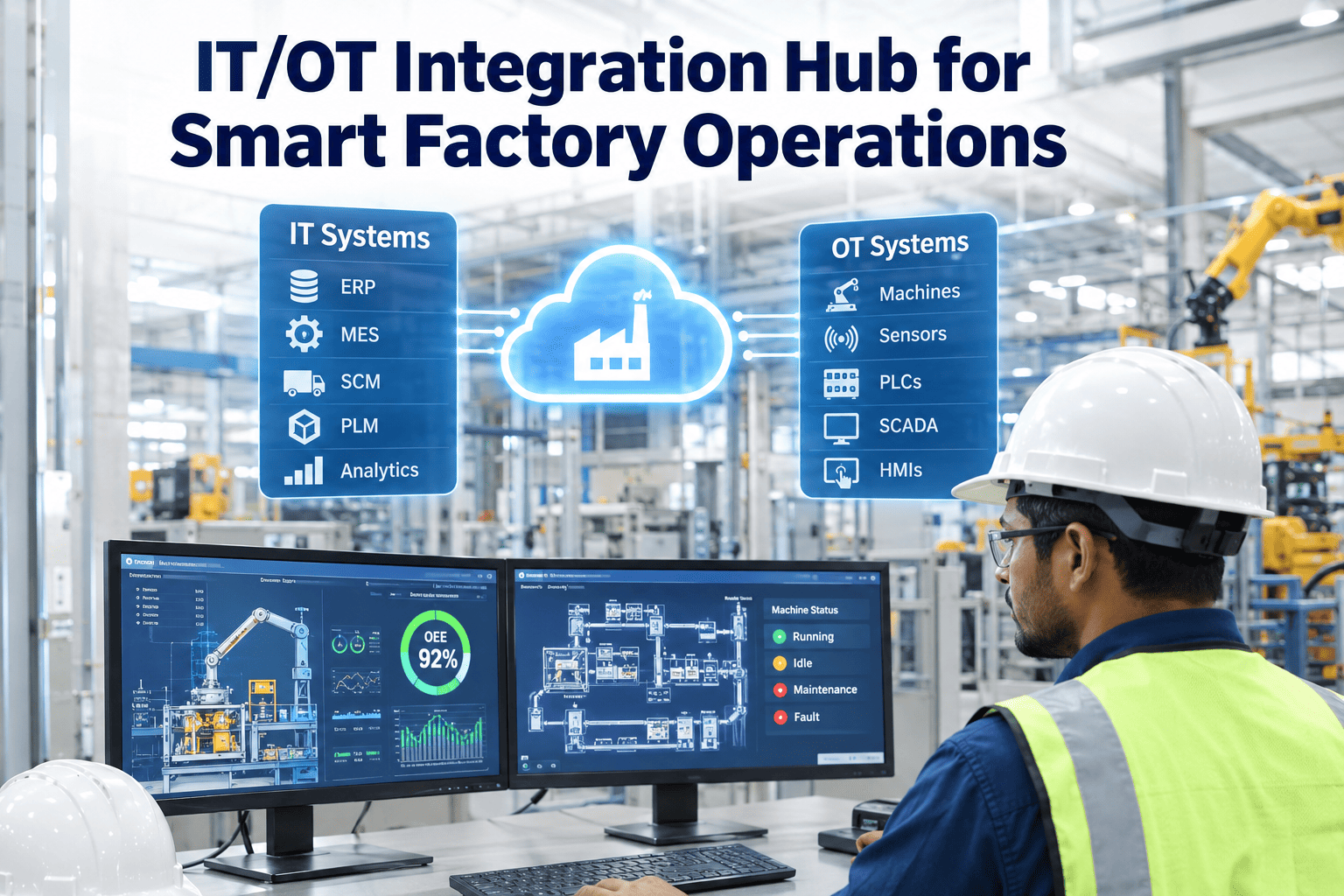
The platform layer unifies data from all sources — PLCs, sensors, SCADA, MES, ERP — into a single real-time data broker. The Unified Namespace (UNS) architecture eliminates data silos by making every data point available to every authorised system instantly, without point-to-point integrations.
Unified Namespace
Data broker
Cloud/Edge hybrid
API layer
AI, Analytics & Digital Twins
Machine learning models ingest unified data to detect anomalies, predict failures, optimise processes, and simulate scenarios. Digital twins create virtual replicas of physical assets for failure mode testing and what-if analysis. Over half of large industrial facilities now deploy at least one digital twin.
Predictive analytics
Digital twins
ML models
RUL estimation
Automation, CMMS & Closed-Loop Control
Insights become actions — automated work orders in your CMMS, dynamic production scheduling in MES, real-time quality adjustments on the line, and autonomous energy optimisation. The gap between detecting a problem and acting on it shrinks from days to minutes to milliseconds.
Auto work orders
Dynamic scheduling
Closed-loop QC
Energy optimisation
The Seven Core Use Cases Driving IIoT Adoption
Industrial IoT unlocks value across every dimension of plant operations. These are the use cases that deliver the fastest, most measurable returns — and the ones driving adoption in 72% of large manufacturers worldwide.
Vibration, thermal, and acoustic sensors detect early degradation patterns 30–90 days before failure. AI models convert sensor data into prioritised work orders — maintenance happens when needed, not on arbitrary schedules.
35–50% less unplanned downtime
Live OEE dashboards track availability, performance, and quality across every line and shift. Operators and managers see production status as it happens — not in yesterday's report. Micro-stops and speed losses become visible for the first time.
Sensors monitor critical process parameters — temperature, pressure, torque, dimensions — during production, not after. Deviations trigger immediate alerts or automatic corrections, catching quality issues before defective parts leave the station.
Up to 100% in-process inspection coverage
Per-machine energy monitoring reveals consumption patterns, peak-load waste, and inefficient equipment. AI optimises energy usage in real time — shutting down non-essential systems during low production, balancing loads, and reducing baseline consumption.
Up to 30% energy reduction
RFID, RTLS, and smart sensors track raw materials, WIP, finished goods, and tooling in real time. Automated inventory counts replace manual audits. Dynamic safety-stock models reduce inventory value while cutting stockout incidents.
18% average inventory reduction
Connected gas detectors, wearables, environmental sensors, and proximity alerts protect workers in hazardous zones. Real-time monitoring replaces periodic checks — exposure events are detected and responded to in seconds, not hours.
Significant incident reduction
IoT extends beyond the factory walls — tracking shipments, monitoring cold-chain conditions, and providing real-time ETA updates. Predictive demand signals from production data refine reorder triggers and reduce rush freight costs.
44% reduction in rush freight fees
Why Most IIoT Pilots Stall — And How to Avoid It
The uncomfortable truth about Industrial IoT adoption is that 70% of IIoT pilots remain pilots after 18 months. The technology works. The ROI is proven. But scaling from a successful proof-of-concept to enterprise-wide deployment is where most programmes fail. Understanding the common failure patterns is the first step to avoiding them.
The Pitfall
Starting Too Big
Trying to connect 500 machines at once. Projects stall under complexity, budget overruns, and organisational resistance.
The Fix
Start With 5–10 Critical Assets
Prove ROI fast on high-impact equipment, then scale. Plants that follow this pattern scale successfully 70%+ of the time.
The Pitfall
Connectivity-First, Outcome-Second
Deploying sensors everywhere without a clear business case. Data floods in but no one acts on it. The platform becomes an expensive dashboard nobody checks.
The Fix
Define the Business Outcome First
Start with one high-cost problem — a downtime event, a quality issue, an energy bill — and design the IoT solution to solve that specific problem.
The Pitfall
IT/OT Convergence Politics
Getting OT equipment onto the corporate network takes 6–18 months of security reviews, VLANs, and organisational negotiation. Many projects die here.
The Fix
Use Cellular-First or Air-Gapped Architectures
Modern IIoT platforms use private cellular or dedicated edge networks that bypass corporate IT entirely — eliminating the biggest non-technical barrier to deployment.
Planning an IIoT deployment and want to avoid the pilot trap? Talk to our implementation specialists.
The IIoT ROI That Justifies Investment
The financial case for Industrial IoT is no longer theoretical. With thousands of documented deployments, the ROI patterns are clear and consistent across industries. Here is where the money comes from — and how fast it arrives.
Where IIoT Delivers Measurable Financial Return
$1–3M
Annual operational improvement from $200K–$800K initial investment
12–24 month payback
295%
Average 3-year ROI from event-driven IIoT architectures
Top performers: 354%
25–40%
Operational efficiency improvement with structured IIoT frameworks
80–90% project success rate
68%
Of IoT adopters report increased revenue as their primary business gain
Source: Eseye IoT Survey
IIoT Adoption by Industry — Where It Matters Most
Industrial IoT delivers value in any asset-intensive environment, but adoption rates and ROI vary by industry. Manufacturing leads global IIoT spending, but energy, logistics, and heavy industry are catching up fast as the technology matures and implementation costs fall.
Largest IIoT market segment. CNC machines, robotic cells, assembly lines, and process equipment generate massive sensor data volumes that drive predictive maintenance, OEE optimisation, and quality analytics.
Fastest-growing IIoT segment. Grid monitoring, turbine health tracking, smart metering, and renewable asset management are driving rapid deployment across power generation and distribution.
Transportation & Logistics
18%
Fleet telematics, warehouse automation, cold-chain monitoring, and real-time shipment tracking are transforming supply chain visibility and operational efficiency across global logistics networks.
Remote asset monitoring, pipeline integrity, environmental compliance, and worker safety in hazardous environments. High downtime costs and safety requirements make IIoT adoption a strategic imperative.
Cleanroom environmental monitoring, equipment calibration tracking, GMP compliance automation, and cold-storage validation for pharmaceutical and biotech manufacturing.
Frequently Asked Questions
Does Industrial IoT work with older or legacy equipment?
Yes. Modern IIoT platforms connect to legacy PLCs via protocols like Modbus RTU that have been standard since 1979. Non-invasive sensors (vibration, temperature, current) retrofit onto virtually any machine regardless of age or manufacturer. Edge gateways normalise data from any source — old or new — into formats analytics platforms can process. Some of the highest ROI comes from monitoring aging, failure-prone equipment.
How much does an IIoT deployment cost to get started?
Pilot programmes on 5–10 critical assets typically cost $40,000–$120,000 including sensors, edge hardware, platform subscription, and integration. Pay-as-you-go models start as low as $50–100 per asset per month. Initial investments of $200K–$800K for broader deployments commonly generate $1–3 million in annual operational improvements, with payback in 12–24 months.
Is IIoT data secure? What about cybersecurity risks?
Security is a real and growing concern — manufacturing is the most attacked industry for the fifth consecutive year. Modern IIoT architectures address this with zero-trust network design, air-gapped or cellular-first connectivity that keeps OT traffic off corporate networks, encrypted data transmission, and anomaly detection at the edge. Platforms should be evaluated on their security architecture as a primary criterion.
How long does it take to see results from IIoT?
Focused pilots on critical assets deliver measurable results in 4–8 weeks after sensor deployment. Common early wins include identifying unknown downtime causes, detecting equipment degradation before failure, and revealing energy waste patterns. Facility-wide deployments typically optimise over 12–24 months as models learn and integration deepens.
What is the Unified Namespace and why does it matter?
The Unified Namespace (UNS) is an architectural pattern where all operational data — from sensors, PLCs, SCADA, MES, ERP, and CMMS — flows into a single real-time data broker instead of living in separate disconnected systems. It eliminates data silos (the single biggest ROI killer in IIoT), enables real-time decision-making, and dramatically simplifies integration. UNS is emerging as the standard architecture for scalable IIoT deployments.
Ready to Connect Your Factory?
Your Machines Are Generating Data Right Now. The Question Is Whether Anyone Is Listening.
iFactory's Industrial IoT platform connects your assets, unifies your data, and delivers real-time intelligence to every team that needs it — from maintenance to operations to the C-suite.