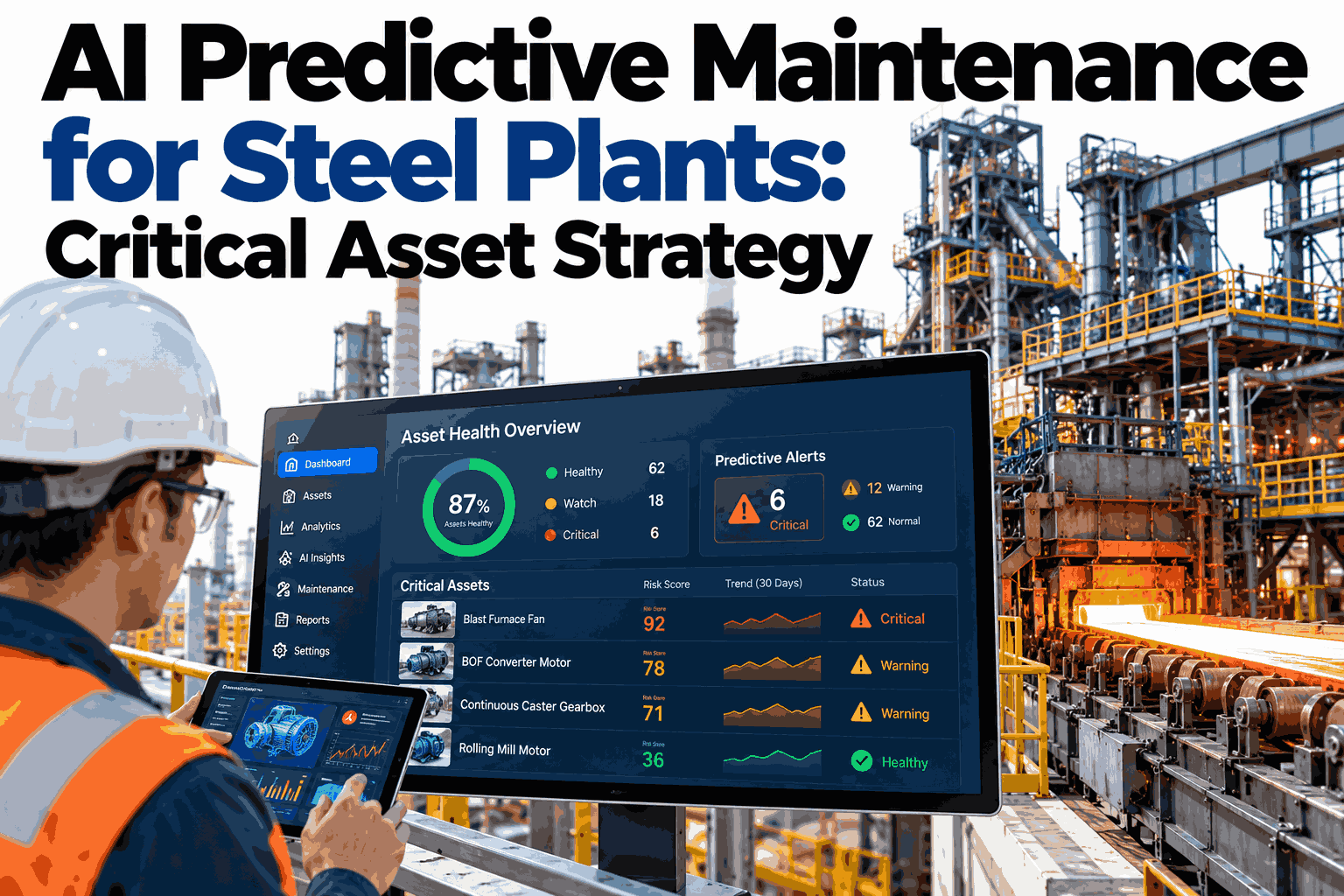
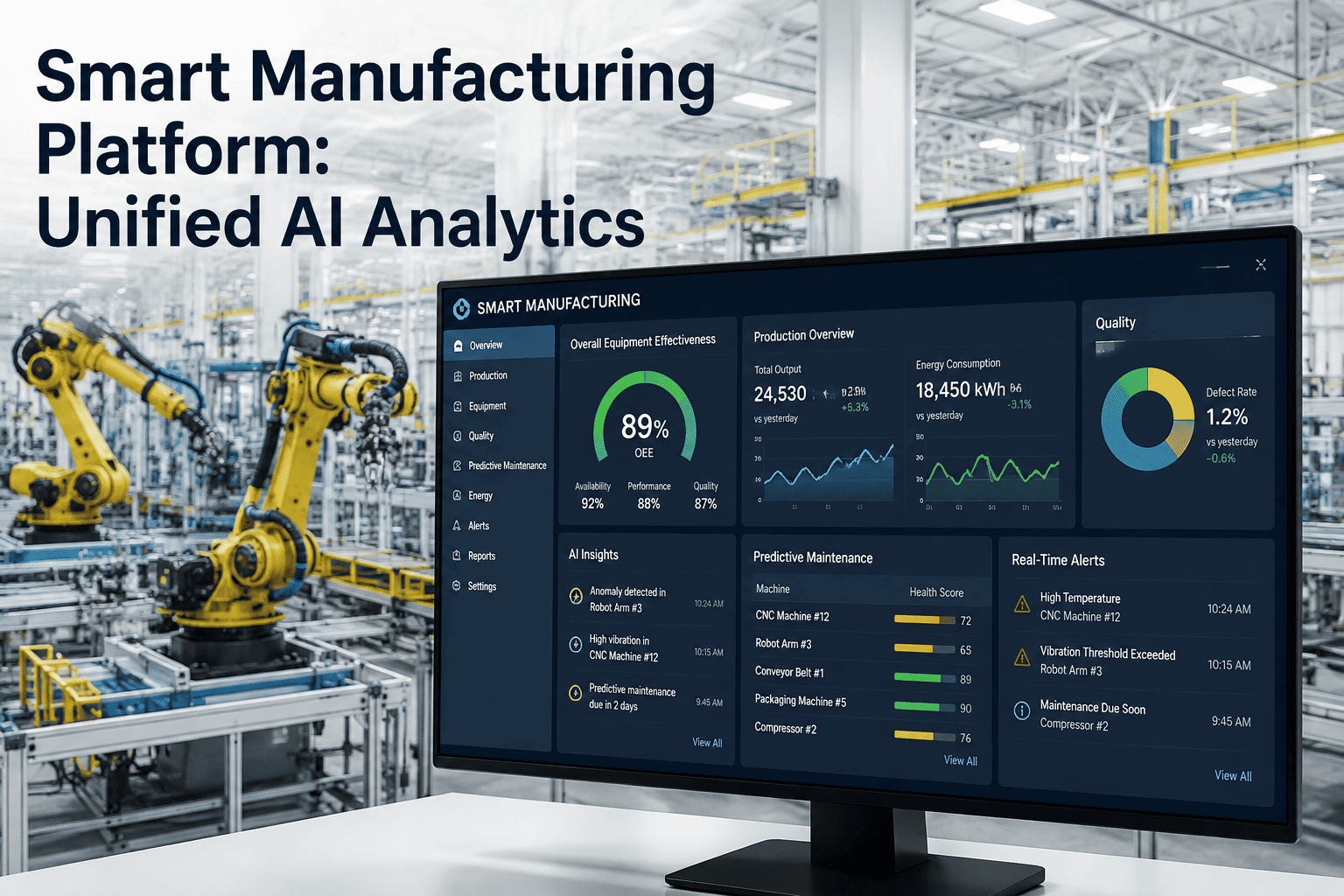
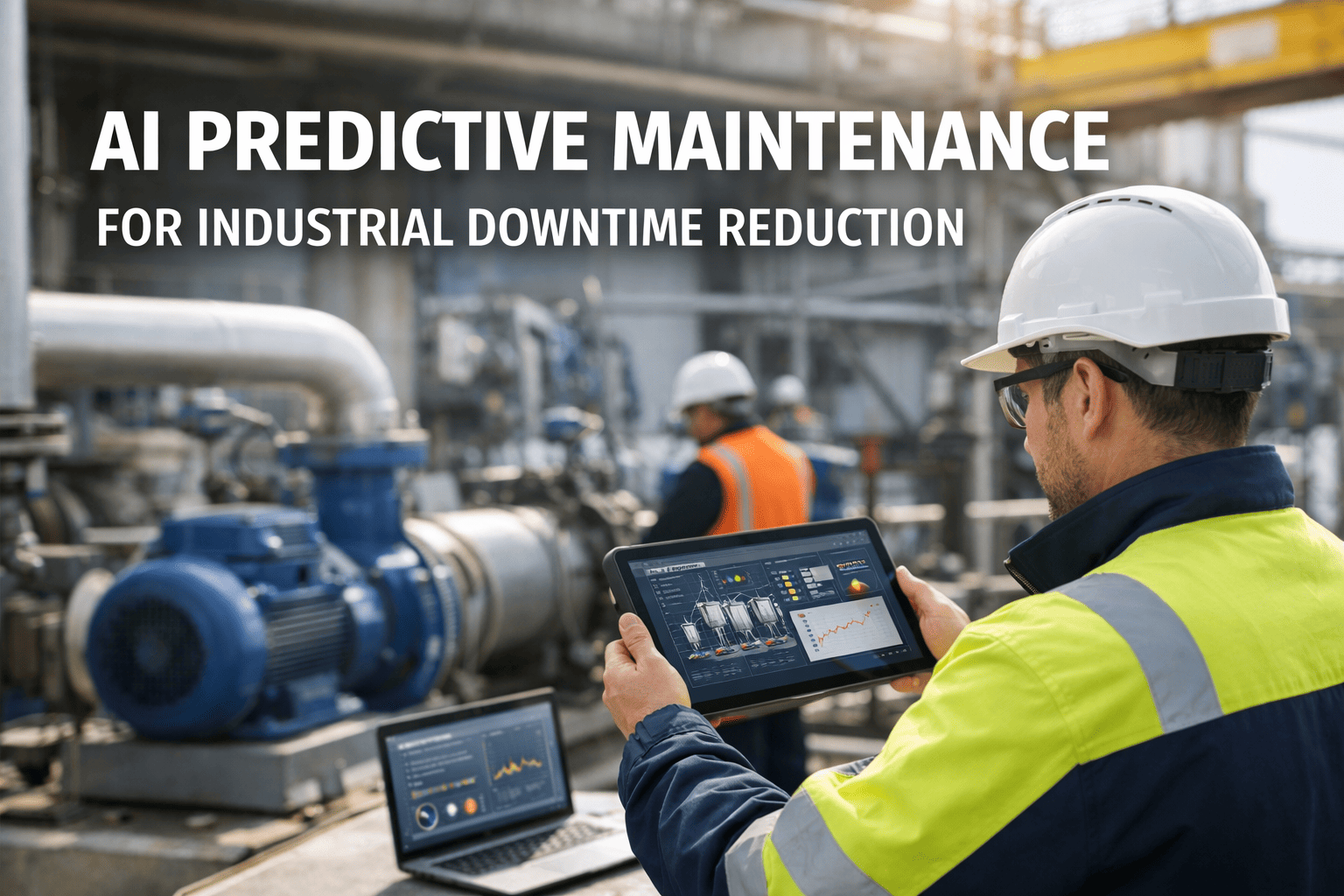
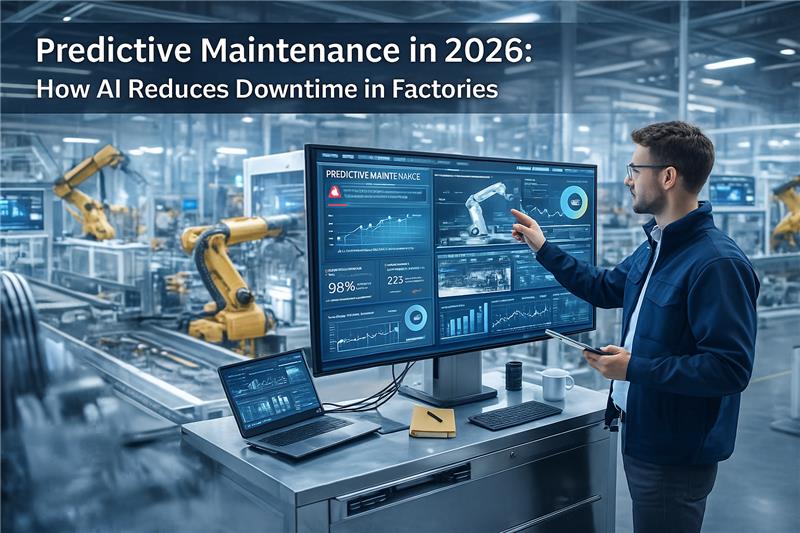
Every hour your production line is down, something between $50,000 and $1 million leaves your business — forever. That is not a marketing number. The Siemens True Cost of Downtime 2024 report puts the average Fortune 500 manufacturer's annual downtime cost at $2.8 billion, roughly 11% of revenue. The typical large plant loses $253 million a year to unplanned equipment stops. The per-hour cost of an unexpected line stoppage has roughly doubled since 2019 thanks to inflation, complex supply chains, and leaner inventory buffers. And yet the majority of manufacturers still run some version of "fix it when it breaks." AI changes the math completely. Plants that move from reactive or calendar-based maintenance to AI-driven predictive maintenance consistently report 30–50% less unplanned downtime, 25% lower maintenance costs, and 70% fewer catastrophic failures — documented by McKinsey, Deloitte, PwC, and IBM. The ROI is equally consistent: $7 return for every $1 invested, and full payback within 12–18 months. This blog walks through exactly how AI does it, what it costs, and what a smart 90-day rollout actually looks like.
Problem · Solution · Results
How AI Actually Reduces Downtime in Manufacturing Plants — And What It Saves You
A blunt, numbers-first look at the real cost of downtime, how AI catches failures 30–90 days early, and the 90-day rollout path plants are using to cut unplanned stops in half.
50%
Unplanned downtime cut by AI predictive maintenance
$7 : $1
Return on every dollar invested — PwC research
30–90 days
Failure prediction lead time with 80–97% accuracy
12–18 mo
Typical payback period from first deployment
Sources: Siemens True Cost of Downtime 2024 · McKinsey · Deloitte · PwC · IBM · Factory AI · iFactory Deployment Data
First, The Number Nobody Wants to Hear
Before anything else, let's anchor on what downtime actually costs. The numbers below are not estimates — they are industry benchmarks pulled from Siemens, Deloitte, and Fortune 500 financial disclosures. If your plant is in any of these tiers, this is your real exposure per hour of unplanned stops.
The Hourly Cost of Unplanned Downtime
By manufacturing industry tier · Siemens True Cost of Downtime 2024
Small & Mid-Market
$50K
per hour
Food, packaging, general discrete
Large Manufacturing
$260K
per hour
Average Fortune 500 plant
Automotive
$2.3M
per hour
Assembly line stoppage
High-Precision
$1M+
per hour
Semiconductor, pharma, aerospace
The Four Kinds of Downtime — And Which One Is Killing You
"Downtime" is not one thing. It is four distinct categories with very different root causes, costs, and remedies. Before you can reduce it, you need to know which type is actually eating your capacity. AI attacks each one differently — so this is where every real improvement program has to start.
01
Unplanned Breakdown
The Big Visible Loss
Catastrophic equipment failure. Bearing seizes, motor burns out, hydraulic system blows. Line stops cold. Emergency parts, overtime crews, cascading damage.
Cost: 3–5x planned maintenance cost
02
Planned But Excessive
The Calendar Trap
Time-based PM schedules that service healthy equipment on a fixed calendar. Parts replaced at 40–60% of remaining useful life. Waste dressed up as discipline.
Cost: 18–25% overspend vs. condition-based
03
Micro-Stops
The Silent Killer
30-second jams, 2-minute sensor trips, 90-second adjustments. Individually invisible. Collectively, they silently erase 8–15% of production time every single shift.
Cost: 8–15% of total capacity
04
Cascade Downtime
The Domino Effect
One machine fails, the downstream stations starve, the upstream stations fill buffers and stop. A 10-minute root cause becomes a 2-hour full-line stop.
Cost: 2–8x original failure duration
Where Is Your Plant on the Maintenance Maturity Curve?
The move from reactive to predictive maintenance is not one decision — it is a progression. Honestly locating yourself on this curve is the first diagnostic. The further left you are, the bigger the savings waiting on the table. And the less your competitors will wait for you to catch up.
Stage 1
Reactive
"Fix it when it breaks." Emergency response, overtime, scramble for parts. No instrumentation.
Most expensive approach · Industry baseline
Stage 2
Preventive
Calendar-based PM. Service every 90 days, replace every 2,000 hours. Disciplined but wasteful — healthy parts thrown away.
10–20% savings vs reactive
Stage 3
Condition-Based
Sensors monitor vibration, temperature, pressure. Thresholds trigger service. First step out of the calendar trap.
25–35% savings · Foundation for AI
Stage 4
AI Predictive
Machine learning predicts failures 30–90 days ahead with 80–97% accuracy. Auto-generates work orders during planned windows.
50% downtime cut · 10:1 to 30:1 ROI
Not sure which stage your plant is at? Book a free 30-minute maintenance maturity assessment.
How AI Actually Catches Failures — The Timeline That Changes Everything
Here is the single most important diagram on this page. It shows the difference in when a human maintenance team catches a failing bearing versus when iFactory's AI does. Same bearing, same plant, same conditions. Completely different outcomes.
Time Before Failure
90 days
60 days
30 days
14 days
7 days
24 hrs
FAIL
iFactory AI
Multi-sensor ML fusion
Alert fired — PM scheduled
Condition Monitoring
Threshold-based alerts
Human Inspection
Walkaround + experience
Reactive (None)
Run to failure
What This Means
AI gives your team 30–90 days to fix a bearing for $500 during a planned window. Wait until failure and the same bearing costs $75,000 in emergency repair, cascading damage, and lost production. The difference is when you see it — not how good your crew is.
What AI Actually Does Under the Hood
"AI" is thrown around loosely. Here is specifically what iFactory's AI does to deliver those 30–90-day predictions — not marketing language, but the actual technical layers working in the background.
01
Multi-Sensor Data Fusion
Vibration, temperature, current draw, acoustic, pressure, and cycle-time data streams unified into one per-asset health model.
02
Anomaly Detection on Baselines
Machine learning builds a model of each asset's "normal" signature during first 30 days, then flags deviations that traditional thresholds would miss entirely.
03
Time-Series Failure Prediction
Trained on historical failures from similar equipment, predicts remaining useful life with 80–97% accuracy on well-defined equipment classes.
04
Automated Root Cause Correlation
Cross-references the detected anomaly against machine, material, method, and man variables — surfaces the actual trigger in under 2 minutes.
05
Auto-Generated Work Orders
Prioritized, parts-reserved work orders created automatically in your CMMS — no manual routing between detection and action.
The ROI Math That Actually Sells Itself
Strip away the jargon and the financial case for AI downtime reduction is boring in the best possible way. Plug in real numbers from your plant and the answer comes out the same way every time.
Typical Mid-Size Plant
800 annual unplanned downtime hours · $50K per hour cost
Current annual downtime cost
$40.0M
35% reduction (conservative)
$14.0M
Maintenance cost savings (25%)
$2.1M
Equipment life extension (30%)
$1.8M
Total Year-One Value Recovered
$17.9M
Typical ROI ratio
10:1 to 30:1
Payback period
12–18 months
Year-one validation
60–70% of projection
Want the same math run on your actual plant numbers? Book a 30-minute ROI session.
Your 90-Day Rollout Path
The biggest mistake plants make is trying to transform everything at once. The proven pattern is a tight-scope pilot on one production line that proves ROI in under 90 days — then scales from validated wins, not theoretical plans.
Days 1–14
Foundation
Identify 5–10 critical assets on pilot line
Install wireless sensors (under 1 hr each)
Connect existing PLC/SCADA data streams
Baseline current downtime & MTBF numbers
Days 15–45
Model Training
AI learns normal operating signatures
Live dashboards deploy to operators
First anomaly alerts start firing
Feedback loop tunes false-positive rates
Days 46–75
Active Prevention
Auto-generated work orders in CMMS
First predicted failures prevented
Downtime hours begin trending down
Operator buy-in compounds
Days 76–90
Validated ROI
60–70% of projected savings hit
Measured downtime reduction confirmed
Business case for rollout locked
Scale decision made with real data
What Plants Recover in Year One
30–50%
Reduction in unplanned downtime across every deployment
70%
Fewer catastrophic failures — IBM documented result
20–40%
Equipment lifespan extension across fleets
$4.2M
Year-one savings — automotive case (servo motors alone)
Frequently Asked Questions
How does AI actually predict equipment failure before it happens?
AI models are trained on historical sensor data from similar equipment — vibration, temperature, current, acoustic, and cycle-time signals. Machine learning identifies the specific pattern signatures that precede failures by 30–90 days, flagging them with 80–97% accuracy. Modern systems fuse multiple sensors together, which is why they catch failures traditional threshold monitoring misses entirely.
Book a demo to see it on live data.
What is the ROI of AI predictive maintenance?
Documented returns consistently run 10:1 to 30:1 within 12–18 months. PwC research puts the return at $7 for every $1 invested. For a plant with 800 hours of annual unplanned downtime at $50K/hr, a 35% reduction alone saves $14M per year. Most organizations hit 60–70% of projected savings in the first quarter and validate full payback within 12–18 months.
Will this work on our older, legacy equipment?
Yes. Legacy machines are typically instrumented with wireless vibration and temperature sensors that install in under an hour per machine — no controller modification required. Edge gateways translate even 1990s PLC signals into standard formats (OPC-UA, MQTT) and feed them into the AI platform. Legacy equipment becomes IoT-ready without replacement.
How much does it cost to get started?
Pilot deployments typically start under $50K, covering 5–10 critical assets on one production line. Full facility rollouts scale from there based on equipment count. Cloud-based AI platforms with subscription pricing ($2K–$10K/month range) dramatically lower the financial barrier compared to traditional enterprise MES or CMMS projects.
Ask support for a pricing walkthrough.
How quickly will we actually see measurable downtime reduction?
First operator-facing dashboards and anomaly alerts typically go live within 2 weeks. Initial downtime reduction becomes measurable within 45–60 days as the AI model learns plant-specific signatures. By day 90, most pilots hit 60–70% of projected annual savings — the data needed to lock in the business case for full rollout.
Does AI replace our maintenance team?
No — it multiplies them. AI handles the repetitive analytical work: scanning millions of sensor data points for early warning signs, correlating variables no human could track simultaneously, and routing alerts. Your maintenance team shifts from reactive firefighting to strategic reliability engineering — the work that actually moves OEE. In practice, AI turns novice technicians into expert-level responders via guided workflows.
Stop Paying for Downtime You Can Predict
Every Hour You Wait Costs What You Could Be Saving. Let's Run the Numbers.
Book a 30-minute session with an iFactory downtime specialist. We will walk your actual equipment inventory, calculate your real hourly exposure, and map a 90-day rollout that proves ROI before you commit to a full deployment.
4 Types
Of downtime — each with its own AI remedy
30–90 Days
Failure prediction lead time with ML fusion
90-Day
Rollout path from pilot to validated ROI
$7 : $1
Documented return ratio — PwC benchmark