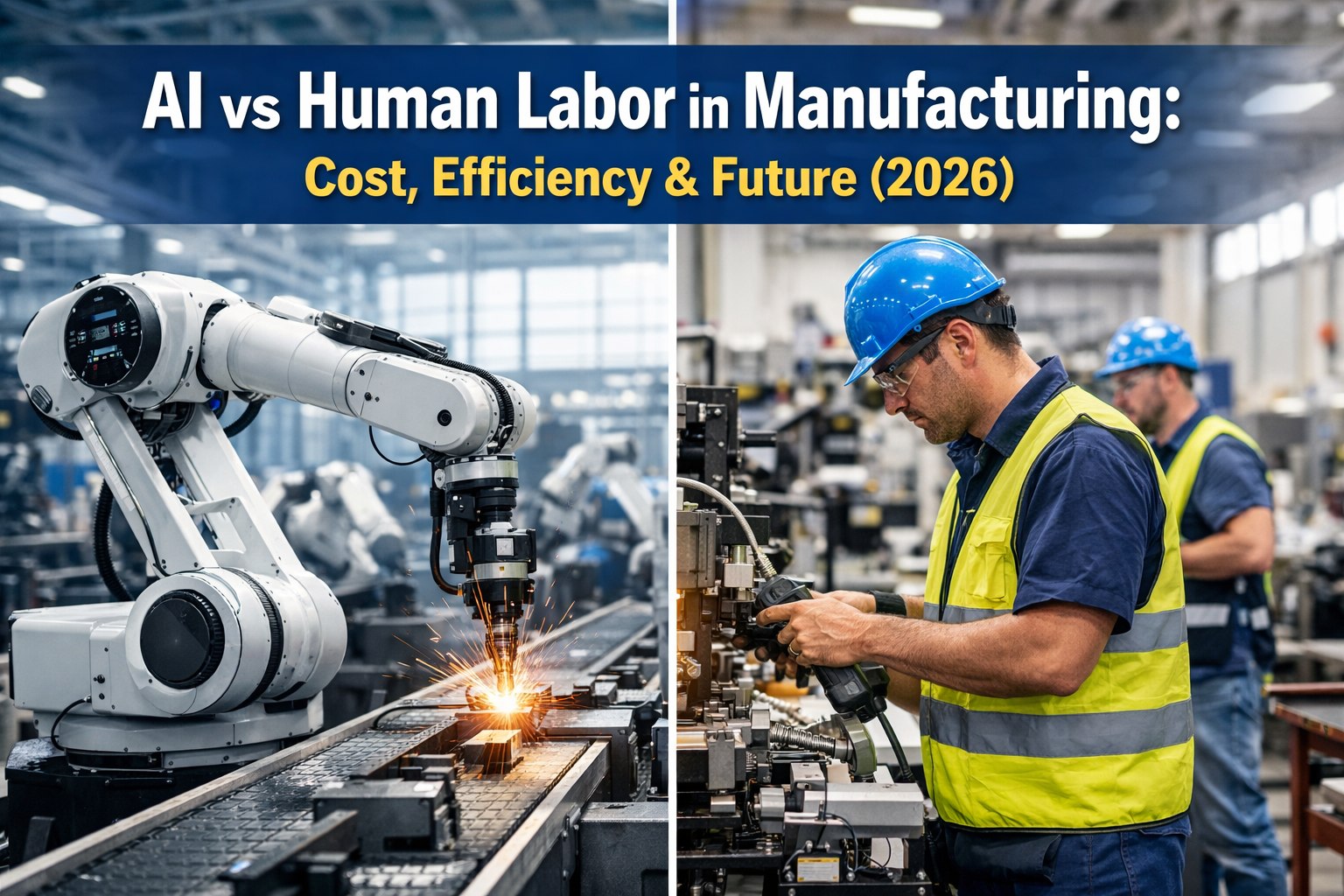
AI vs Human Labor in Manufacturing 2026 | Cost & Efficiency
By Riley Quinn on April 17, 2026
The manufacturing floor in 2026 looks nothing like it did five years ago. With 2 million jobs unfilled, 26% of the workforce retiring by 2030, and labor costs hitting $46.30 per hour, the question has evolved. It's no longer "AI or humans?" — it's "where does each deliver the most value?" The surprising answer: manufacturers using a hybrid approach see 40% higher ROI than those betting on either extreme alone.
U.S. manufacturing faces a structural challenge that automation alone cannot solve—and that human labor alone cannot fill. Understanding these pressures is essential before making any AI investment decision.
2 Million
Jobs Unfilled
449,000 positions open as of March 2025. Workforce gap widening as baby boomers retire.
26%
Retiring by 2030
1.5+ million roles vacated. Decades of institutional knowledge walking out the door.
69%
Investing in Automation
Up 9% from 2025. Companies filling gaps with robots and AI—not replacing, augmenting.
The Real Cost Breakdown
Most ROI calculations fail because they only compare robot cost to hourly wage. That's a 30-60% underestimate. Here's what the full picture looks like for a typical 3-shift manufacturing operation.
Annual Operating Cost Comparison
3-Shift Operation • 250 Working Days
Cost Category
Base Labor/System
Training & Turnover
Error & Rework
Overtime Premium
Benefits & Insurance
TOTAL ANNUAL
Human Team
3 Workers
$210,000
$45,000
$38,000
$52,000
$90,000
$435,000
AI + Operator
1 Worker
$120,000
$8,000
$6,000
$0
$25,000
$159,000
Annual Savings
$276,000
63% Cost Reduction
Based on $70K base salary + $30K benefits per operator. AI system amortized over 5 years. Results vary by application complexity.
Where AI Wins vs Where Humans Win
The data reveals a clear pattern: AI dominates repetitive, high-volume tasks requiring consistency. Humans excel at complex judgment, adaptation, and relationship-building. Smart manufacturers leverage both.
AI Excels At
Quality Inspection
98-99% accuracy
vs 70-85% human
24/7 Consistency
Zero fatigue
vs 25% decline after 2hrs
Predictive Maintenance
15-30% less downtime
$100K/hr saved
Data Processing
10,000+ parts/hour
Real-time analysis
Hazardous Tasks
Zero injury risk
No workers' comp
VS
Humans Excel At
Complex Problem Solving
Novel situations
Root cause analysis
Rapid Adaptation
Quick pivots
Low-volume custom work
Contextual Judgment
Nuanced decisions
Exception handling
Fine Motor Skills
Complex assembly
Delicate manipulation
Relationship Building
Customer trust
Supplier negotiation
Key Insight
The MIT Finding That Changed Everything
Only 23% of vision-related manufacturing tasks are cost-effective to fully automate. The hybrid model—AI handling repetitive inspection while humans focus on process improvement—delivers 40% greater ROI than pure automation or pure human approaches.
Not Sure Where to Start?
Our team can analyze your current operations and identify exactly where AI delivers the fastest ROI for your specific situation.
Forget the hype—here's what manufacturers actually experience when implementing AI, based on 2025-2026 deployment data across hundreds of facilities.
Day 1
Deployment
3-6 Months
Most Hit Payback
12 Months
70% Achieve ROI
36 Months
330% Avg Return
7-8
months
Average Payback Period
Forrester Research
330%
return
3-Year ROI Average
Intelligent Automation
45%
reduction
Operational Expenses
Fully Automated Lines
The Winning Formula: Strategic Hybrid
The manufacturers outperforming in 2026 aren't choosing sides—they're strategically deploying AI for what it does best while elevating human workers to higher-value roles.
Automate These
Visual Quality Inspection
Predictive Maintenance Alerts
Production Scheduling
Real-Time Data Collection
Anomaly Detection
Inventory Monitoring
+
Elevate Humans To
Root Cause Analysis
Process Improvement
Exception Handling
Customer Relationships
Strategic Planning
Innovation & R&D
The Result
40% Higher ROI
than pure automation or pure human labor approaches
Implementation Roadmap
01
Identify Pain Points
Start with your highest-cost quality problems. Usually zones with most rework, warranty claims, or inspector turnover.
Week 1-2
02
Pilot Single Line
Deploy on one line first. Run AI in shadow mode alongside existing inspection. Compare results and measure the gap.
Week 3-6
03
Measure & Document
Track labor hours saved, defect rates, throughput changes. Build the business case with real data from your floor.
Week 6-10
04
Scale Strategically
Use pilot data to unlock larger investment. Expand to maintenance, scheduling, then supply chain optimization.
Month 3+
Frequently Asked Questions
QWill AI actually replace manufacturing jobs?
The World Economic Forum estimates 85 million jobs displaced by end of 2026—but 170 million new roles created, for a net gain of 78 million jobs. Manufacturing is shifting from repetitive physical tasks to oversight, maintenance, and process optimization. The more urgent issue: 2 million positions already can't find workers.
QWhat does AI implementation actually cost?
Entry-level 2D vision systems start at $5K-$10K per station. Full AI-powered inspection runs $100K-$500K depending on complexity. Most manufacturers see payback in 7-8 months. The key: calculate true labor cost (wages + benefits + turnover + errors + overtime), not just hourly rate.
QWhere should we start with AI implementation?
Quality inspection and predictive maintenance typically show fastest ROI. Start where you have the most pain—highest rework costs, most warranty claims, or worst turnover. Pilot on one line, measure rigorously, then scale. The biggest mistake is trying to automate everything at once.
QHow do we get buy-in from floor workers?
Involve floor teams early. Position AI as a tool that handles tedious tasks so humans can focus on problem-solving. Build dashboards operators actually use. Publicly attribute savings to the team. Companies that invest in change management see 2-3x better adoption rates.
QWhat's the realistic timeline to see results?
AI readiness assessment takes 4-6 weeks. Pilot deployment runs 2-4 months. Most see measurable results within 90 days of going live. Full enterprise deployment typically takes 12-24 months. Fast-track approaches with proven vendors can deliver 4x ROI in as little as 2 months.
Ready to Find Your AI + Human Balance?
See how iFactory helps manufacturers deploy AI strategically—not to replace workers, but to amplify what humans do best while automating what machines do better.
.png)