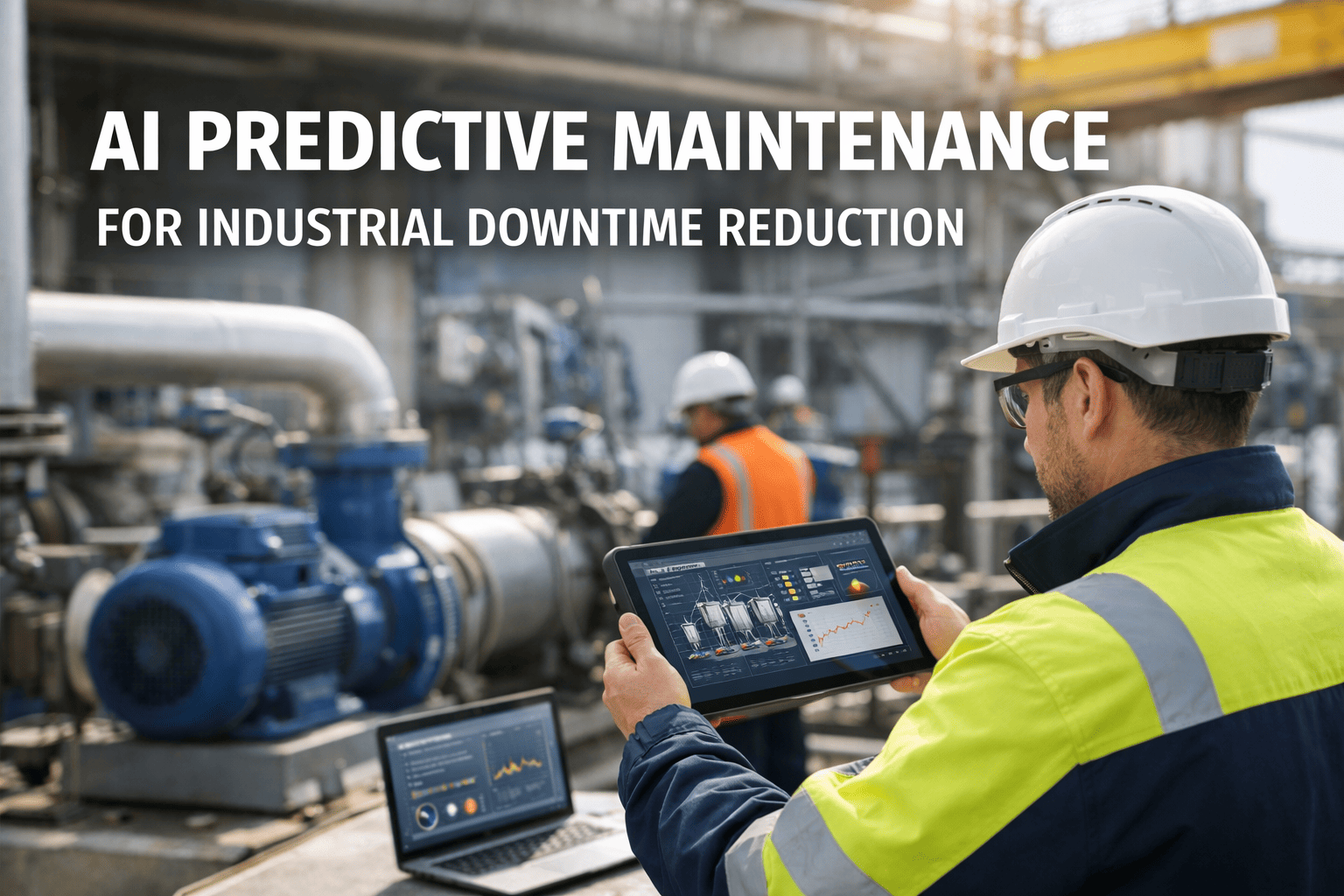
A chemical plant in Texas ran its cooling water pumps on a fixed 90-day maintenance schedule for eleven years. The pumps were either serviced too early — wasting parts and labour on healthy equipment — or too late, after a bearing had already seized and forced an emergency shutdown. When the plant deployed AI-driven vibration and thermal sensors on those same pumps, the system detected a developing bearing fault 47 days before failure on pump unit 3 — a unit that had passed its last scheduled inspection with no flags. The maintenance team replaced the bearing during a planned weekend window. Cost: $1,800 in parts and zero lost production. The previous unplanned failure on the same unit had cost $214,000 in emergency repairs, spoiled batch product, and 19 hours of downtime. Predictive maintenance did not add new technology to the plant — it added foresight.
iFactory AI Maintenance Intelligence
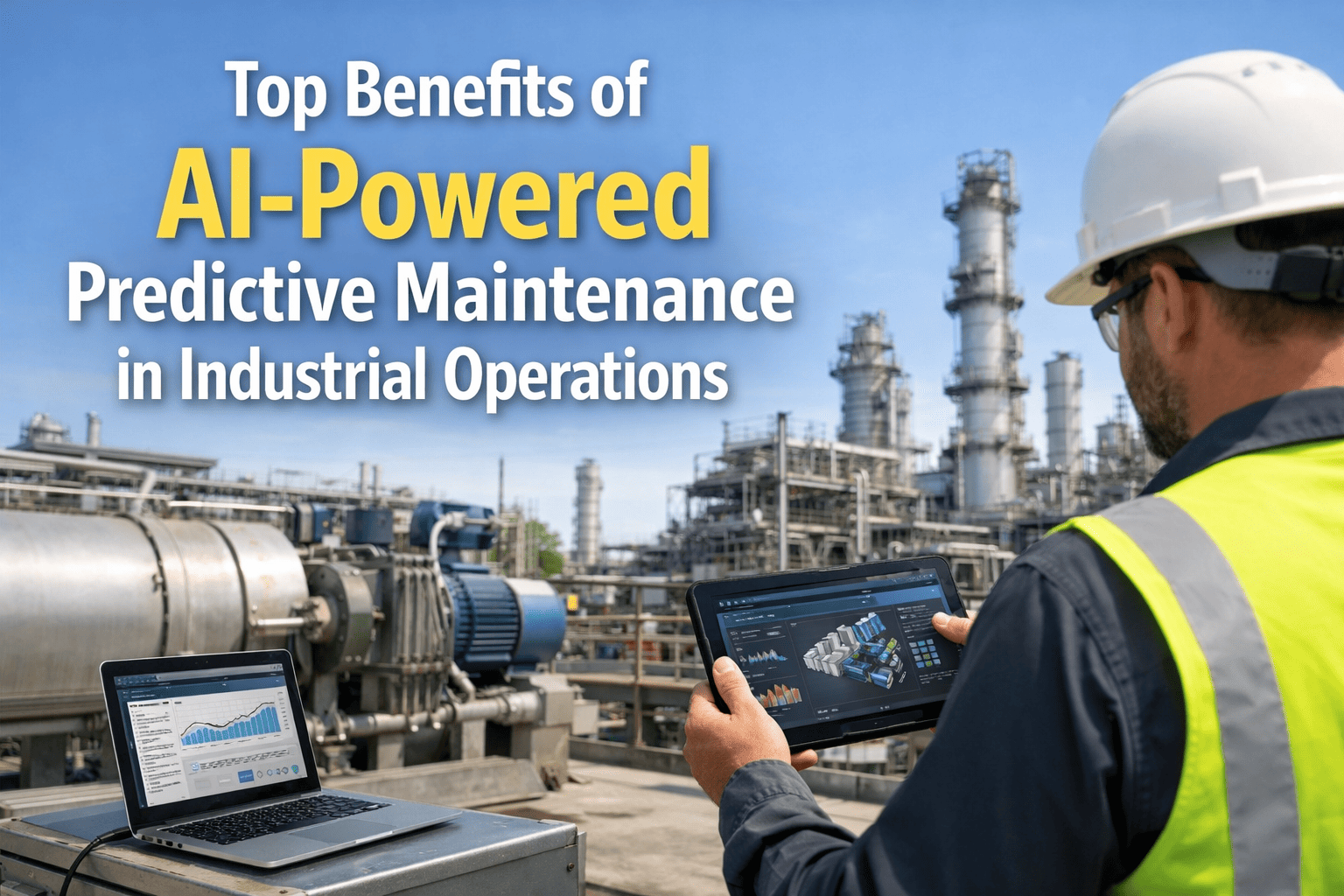
Top Benefits of AI-Powered Predictive Maintenance in Industrial Operations
Why the world's most reliable factories no longer wait for equipment to fail — they predict it, prevent it, and profit from it
$18.9B
Global PdM market size in 2026
35%+
CAGR — fastest-growing maintenance category
73%
Reduction in infrastructure failures with AI PdM
12–18mo
Typical payback period on PdM investment
The Maintenance Strategy Shift Every Industrial Leader Needs to Understand
For decades, industrial maintenance followed two models: fix it when it breaks (reactive), or service it on a fixed schedule regardless of condition (preventive). Both are expensive in different ways. Reactive maintenance causes unplanned downtime that costs manufacturing facilities an average of $260,000 per hour. Preventive maintenance wastes 30–40% of its budget servicing equipment that does not need attention yet — replacing healthy bearings, draining clean oil, and pulling technicians away from assets that genuinely need help.
AI-powered predictive maintenance eliminates both failure modes. It monitors the actual condition of each asset in real time using IoT sensors — vibration, temperature, pressure, acoustic signatures, power draw — and applies machine learning to detect the earliest patterns of degradation. Maintenance happens exactly when needed: not too early, not too late. The result is less downtime, longer equipment life, lower costs, and a maintenance team that works smarter instead of harder.
How Maintenance Strategy Has Evolved
Stage 1
Reactive
Run to failure. Fix what breaks. Accept downtime as inevitable.
High risk, high cost
Stage 2
Preventive
Service on fixed schedules. Reduces failures but over-maintains healthy assets.
Moderate waste
Stage 3
Predictive (AI)
Sensor data + machine learning predict failures 30–90 days in advance. Maintenance is condition-based.
Optimal timing, minimal cost
Stage 4
Prescriptive (Agentic AI)
AI predicts, plans, orders parts, and schedules technicians — autonomously.
The 2026–2030 frontier
Still running reactive or calendar-based maintenance? See what predictive looks like for your plant.
The Core Benefits of AI-Powered Predictive Maintenance
Predictive maintenance is not a single improvement — it is a cascade of compounding advantages that touch every dimension of plant operations. Here are the benefits that drive adoption across manufacturing, energy, transportation, and heavy industry.
01
Dramatic Reduction in Unplanned Downtime
AI models detect degradation patterns 30–90 days before failure, converting emergency shutdowns into planned maintenance windows. Facilities using AI-driven PdM report 35–50% less unplanned downtime — a direct recovery of lost production hours and revenue.
Up to 50% downtime reduction
02
25–40% Lower Maintenance Costs
By eliminating both unnecessary scheduled maintenance and expensive emergency repairs, AI optimises every maintenance dollar. Parts are replaced based on actual condition, not arbitrary timelines — reducing spare parts inventory, overtime labour, and expedited shipping costs.
Up to 40% cost savings vs reactive
03
20–40% Longer Equipment Lifespan
Catching problems early — micro-cracks, bearing wear, insulation degradation — prevents the cascading damage that shortens asset life. Equipment consistently maintained at optimal condition lasts significantly longer, deferring capital expenditure on replacements.
Up to 40% lifespan extension
04
70–75% Fewer Unexpected Breakdowns
AI does not just predict the next failure — it learns from every asset in your fleet to identify failure signatures across all equipment types. The result is a systematic elimination of surprise breakdowns that previously disrupted production schedules and supply commitments.
Up to 75% breakdown elimination
05
Higher OEE and Throughput
Equipment availability is the first pillar of OEE. When machines run reliably without unplanned stops, availability climbs — lifting OEE, increasing throughput, and enabling tighter production scheduling. Facilities with AI-driven PdM consistently report 10–23% higher OEE.
Up to 23% OEE improvement
06
Safer Work Environment
Equipment failures are a leading cause of industrial injuries. By preventing catastrophic failures — overheated motors, ruptured pressure vessels, seized rotating equipment — AI-driven PdM directly reduces workplace hazard exposure and improves safety compliance by up to 75%.
Up to 75% safety improvement
How AI Predictive Maintenance Works — The Technology Stack
AI predictive maintenance is not a single tool — it is an integrated stack of sensing, computing, and analytics technologies that work together to transform raw machine data into actionable maintenance intelligence. Understanding the stack helps you evaluate solutions and plan implementation.
Vibration, temperature, pressure, acoustic, current, and oil-quality sensors are deployed on critical assets. Modern multi-modal sensors cost a fraction of what they did five years ago and capture thousands of data points per second per asset.
Vibration (39.7% of implementations)
Thermal imaging
Acoustic monitoring
Oil analysis
Power signatures
Process
Edge + Cloud Computing
Edge devices process data locally for sub-millisecond anomaly detection. Cloud platforms handle heavy model training, fleet-wide pattern analysis, and long-term data storage. Private 5G networks now support over 1 million connected devices per square kilometre.
Edge AI inference
Cloud model training
5G connectivity
Offline operation
Analyse
Machine Learning Models
Anomaly detection, time-series forecasting, and Remaining Useful Life (RUL) estimation models compare live sensor readings against learned baselines. Generative AI creates synthetic failure data for rare events, improving prediction accuracy even when historical failure data is scarce.
Anomaly detection
RUL estimation
Generative AI
Digital twins
Act
CMMS + Work Order Automation
Predictions flow directly into your CMMS as prioritised work orders — with failure type, recommended action, parts needed, and optimal scheduling window. No manual interpretation required. The gap between insight and action shrinks to minutes.
Auto work orders
Parts pre-staging
Technician scheduling
MES integration
The ROI Case — What Predictive Maintenance Actually Saves
The financial case for predictive maintenance is not theoretical. Across industries, documented implementations show consistent, measurable returns — typically achieving full payback within 12–18 months of deployment.
Predictive Maintenance ROI Breakdown
Avoided Downtime
At $260K/hour average downtime cost, even a 30% reduction saves hundreds of thousands annually per facility
Reduced Maintenance Spend
Fewer emergency callouts, less overtime, reduced spare parts inventory, and eliminated unnecessary scheduled services
Extended Asset Life
Deferred capital expenditure on replacement equipment — a $500K compressor lasting 15 years instead of 10 is $33K/year saved
Energy Optimisation
Equipment running at optimal condition consumes less energy — misaligned motors, fouled heat exchangers, and degraded bearings all waste power
Supply Chain Efficiency
Dynamic safety stock models reduce spare parts inventory value while cutting parts-out-of-stock incidents by 55%
Typical ROI Range
10:1 to 30:1 return within 12–18 months
Want to calculate the ROI for your specific facility? Get a free predictive maintenance assessment.
Which Industries Benefit Most?
AI predictive maintenance delivers value in any asset-intensive operation, but certain industries see outsized returns because of their equipment complexity, downtime cost severity, or regulatory requirements.
Manufacturing
CNC machines, robotic arms, injection moulding, assembly lines — complex equipment where a single failure cascades through the entire production schedule
32% of all PdM market demand
Energy & Utilities
Turbines, transformers, pumps, compressors — critical assets where failures cause grid instability, safety hazards, and regulatory penalties
Fastest-growing PdM segment at 34.6% CAGR
Oil, Gas & Chemicals
Rotating equipment, heat exchangers, pressure vessels — extreme operating conditions where early detection prevents catastrophic and hazardous failures
$1M+ per hour downtime cost in high-precision operations
Automotive & EV
Stamping presses, welding robots, paint systems, battery assembly — high-speed lines where minutes of downtime mean hundreds of vehicles not produced
Up to $2.3M/hour downtime cost
Food, Beverage & Pharma
Cleanroom equipment, filling lines, HVAC systems — regulated environments where failures risk product quality, batch spoilage, and compliance violations
Compliance-critical asset monitoring
Mining & Heavy Industry
Crushers, conveyors, haul trucks, processing mills — remote, high-cost assets where replacement parts take weeks and unplanned stops halt entire operations
Highest individual asset replacement costs
Getting Started — The Practical Implementation Path
The most successful predictive maintenance programmes do not try to instrument every asset on day one. They start with high-impact pilots, prove ROI fast, and scale methodically. Here is the proven path.
Phase 1
Identify Critical Assets
Pick 3–5 assets with the highest downtime cost, failure frequency, or safety risk. These are your pilot candidates — the assets where PdM will deliver the fastest, most visible ROI.
Week 1–2
Phase 2
Deploy Sensors & Collect Baseline Data
Install IoT sensors on pilot assets and collect 4–8 weeks of baseline operating data. The AI needs to learn what "normal" looks like before it can detect "abnormal."
Week 2–10
Phase 3
Train Models & Validate Predictions
AI models are trained on baseline data plus historical maintenance records. Initial predictions are validated against known failure patterns before going live.
Week 8–14
Phase 4
Integrate, Scale & Optimise
Connect predictions to your CMMS for automated work orders. Measure ROI on pilot assets. Then expand to additional equipment, lines, and facilities based on proven results.
Week 12+ (ongoing)
Frequently Asked Questions
How is predictive maintenance different from preventive maintenance?
Preventive maintenance services equipment on fixed time intervals regardless of condition — often replacing healthy parts or missing degradation between scheduled checks. Predictive maintenance uses real-time sensor data and AI to determine actual equipment condition, triggering maintenance only when needed. The result is 25–40% lower costs and significantly fewer surprise failures.
Does AI predictive maintenance work on older or legacy equipment?
Yes. Non-invasive sensors (vibration, temperature, acoustic, current) can be retrofitted to virtually any equipment regardless of age or manufacturer. Edge gateways normalise data from legacy PLCs and older machines into formats AI models can process. Some of the highest ROI comes from monitoring aging assets that are most failure-prone.
How quickly can we see ROI from predictive maintenance?
Most implementations achieve positive ROI within 12–18 months. Pilot programmes on 3–5 critical assets can demonstrate measurable results in as little as 8–12 weeks after baseline data collection. Pay-as-you-go models allow plants to start for as low as $50–100 per asset per month.
What data does the AI system need to get started?
At minimum, the system needs real-time sensor data from monitored assets and historical maintenance logs. Equipment specifications, failure records, and operating manuals improve model accuracy. Most plants already have sufficient historical data — the AI organises it into prediction inputs.
Can predictive maintenance integrate with our existing CMMS?
Yes. Modern PdM platforms are designed to integrate with existing CMMS, ERP, MES, and SCADA systems via standard APIs. Predictions flow directly into your existing work order workflow — no separate dashboards or manual interpretation required.
Ready to Stop Reacting and Start Predicting?
Your Equipment Is Already Telling You What It Needs. AI Just Translates.
iFactory's AI predictive maintenance platform connects to your assets, detects degradation patterns in real time, and delivers actionable predictions directly to your maintenance team — so failures become a thing you prevent, not a thing you survive.
50%
Less unplanned downtime
40%
Lower maintenance costs