Power grids worldwide are under pressure they were never designed to handle. AI data centers consuming hundreds of megawatts appear almost overnight. Electric vehicles rewrite evening load curves. Solar and wind inject generation volatility that no historical model ever trained on. And in the middle of it all, grid operators are still relying on statistical forecasting tools built for a simpler era — tools that failed a 1,500MW demand anomaly in a single heatwave event in May 2024. The cost of that gap is measured in wasted generation, expensive emergency balancing, grid instability, and unreliable supply to the industries and consumers who depend on it. AI-powered load forecasting closes that gap — predicting demand with up to 94% accuracy, optimizing dispatch in milliseconds and turning reactive grid management into proactive grid intelligence.
AI-Powered Energy Intelligence
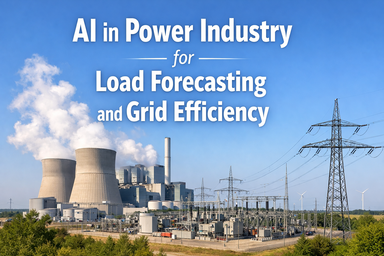
AI in Power Industry for Load Forecasting and Grid Efficiency
Predict demand before it spikes, optimize every dispatch decision, and build a grid that responds in real time — not after the fact.
$58.66B
AI in energy market projected by 2030 at 36.9% CAGR
94%
Load forecasting accuracy achieved with deep learning models
28%
Reduction in grid imports with AI energy management systems
40%+
Of utilities adopting AI-powered grid scheduling by 2026
Sources: MarketsandMarkets · Frontiers in AI · ScienceDirect · Precedence Research · Grid Strategies 2025
Why Traditional Load Forecasting Is Failing the Modern Grid
Traditional forecasting was built for a predictable world — stable baseload generation, seasonal demand curves, and no distributed energy complexity. That world no longer exists. AI data centers can reshape regional demand overnight. Renewable energy sources introduce supply variability with no historical precedent. Electric vehicles create demand spikes that legacy models cannot model. The result is a forecasting gap that costs utilities billions in over-generation, emergency balancing purchases, and reliability failures. AI-powered forecasting doesn't just improve accuracy — it changes the entire paradigm, learning from anomalies instead of failing on them.
Data Centers
New demand, no history
The Problem
90 GW of forecast peak load growth linked to data centers by 2030
Loads appear rapidly, cluster geographically, and evolve faster than planning cycles
Traditional models have no historical training data for AI workload demand patterns
What AI Does
Continuously ingests real-time interconnection data, tracks new large-load additions, and adapts forecasts dynamically without requiring historical precedent.
Renewables
Variable generation, fixed demand assumptions
The Problem
Solar and wind introduce supply volatility no statistical model was designed to handle
Curtailment waste and fossil backup costs rise when forecasts miss renewable output
Grid balancing costs spike on days where generation and demand diverge unexpectedly
What AI Does
Fuses weather satellite data, irradiance models, and wind speed forecasts with real-time generation telemetry — predicting renewable output and adjusting dispatch automatically.
Electrification
EVs and heat pumps reshape load curves
The Problem
EV charging creates unpredictable evening demand spikes that overwhelm legacy peak models
Heat pump adoption changes seasonal consumption patterns across entire distribution zones
Demand elasticity varies by customer segment in ways traditional models cannot capture
What AI Does
Tracks EV penetration data, smart charger telemetry, and building energy consumption to model electrification-driven load shifts before they reach the grid.
Extreme Events
When normal fails, old models collapse
The Problem
Hydro-Québec's legacy model missed a 1,500 MW demand anomaly during a May 2024 heatwave
Statistical models trained on historical patterns have no reference for unprecedented events
Unusual conditions are becoming more frequent — not less — making this failure mode systemic
What AI Does
AI models improve specifically on anomalies — learning from each unusual event and building accuracy precisely where traditional models degrade. Unusual days become AI's competitive advantage.
Five AI Capabilities Reshaping Grid Operations
AI doesn't replace grid operators — it gives them capabilities that were impossible before. Here are the five core functions iFactory deploys across power generation, transmission, and distribution operations.
01
Short-Term Load Forecasting
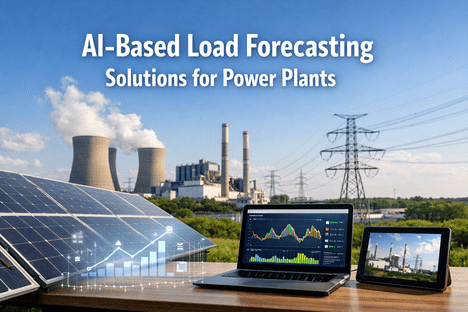
AI processes smart meter time series, weather feeds, and real-time consumption patterns using LSTM networks and Temporal Fusion Transformers — delivering demand predictions from 15 minutes to 48 hours ahead with up to 94% accuracy. Operators use these forecasts to optimize economic dispatch, reduce spinning reserves, and eliminate expensive last-minute balancing market purchases.
Typical result: 20% reduction in load forecasting errors
02
Renewable Energy Integration and Curtailment Reduction
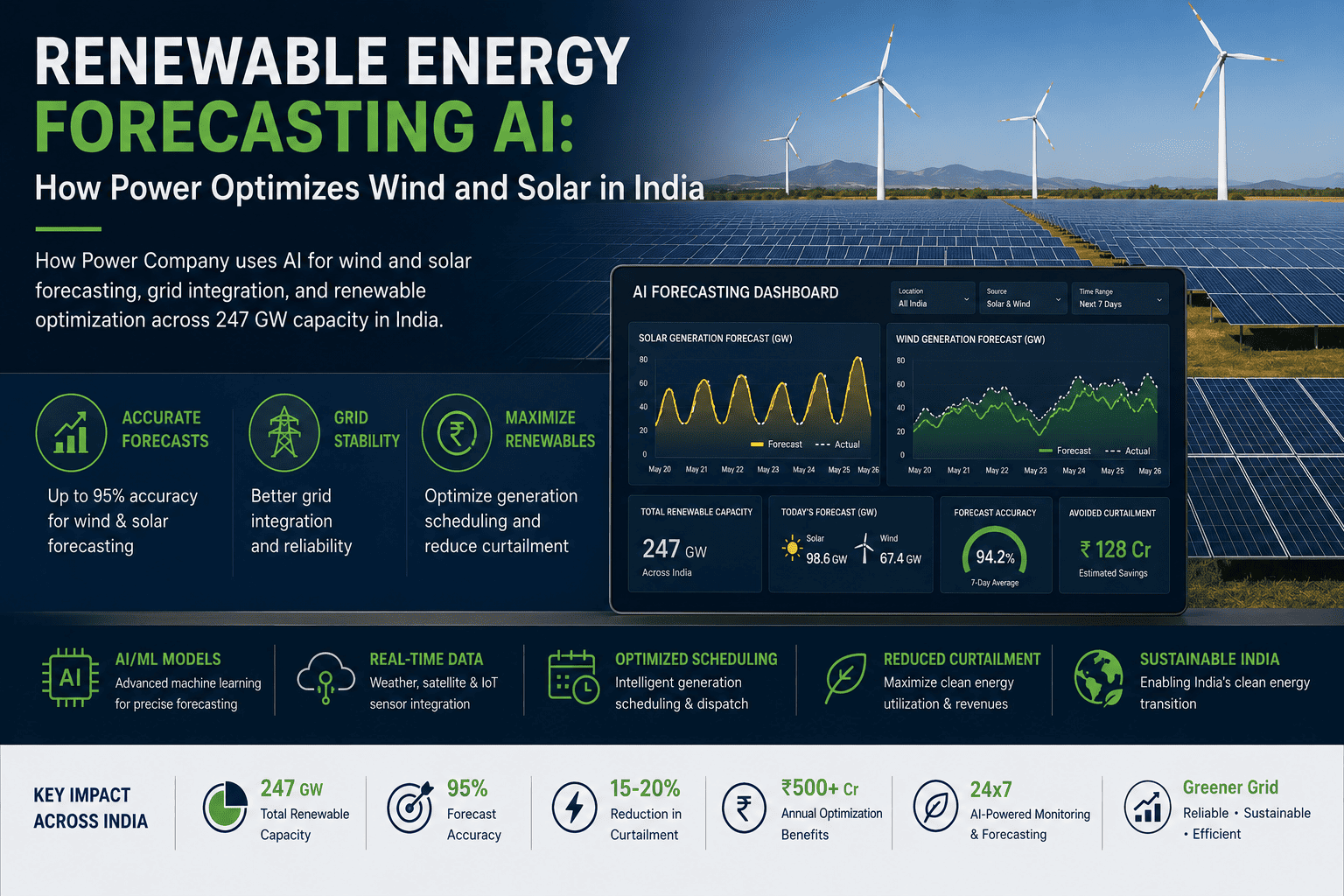
AI fuses solar irradiance forecasts, wind speed models, satellite data, and generation telemetry to predict renewable output with precision. The system automatically adjusts dispatchable generation to absorb maximum renewable energy without destabilizing frequency — reducing curtailment waste and fossil backup dependency simultaneously across the full generation portfolio.
Typical result: 15% curtailment reduction within first operating season
03
Dynamic Tariff and Demand Response Optimization
AI predicts demand 24 hours ahead and adjusts tariffs every 15 minutes to shift consumption to off-peak windows — flattening load curves, reducing peak infrastructure stress, and enabling real-time pricing signals that drive measurable demand response. Industrial and commercial customers respond to price signals that AI calculates, not static schedules that no longer reflect grid conditions.
Typical result: Measurable load factor improvement within 90 days of activation
04
Grid Self-Healing and Fault Prediction
Autonomous AI agents monitor grid topology in real time, detecting fault precursors before they cascade into outages. The system executes rerouting, isolation, and restoration actions within milliseconds — converting potential blackouts into managed micro-events that are invisible to end customers. Grid operators move from responding to failures to preventing them entirely.
Typical result: 35–55% reduction in unplanned outage duration
05
Battery Storage Dispatch and Asset Optimization
AI orchestrates charge and discharge cycles for grid-connected storage based on forecast load peaks, real-time spot price signals, and frequency regulation requirements. Every cycle is optimized to maximize revenue while protecting battery health — extending asset life by years and compounding financial returns across the storage fleet from day one of deployment.
Typical result: 22% improvement in battery cycle longevity
Want to identify which AI capabilities deliver the fastest ROI for your grid operations? Book a free grid optimization assessment.
Before vs. After: What AI Load Forecasting Changes
The shift from traditional forecasting to AI-powered grid intelligence is not incremental — it is structural. Every layer of how decisions are made, how fast they execute, and how accurately they perform changes fundamentally when AI replaces static models.
Forecast Accuracy
70–80% on normal days, fails on anomalies
Up to 94% accuracy, improves on unusual events
Data Sources
Historical load curves and seasonal patterns only
Smart meters, weather, satellites, IoT, EV data fused in real time
Forecast Horizon
Day-ahead only, static update cycles
15 minutes to multi-year, continuously recalibrated
New Load Types
Cannot model data centers or EV fleet demand
Adapts to new demand types without historical data requirement
Grid Response
Reactive — corrects after instability occurs
Proactive — prevents instability before it forms
Model Improvement
Degrades as conditions change from training baseline
Self-learning — accuracy compounds every operating cycle
Measurable Results from AI Grid Deployments
These are documented outcomes from real AI deployments across utilities, microgrids, and distributed energy systems — not projections. The data is drawn from published research and operational assessments completed in 2024 and 2025.
94%
Load Forecasting Accuracy
Deep learning models achieve 94% accuracy in distribution transformer load forecasting — a step change from the 70–80% typical of statistical methods on normal operating days
28%
Grid Import Reduction
AI-enhanced energy management systems reduce reliance on grid imports in microgrid deployments by optimizing local generation dispatch and storage utilization simultaneously
20%
Forecast Error Reduction
Probabilistic AI models cut energy consumption forecasting errors by 20%, directly reducing overgeneration waste and expensive last-minute balancing market purchases
22%
Battery Longevity Improvement
AI-driven storage dispatch optimization improves battery cycle longevity by 22% while simultaneously improving average state-of-charge tracking accuracy by 15%
12%
Energy Efficiency Gain
IoT-integrated AI systems delivering real-time parameter optimization across wind generation assets achieve consistent 12% energy efficiency improvements per turbine
1,500 MW
Anomaly Correctly Predicted
Hydro-Québec's AI model accurately forecast the 1,500MW demand anomaly that its legacy model completely missed during the May 2024 heatwave — zero emergency intervention required
Sources: Frontiers in AI 2025 · ScienceDirect 2025 · Power Technology · Hydro-Québec AI Integration Assessment 2024 · Grid Strategies 2025
Industry Applications: Where AI Grid Intelligence Delivers the Biggest Wins
AI load forecasting and grid optimization adapts across the full power value chain — but certain segments see outsized returns because of the complexity of their dispatch environment, the volatility of their generation mix, or the cost of reliability failures.
Transmission System Operators
Managing bidirectional power flows, large new industrial loads, and renewable variability simultaneously requires forecasting far beyond what statistical models deliver. AI optimizes real-time dispatch across transmission assets, predicts congestion before it materializes, and coordinates demand response at scale — keeping interconnected grids stable under conditions no historical model anticipated.
Distribution Utilities
EV adoption, rooftop solar, and smart meters are transforming distribution networks from passive delivery systems into active balancing environments. AI processes smart meter time series, vehicle charging data, and weather feeds to predict distribution-level demand with granularity that enables proactive asset management, reduced outage frequency, and optimized infrastructure investment planning.
Renewable Energy Operators
Wind and solar operators face curtailment penalties and imbalance settlement costs when generation forecasts miss actual output. AI integrates satellite irradiance data, numerical weather prediction, and real-time turbine telemetry to deliver day-ahead and intraday generation forecasts that minimize curtailment, reduce balancing exposure, and maximize revenue per megawatt installed.
Industrial Power Consumers
Large industrial sites — steel mills, chemical plants, data centers — face peak demand charges that can represent 30–40% of their total electricity bill. AI forecasts on-site demand patterns, optimizes interruptible load schedules, and coordinates on-site generation and storage to systematically reduce peak demand exposure while maintaining full production output.
Energy Storage Operators
Battery storage economics depend entirely on dispatching the right charge and discharge cycles at the right time. AI combines price forecasts, load predictions, frequency regulation signals, and battery health data to orchestrate storage dispatch that maximizes revenue per cycle, extends asset life, and captures arbitrage opportunities that manual scheduling consistently misses.
Microgrid and DER Operators
Managing distributed energy resources across microgrids requires coordinating solar generation, storage, demand response, and grid import in real time. AI reduces grid imports by 28%, optimizes self-consumption, and maintains islanding capability through predictive load management — making microgrids genuinely energy-independent at economically viable cost points.
The Market Is Accelerating — Rapidly
The global AI in energy market was valued at $8.91 billion in 2024 and is projected to reach $58.66 billion by 2030 — a 36.9% CAGR. Demand forecasting is the fastest-growing application segment, driven by EV adoption, renewable expansion, and the explosive growth of AI data center loads that have increased five-year demand forecasts by a factor of six in just four years. By 2026, over 40% of utilities will deploy AI-powered scheduling. Grid operators who move first will own the efficiency and reliability advantage for years. Those who wait are managing a grid that has already outgrown their forecasting tools.
$18.1B
AI in energy market size in 2025
6x
Growth in five-year demand forecasts since 2021
How iFactory Deploys AI Grid Intelligence
iFactory does not require you to replace your existing grid management systems. Our AI layer connects to your SCADA, EMS, smart meters, and sensor infrastructure — ingesting the data your grid already produces and transforming it into real-time forecasting and optimization intelligence.
Week 1–2
Connect and Integrate
Integrate with your existing SCADA, EMS, smart meter systems, and weather data feeds via OPC-UA, REST API, or MQTT. Begin streaming load, generation, grid topology, and environmental data into iFactory's analytics engine. Zero disruption to live grid operations throughout the integration process.
Week 3–4
Baseline and Model
AI trains on your historical load profiles, seasonal demand patterns, generation mix, and anomaly records across all operating conditions. Deep learning models map the relationships between weather, large-load behavior, and demand outcomes — building forecasting precision tuned to your specific grid topology and customer base.
Week 5–6
Forecast and Alert
Activate real-time load forecasts, dispatch recommendations, renewable integration signals, and demand response alerts. AI delivers predictions to operators via dashboard or executes automated grid actions through closed-loop control. Predictive fault detection flags precursors before they cascade into outages.
Week 7–8
Measure and Scale
Quantify forecast accuracy improvement, balancing cost reduction, renewable curtailment savings, outage reduction, and storage revenue gains against your pre-deployment baseline. Present board-ready ROI analysis. Expand to additional grid zones and use cases based on demonstrated results.
Ready to bring AI-powered load forecasting to your grid operations? Schedule your free grid optimization assessment.
Frequently Asked Questions
What is AI-based load forecasting for power grids?
AI-based load forecasting uses machine learning and deep learning models — including LSTM networks and Temporal Fusion Transformers — to predict electricity demand across multiple time horizons by processing smart meter data, weather feeds, satellite data, and real-time consumption patterns. Unlike traditional statistical forecasting, AI adapts continuously and improves specifically on unusual events, making it the only viable approach for today's increasingly volatile and unpredictable grid.
Book a demo to see it in action.
How accurate is AI load forecasting compared to traditional methods?
Deep learning models achieve up to 94% accuracy in load forecasting and reduce forecasting errors by 20% compared to statistical baselines. Traditional models deliver 70–80% accuracy on normal days and fail significantly on anomalous events — exactly the events becoming more frequent. Hydro-Québec's 2024 operational assessment confirmed that their AI model correctly predicted a 1,500MW demand anomaly that their legacy model missed entirely, requiring zero emergency operator intervention.
Does AI grid optimization work with our existing SCADA and EMS systems?
Yes. iFactory's AI layer connects to your existing SCADA, EMS, smart meter, and sensor infrastructure without requiring replacement of any existing systems. If your grid infrastructure already generates digital data — which virtually all modern grid systems do — iFactory can ingest, analyze, and optimize from it. Integration uses standard protocols including OPC-UA, REST API, and MQTT, typically completing within two weeks with no operational disruption.
What ROI can utilities expect from AI grid optimization?
Grid operators typically see 20–28% reductions in balancing and import costs, 15–22% improvements in storage asset performance, measurable renewable curtailment reduction, and 35–55% shorter unplanned outage durations. The compounding effect of a self-learning forecasting model means accuracy and financial returns improve with every operating cycle. Most implementations deliver measurable gains within weeks, with full ROI documented within 6 to 12 months.
Schedule a demo to model your specific savings.
Can AI handle demand from AI data centers and EV fleets?
This is precisely where AI forecasting outperforms legacy tools. Traditional models require historical data to make accurate predictions — they have no basis for demand patterns from AI data centers or rapid EV fleet growth. iFactory's AI continuously incorporates new load types, tracks interconnection applications for new large-load projects, and adapts forecasts as these demand sources evolve. It is the only forecasting approach built for the grid as it exists today, not the grid of a decade ago.
Stop Reacting. Start Predicting.
Your Grid Already Produces the Data. Let AI Turn It Into Foresight.
iFactory connects to your SCADA, EMS, and smart meter infrastructure to deliver real-time load forecasting, renewable integration, grid self-healing, and storage optimization — all running within 8 weeks, with zero disruption to live operations.
8 Weeks
From data connection to live forecasting
Zero
Disruption to grid operations during deployment
94%
Achievable load forecasting accuracy
36.9%
Annual growth rate of AI in energy market