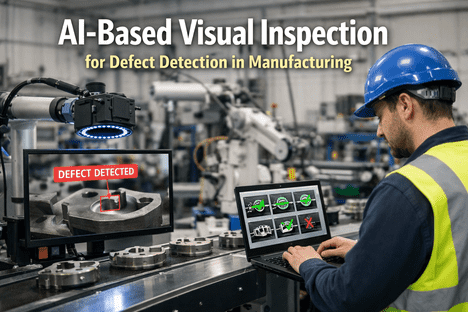
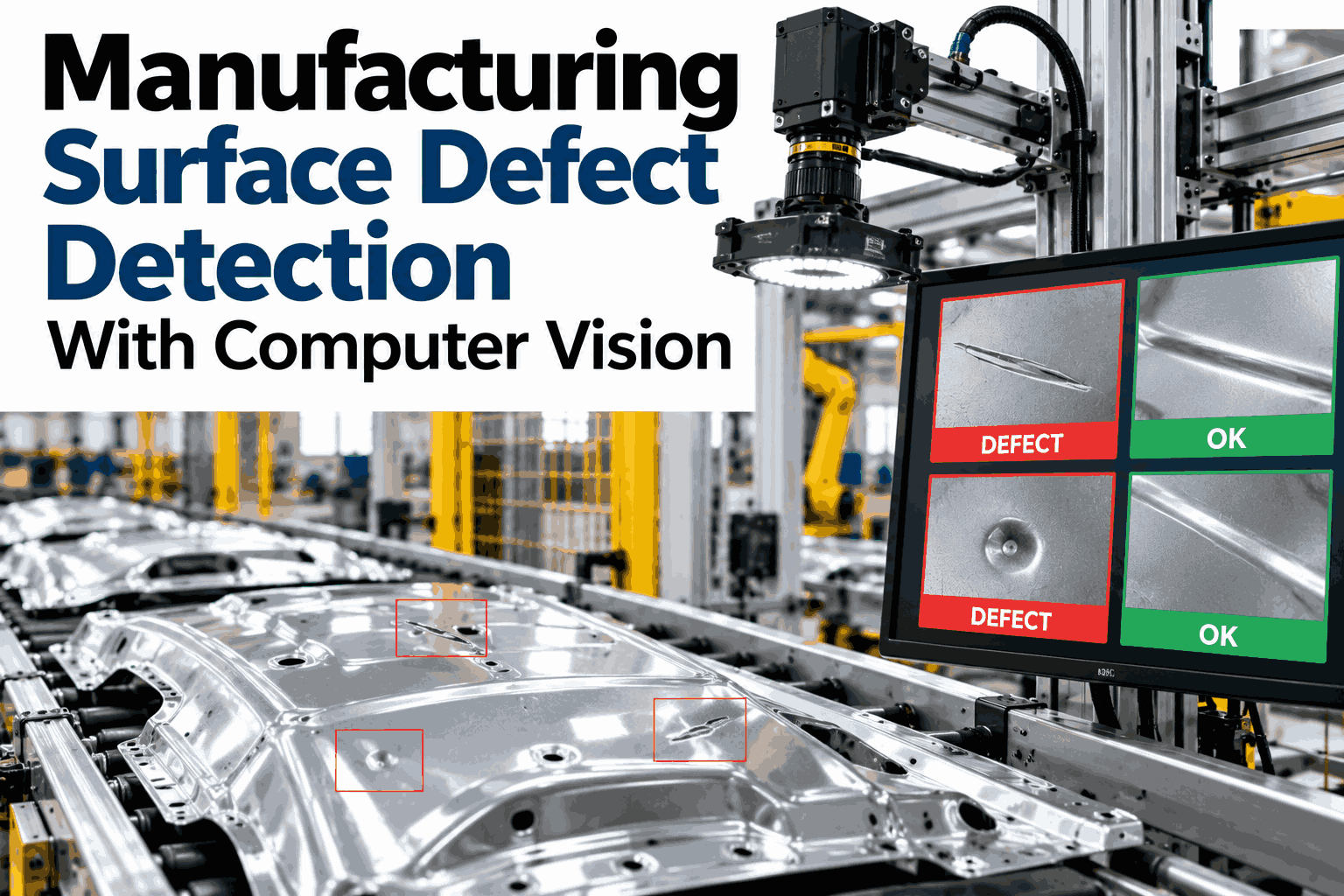
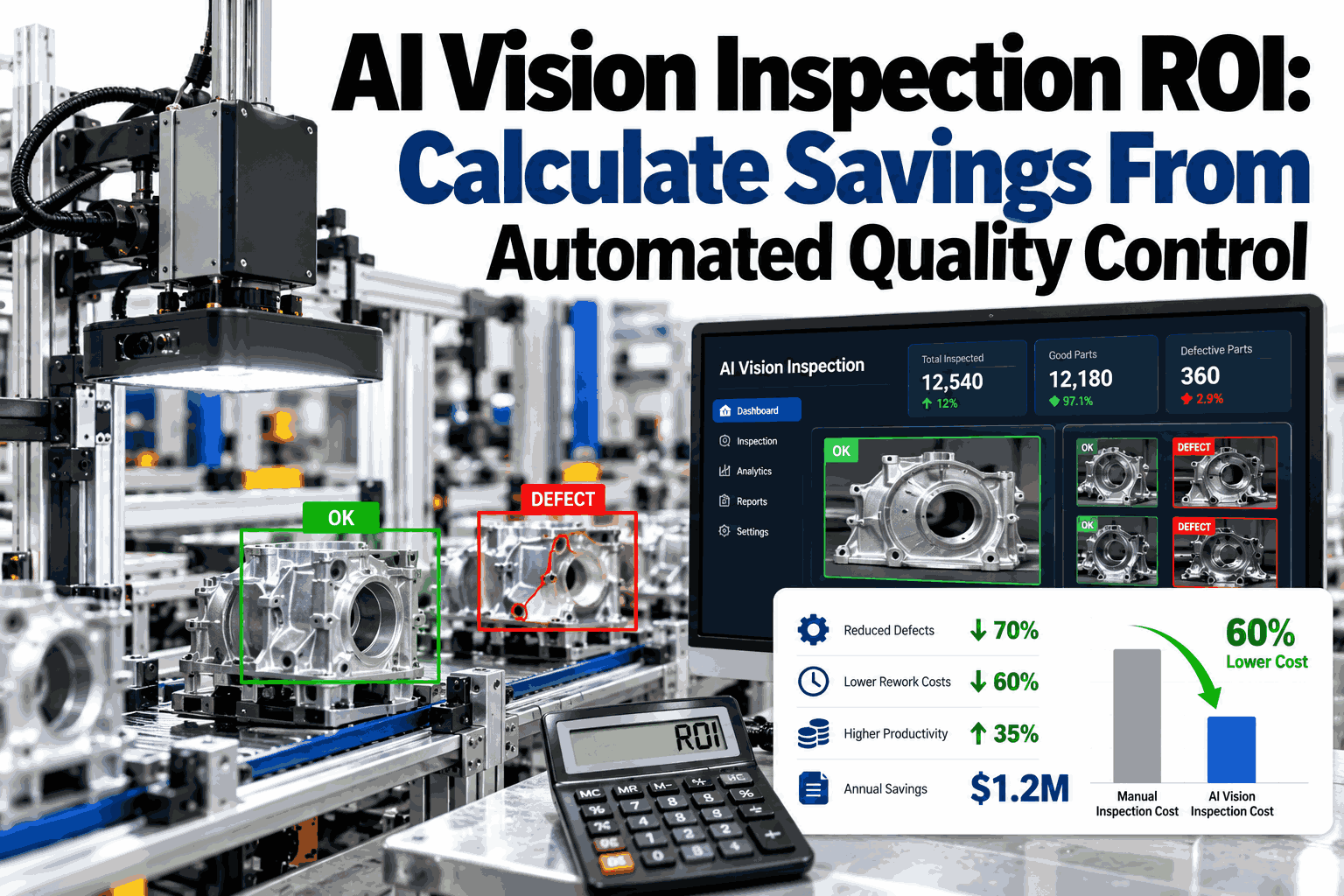
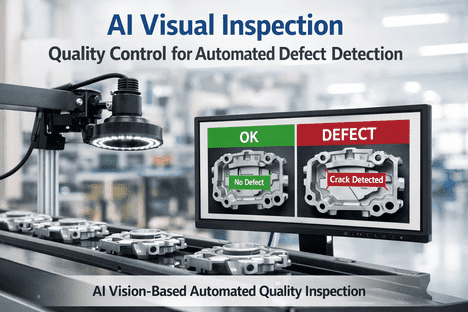
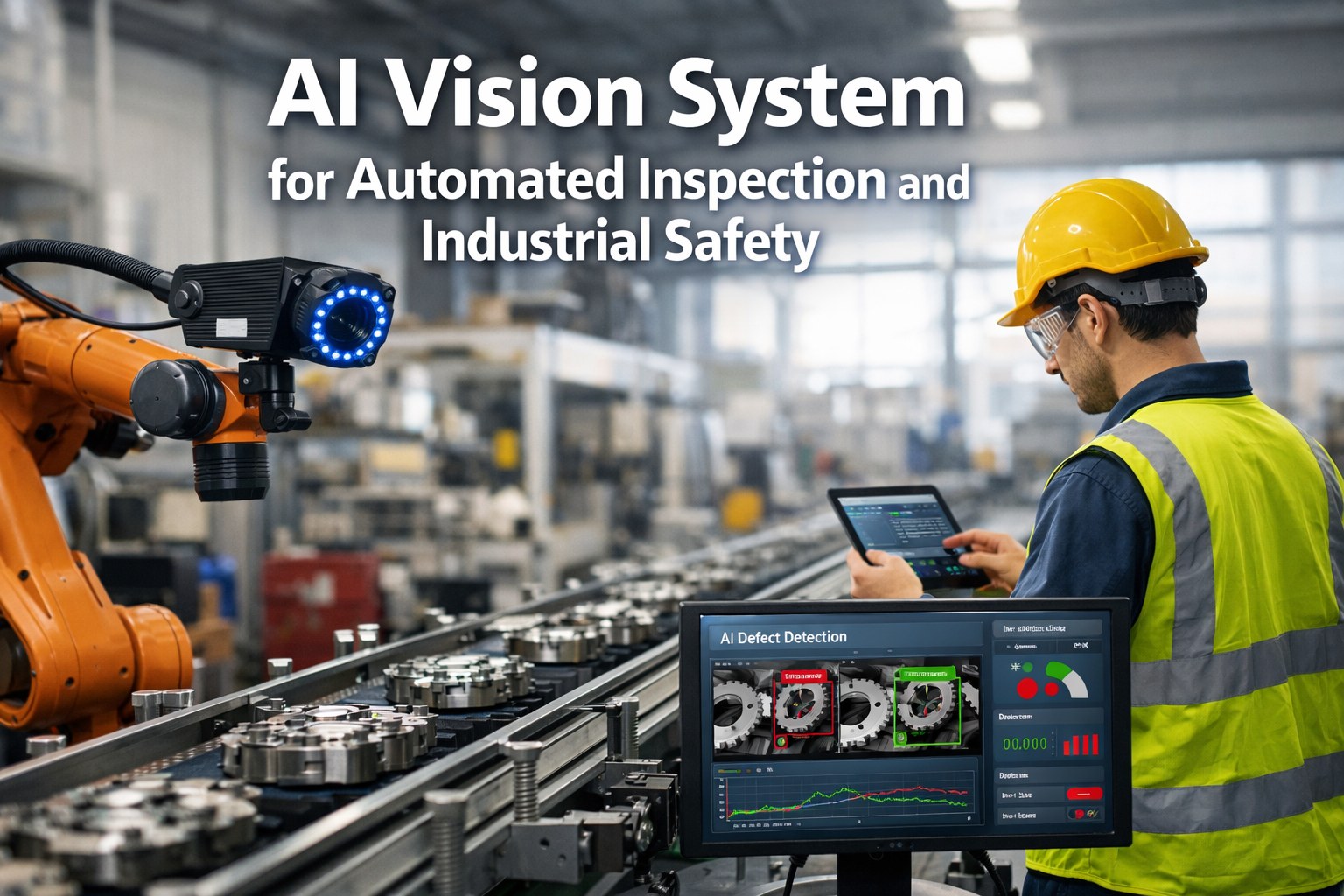
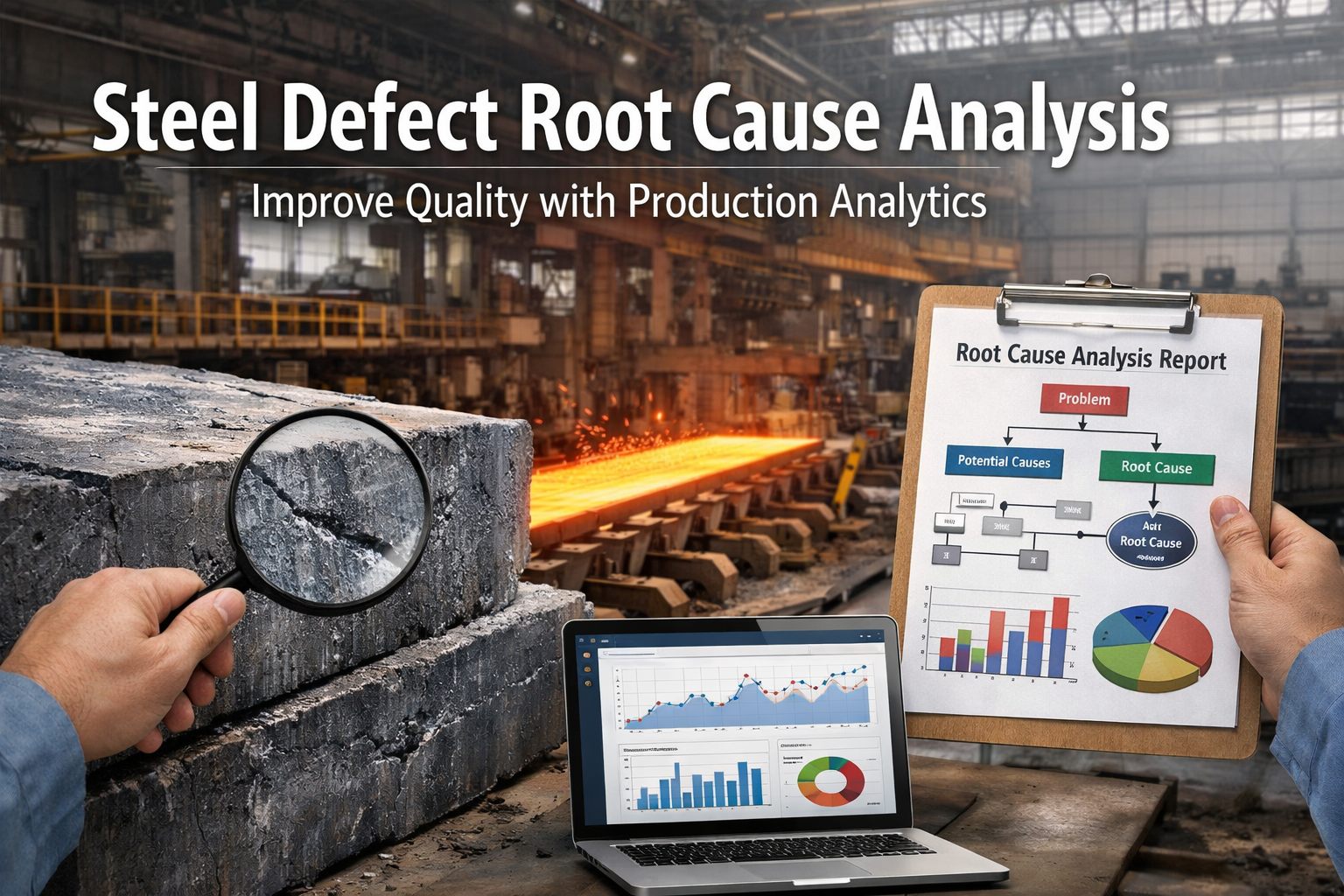
An automotive parts manufacturer in Japan was losing $1.8 million annually to quality failures — warranty claims, customer returns, scrap, and rework that traced back to defects missed on the production line. Their 12-person inspection team, working three shifts, caught roughly 75% of surface defects on stamped metal components. The other 25% shipped to customers. After deploying AI-powered visual inspection on two critical lines, defect detection jumped to 95% — a 20-point accuracy gain achieved with two cameras, an edge server, and 500 labeled training images. Customer complaints dropped 85% within four months. The system paid for itself in seven months. The inspectors didn't lose their jobs — they moved to root cause analysis and process improvement, using the defect data AI was now generating at a scale and consistency no human team could match.
Visual Inspection
Your Inspectors Miss 20–30% of Defects.
AI Misses Less Than 1%.
The global defect detection market hit $3.3 billion in 2024 and is projected to reach $6.6 billion by 2034. Companies still relying on manual inspection lose nearly 20% of annual sales to poor quality costs. AI vision systems now achieve 95–99% detection accuracy at 10,000+ parts per hour — maintaining identical standards 24/7 without fatigue, attention drift, or shift-to-shift variability.
$6.6B
Defect detection market projected by 2034
20–30%
Defect miss rate for human inspectors
95–99%
Detection accuracy with AI vision systems
374%
Three-year ROI documented for AI inspection
Sources: Jidoka Technologies 2026 · IISE Research · iFactory Platform Data 2026 · Industry ROI Benchmarks
The Human Inspection Problem: Biology vs. Production Speed
Human inspectors aren't bad at their jobs — they're biologically limited. The human visual system was designed to scan landscapes for predators, not detect 50-micron scratches on metal surfaces at 120 parts per minute. Under real production conditions, the gap between what inspectors should catch and what they actually catch is enormous — and it costs manufacturers millions.
Human Inspection Under Real Conditions
70–80%
Actual detection accuracy under production speeds — not the 95%+ measured in controlled lab settings
15–25%
Accuracy degradation after just 2 hours of continuous observation — peak miss rates occur in final shift hours
55–70%
Inter-inspector agreement on defect severity — identical parts get different verdicts on different shifts
2–3/min
Manual inspection throughput — becomes the production bottleneck on high-speed lines
20%
Of total revenue lost to cost of poor quality — scrap, rework, warranties, and inspection overhead combined
AI Vision Inspection Performance
95–99%
Consistent detection accuracy across all shifts — no fatigue, no attention drift, no biological limits
0%
Degradation over time — AI maintains identical performance at hour 1 and hour 1,000 of continuous operation
100%
Consistency — identical defects receive identical classification every time, on every shift, on every line
10,000+/hr
Inspection throughput at sub-100ms per part — never the bottleneck, always at line speed
Every image
Logged with timestamp, defect category, severity score, and disposition — creating a complete auditable quality record
How much is your current inspection miss rate costing you? Book a live demo and see AI vision on your actual production parts.
How AI Visual Inspection Works: From Camera to Decision in Milliseconds
AI visual inspection isn't a camera upgrade — it's a complete intelligence pipeline that captures images, processes them through deep learning models, classifies defects, and triggers reject mechanisms in under 100 milliseconds. Every decision is logged, every image is stored, and the system improves with every part it inspects.
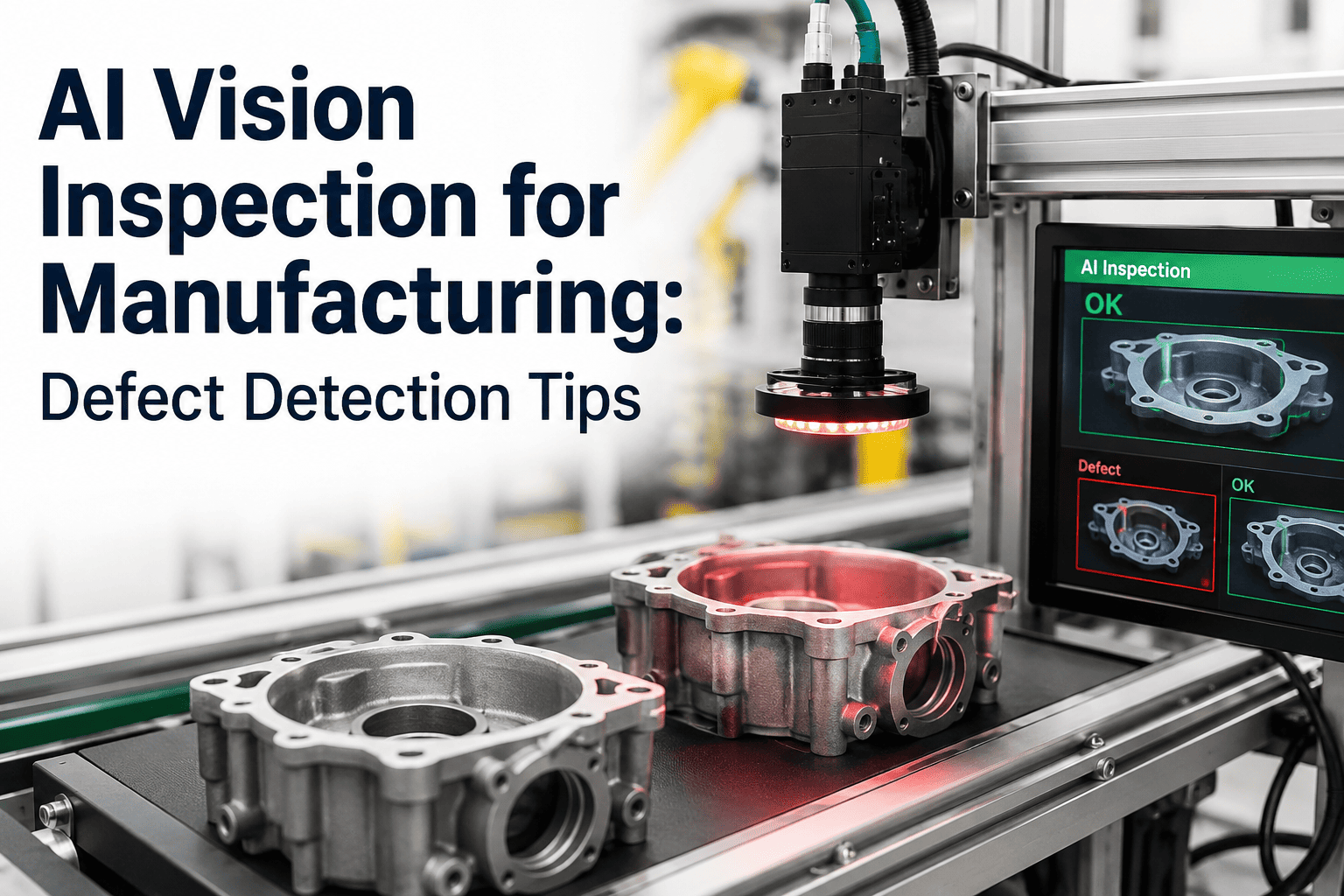
High-resolution industrial cameras with specialized lighting — diffuse, coaxial, dark-field, or structured — capture every part at line speed. Lighting design is critical: the right illumination makes defects visible that would be invisible under standard factory lighting.
GigE Vision · 5–20 MP resolution · 30–500 fps · Multi-angle capture
Deep learning models run on GPU-accelerated edge servers inside the plant — no cloud dependency, no network latency. CNN architectures optimized for industrial defects process each image in under 50ms, classifying defect type, location, and severity simultaneously.
NVIDIA GPU · Sub-100ms latency · On-premise · Air-gapped capable
The model outputs defect class (scratch, crack, dent, stain, misalignment, missing component), bounding box location, pixel-level segmentation mask, and confidence score. Multi-class models handle 20+ defect types simultaneously per product.
Classification · Object Detection · Segmentation · Anomaly Detection
Pass/fail decisions trigger physical reject mechanisms instantly. Every inspection is logged with image, timestamp, defect data, and disposition. Active learning flags uncertain cases for human review — the model improves from 90–92% to 99%+ within the first week of production deployment.
Auto-reject · MES integration · SPC alerts · Continuous learning
Start With One Camera, One Station. Scale When ROI Proves Itself.
iFactory deploys AI vision inspection starting from a single critical station — capturing 500–2,000 training images, training your custom model, shadow-running alongside manual inspection for validation, then going live. First results in 6–8 weeks.
Industry Applications: AI Vision Across Manufacturing Sectors
Different industries face different defect types, tolerance requirements, and line speeds. iFactory trains industry-specific AI models that understand the visual characteristics and acceptance criteria unique to each manufacturing sector.
Automotive
Paint defects, weld quality, gap/flush analysis, assembly completeness, stud placement
BMW achieved 37% defect reduction with AI vision across production lines
Electronics & Semiconductors
Solder joint inspection, missing components, tombstoning, bridging, wafer defects
Intel saves $2M annually in scrap avoidance with AI wafer vision inspection
Steel & Metals
Surface scratches, cracks, inclusions, scale defects, coating thickness, roll marks
POSCO improved hot-rolled yield by 3% using AI surface inspection across mills
Food & Beverage
Fill level verification, seal integrity, foreign object detection, label accuracy, date codes
US packaging company reduced inspection time by 50% while improving detection
Pharmaceuticals
Tablet integrity, blister pack completeness, label verification, particulate contamination
Regulatory compliance demands 100% inspection — AI delivers it without manual bottleneck
Glass & Ceramics
Bubbles, stones, scratches, chips, thickness variation, optical distortion, edge defects
Siemens reported 30% increase in inspection accuracy with AI vision systems
The ROI of AI Visual Inspection
AI vision inspection isn't a quality department expense — it's a profitability investment that pays for itself in months. The returns come from three sources simultaneously: fewer defects reaching customers, less scrap and rework internally, and higher throughput from eliminating the inspection bottleneck.
Payback Period
7–8 Months
Most deployments recover full investment within the first year through scrap reduction, complaint elimination, and inspection labor reallocation to higher-value work.
Defect Reduction
37–85%
BMW documented 37% defect reduction; Foxconn achieved 80% improvement in detection rates. Customer complaints drop 85% within months of deployment.
Inspection Speed
10,000+/hr
AI processes parts at line speed — sub-100ms per inspection. Eliminates the manual inspection bottleneck that limits production throughput on high-speed lines.
Productivity Boost
Up to 50%
A semiconductor manufacturer in Taiwan increased throughput by 50% with AI vision. PWC projects AI will boost production 40% by 2035 across manufacturing.
False Positive Reduction
50% fewer
Legacy systems flag 50% false positives. AI achieves 97–99% accuracy with minimal false alarms — operators trust the system and stop overriding it.
Three-Year ROI
374%
Documented three-year return on investment from combined scrap savings, rework elimination, warranty cost reduction, and throughput gains.
Why iFactory for AI Visual Inspection
01
Unified Quality + Maintenance + Production Intelligence
When AI vision detects a recurring scratch pattern, it doesn't just reject parts — it correlates the defect with upstream process data (tool wear, temperature, pressure) and triggers a predictive maintenance work order for the root cause. One detection solves three problems simultaneously.
02
Edge-First, Zero Cloud Dependency
All inference runs on GPU-accelerated edge servers inside your plant's network — sub-100ms latency, zero data leaving the premises, continuous operation during network outages. Your production line never waits for a cloud round-trip to make a quality decision.
03
500 Images to Production — Not 50,000
iFactory's active learning and data augmentation pipeline trains production-grade models from 500–2,000 labeled images — not the 50,000+ that traditional approaches demand. Shadow-run validation against your manual inspection team ensures confidence before go-live.
04
Multi-Line, Multi-Plant Scalability
Deploy on one station, prove ROI, then scale across lines and facilities. iFactory normalizes defect data across every inspection point — creating a plant-wide quality intelligence layer that tracks defect trends, shift performance, and process correlations across your entire operation.
Every Part Your Inspectors Miss Is a Part Your Customer Finds
iFactory deploys AI visual inspection that catches what humans can't — consistently, at line speed, 24/7. Start with one camera on your most critical station. See results in 6–8 weeks. Scale when ROI proves itself.
Frequently Asked Questions
How accurate is AI visual inspection compared to human inspectors?
AI vision achieves 95–99% detection accuracy consistently across all shifts, compared to 70–80% for human inspectors under real production conditions. More importantly, AI maintains identical performance 24/7 — human accuracy degrades 15–25% after just 2 hours of continuous inspection, and inter-inspector agreement on defect severity is only 55–70%. AI eliminates both fatigue-based misses and subjective variability.
How many training images does AI need to detect our specific defects?
iFactory's active learning pipeline trains production-grade models from 500–2,000 labeled images — typically 20–40 images per defect class. Data augmentation techniques (rotation, scaling, lighting variation) multiply the effective training set. The system then shadow-runs alongside your manual inspection for one week, comparing outputs and resolving edge cases before full handover. Most models reach 99%+ accuracy within the first week of production deployment through continuous learning.
Can AI vision inspection keep up with our production line speed?
Yes. AI processes each inspection in under 100 milliseconds — meaning it can handle 10,000+ parts per hour at full line speed. Edge GPU servers perform all inference locally with zero network latency. For very high-speed lines (500+ fps), multi-camera setups with parallel inference ensure 100% inspection coverage without any production slowdown. AI is never the bottleneck — manual inspection is.
Does AI replace our quality inspectors?
No — it elevates them. AI handles the high-volume, repetitive visual scanning that causes human fatigue and inconsistency. Inspectors move to higher-value roles: root cause analysis using AI-generated defect data, process improvement based on defect trend patterns, edge case review for continuous model improvement, and quality system management. Most manufacturers report that AI frees inspectors to do the analytical work they were always too busy scanning parts to do.
What's the typical ROI and payback period?
Documented results show average payback in 7–8 months and 374% three-year ROI. The primary savings come from scrap reduction (37–85% fewer defects reaching customers), rework elimination, warranty claim reduction (85% fewer complaints), and throughput improvement from removing the inspection bottleneck. Intel reports $2M annual savings from AI wafer inspection alone. For a plant with $10M revenue and 20% cost of poor quality, even a 25% reduction in quality costs saves $500K annually.