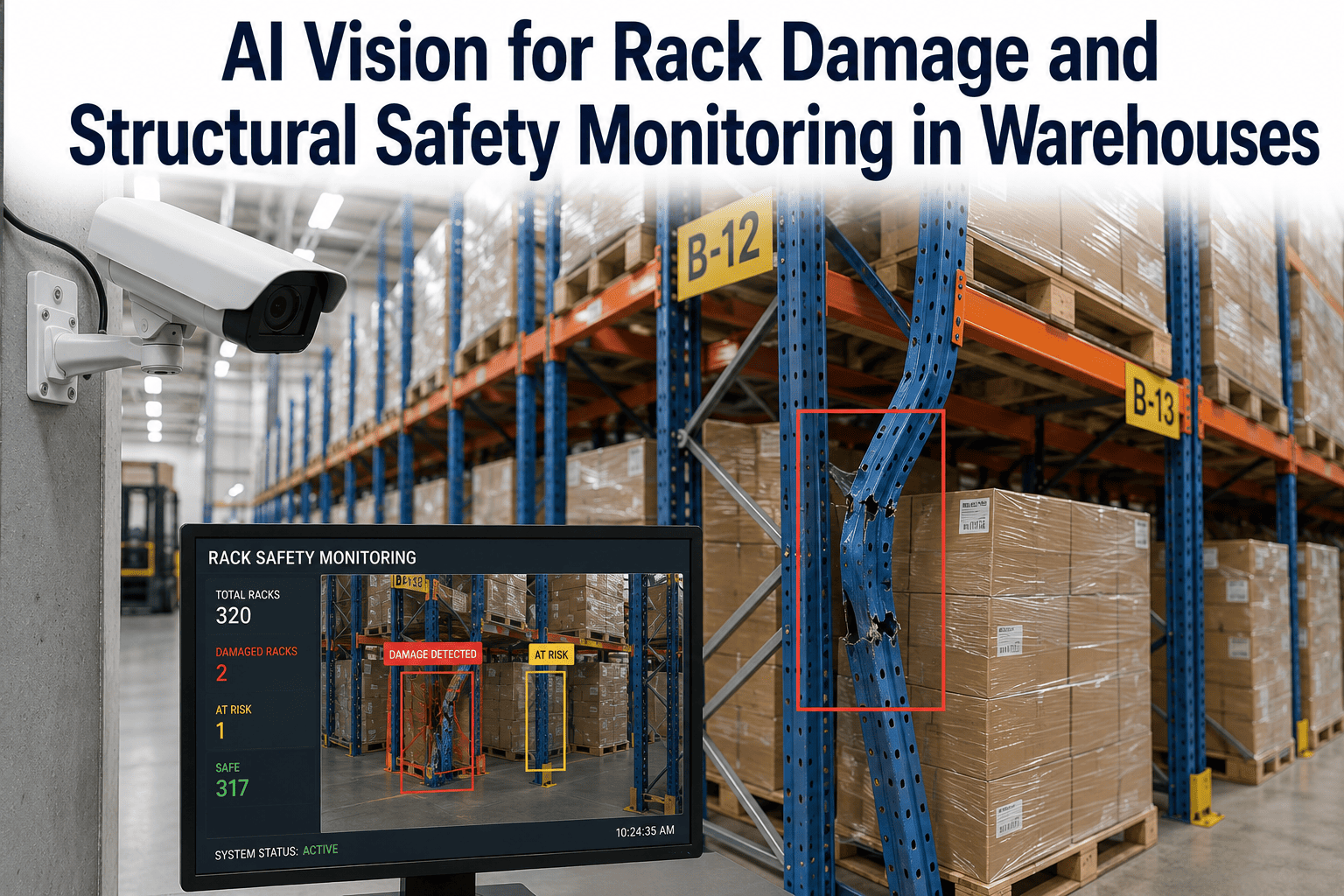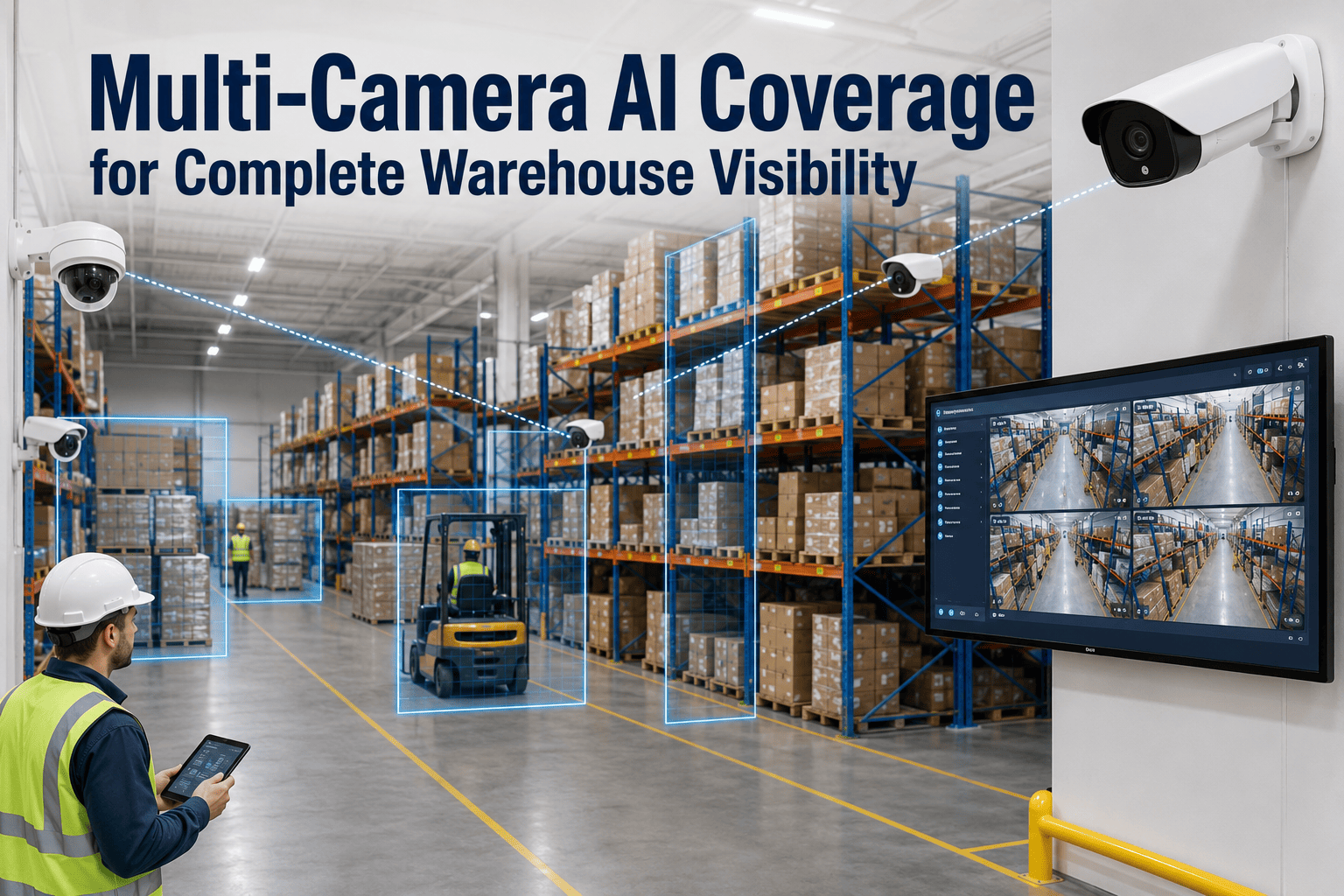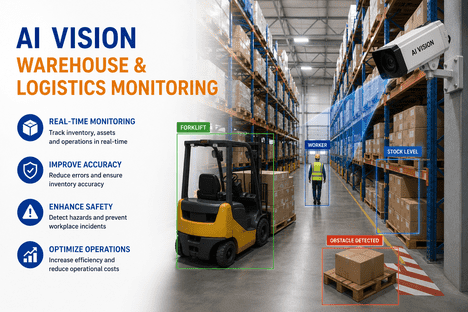
The average warehouse runs on inventory records that are only 63 percent accurate — meaning more than a third of what your system says is on the shelf is wrong at any given moment. The usual response is to bolt on another point solution: a safety camera here, an inventory scanner there, a separate dock-tracking tool bought last year. The result is six disconnected systems that each see one slice of the operation and none of them see the whole floor. Unified AI vision solves this differently — one platform, one set of cameras, watching receiving, storage, picking, packing, loading, and the yard simultaneously, feeding a single source of operational truth. Book a Demo to see every zone of your facility on one dashboard.
Stop Stitching Together Six Different Systems to See One Warehouse
Inventory tracking, safety monitoring, and workflow analytics — from receiving to the yard — on a single AI vision platform built for your existing cameras.
Why Most Warehouses See Their Floor in Six Different Screens
Warehouse technology adoption has followed a predictable pattern for a decade — a safety incident triggers a camera-based PPE detection purchase, a shrinkage problem triggers a separate loss-prevention tool, an inventory discrepancy triggers a barcode or RFID project, and a dock congestion complaint triggers yet another point solution for truck tracking. Each tool solves its narrow problem well. None of them talk to each other. Operations leaders end up logging into four or five different dashboards every morning, mentally reconciling data that was never designed to connect, while the floor itself tells one continuous story that no single screen shows.
This fragmentation carries a real, measurable cost — not just in software licensing, but in the decisions that never get made because nobody had the full picture in one place. Talk to our engineers about consolidating your current camera and sensor stack into a single vision layer.
One Product's Journey Through Your Warehouse — And What AI Sees at Every Step
Every unit that moves through your facility passes through the same six zones. A unified vision platform places purpose-trained AI models at each stage, so instead of six disconnected tools you get one continuous chain of custody from the moment a pallet arrives to the moment a truck pulls away loaded.
Receiving
AI counts and verifies inbound pallets against the PO in real time, flags damaged or mislabeled cargo, and timestamps dock-to-putaway duration automatically — no manual tally sheet required.
Storage
Continuous shelf and bin scanning cross-checks physical stock against WMS records, closing the gap behind the 63 percent accuracy average and surfacing phantom stock and misplaced SKUs the same day they occur.
Picking
Vision verifies correct item, correct location, correct quantity at the point of pick — catching mis-picks before they become a return, and measuring travel path efficiency per operator per shift.
Packing
Carton content verification against the order manifest before sealing, plus dwell-time tracking to identify packing-station starvation caused by upstream congestion elsewhere on the floor.
Loading
Load verification confirms the right pallets board the right truck, captures load-sequence photo evidence for carrier disputes, and measures dock-door turnaround against SLA thresholds.
Yard
Trailer and vehicle tracking across the yard eliminates the walk-and-search for a specific trailer, flags unauthorised movement, and closes the loop from dock appointment to departure.
Inventory Tracking, Safety Monitoring, and Workflow Analytics — Running on the Same Cameras
The reason unification works is that a single video frame already contains everything three separate point solutions were each trying to extract independently. iFactory's models run all three analysis layers on the same feed, simultaneously, at the edge.
Inventory Intelligence
SKU counting, shelf-level stock verification, phantom-stock detection, and cycle-count automation — closing the gap between what the system says and what is physically on the floor.
Safety & Compliance Monitoring
PPE detection, forklift-pedestrian proximity alerts, restricted-zone intrusion, and near-miss logging — the same coverage a dedicated safety camera system would provide, without a second install.
Workflow & Throughput Analytics
Congestion heatmaps, dwell time, travel-path efficiency, and dock turnaround — the operational intelligence layer that shows why throughput moves, not just that it moved.
What Operations Leaders See Every Morning — Instead of Five Logins
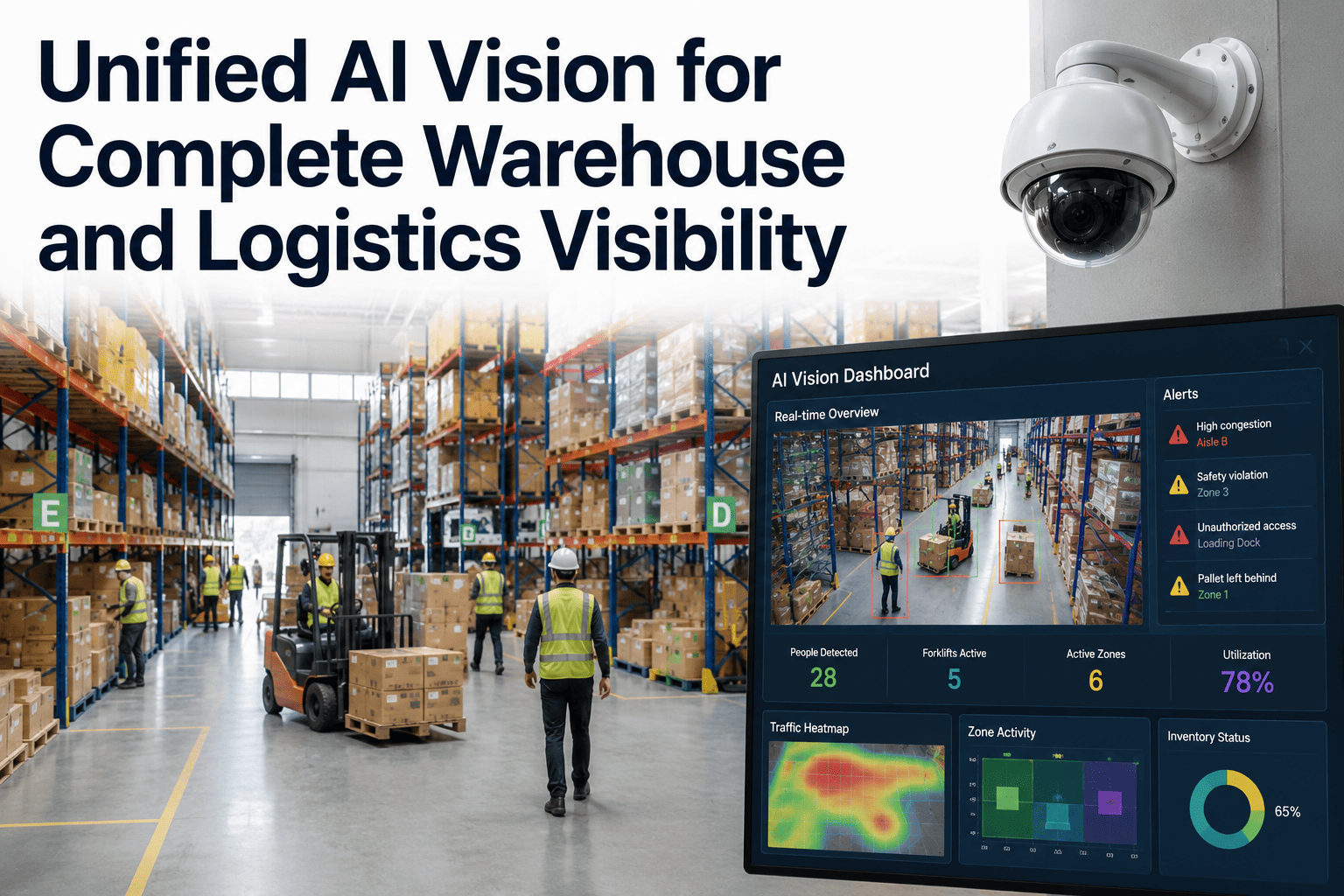
A single unified view replaces the daily ritual of checking a WMS report, a separate safety incident log, a spreadsheet of dock times, and a loss-prevention portal. Below is a simplified representation of the kind of consolidated view iFactory delivers.
See Your Own Six Zones Unified on One Dashboard
Send footage from any two zones — we'll show inventory, safety, and workflow analytics running together, live, inside 48 hours.
What Changes When Six Tools Become One Platform
The comparison below reflects what operations teams typically report after consolidating a fragmented camera and software stack into a single unified vision platform.
| Dimension | Fragmented Point Solutions | Unified AI Vision Platform |
|---|---|---|
| Dashboards to check daily | 4-6 separate logins | 1 unified view |
| Camera hardware required | Often duplicated per tool | Single shared camera network |
| Cross-zone correlation | Manual, after the fact | Automatic, real time |
| Inventory record accuracy | ~63% typical baseline | 95%+ typical result |
| Root-cause investigation time | Hours across systems | Minutes on one timeline |
| WMS / ERP integration effort | Separate project per tool | One integration layer |
Live in 6 to 12 Weeks — Zone by Zone, Fully Connected From Day One
iFactory ships a pre-configured NVIDIA AI edge server, racked and ready. Rack it, connect power and Ethernet, and every zone your cameras cover joins the same unified dashboard — no separate onboarding per module.
Full-Facility Camera Audit
Coverage map across all six zones — receiving, storage, picking, packing, loading, yard. Gap analysis for any blind spots. Hardware shipped pre-configured.
Zone Calibration & Model Activation
Inventory, safety, and workflow models activated per zone. Baseline metrics captured — current inventory accuracy, congestion patterns, safety incident rate.
WMS Integration & Unified Go-Live
Bidirectional WMS/ERP sync connected, alert thresholds tuned, operator training completed, single dashboard live across the entire facility footprint.
Built as One Platform From the Ground Up — Not Bundled Point Tools
Many vendors sell a bundle of separately built modules under one brand. iFactory's inventory, safety, and workflow models share the same underlying vision engine and the same camera feed, which is why cross-zone correlation happens automatically instead of requiring custom integration work. Book a Demo to see the architecture difference live.
Single Vision Engine, Three Analysis Layers
Inventory, safety, and workflow intelligence run on one shared model architecture — not three bolted-together products with separate data schemas.
Camera-Agnostic (RTSP / ONVIF)
Works with your existing CCTV network across every zone. No forced hardware refresh, no per-module camera requirement.
Turnkey On-Prem AI Hub
Pre-configured NVIDIA server ships racked and ready. Cabling, network, WMS integration, and training included in deployment.
Edge-First Processing
Video stays on-site. Only structured metadata syncs to the cloud dashboard — bandwidth cost drops over 90 percent versus cloud-only alternatives.
Native WMS & SAP Integration
Bidirectional API into SAP EWM, Manhattan, Blue Yonder, Oracle WMS. Detections become tasks; task completion syncs back automatically.
1000+ Clients · 99.9% Uptime
Proven at scale across logistics and manufacturing. 24×7 remote monitoring included as standard across every deployment.
Unified Warehouse Vision — Questions Operations Leaders Ask
The most common due-diligence questions from operations and logistics leaders evaluating a consolidated AI vision platform for the first time.
Do we need new cameras for every zone, or can we use what we already have?
iFactory works with any camera supporting standard RTSP or ONVIF protocols, which covers effectively every IP camera installed across warehouses in the last decade. Most facilities already have partial coverage across receiving, picking, and loading from prior safety or security investments — the unified platform extends analysis to those existing feeds rather than requiring a hardware refresh. Gaps identified during the camera audit are the only zones needing new installation. Talk to our engineers for a free coverage assessment.
How does unifying inventory, safety, and workflow analytics actually improve accuracy versus separate tools?
Separate tools each see a fragment of context. A safety camera sees a forklift near a picker but has no inventory context; an inventory scanner sees a stock discrepancy but no visibility into why. A unified platform correlates events across layers automatically — a congestion event in Aisle 7 that caused a picker to grab the wrong bin is visible as one connected story, not two disconnected alerts in two different systems. That correlation is what drives inventory accuracy from a 63 percent baseline toward 95 percent and above in most deployments.
Can we roll this out zone by zone instead of the whole facility at once?
Yes. Most deployments start with one or two zones — commonly receiving and picking, where inventory discrepancies are most costly — and expand to packing, loading, and the yard over subsequent phases. Because every zone runs on the same underlying platform, each new zone activated joins the existing dashboard automatically rather than requiring a separate onboarding project, so the unified benefit compounds as coverage expands.
How does this integrate with our existing WMS and ERP systems?
iFactory offers native bidirectional API integration with SAP EWM, Manhattan Active WM, Blue Yonder, Oracle WMS, and custom systems exposing a REST API. Detected inventory discrepancies, safety incidents, and workflow bottlenecks automatically create tasks or alerts in your existing system, and completion status syncs back to close the loop — so the unified vision layer becomes an extension of your current tech stack rather than a parallel system to maintain. Book a Demo to see live WMS integration.
What is the typical ROI timeline for a full-facility unified deployment?
Most facilities see measurable inventory accuracy improvement within the first month of a zone going live, since the platform is surfacing discrepancies that were previously invisible until a physical count. Full documented payback across labour savings, shrinkage reduction, and eliminated point-solution licensing typically lands between 4 and 6 months for a phased, multi-zone rollout, with each additional zone activated compounding the return rather than starting the payback clock over.
Replace Six Disconnected Tools With One Unified Vision Platform
Live in 6 to 12 weeks. Works with your existing cameras. Inventory, safety, and workflow analytics on a single dashboard from receiving to the yard.